Showing posts with label KENNETH BRANAGH. Show all posts

Friday, September 15, 2023

PHANTOM VENICE

Opening today:

A Haunting in Venice--Kenneth Branagh returns as Hercule Poirot in this gothic, which he also directed. It's 1947 here, and the vain, dapper sleuth with the elaborate mustache has retired from detective work in gradually reviving postwar Venice. He's pulled back into the game by his old acquaintance, mystery novelist Ariadne Oliver (Tina Fey), who asks him to debunk, if he can, a supposed clairvoyant (Michelle Yeoh) at a seance after a Halloween party in a beautiful but decaying palazzo.

The seance is intended to conjure the ghost of the daughter of the opera singer hostess (Kelly Reilly), drowned the previous year, but the palazzo has a sinister history beyond this; it's supposedly cursed and haunted. The nonbelieving Poirot naturally is buying none of it, but his skepticism is rattled by the unsettling events of the evening, which include an attempt on his own life.

This is Branagh's third lavish outing as Agatha Christie's elegant gumshoe, after Murder on the Orient Express in 2017 and Death on the Nile in 2022, all three of them scripted by Michael Green. Though Green borrows a few memorable elements from Christie's unusually nasty 1969 novel Hallowe'en Party, Haunting is essentially an original tale; in his amusing preface to the tie-in paperback re-issue of Hallowe'en Party (published under the movie's title), Green preemptively braces himself for the lambasting he's expecting from the hardcore Christie faithful for the movie's liberties.

I've been a Christie reader since high school, and can only say that much as I enjoy her work, I certainly don't regard it as sacred and inviolate. So Green and Branagh's alterations--made with the blessing of the Christie estate--bothered me not in the least. These include changing Ariadne Oliver, Christie's apple-addicted semi-autobiographical alter ego, into an American as a showcase role for Fey, who's a nervy, mischievous hoot and a fine foil for Branagh's sober Poirot. At one point she lets out a scream that could make Fay Wray proud, too.

The rest of the cast--including Reilly, Jamie Dornan,  Riccardo Scamarcio, Camille Cottin, Emma Laird, Ali Khan and Jude Hill, the kid from Branagh's Belfast--all commit to their skulking and lurking and exchanging of pregnant glances, and Yeoh really lets it rip as the medium. The sumptuous, shadowy palazzo setting, designed by John Paul Kelley and shot by Haris Zambarloukos, is properly both gorgeous and claustrophobically oppressive.

I'm generally very dense at whodunits, but about three-quarters of the way through A Haunting in Venice, I correctly guessed who the culprit was. Still, there were plenty of cunning revelations in the story that I didn't see coming. I don't think the mystery is as central to this picture, anyway, as the woozy, nightmarish atmosphere. In many ways this film seems to owe less to Christie than to Don't Look Now, Nicolas Roeg's great Venetian fever dream of 1973.

Despite the sly, enjoyable old dark house trappings, Branagh and Green decline to tip the material into overt camp. Green's literate dialogue--there's even a quick throwaway cribbing from Love's Labor's Lost--allows Branagh to deepen Poirot's response to the situation into a faith-versus-reason internal conflict, without letting the movie slide the other way into pretentiousness. I found Branagh's performance moving; he presents a convincing long dark night of the soul.

Friday, July 21, 2023

BOMBS & BOMBSHELLS

Opening in theaters this weekend:

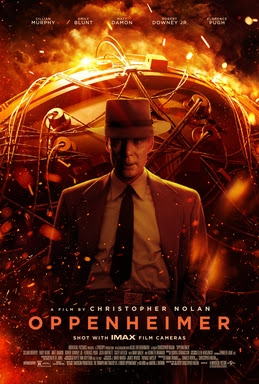
Oppenheimer--This biopic splits time the way its hero splits the atom. Narrative is fissionable to writer-director Christopher Nolan; he skips back and forth between episodes of Oppenheimer (Cillian Murphy) as a bumbling student, then as a philandering rising star in the new field of quantum physics, then as the determined yet haunted lord of Los Alamos, then as a post-bomb martyr to '50s era red-baiting. It glides along smoothly through its fractured scheme, beautifully shot by Hoyt van Hoytema in black and white and varyingly muted shades of color depending on period and point of view, and pushed along by a solemn Philip Glass-esque score by Ludwig Göransson.

Often crowned by a horizontal wide-brimmed preacher-style hat that makes him look like Brad Dourif in Wise Blood, Murphy uncannily captures the bursting, wide-eyed, near-ecstatic face that we see in photos of Oppenheimer. But he manages to give the performance a human dimension, with everyday foibles and touches of humor. He's not a pageant figure.

Murphy carries a star presence. But he's very ably supported by a huge, colorful gallery of star character players: Robert Downey Jr. as AEC Chairmen Lewis Strauss and Josh Hartnett as Ernest Lawrence and Benny Safdie as Edward Teller and Tom Conti as Albert Einstein and David Krumholtz as Isidore Rabi, Oppenheimer's menschy colleague who makes sure he eats and nudges his conscience, and Matthew Modine and Casey Affleck and Kenneth Branagh and Rami Malek and Alden Ehrenreich, to name only a few.

They're all entertaining, but two in particular jolt the movie to life: Florence Pugh as Oppenheimer's joyless lover Jean Tatlock and Matt Damon as the practical-minded, professionally unimpressed Leslie Groves, representing us laypeople in his deadpan, flummoxed scenes with Murphy. For a while it seems like Emily Blunt is underserved as Kitty Oppenheimer, but near the end she gets a juicy, angry scene opposite AEC lawyer Roger Robb (Jason Clarke), who has underestimated her. 

Other than maybe a few too many scenes of the young "Oppie" having visions that look like the psychedelic mindtrip at the end of 2001, there was no point where I found Oppenheimer less than absorbing. Few would suggest that this ambitious, superbly acted, superbly crafted film isn't a major, compelling work, a vast expansion on Roland Joffé's watchable but modest Fat Man and Little Boy from 1989. If Nolan's film isn't quite completely satisfying, there could be two reasons.

One is that trying to arrive at a moral conclusion about this movie's hero seems impossible. Put (too) simply: on the one hand, Oppenheimer won World War II for the good guys and checked fascism (not checkmated it, alas) for more than half a century. On the other hand, his invention killed hundreds of thousands of people, and still has the potential to ruin the world for everybody. Both can be true, and the ambiguity is unresolvable.

Another problem with the film, however, is a matter of simple showmanship. Back in 1994, James Cameron brought his silly action picture True Lies to a point where Arnold Schwarzenegger and Jamie Lee Curtis kiss while, far in the distance, we see a mushroom cloud erupt on the horizon. Triumphant, but then Cameron pushed his luck, piling on one last struggle with the villain in a Harrier jet. I remember thinking (and writing) at the time that when your hero and heroine kiss in front of a mushroom cloud, the movie is over.

Oppenheimer, obviously a very different movie, is uneasily structured in the same way. The scenes leading up to the Trinity Test at White Sands in 1945 are riveting, pulse pounding. The explosion and the immediate aftermath, ending the war in Japan, is a stunning dramatic climax.

But then the movie keeps going, for another hour or so, detailing the war of spite and will between Strauss and Oppenheimer, and the revocation of Oppenheimer's security clearance. It's interesting, provocative material in itself, but it seems a little petty and trivial after the "I am become death; destroyer of worlds" stuff. Given Nolan's supposed consummate skill at scrambling sequence, couldn't he have somehow structured the movie to end with a bang and not a whimper?

Barbie--Something is rotten in the state of Barbieland. As this, her first live-action feature begins, our titular heroine finds herself haunted, right in the middle of raging dance parties at her Dreamhouse, by thoughts of death. Still more alarming, when she steps out of her pumps, her feet go flat to the ground.

To be clear, the Barbie in question, played by Margot Robbie, is "Stereotypical Barbie," the blond, inhumanly thin and leggy iconic version of the Mattel doll. She shares the relentlessly cheery pink-plastic realm of Barbieland with countless other Barbies of every race and body shape and profession, all happy and accomplished and untroubled and mutually supportive. They're dimly aware of us in the "Real World"; they believe that their own harmony has created an example that has led to female empowerment and civil rights over here.

The Barbies also share Barbieland with Ken (Ryan Gosling) and countless variant Kens, as well as Ken's featureless friend Allan (a perfectly cast Michael Cera). But the guys exist entirely as accessories to the relatively uninterested Barbies. Ken's unrequited fascination with Barbie makes him subject, unlike the Barbies, to dissatisfaction.

Barbie goes for advice to "Weird Barbie" (Kate McKinnon), whose hair is frizzy and patchy and who's stuck in a permanent split. She's told that her troubles come from the dark feelings of somebody who's playing with her in our reality, so she sets out on a quest to the Real World, emerging in Venice Beach. Barbie connects with a mom and teenage daughter (America Ferrera and Ariana Greenblatt) whose relationship is strained; she's also pursued by the all-male board of Mattel, led by Will Ferrell. Ken, meanwhile, learns about our patriarchy, likes what he hears, and heads back to Barbieland alone to institute it, with himself at the top.

Mattel was founded in 1945, the same year as the Trinity Test, and there are probably feminist social critics who would argue that Barbie, invented in 1959 by Mattel co-founder Ruth Handler (well played by Rhea Perlman in the film), has wreaked only a little less havoc on the modern psyche than Oppenheimer's gadget. Even though I'm in exactly the right generational wheelhouse (I was born in 1962), my own childhood experience with Barbie was very limited, and thus so were my nostalgic associations with her.

Even so, this nutty fantasy, directed by Greta Gerwig from a brilliant script she wrote with Noah Baumbach, made me laugh from its inspired first scene to its Wings of Desire finish. Narrated in the droll, arch tones of Helen Mirren, it manages to come across as both an ingenious pop-culture lampoon/celebration and an unpretentious but surprisingly heartfelt deep dive into the implications of the Barbie archetype. I wasn't a big fan of Gerwig's 2019 version of Little Women, but here she builds her world with the freedom of, well, a kid playing with dolls, but also with the confidence and adult perspective of an artist.

Not everything in the movie works; in the second half the narrative gets a little lost at times in some very strange musical numbers/battle scenes, and the whole thing comes close to going on a bit too long. And it's hard to say just who this movie is for. It hardly seems intended for little girls; however smart, they're too young for the commentary about female identity to mean much to them yet. It seems more like it's meant for adult women with both a fondness for and an ambivalence toward Barbie.

No doubt there are those who would also complain that, however witty and self-effacing, the movie amounts to a feature-length commercial for the brand. But in the age of Marvel and other such franchises, it seems a little late to object to this.

The revelation in the film is Margot Robbie. It seems ridiculous that she's able, in the role of freaking Barbie, to give a performance of such subtlety and nuance and shading and quiet, unforced wistfulness, but she does. And she gets to deliver the best last line of the year.

Theater Camp--Joan, the founder of "AdirondACTS," a slightly gone-to-seed theater camp in upstate New York, has fallen into a coma. The job of keeping the struggling camp afloat falls to her decidedly non-theatrical "crypto bro" son Troy. Meanwhile the devoted instructors work with the exuberantly happy campers to mount the shows, including an original musical about the life of poor comatose Joan (Amy Sedaris). Needless to say, all does not go smoothly.

The creators of this Waiting for Guffman-esque "mockumentary" comedy, Molly Gordon, Nick Lieberman, Ben Platt and Noah Galvin, know the world they're depicting very well; all of them have been doing theater since they were small children. Gordon and Lieberman co-directed, from a script by all four; Platt and Gordon play Amos and Rebecca-Diane, the utterly enmeshed, co-dependent acting instructors and Galvin plays the low-profile tech director.

They capture the camaraderie and the sense of belonging that theater can give kids, and their affection for that world is unmistakable, but they're careful not to get too sentimental. The envies and resentments and passive-aggressive denigrations among theater folk, especially at this often professionally frustrated level, are vividly represented.

Getting laughs from the self-important vanities of theater people is pretty low-hanging fruit, I suppose, but Theater Camp is nonetheless often hilarious. The film also manages to get a little deeper at times, touching on the irony that while theater can create a haven and a community for misfit kids, this can generate its own clannishness and exclusionary snobbery, as in Amos and Rebecca-Diane's coldness toward the imbecilic but well-intentioned Troy, charmingly played by a sort of poor-man's Channing Tatum named Jimmy Tatro.

The real joy in Theater Camp, of course, is the acting: Platt, Gordon, Tatro, plus a few vets like Sedaris, Caroline Aaron and David Rasche bring the material to life. But as Glenn, the long-suffering backstage drudge who really ought to be onstage, Noah Galvin, who replaced Platt on Broadway in Dear Evan Hansen, is the revelation among the adults in the cast. He's a knockout.

The revelation among the kids playing the campers is, well, pretty much all of the kids playing the campers. There are some real singing, dancing and acting prodigies in this company. If there was a real theater camp somewhere with this kind of talent, their shows would sell out.

Friday, February 11, 2022

NILE BE YOUR HUCKLEBERRY

Opening only (and worth seeing in) the multiplexes this weekend...

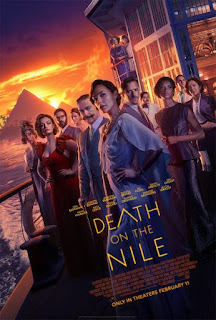
Death on the Nile--The prologue to Kenneth Branagh's sumptuous new adaptation of Agatha Christie's 1937 novel offers us some backstory on an iconic element of Hercule Poirot's image. It's very much like an origin story in a superhero movie.

It's hard to say how much this episode will be to the liking of hardcore Christie purists, just as it was hard to say how such enthusiasts would feel about Branagh's previous outing as the vain, dapper, extravagantly mustachioed Belgian super-sleuth with the OCD tendencies and the potent "little gray cells"; in 2017 he directed and starred in a flashy Murder on the Orient Express. Now Poirot is cruising down the title river in a palatial paddleboat full of shifty frenemies of a rich beauty (Gal Gadot) and her rakish new husband (Armie Hammer). There are cryptic clues and overheard motives and skulkings around Abu Simbel. It all culminates in murder, and among the suspects are Annette Bening, Letitia Wright, Dawn French, Jennifer Saunders, Tom Bateman, Russell Brand, Ali Fazal, Emma Mackey, Sophie Okonedo and others.

The script, as with Orient Express, is by Michael Green, and once again there's a sense that he and Branagh are gleefully shaking up Christie's staid and bigoted worldview, trying to get to her to roll in her grave (the film has, anyway, the blessing of her great-grandson, Executive Producer James Prichard, who runs Agatha Christie Limited). While the plot, in outline, and the solution to the mystery are essentially the same as in the novel and the enjoyable all-star movie version of 1978 with Peter Ustinov as Poirot, this is still a very free adaptation, with characters added, subtracted and altered for the sake of greater diversity in race and sexuality.

The period sets and costumes are luxurious, as is the cinematography of Haris Zambarloukos, who brought a very different look to Branagh's Belfast. The direction also has plenty of Branagh's characteristic flamboyance and old-school theatrics. Christie was fascinated by the setting (in addition to this book she also set a novel, 1944's Death Comes as the End, in ancient Egypt), so whatever she thought of the characterizations, she might well have liked this movie's lush Egyptian atmosphere; the camera takes in the sights on the riverbanks, and even snoops around below the surface at times.

It may be that contemporary audiences (and critics) will find this a laborious throwback, but I found it not only an opulent, sometimes sexy treat, but also surprisingly emotional; far more so than the 1978 version. This element comes, mostly, from Branagh's heartfelt performance. At key points his Poirot rises to the level of the tragic, like his Shakespeare did in that one great speech about the penknife in 2018's otherwise badly uneven All Is True. In both cases, it's the kind of masterly acting that likely won't get award nominations, but will richly reward attentive viewers. Provided, of course, that we use our little gray cells.

Monday, December 13, 2021

BELFAST AND THE FURIOUS

Phoenix Film Critic Society, of which I'm always proud to note that I'm a founding member, has announced our 2021 award winners. Kenneth Branagh's autobiographical drama Belfast...

...won Best Picture, Best Director and three other awards; the new version of Dune also won five awards. Check out the full list here. As always, some of it reflects my voting, some doesn't, but there are lots of movies worth seeing on the list.

Friday, November 12, 2021

THINK YOU'VE GOT TROUBLES?

Opening this weekend:

Belfast--One day in 1969, nine-year-old Buddy is walking home through the teeming, friendly streets of his working-class, religiously-mixed neighborhood in the title city. Just before he gets there, a furious mob suddenly rounds the corner and starts smashing windows of his Catholic neighbors. Before long the streets are full of tanks and soldiers and barricades.

This is the beginning of "The Troubles," the decades-long strife between Protestants and Catholics in Belfast. But for Buddy (Jude Hill), the more pressing issues are his crush on a beautiful classmate, or which movie he'll be taken to see, or keeping straight which road his fire-and-brimstone (Protestant) clergyman recommends he take to avoid damnation.

We see the struggles of his beautiful, decent mother (Caitriona Balfe), to raise him and his siblings during the frequent and lengthy absences of his loving but financially nonchalant father (Jamie Dornan), and the gentle teasing between his mutually adoring grandparents (Judy Dench and Ciaran Hinds), all through Buddy's eyes. We also see his father's courageous refusal to be roped in to the mob by local protestant thugs, and we hear his parents debate whether to leave their beloved hometown.

The film, written and directed by Kenneth Branagh, is largely autobiographical; it's much like Branagh's version of John Boorman's great Hope and Glory (1987), about childhood fun during the Blitz. After a glimpse of modern-day Belfast, the movie is rendered in crisply beautiful black and white by cinematographer Haris Zambarloukos, with moments in vivid color when Buddy sees movies like One Million Years B.C. or Chitty Chitty Bang Bang, or when he's taken to see A Christmas Carol onstage.

The period detail is convincing, and the acting is terrific, with Dench and Hinds unsurprisingly filching big chunks of the movie as the grandparents. Their roles, especially Dench's, are arguably underwritten, but they let us see, without telegraphing, oceanic expanses of love and worry and pride behind their offhanded manner. Branagh confers a child's-eye glamor on Dornan and Balfe; the latter lets us see her passionate nature in a couple of scenes in which she dances. And young Hill is splendidly unfussy and direct as Buddy.

Not every aspect of Belfast works; Buddy's crush, for instance, doesn't build up much audience investment, and his siblings barely register. But the movie sneaks up on you emotionally. By the end I was in tears, very honestly won.

Also, any movie with a soundtrack made up of one Van Morrison tune after another is sure to be worth seeing, if only for that.

Saturday, May 18, 2019

TRIUMPH OF THE WILL?

Check out my review, on Phoenix Magazine online, of All is True, with Kenneth Branagh as William Shakespeare.


Have a great weekend one and all!

Monday, November 13, 2017

THE RAILS OF JUSTICE

Now in theaters:


Murder on the Orient Express—Sidney Lumet’s tautly made 1974 version of Agatha Christie’s 1934 novel, with Albert Finney as Belgian master detective Hercule Poirot, is a favorite of mine, and I admit I saw no pressing need to remake it. But remade it has been, in a manner sufficiently different from the original that it can be enjoyed on its own terms.

The new version is directed by Kenneth Branagh, who also assumes the role of Poirot. As before, a shady character gets bumped off in a sleeping car of the famed luxury line, which used to run all the way from Istanbul to Paris. The train is derailed by an avalanche somewhere in Croatia, and Poirot, who had been hoping for a quiet holiday, is pressed into service to identify the guilty party from among the shifty types aboard before the trip is back on track.

The cast ranges from Johnny Depp to Judi Dench, Josh Gad to Penelope Cruz, Willem Dafoe to Derek Jacobi, Daisy Ridley to Leslie Odom, Jr. to Michelle Pfeiffer, among others, and they let it rip. Offsetting this is Branagh’s impressively reserved, melancholy OCD turn as Poirot.

As director, Branagh works in his characteristically flamboyant style, sweeping from one melodramatic flourish to the next, even adding in some fights and gunplay. This won’t be to the taste of every Christie aficionado, but I enjoyed it. I also enjoyed screenwriter Michael Green’s distaste for the casual racism that Christie, to judge from her books, would have regarded as quite proper.

But the real stars, perhaps, of this Orient Express are, first, Branagh’s mesmerizing mustache, and second, the lushness of the production—cinematography by Haris Zambarloukos, costumes by Alexandra Byrne, music by Patrick Doyle. The movie may leave you in the mood for a leisurely holiday by train. Allowing for the odd murder or avalanche, it looks like a great time.

Friday, July 21, 2017

NOT JUST ANOTHER DAY AT THE BEACH

Opening this weekend:


Dunkirk--In the hair-raising opening scenes of this historical epic from Christopher Nolan, a young English soldier tries to make it to the title town's beach alive, and just barely succeeds. Aside from surviving, all he really wants to do is find a peaceful place to evacuate his bowels. This is the sort of human detail that many war movies leave out, or treat jocularly, but realities like this are the core of Dunkirk.

Well-played by a newcomer named Fionn Whitehead, the character is listed in the credits as "Tommy," but his name hardly matters. He's an everyman--an everykid, really--and the other young soldiers he meets, played by Aneurin Barnard and One Direction's Harry Styles, are similarly generic. Nolan's script, clearly by design, offers no real characterization, presumably on the theory that backstory, in these circumstances, would be grotesquely irrelevant.

Instead, Nolan relies on his actors to fill in the stock figures. Since the cast includes such vets as Mark Rylance, Kenneth Branagh, Cillian Murphy, James D'Arcy and Tom Hardy, it need hardly be said that this proves a sound strategy.

Almost everything Nolan tries here seems to work. The movie focuses on the evacuation of hundreds of thousands of English and French soldiers, surrounded by the German army and threatened from the air by the Luftwaffe, across the Channel to England in late May and early June of 1940. Nolan cuts between three main strands, "The Mole," aka the breakwater where soldiers like Tommy waited days to be picked up by Navy vessels, "The Sea," in which we follow one of the "Little Ships of Dunkirk," the small civilian commercial and private crafts that took to the Channel to rescue the trapped men, and "The Air," in which we follow three RAF pilots in Spitfires trying to down German airplanes before they can bomb or strafe the evacuees.

The dialogue, sparing to begin with, battles the ambient noise, Hans Zimmer's brooding, gut-vibrating score, and (for us Yanks especially) thick accents, to the point that after a while I mostly gave up and just tried to follow what was going on by context. Similarly, because of the differing travel times required for the three modes of Channel crossing, Dunkirk employs another of those intricately non-chronological time-schemes, as in Momento, so that Nolan can use crosscutting to maximum emotional effect. And while emotional it certainly is, I must confess that in the final third of the film I found myself disoriented at times by where we were in this reticular narrative. But that may have just been me.

In any case, it didn't detract from the overall impact of Dunkirk, which at its best has something like the sweep and punch of the great silent war epics (I saw the film on an IMAX screen, by the way, and recommend this format if it's available to you). The performances, the incongruously gentle hues of Hoyte van Hoytema's exquisite cinematography, and the sustained assurance of Nolan's direction all combined to make this sad, terrifying yet ultimately uplifting story one of the more potent movie experiences I've had in a while.

Wednesday, August 13, 2014

ROBIN'S BEST

Like everyone else, I was shocked and saddened by the death of Robin Williams, apparently by his own hand after a lifelong struggle with depression and addiction. I’m a big fan, but his signature hits—Dead Poets Society, Good Will Hunting, Mrs. Doubtfire, Good Morning, Vietnam—aren’t, on the whole, my favorites. Some of what I think is his best, funniest, least sentimental, most ebullient work was in films that were ignored by audiences and panned by critics.

Below are some examples of the underrated or neglected “other” Robin Williams, which I would encourage you to give another look.


The Adventures of Baron Munchhausen—In his brief role as The King of the Moon, whose head and body are disconnected, in Terry Gilliam’s uneven but fascinating 1989 fantasy, Williams may have taken his fast talking, haywire routine as far as he ever did; he was like Mork squared, or like a live-action version of the Genie in Aladdin. This is one of several films on which Williams worked under a pseudonym—Bob Goldthwait’s notorious Shakes the Clown was another. Under his own name, Williams later gave an immensely touching performance in Gilliam’s The Fisher King.

Hamlet—Williams was just right for the foppish, fawning courtier Osric in Kenneth Branagh’s full-text version of Shakespeare’s masterpiece. Pity he didn’t get to do more Shakespeare. He was also terrific in a funny, quietly intense turn as the psychiatrist in Branagh’s Dead Again.

One Hour Photo—Mark Romanek’s odd little thriller about a lonely, alienated snapshot developer who becomes fixated on a seemingly picture-perfect family of customers is sad, unsavory and ultimately unsatisfying. But Williams brings so much gravity and pathos to the part that it’s essential viewing.

The Birdcage—This hilarious and sweet American version of La Cage aux Folles was a hit, certainly, but much of the attention went, rightly, to Nathan Lane as Albert, the maternal drag queen. It’s possible that the quieter excellence of Williams as the father posing as straight for his conservative future in-laws was a little overlooked. His scene with Lane on a bench, while a ship passes behind them, is one of the best he ever played.

Being Human—Bill Forsythe’s reincarnation drama, in which Williams played five people—or rather, the same person in five different lifetimes—doesn’t quite add up, but Williams is great in all five. As a prehistoric man in the opening segment he has a shattering moment, screaming “Mine! Mine!” as he sees his family being abducted.


Cadillac Man—Williams is a philandering, hustling car salesman who finds himself frantically trying to manage a hostage situation when jealous husband Tim Robbins brings a gun into the car dealership where he works. This 1990 comedy with dramatic overtones from director Roger Donaldson shows Williams as an irresponsible but essentially humane guy trying to stave off disaster.

Moscow on the Hudson—Williams plays a Soviet circus musician who defects in the middle of Bloomingdale’s in New York in Paul Mazursky’s comedy-drama. This performance was one of the first to demonstrate his remarkable range.


Popeye—Williams is buried in the title character’s persona in Robert Altman’s live-action version of the cartoon. But he gives amusing, stoic line readings, and his warmth and sweetness shine through the makeup.


The Survivors—Michael Ritchie’s satire of survivalists and gun nuts was poorly received, but its picture of the sort of chaotic modern life that breeds such reactionaries is mercilessly funny and original—it starts with Williams getting fired from his job by a parrot. Williams was rarely as precise in his manic style as he is here, and he seems all the crazier with Walter Matthau as his straight man.


The Best of Times—This football comedy, directed by Roger Spottiswoode from a script by Ron Shelton, is my favorite Robin Williams movie, but it doesn’t seem to be anybody else’s. It’s about a group of middle-aged men who get bamboozled into replaying a high school football game in Taft, California, by the bank manager (Williams) who dropped what would have been the game-winning pass back when. Williams is at his very best here. He never seems to be self-consciously playing the sad clown—something that, for all his great talent, he was quite capable of doing—and thus he’s truly lovable and poignant. And, of course, magnificently funny.