Showing posts with label CILLIAN MURPHY. Show all posts

Friday, July 21, 2023

BOMBS & BOMBSHELLS

Opening in theaters this weekend:
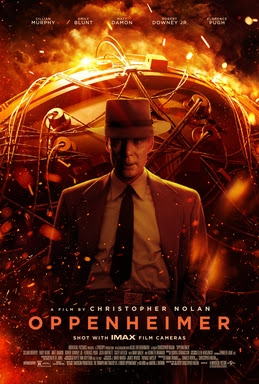
Oppenheimer--This biopic splits time the way its hero splits the atom. Narrative is fissionable to writer-director Christopher Nolan; he skips back and forth between episodes of Oppenheimer (Cillian Murphy) as a bumbling student, then as a philandering rising star in the new field of quantum physics, then as the determined yet haunted lord of Los Alamos, then as a post-bomb martyr to '50s era red-baiting. It glides along smoothly through its fractured scheme, beautifully shot by Hoyt van Hoytema in black and white and varyingly muted shades of color depending on period and point of view, and pushed along by a solemn Philip Glass-esque score by Ludwig Göransson.

Often crowned by a horizontal wide-brimmed preacher-style hat that makes him look like Brad Dourif in Wise Blood, Murphy uncannily captures the bursting, wide-eyed, near-ecstatic face that we see in photos of Oppenheimer. But he manages to give the performance a human dimension, with everyday foibles and touches of humor. He's not a pageant figure.

Murphy carries a star presence. But he's very ably supported by a huge, colorful gallery of star character players: Robert Downey Jr. as AEC Chairmen Lewis Strauss and Josh Hartnett as Ernest Lawrence and Benny Safdie as Edward Teller and Tom Conti as Albert Einstein and David Krumholtz as Isidore Rabi, Oppenheimer's menschy colleague who makes sure he eats and nudges his conscience, and Matthew Modine and Casey Affleck and Kenneth Branagh and Rami Malek and Alden Ehrenreich, to name only a few.

They're all entertaining, but two in particular jolt the movie to life: Florence Pugh as Oppenheimer's joyless lover Jean Tatlock and Matt Damon as the practical-minded, professionally unimpressed Leslie Groves, representing us laypeople in his deadpan, flummoxed scenes with Murphy. For a while it seems like Emily Blunt is underserved as Kitty Oppenheimer, but near the end she gets a juicy, angry scene opposite AEC lawyer Roger Robb (Jason Clarke), who has underestimated her. 

Other than maybe a few too many scenes of the young "Oppie" having visions that look like the psychedelic mindtrip at the end of 2001, there was no point where I found Oppenheimer less than absorbing. Few would suggest that this ambitious, superbly acted, superbly crafted film isn't a major, compelling work, a vast expansion on Roland Joffé's watchable but modest Fat Man and Little Boy from 1989. If Nolan's film isn't quite completely satisfying, there could be two reasons.

One is that trying to arrive at a moral conclusion about this movie's hero seems impossible. Put (too) simply: on the one hand, Oppenheimer won World War II for the good guys and checked fascism (not checkmated it, alas) for more than half a century. On the other hand, his invention killed hundreds of thousands of people, and still has the potential to ruin the world for everybody. Both can be true, and the ambiguity is unresolvable.

Another problem with the film, however, is a matter of simple showmanship. Back in 1994, James Cameron brought his silly action picture True Lies to a point where Arnold Schwarzenegger and Jamie Lee Curtis kiss while, far in the distance, we see a mushroom cloud erupt on the horizon. Triumphant, but then Cameron pushed his luck, piling on one last struggle with the villain in a Harrier jet. I remember thinking (and writing) at the time that when your hero and heroine kiss in front of a mushroom cloud, the movie is over.

Oppenheimer, obviously a very different movie, is uneasily structured in the same way. The scenes leading up to the Trinity Test at White Sands in 1945 are riveting, pulse pounding. The explosion and the immediate aftermath, ending the war in Japan, is a stunning dramatic climax.

But then the movie keeps going, for another hour or so, detailing the war of spite and will between Strauss and Oppenheimer, and the revocation of Oppenheimer's security clearance. It's interesting, provocative material in itself, but it seems a little petty and trivial after the "I am become death; destroyer of worlds" stuff. Given Nolan's supposed consummate skill at scrambling sequence, couldn't he have somehow structured the movie to end with a bang and not a whimper?

Barbie--Something is rotten in the state of Barbieland. As this, her first live-action feature begins, our titular heroine finds herself haunted, right in the middle of raging dance parties at her Dreamhouse, by thoughts of death. Still more alarming, when she steps out of her pumps, her feet go flat to the ground.

To be clear, the Barbie in question, played by Margot Robbie, is "Stereotypical Barbie," the blond, inhumanly thin and leggy iconic version of the Mattel doll. She shares the relentlessly cheery pink-plastic realm of Barbieland with countless other Barbies of every race and body shape and profession, all happy and accomplished and untroubled and mutually supportive. They're dimly aware of us in the "Real World"; they believe that their own harmony has created an example that has led to female empowerment and civil rights over here.

The Barbies also share Barbieland with Ken (Ryan Gosling) and countless variant Kens, as well as Ken's featureless friend Allan (a perfectly cast Michael Cera). But the guys exist entirely as accessories to the relatively uninterested Barbies. Ken's unrequited fascination with Barbie makes him subject, unlike the Barbies, to dissatisfaction.

Barbie goes for advice to "Weird Barbie" (Kate McKinnon), whose hair is frizzy and patchy and who's stuck in a permanent split. She's told that her troubles come from the dark feelings of somebody who's playing with her in our reality, so she sets out on a quest to the Real World, emerging in Venice Beach. Barbie connects with a mom and teenage daughter (America Ferrera and Ariana Greenblatt) whose relationship is strained; she's also pursued by the all-male board of Mattel, led by Will Ferrell. Ken, meanwhile, learns about our patriarchy, likes what he hears, and heads back to Barbieland alone to institute it, with himself at the top.

Mattel was founded in 1945, the same year as the Trinity Test, and there are probably feminist social critics who would argue that Barbie, invented in 1959 by Mattel co-founder Ruth Handler (well played by Rhea Perlman in the film), has wreaked only a little less havoc on the modern psyche than Oppenheimer's gadget. Even though I'm in exactly the right generational wheelhouse (I was born in 1962), my own childhood experience with Barbie was very limited, and thus so were my nostalgic associations with her.

Even so, this nutty fantasy, directed by Greta Gerwig from a brilliant script she wrote with Noah Baumbach, made me laugh from its inspired first scene to its Wings of Desire finish. Narrated in the droll, arch tones of Helen Mirren, it manages to come across as both an ingenious pop-culture lampoon/celebration and an unpretentious but surprisingly heartfelt deep dive into the implications of the Barbie archetype. I wasn't a big fan of Gerwig's 2019 version of Little Women, but here she builds her world with the freedom of, well, a kid playing with dolls, but also with the confidence and adult perspective of an artist.

Not everything in the movie works; in the second half the narrative gets a little lost at times in some very strange musical numbers/battle scenes, and the whole thing comes close to going on a bit too long. And it's hard to say just who this movie is for. It hardly seems intended for little girls; however smart, they're too young for the commentary about female identity to mean much to them yet. It seems more like it's meant for adult women with both a fondness for and an ambivalence toward Barbie.

No doubt there are those who would also complain that, however witty and self-effacing, the movie amounts to a feature-length commercial for the brand. But in the age of Marvel and other such franchises, it seems a little late to object to this.

The revelation in the film is Margot Robbie. It seems ridiculous that she's able, in the role of freaking Barbie, to give a performance of such subtlety and nuance and shading and quiet, unforced wistfulness, but she does. And she gets to deliver the best last line of the year.

Theater Camp--Joan, the founder of "AdirondACTS," a slightly gone-to-seed theater camp in upstate New York, has fallen into a coma. The job of keeping the struggling camp afloat falls to her decidedly non-theatrical "crypto bro" son Troy. Meanwhile the devoted instructors work with the exuberantly happy campers to mount the shows, including an original musical about the life of poor comatose Joan (Amy Sedaris). Needless to say, all does not go smoothly.

The creators of this Waiting for Guffman-esque "mockumentary" comedy, Molly Gordon, Nick Lieberman, Ben Platt and Noah Galvin, know the world they're depicting very well; all of them have been doing theater since they were small children. Gordon and Lieberman co-directed, from a script by all four; Platt and Gordon play Amos and Rebecca-Diane, the utterly enmeshed, co-dependent acting instructors and Galvin plays the low-profile tech director.

They capture the camaraderie and the sense of belonging that theater can give kids, and their affection for that world is unmistakable, but they're careful not to get too sentimental. The envies and resentments and passive-aggressive denigrations among theater folk, especially at this often professionally frustrated level, are vividly represented.

Getting laughs from the self-important vanities of theater people is pretty low-hanging fruit, I suppose, but Theater Camp is nonetheless often hilarious. The film also manages to get a little deeper at times, touching on the irony that while theater can create a haven and a community for misfit kids, this can generate its own clannishness and exclusionary snobbery, as in Amos and Rebecca-Diane's coldness toward the imbecilic but well-intentioned Troy, charmingly played by a sort of poor-man's Channing Tatum named Jimmy Tatro.

The real joy in Theater Camp, of course, is the acting: Platt, Gordon, Tatro, plus a few vets like Sedaris, Caroline Aaron and David Rasche bring the material to life. But as Glenn, the long-suffering backstage drudge who really ought to be onstage, Noah Galvin, who replaced Platt on Broadway in Dear Evan Hansen, is the revelation among the adults in the cast. He's a knockout.

The revelation among the kids playing the campers is, well, pretty much all of the kids playing the campers. There are some real singing, dancing and acting prodigies in this company. If there was a real theater camp somewhere with this kind of talent, their shows would sell out.

Sunday, May 23, 2021

CRUELLA TO BE KIND

Opening in theaters this week:

Cruella--The title character is Cruella de Vil, the notorious villainess from Dodie Smith's 1956 novel The One Hundred and One Dalmatians, by way of the 1961 Disney animated movie and its various remakes, sequels and spin-offs. In the original animated classic she's a fur-clad bag-of-bones rich hag with a demonic touring car. She covets the puppies for their black-spotted white coats; they match Cruella's own, weirdly yin-and-yang half-black half-white mop.

Cruella is to One Hundred and One Dalmatians (and the 1996 live-action remake 101 Dalmatians, where she's grandly played by Glenn Close) what the horned sorceress Maleficent was to Disney's Sleeping Beauty: The only truly memorable character. So, as 2014's Maleficent showcased Angelina Jolie, this new origin story offers a deluxe vehicle to Emma Stone.

In this telling, the character starts out simply as Estella; "Cruella" is a teasing nickname for the dark streak in her personality. Cast out of her school, Estella washes up homeless in Regent's Park, then gradually rises through the world of London fashion of the '60s and '70s. She goes to work for the Baroness von Hellman (Emma Thompson), an imperious designer, while at the same time developing her "Cruella" persona to get up to incognito mischief with her cronies Horace and Jasper (Paul Walter Hauser and Joel Fry, both appealing).

Give Disney its due: This lavish production is terrific to look at, and to listen to, as well; the soundtrack is a feast of gutsy, (mostly) '60s- and '70s-era pop hits. Both of the Emmas are in solid form--Stone with her half-sheepish little grins as she wreaks mayhem; Thompson with her unflappable slow burn--and both are costumed to dementedly chic grandeur. The script, credited to a mob that includes Dana Fox and Aline Brosh McKenna, has ideas and gags that recall everything from The Devil Wears Prada to The Winter's Tale to The Terminator, and is by no means lacking in wit or ingenious twists.

That said, Cruella, directed by the Australian Craig Gillespie of I, Tonya, is badly overlong, full of ideas that don't have sufficient payoff for the drag that they add to the narrative. Beyond that, it is, like Maleficent, like 2015's Pan, like 2014's Dracula Untold, even like 2007's Hannibal Rising and 2019's Joker, one of those sympathy-for-the-devil backstories of an iconic evildoer for whom audiences have developed an affection.

I'm not sure why it is that such revisionist sagas irk me, often at the same time that I'm enjoying them; why they bring out my inner Fox News commentator, judgmentally griping about creeping moral relativism in popular art. After all, villains in real life don't typically spring out of a vacuum. Past experiences do matter, and if a fictional ne'er-do-well inspires a fictional backstory, it's a testament to how vividly drawn the character is.

That said, qualifying and quantifying the menace of characters like Cruella or Maleficent reduces their status as symbolic villains, boiling them down to the sum of the specific trauma and betrayals of their youth. It's an impertinence to the scale of their villainy.

Cruella is a fairly enjoyable spectacle, but, like Maleficent, it shrinks its title character a bit. These filmmakers know some good music, but they should have listened more closely to the lyrics of a lesser pop song: In the wise words of Huey Lewis, sometimes bad is bad.

A Quiet Place Part II--This sequel starts as a prequel; writer-director John Krasinski takes us back before the events of the 2018 horror/sci-fi hit, to the day that Earth was invaded by shrieking aliens. Sightless, these ghastly quadrupeds are extremely sensitive to sound, and come charging in to maul any humans who make the slightest racket.

Krasinski appears only in this brief--but pretty enthralling--prologue, after which the movie picks up right where Part I left off. Intrepid Mom (Emily Blunt), her intrepid-er daughter (Millicent Simmonds) and cautious but brave son (Noah Jupe), as well as an infant requiring oxygen tanks, are forced to look around rural New York for a new quiet place. Eventually the daughter, who is deaf, strikes out on her own in search of a radio signal; somebody plays Bobby Darin singing "Beyond the Sea" every day at the same time.

The first film had a wide-awake intensity and deliberation, but Krasinski seems to have grown as a director with this follow-up. Here he gives us sustained, bravura sequences, like the centerpiece in which he intercuts between three currents of action, and the scenes bounce thematic echoes off of each other. This isn't the sort of movie that Hitchcock cared for, but I bet if Hitchcock watched it, he would admire Krasinski's work.

Like the first film, this one has dubious elements. You may look at the aliens and think: Really? These screeching, squalling horrors, looking like creatures from the Francis Bacon triptych, were advanced enough to master interstellar travel? And having arrived on a new planet, they seem to have nothing better to do but to obsessively wait for one of the natives to drop or bump into something. Admittedly, though, plenty of human behavior would probably seem equally incomprehensible to intelligent alien observers.

The family has also discovered the achilles heel of the aliens, and while it's satisfying to see them brought low, it also seems a little too easy. It's essentially the same weakness that the aliens had in the Twilight Zone episode "Hocus Pocus and Frisby."

But Krasinski's taut yet passionate direction carries us past such objections while we're watching the movie, as does the acting. Blunt has a heroic, warrior-goddess presence here, like the carving on the prow of a ship. The kids are superb, especially the soulful Simmonds; Cillian Murphy is effective as a frightened, bereaved neighbor who's given up on humankind, and Djimon Hounsou contributes a warm bit in the later acts.

And aside from all of these merits, any movie that holds up Bobby Darin singing "Beyond  the Sea" as a promising sign of civilization shows good sense to me.

Friday, July 21, 2017

NOT JUST ANOTHER DAY AT THE BEACH

Opening this weekend:


Dunkirk--In the hair-raising opening scenes of this historical epic from Christopher Nolan, a young English soldier tries to make it to the title town's beach alive, and just barely succeeds. Aside from surviving, all he really wants to do is find a peaceful place to evacuate his bowels. This is the sort of human detail that many war movies leave out, or treat jocularly, but realities like this are the core of Dunkirk.

Well-played by a newcomer named Fionn Whitehead, the character is listed in the credits as "Tommy," but his name hardly matters. He's an everyman--an everykid, really--and the other young soldiers he meets, played by Aneurin Barnard and One Direction's Harry Styles, are similarly generic. Nolan's script, clearly by design, offers no real characterization, presumably on the theory that backstory, in these circumstances, would be grotesquely irrelevant.

Instead, Nolan relies on his actors to fill in the stock figures. Since the cast includes such vets as Mark Rylance, Kenneth Branagh, Cillian Murphy, James D'Arcy and Tom Hardy, it need hardly be said that this proves a sound strategy.

Almost everything Nolan tries here seems to work. The movie focuses on the evacuation of hundreds of thousands of English and French soldiers, surrounded by the German army and threatened from the air by the Luftwaffe, across the Channel to England in late May and early June of 1940. Nolan cuts between three main strands, "The Mole," aka the breakwater where soldiers like Tommy waited days to be picked up by Navy vessels, "The Sea," in which we follow one of the "Little Ships of Dunkirk," the small civilian commercial and private crafts that took to the Channel to rescue the trapped men, and "The Air," in which we follow three RAF pilots in Spitfires trying to down German airplanes before they can bomb or strafe the evacuees.

The dialogue, sparing to begin with, battles the ambient noise, Hans Zimmer's brooding, gut-vibrating score, and (for us Yanks especially) thick accents, to the point that after a while I mostly gave up and just tried to follow what was going on by context. Similarly, because of the differing travel times required for the three modes of Channel crossing, Dunkirk employs another of those intricately non-chronological time-schemes, as in Momento, so that Nolan can use crosscutting to maximum emotional effect. And while emotional it certainly is, I must confess that in the final third of the film I found myself disoriented at times by where we were in this reticular narrative. But that may have just been me.

In any case, it didn't detract from the overall impact of Dunkirk, which at its best has something like the sweep and punch of the great silent war epics (I saw the film on an IMAX screen, by the way, and recommend this format if it's available to you). The performances, the incongruously gentle hues of Hoyte van Hoytema's exquisite cinematography, and the sustained assurance of Nolan's direction all combined to make this sad, terrifying yet ultimately uplifting story one of the more potent movie experiences I've had in a while.

Friday, August 12, 2016

GO WITH THE FLO

Opening this weekend: Two stories from the 1940s, very different, both worth seeing:


Florence Foster JenkinsThe title character was a much-loved patron of the New York classical music scene who loved to sing. She was a nice lady, and a rich lady, and thus nobody had the heart, or the nerve, to tell her that she sounded like an angry monkey defending its tree branch.

Besides, the carefully cherry-picked audiences for her recitals found her performances funny. In the early ‘40s she cut some records which actually received some radio airplay, and in 1944 finally gave a performance at Carnegie Hall—which, alas, legitimate music critics were able to attend.

This interesting little story from Manhattan’s high-culture scene certainly seems irresistible as movie material (there have already been several stage versions of it). But it also had the potential to make a really ugly movie. Many of us who love music and have no talent still indulge the fantasy of performing, and it could have been agonizingly embarrassing to see the consequences of someone living that fantasy out, especially in front of a smirking audience of musical heavy-hitters.

Happily, Florence Foster Jenkins was helmed by the masterly, old-school Stephen Frears, working from a script by Nicholas Martin. Three years ago Frears brought a gentle, lightly comic energy to Philomena, which could have been a drag for very different, more serious reasons, but instead was a delight. With Florence Foster Jenkins his touch is more broad, even farcical, but the movie has the same generous-hearted tone and emotional maturity, not to mention a lush period atmosphere.

Of course, Frears would have been helpless without Meryl Streep, bringing Florence something of the same dotty lovability that she gave to Julia Child in Julie & Julia. Simon Helberg, as Florence’s accompanist Cosme McMoon, turns his lines into a master class in effete dithering. And as St. Clair Bayfield, the failed Shakespearean and Broadway veteran who became Florence’s manager and common-law husband, Hugh Grant has rarely been better—suavely sheepish and witty in his tireless efforts to keep her reality pleasant, and deluded in his belief that he’s always successful. 


AnthropoidThis historical thriller, which dramatizes the plot to assassinate Nazi leader Reinhard Heydrich in Prague in 1942, keeps us tense with murmured conversations in back rooms and furtive romance between bursts of violence. We badly want Czech partisans Cillian Murphy and Jamie Dornan to succeed in killing “The Butcher of Prague”—an SS bigwig and Chairman of the Wannsee Conference—even though we know that if they do, the reprisals will be horrible, and director Sean Ellis, who co-scripted with Anthony Frewin, uses this ambiguity to give Anthropoid a brooding mix of tragedy and exhilaration.

Squeamish viewers should be forewarned: Anthropoid is gripping, but also Jacobean. There are scenes of torture that are hard to watch, and the movie’s sacrificial lambs can be spotted a mile away.