Showing posts with label CHRISTOPHER NOLAN. Show all posts

Friday, July 17, 2026

Friday, July 21, 2023

BOMBS & BOMBSHELLS

Opening in theaters this weekend:

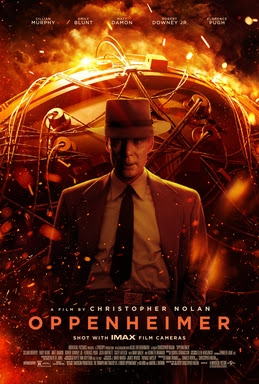
Oppenheimer--This biopic splits time the way its hero splits the atom. Narrative is fissionable to writer-director Christopher Nolan; he skips back and forth between episodes of Oppenheimer (Cillian Murphy) as a bumbling student, then as a philandering rising star in the new field of quantum physics, then as the determined yet haunted lord of Los Alamos, then as a post-bomb martyr to '50s era red-baiting. It glides along smoothly through its fractured scheme, beautifully shot by Hoyt van Hoytema in black and white and varyingly muted shades of color depending on period and point of view, and pushed along by a solemn Philip Glass-esque score by Ludwig Göransson.

Often crowned by a horizontal wide-brimmed preacher-style hat that makes him look like Brad Dourif in Wise Blood, Murphy uncannily captures the bursting, wide-eyed, near-ecstatic face that we see in photos of Oppenheimer. But he manages to give the performance a human dimension, with everyday foibles and touches of humor. He's not a pageant figure.

Murphy carries a star presence. But he's very ably supported by a huge, colorful gallery of star character players: Robert Downey Jr. as AEC Chairmen Lewis Strauss and Josh Hartnett as Ernest Lawrence and Benny Safdie as Edward Teller and Tom Conti as Albert Einstein and David Krumholtz as Isidore Rabi, Oppenheimer's menschy colleague who makes sure he eats and nudges his conscience, and Matthew Modine and Casey Affleck and Kenneth Branagh and Rami Malek and Alden Ehrenreich, to name only a few.

They're all entertaining, but two in particular jolt the movie to life: Florence Pugh as Oppenheimer's joyless lover Jean Tatlock and Matt Damon as the practical-minded, professionally unimpressed Leslie Groves, representing us laypeople in his deadpan, flummoxed scenes with Murphy. For a while it seems like Emily Blunt is underserved as Kitty Oppenheimer, but near the end she gets a juicy, angry scene opposite AEC lawyer Roger Robb (Jason Clarke), who has underestimated her. 

Other than maybe a few too many scenes of the young "Oppie" having visions that look like the psychedelic mindtrip at the end of 2001, there was no point where I found Oppenheimer less than absorbing. Few would suggest that this ambitious, superbly acted, superbly crafted film isn't a major, compelling work, a vast expansion on Roland Joffé's watchable but modest Fat Man and Little Boy from 1989. If Nolan's film isn't quite completely satisfying, there could be two reasons.

One is that trying to arrive at a moral conclusion about this movie's hero seems impossible. Put (too) simply: on the one hand, Oppenheimer won World War II for the good guys and checked fascism (not checkmated it, alas) for more than half a century. On the other hand, his invention killed hundreds of thousands of people, and still has the potential to ruin the world for everybody. Both can be true, and the ambiguity is unresolvable.

Another problem with the film, however, is a matter of simple showmanship. Back in 1994, James Cameron brought his silly action picture True Lies to a point where Arnold Schwarzenegger and Jamie Lee Curtis kiss while, far in the distance, we see a mushroom cloud erupt on the horizon. Triumphant, but then Cameron pushed his luck, piling on one last struggle with the villain in a Harrier jet. I remember thinking (and writing) at the time that when your hero and heroine kiss in front of a mushroom cloud, the movie is over.

Oppenheimer, obviously a very different movie, is uneasily structured in the same way. The scenes leading up to the Trinity Test at White Sands in 1945 are riveting, pulse pounding. The explosion and the immediate aftermath, ending the war in Japan, is a stunning dramatic climax.

But then the movie keeps going, for another hour or so, detailing the war of spite and will between Strauss and Oppenheimer, and the revocation of Oppenheimer's security clearance. It's interesting, provocative material in itself, but it seems a little petty and trivial after the "I am become death; destroyer of worlds" stuff. Given Nolan's supposed consummate skill at scrambling sequence, couldn't he have somehow structured the movie to end with a bang and not a whimper?

Barbie--Something is rotten in the state of Barbieland. As this, her first live-action feature begins, our titular heroine finds herself haunted, right in the middle of raging dance parties at her Dreamhouse, by thoughts of death. Still more alarming, when she steps out of her pumps, her feet go flat to the ground.

To be clear, the Barbie in question, played by Margot Robbie, is "Stereotypical Barbie," the blond, inhumanly thin and leggy iconic version of the Mattel doll. She shares the relentlessly cheery pink-plastic realm of Barbieland with countless other Barbies of every race and body shape and profession, all happy and accomplished and untroubled and mutually supportive. They're dimly aware of us in the "Real World"; they believe that their own harmony has created an example that has led to female empowerment and civil rights over here.

The Barbies also share Barbieland with Ken (Ryan Gosling) and countless variant Kens, as well as Ken's featureless friend Allan (a perfectly cast Michael Cera). But the guys exist entirely as accessories to the relatively uninterested Barbies. Ken's unrequited fascination with Barbie makes him subject, unlike the Barbies, to dissatisfaction.

Barbie goes for advice to "Weird Barbie" (Kate McKinnon), whose hair is frizzy and patchy and who's stuck in a permanent split. She's told that her troubles come from the dark feelings of somebody who's playing with her in our reality, so she sets out on a quest to the Real World, emerging in Venice Beach. Barbie connects with a mom and teenage daughter (America Ferrera and Ariana Greenblatt) whose relationship is strained; she's also pursued by the all-male board of Mattel, led by Will Ferrell. Ken, meanwhile, learns about our patriarchy, likes what he hears, and heads back to Barbieland alone to institute it, with himself at the top.

Mattel was founded in 1945, the same year as the Trinity Test, and there are probably feminist social critics who would argue that Barbie, invented in 1959 by Mattel co-founder Ruth Handler (well played by Rhea Perlman in the film), has wreaked only a little less havoc on the modern psyche than Oppenheimer's gadget. Even though I'm in exactly the right generational wheelhouse (I was born in 1962), my own childhood experience with Barbie was very limited, and thus so were my nostalgic associations with her.

Even so, this nutty fantasy, directed by Greta Gerwig from a brilliant script she wrote with Noah Baumbach, made me laugh from its inspired first scene to its Wings of Desire finish. Narrated in the droll, arch tones of Helen Mirren, it manages to come across as both an ingenious pop-culture lampoon/celebration and an unpretentious but surprisingly heartfelt deep dive into the implications of the Barbie archetype. I wasn't a big fan of Gerwig's 2019 version of Little Women, but here she builds her world with the freedom of, well, a kid playing with dolls, but also with the confidence and adult perspective of an artist.

Not everything in the movie works; in the second half the narrative gets a little lost at times in some very strange musical numbers/battle scenes, and the whole thing comes close to going on a bit too long. And it's hard to say just who this movie is for. It hardly seems intended for little girls; however smart, they're too young for the commentary about female identity to mean much to them yet. It seems more like it's meant for adult women with both a fondness for and an ambivalence toward Barbie.

No doubt there are those who would also complain that, however witty and self-effacing, the movie amounts to a feature-length commercial for the brand. But in the age of Marvel and other such franchises, it seems a little late to object to this.

The revelation in the film is Margot Robbie. It seems ridiculous that she's able, in the role of freaking Barbie, to give a performance of such subtlety and nuance and shading and quiet, unforced wistfulness, but she does. And she gets to deliver the best last line of the year.

Theater Camp--Joan, the founder of "AdirondACTS," a slightly gone-to-seed theater camp in upstate New York, has fallen into a coma. The job of keeping the struggling camp afloat falls to her decidedly non-theatrical "crypto bro" son Troy. Meanwhile the devoted instructors work with the exuberantly happy campers to mount the shows, including an original musical about the life of poor comatose Joan (Amy Sedaris). Needless to say, all does not go smoothly.

The creators of this Waiting for Guffman-esque "mockumentary" comedy, Molly Gordon, Nick Lieberman, Ben Platt and Noah Galvin, know the world they're depicting very well; all of them have been doing theater since they were small children. Gordon and Lieberman co-directed, from a script by all four; Platt and Gordon play Amos and Rebecca-Diane, the utterly enmeshed, co-dependent acting instructors and Galvin plays the low-profile tech director.

They capture the camaraderie and the sense of belonging that theater can give kids, and their affection for that world is unmistakable, but they're careful not to get too sentimental. The envies and resentments and passive-aggressive denigrations among theater folk, especially at this often professionally frustrated level, are vividly represented.

Getting laughs from the self-important vanities of theater people is pretty low-hanging fruit, I suppose, but Theater Camp is nonetheless often hilarious. The film also manages to get a little deeper at times, touching on the irony that while theater can create a haven and a community for misfit kids, this can generate its own clannishness and exclusionary snobbery, as in Amos and Rebecca-Diane's coldness toward the imbecilic but well-intentioned Troy, charmingly played by a sort of poor-man's Channing Tatum named Jimmy Tatro.

The real joy in Theater Camp, of course, is the acting: Platt, Gordon, Tatro, plus a few vets like Sedaris, Caroline Aaron and David Rasche bring the material to life. But as Glenn, the long-suffering backstage drudge who really ought to be onstage, Noah Galvin, who replaced Platt on Broadway in Dear Evan Hansen, is the revelation among the adults in the cast. He's a knockout.

The revelation among the kids playing the campers is, well, pretty much all of the kids playing the campers. There are some real singing, dancing and acting prodigies in this company. If there was a real theater camp somewhere with this kind of talent, their shows would sell out.

Friday, July 21, 2017

NOT JUST ANOTHER DAY AT THE BEACH

Opening this weekend:


Dunkirk--In the hair-raising opening scenes of this historical epic from Christopher Nolan, a young English soldier tries to make it to the title town's beach alive, and just barely succeeds. Aside from surviving, all he really wants to do is find a peaceful place to evacuate his bowels. This is the sort of human detail that many war movies leave out, or treat jocularly, but realities like this are the core of Dunkirk.

Well-played by a newcomer named Fionn Whitehead, the character is listed in the credits as "Tommy," but his name hardly matters. He's an everyman--an everykid, really--and the other young soldiers he meets, played by Aneurin Barnard and One Direction's Harry Styles, are similarly generic. Nolan's script, clearly by design, offers no real characterization, presumably on the theory that backstory, in these circumstances, would be grotesquely irrelevant.

Instead, Nolan relies on his actors to fill in the stock figures. Since the cast includes such vets as Mark Rylance, Kenneth Branagh, Cillian Murphy, James D'Arcy and Tom Hardy, it need hardly be said that this proves a sound strategy.

Almost everything Nolan tries here seems to work. The movie focuses on the evacuation of hundreds of thousands of English and French soldiers, surrounded by the German army and threatened from the air by the Luftwaffe, across the Channel to England in late May and early June of 1940. Nolan cuts between three main strands, "The Mole," aka the breakwater where soldiers like Tommy waited days to be picked up by Navy vessels, "The Sea," in which we follow one of the "Little Ships of Dunkirk," the small civilian commercial and private crafts that took to the Channel to rescue the trapped men, and "The Air," in which we follow three RAF pilots in Spitfires trying to down German airplanes before they can bomb or strafe the evacuees.

The dialogue, sparing to begin with, battles the ambient noise, Hans Zimmer's brooding, gut-vibrating score, and (for us Yanks especially) thick accents, to the point that after a while I mostly gave up and just tried to follow what was going on by context. Similarly, because of the differing travel times required for the three modes of Channel crossing, Dunkirk employs another of those intricately non-chronological time-schemes, as in Momento, so that Nolan can use crosscutting to maximum emotional effect. And while emotional it certainly is, I must confess that in the final third of the film I found myself disoriented at times by where we were in this reticular narrative. But that may have just been me.

In any case, it didn't detract from the overall impact of Dunkirk, which at its best has something like the sweep and punch of the great silent war epics (I saw the film on an IMAX screen, by the way, and recommend this format if it's available to you). The performances, the incongruously gentle hues of Hoyte van Hoytema's exquisite cinematography, and the sustained assurance of Nolan's direction all combined to make this sad, terrifying yet ultimately uplifting story one of the more potent movie experiences I've had in a while.

Monday, May 29, 2017

TRAILER IN A TRAILER

Hope everybody is having a fun, safe, grateful and reflective Memorial Day weekend. My holiday wish is that fewer and fewer honorees for the day be created in the years to come.


Today also marks an infinitely less auspicious occasion: This is the tenth anniversary of Less Hat, Moorhead. Yes, it was with this post on this date ten years ago (on livejournal, I moved it to blogspot early in 2010) that Your Humble Narrator began enriching humankind with my reviews, musings, platitudes, timid suggestions, milquetoast ditherings and passionate sermons to the choir. To anyone who has stopped by my little corner of the web and taken the time to read my stuff during those eventful years, I'm genuinely appreciative.


This weekend I had the pleasure to sit on two panels at Phoenix Comicon; one, on Friday morning, about the legacy of Edgar Rice Burroughs, and another, on Saturday morning, about the ape in pop culture. The panels were great fun; getting into Phoenix Convention Center wasn't. After a disturbing, potentially horrifying incident Thursday, thankfully resolved without injury, security was massively tightened, and lines of thousands of people curled around the building.

But the crowds mostly kept their good humor, the people-watching was lively, and considering the curve they'd been thrown, I thought the Convention Center security staff handled the matter more courteously and efficiently than might have been expected. And at least I wasn't dressed as Groot, or in some other heat-stroke-inducing get-up. The outfit for my cosplay character, Paunchy Bald Middle-Aged Arrested Adolescent Man, remained surprisingly comfortable.

While I was there, I also got to see the trailer for Christopher Nolan's upcoming Dunkirk, in a literal trailer...


...equipped with some sort of special sound system that created a dreadful, seat-shuddering sense of being immersed in the event. Potent.

Friday, November 14, 2014

BEATFLICK

Opening today at Filmbar Phoenix:


Burroughs: The MovieWilliam S. Burroughs is my favorite of the Beats, though the work of his I like best is his relatively straightforward early stuff, like Junky (1953). The clarity and velocity of his prose at its best is a marvel, although I doubt it’s ever as good on the page as it is when he reads it aloud, in his metallic Midwestern blare.

This documentary, directed by Howard Brookner, opens with Burroughs on a 1981 episode of Saturday Night Live, introduced by Lauren Hutton. He proceeds to read from Naked Lunch and Nova Express, and get solid laughs. The film then gives us a full but not exhausting chronicle of the author’s often harrowing life, much of it narrated by the man himself, dapper, deadpan and unflappably stoic as ever.

Brookner, who died of complications from AIDS in 1989 at the age of 34 (Burroughs outlived him by nearly a decade), started the film as his NYU senior thesis; Tom DiCillo and Jim Jarmusch were on his crew. He filmed Burroughs for 5 years, and captured some remarkably unguarded footage—Burroughs interacting with his talented, ill-fated son Billy, for instance, or with old cronies like Allen Ginsberg and Lucien Carr. He also got good talking head stuff from such talkers as Terry Southern and Patti Smith and Brion Gysin and even William’s brother Mortimer Burroughs, who put down Naked Lunch halfway through because he disapproved of the language.

The film’s been around since 1983, but Filmbar is showing a remastered version, in connection with the subject’s centennial. For Beat enthusiasts, it’s a must.

Still in theaters:


InterstellarChristopher Nolan’s sci-fi saga looks, in its first stretch, more like John Steinbeck than Ray Bradbury or Robert Heinlein. Earth of the future has become a dustbowl, wheat has become extinct, billions of humans have died, and farming is understandably the most respected of all professions. Corn is still abundant, but it’s only a matter of time before it goes too, and when it does humankind is done for.

Former NASA pilot Matthew McConaughey has turned farmer, though he doesn’t really like it. But he gets the chance to go back to work for his now-disreputable former employers, flying a spaceship through an inter-dimensional “wormhole” to another galaxy, at the other end of which three planets, each a possible candidate for human colonization, have been discovered.

What ensues is a tale, complex in the Nolan manner, of space travel, time travel, paradoxes, robots, brave new worlds, rationality versus love, survival weighed against worthiness for survival. In other words, it touches on just about every classic theme in sci-fi, none of them all that new since Philip Wylie and Edwin Balmer wrote When Worlds Collide and After Worlds Collide back in the ‘30s.

But Nolan’s treatment of them is absorbing, tense and urgent, and full of hushed, eerie visual beauties that recall such atmospheric ‘60s and ‘70s sci-fi favorites as Kubrick’s 2001, Tarkovsky’s Solaris or Douglas Trumbull’s Silent Running, without seeming imitative. At nearly three hours Instellar is, I suppose, a lot of movie, though I can’t think of any point at which I was bored.

Be forewarned though: despite a cast that includes Anne Hathaway, Michael Caine, Jessica Chastain, Casey Affleck, Topher Grace, Wes Bentley, Ellen Burstyn and the terrific David Gyasi, this movie's a very heavy dose of Matthew McConaughey—he’s onscreen a lot, and his singsong Texas drawl is heard a lot. If, like me, you’re OK with that, Interstellar may be for you. If not, it’ll be one long space odyssey indeed.

Monday, July 23, 2012

CAPETOWN

Just as it was difficult to discuss 2008’s The Dark Knight out of the shadow of the heartbreaking loss of Heath Ledger, so it’s likely to be difficult, for a while at least, to discuss The Dark Knight Rises out of the context of the horror at the multiplex in Colorado. As it happened, I was unable to attend the screening of the film before it opened, so unlike many of my fellow critics, I saw it—Sunday morning, in a theater maybe one-third full—with the Aurora shootings in my head.

But in terms of the movie, all the tragedy proves is how much easier it is to be a supervillain than a superhero. The real world squeezes the “super” part out of super-villainy, however—it’s terrifying when somebody tries to realize that sort of large-scale, comic-book-style mayhem, but in the end it’s also sordid and pathetic and wretched. It isn’t grand or epic.

And, except to express sympathy to the victims and their loved ones, it probably isn’t worthy of even as many words as I’ve already given it. So let’s turn to a far less important subject—the movie itself.

I wish I could report that the new Batman flick by Christopher Nolan, from a script he wrote with his brother Jonathan, is a masterpiece, but I can’t. As with the earlier film, it’s a severely uneven mixed bag, polished and handsome but preposterously overlong, confusing, glutted with enough ideas for three or four movies but way too many for one. Like many, many big Hollywood blockbusters of the last couple of decades, it’s fascinating, even thrilling in fits and starts, but wearying in the aggregate.

Batman hasn’t been seen since the end of Dark Knight. Wayne Industries is in the red, and Bruce Wayne (Christian Bale), ravaged both physically and spiritually by the tragic events of the last movie, is going through a Howard Hughes-ish recluse phase. Alfred (Michael Caine) keeps pestering Bruce like a Jewish mother to get out and find a nice girl, even if it’s the second-story gal Catwoman (Anne Hathaway), who’s managed to filch a string of pearls belonging to Bruce’s mother.

The principal dastardly duties here fall to a certain Bane, played by the very good Brit actor Tom Hardy, here wasted behind a mask. Bane is like a mash-up of post-Boomer pop villainy, with elements of Darth Vader, The Predator, Hannibal Lecter and especially The Lord Humungus from The Road Warrior—he speaks in the same mushy rumble. But I can’t say I found him as scary as any of the above.

Bane is up to something with a huge crew of henchmen in the sewers of Gotham. Eventually he cuts the city off from the outside world and holds its inhabitants hostage for weeks with a nuclear bomb, while imprisoning Bruce in a hellhole prison overseas.

So there are explosions and chases and fistfights and shootouts and abductions and flashbacks and escapes, between and during which the actors spout pages and pages of exposition, much of it hard to follow even when it’s comprehensible, which for me was maybe about half the time. Things aren’t much easier on a thematic level—politically, the movie flails incoherently, coming across one minute like an Occupy rant and the next like Wall Street propaganda. Scene after scene is propulsive and exciting in itself, but often I was unsure what had happened, or what I should want to happen.


What redeems The Dark Knight Rises is what redeems most overworked movies, if anything does—the acting. Bale is better, or at least less annoying, than he was in the last film, though he’s still using that stupid raspy growl when he has the cape and mask on. Between him and Hardy, much of the dialogue sounds like it’s coming through blown stereo speakers.

There’s no performance on the level of Ledger’s in the previous film, but Caine, Morgan Freeman and Gary Oldman each get a few minutes to show what they’re capable of without breaking a sweat. Hathaway is certainly not repellent in her Catwoman get-up, but Marion Cotillard casts an even stronger seductive spell as a rival love interest for Bruce.

But it’s Joseph Gordon-Levitt, as an intrepid young Gotham cop, who develops more of a relationship with the audience than anybody else in The Dark Knight Rises. If there’s another film in the series, there’s reason to believe he’ll figure prominently, and that wouldn’t be a bad thing.

RIP to Al Franken’s laid-back early writing and performing partner Tom Davis, passed on too young at 59.