Showing posts with label GRETA GERWIG. Show all posts

Friday, July 21, 2023

BOMBS & BOMBSHELLS

Opening in theaters this weekend:
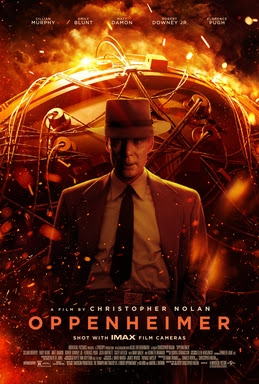
Oppenheimer--This biopic splits time the way its hero splits the atom. Narrative is fissionable to writer-director Christopher Nolan; he skips back and forth between episodes of Oppenheimer (Cillian Murphy) as a bumbling student, then as a philandering rising star in the new field of quantum physics, then as the determined yet haunted lord of Los Alamos, then as a post-bomb martyr to '50s era red-baiting. It glides along smoothly through its fractured scheme, beautifully shot by Hoyt van Hoytema in black and white and varyingly muted shades of color depending on period and point of view, and pushed along by a solemn Philip Glass-esque score by Ludwig Göransson.

Often crowned by a horizontal wide-brimmed preacher-style hat that makes him look like Brad Dourif in Wise Blood, Murphy uncannily captures the bursting, wide-eyed, near-ecstatic face that we see in photos of Oppenheimer. But he manages to give the performance a human dimension, with everyday foibles and touches of humor. He's not a pageant figure.

Murphy carries a star presence. But he's very ably supported by a huge, colorful gallery of star character players: Robert Downey Jr. as AEC Chairmen Lewis Strauss and Josh Hartnett as Ernest Lawrence and Benny Safdie as Edward Teller and Tom Conti as Albert Einstein and David Krumholtz as Isidore Rabi, Oppenheimer's menschy colleague who makes sure he eats and nudges his conscience, and Matthew Modine and Casey Affleck and Kenneth Branagh and Rami Malek and Alden Ehrenreich, to name only a few.

They're all entertaining, but two in particular jolt the movie to life: Florence Pugh as Oppenheimer's joyless lover Jean Tatlock and Matt Damon as the practical-minded, professionally unimpressed Leslie Groves, representing us laypeople in his deadpan, flummoxed scenes with Murphy. For a while it seems like Emily Blunt is underserved as Kitty Oppenheimer, but near the end she gets a juicy, angry scene opposite AEC lawyer Roger Robb (Jason Clarke), who has underestimated her. 

Other than maybe a few too many scenes of the young "Oppie" having visions that look like the psychedelic mindtrip at the end of 2001, there was no point where I found Oppenheimer less than absorbing. Few would suggest that this ambitious, superbly acted, superbly crafted film isn't a major, compelling work, a vast expansion on Roland Joffé's watchable but modest Fat Man and Little Boy from 1989. If Nolan's film isn't quite completely satisfying, there could be two reasons.

One is that trying to arrive at a moral conclusion about this movie's hero seems impossible. Put (too) simply: on the one hand, Oppenheimer won World War II for the good guys and checked fascism (not checkmated it, alas) for more than half a century. On the other hand, his invention killed hundreds of thousands of people, and still has the potential to ruin the world for everybody. Both can be true, and the ambiguity is unresolvable.

Another problem with the film, however, is a matter of simple showmanship. Back in 1994, James Cameron brought his silly action picture True Lies to a point where Arnold Schwarzenegger and Jamie Lee Curtis kiss while, far in the distance, we see a mushroom cloud erupt on the horizon. Triumphant, but then Cameron pushed his luck, piling on one last struggle with the villain in a Harrier jet. I remember thinking (and writing) at the time that when your hero and heroine kiss in front of a mushroom cloud, the movie is over.

Oppenheimer, obviously a very different movie, is uneasily structured in the same way. The scenes leading up to the Trinity Test at White Sands in 1945 are riveting, pulse pounding. The explosion and the immediate aftermath, ending the war in Japan, is a stunning dramatic climax.

But then the movie keeps going, for another hour or so, detailing the war of spite and will between Strauss and Oppenheimer, and the revocation of Oppenheimer's security clearance. It's interesting, provocative material in itself, but it seems a little petty and trivial after the "I am become death; destroyer of worlds" stuff. Given Nolan's supposed consummate skill at scrambling sequence, couldn't he have somehow structured the movie to end with a bang and not a whimper?

Barbie--Something is rotten in the state of Barbieland. As this, her first live-action feature begins, our titular heroine finds herself haunted, right in the middle of raging dance parties at her Dreamhouse, by thoughts of death. Still more alarming, when she steps out of her pumps, her feet go flat to the ground.

To be clear, the Barbie in question, played by Margot Robbie, is "Stereotypical Barbie," the blond, inhumanly thin and leggy iconic version of the Mattel doll. She shares the relentlessly cheery pink-plastic realm of Barbieland with countless other Barbies of every race and body shape and profession, all happy and accomplished and untroubled and mutually supportive. They're dimly aware of us in the "Real World"; they believe that their own harmony has created an example that has led to female empowerment and civil rights over here.

The Barbies also share Barbieland with Ken (Ryan Gosling) and countless variant Kens, as well as Ken's featureless friend Allan (a perfectly cast Michael Cera). But the guys exist entirely as accessories to the relatively uninterested Barbies. Ken's unrequited fascination with Barbie makes him subject, unlike the Barbies, to dissatisfaction.

Barbie goes for advice to "Weird Barbie" (Kate McKinnon), whose hair is frizzy and patchy and who's stuck in a permanent split. She's told that her troubles come from the dark feelings of somebody who's playing with her in our reality, so she sets out on a quest to the Real World, emerging in Venice Beach. Barbie connects with a mom and teenage daughter (America Ferrera and Ariana Greenblatt) whose relationship is strained; she's also pursued by the all-male board of Mattel, led by Will Ferrell. Ken, meanwhile, learns about our patriarchy, likes what he hears, and heads back to Barbieland alone to institute it, with himself at the top.

Mattel was founded in 1945, the same year as the Trinity Test, and there are probably feminist social critics who would argue that Barbie, invented in 1959 by Mattel co-founder Ruth Handler (well played by Rhea Perlman in the film), has wreaked only a little less havoc on the modern psyche than Oppenheimer's gadget. Even though I'm in exactly the right generational wheelhouse (I was born in 1962), my own childhood experience with Barbie was very limited, and thus so were my nostalgic associations with her.

Even so, this nutty fantasy, directed by Greta Gerwig from a brilliant script she wrote with Noah Baumbach, made me laugh from its inspired first scene to its Wings of Desire finish. Narrated in the droll, arch tones of Helen Mirren, it manages to come across as both an ingenious pop-culture lampoon/celebration and an unpretentious but surprisingly heartfelt deep dive into the implications of the Barbie archetype. I wasn't a big fan of Gerwig's 2019 version of Little Women, but here she builds her world with the freedom of, well, a kid playing with dolls, but also with the confidence and adult perspective of an artist.

Not everything in the movie works; in the second half the narrative gets a little lost at times in some very strange musical numbers/battle scenes, and the whole thing comes close to going on a bit too long. And it's hard to say just who this movie is for. It hardly seems intended for little girls; however smart, they're too young for the commentary about female identity to mean much to them yet. It seems more like it's meant for adult women with both a fondness for and an ambivalence toward Barbie.

No doubt there are those who would also complain that, however witty and self-effacing, the movie amounts to a feature-length commercial for the brand. But in the age of Marvel and other such franchises, it seems a little late to object to this.

The revelation in the film is Margot Robbie. It seems ridiculous that she's able, in the role of freaking Barbie, to give a performance of such subtlety and nuance and shading and quiet, unforced wistfulness, but she does. And she gets to deliver the best last line of the year.

Theater Camp--Joan, the founder of "AdirondACTS," a slightly gone-to-seed theater camp in upstate New York, has fallen into a coma. The job of keeping the struggling camp afloat falls to her decidedly non-theatrical "crypto bro" son Troy. Meanwhile the devoted instructors work with the exuberantly happy campers to mount the shows, including an original musical about the life of poor comatose Joan (Amy Sedaris). Needless to say, all does not go smoothly.

The creators of this Waiting for Guffman-esque "mockumentary" comedy, Molly Gordon, Nick Lieberman, Ben Platt and Noah Galvin, know the world they're depicting very well; all of them have been doing theater since they were small children. Gordon and Lieberman co-directed, from a script by all four; Platt and Gordon play Amos and Rebecca-Diane, the utterly enmeshed, co-dependent acting instructors and Galvin plays the low-profile tech director.

They capture the camaraderie and the sense of belonging that theater can give kids, and their affection for that world is unmistakable, but they're careful not to get too sentimental. The envies and resentments and passive-aggressive denigrations among theater folk, especially at this often professionally frustrated level, are vividly represented.

Getting laughs from the self-important vanities of theater people is pretty low-hanging fruit, I suppose, but Theater Camp is nonetheless often hilarious. The film also manages to get a little deeper at times, touching on the irony that while theater can create a haven and a community for misfit kids, this can generate its own clannishness and exclusionary snobbery, as in Amos and Rebecca-Diane's coldness toward the imbecilic but well-intentioned Troy, charmingly played by a sort of poor-man's Channing Tatum named Jimmy Tatro.

The real joy in Theater Camp, of course, is the acting: Platt, Gordon, Tatro, plus a few vets like Sedaris, Caroline Aaron and David Rasche bring the material to life. But as Glenn, the long-suffering backstage drudge who really ought to be onstage, Noah Galvin, who replaced Platt on Broadway in Dear Evan Hansen, is the revelation among the adults in the cast. He's a knockout.

The revelation among the kids playing the campers is, well, pretty much all of the kids playing the campers. There are some real singing, dancing and acting prodigies in this company. If there was a real theater camp somewhere with this kind of talent, their shows would sell out.

Friday, December 30, 2022

TOXIC CLOUD; TOXIC FRIENDSHIP

Now streaming...

White Noise--Noah Baumbach's adaptation of the Don DeLillo novel begins on the quaint campus of College-On-the-Hill, where mortality-haunted "Hitler Studies" prof Adam Driver lives with his wife Greta Gerwig and their talkative but deadpan blended brood. His wife's pill usage and other academic-life worries are intruded upon when the collision of a train with a tanker truck and the resulting "Airborne Toxic Event" requires the family and their neighbors to flee and take refuge in summer camps, Chinese restaurants and other makeshift shelters. Baumbach's style here seems to pay homage to other directors; the early college scenes suggest the twee formality of Wes Anderson, there's a big dose of the Close Encounters-era Spielberg later on, a hint of Jason Reitman's Juno here or of David Byrne's True Stories there. 

The movie feels large and consequential; there are many funny and fascinating passages, and the '80s period look is colorful. But while the story's elusive ambiguities are intriguing for a while, they gradually start to get irritating, particularly when it moves from the epic-scale first half to the more personal and anticlimactic second half. Still, the cast is strong, Driver is paradoxically both commanding and neurotic in the lead, and Gerwig is a doleful, troublingly erotic presence--at one point Driver's colleague Don Cheadle observes, accurately, that she has "important hair." 

The Banshees of Inisherin--Colm and Padraic live on a bleak island off the coast of Ireland in the 1920s. Artillery fire from the Irish Civil War can be heard from the mainland, but the islanders pay it less attention than they do the trouble that arises when Colm, a fiddler played by Brendan Gleeson, abruptly stops speaking to and socializing with his lifelong companion Padraic, a dairyman played by Colin Farrell. Colm admits, bluntly but without rancor, that he simply finds Padraic intolerably dull, and doesn't want to waste any more time drinking and talking with him when he could be working on his music. He'll still chat amiably with the other islanders, but something about the very presence of the dear, baffled Padraic seems symbolic to Colm of his life being squandered on triviality, and he'll go to extremes to reject it.

The great Martin McDonagh was really on to something here; it starts out as one of the most original, grimly funny and painful takes on friendship in some time. But as the conflict escalates, it's as if the writer-director remembers he's the Martin McDonagh of films like In Bruges and plays like A Behanding in Spokane, and feels obligated to take the story in a gruesome, Grand Guignol direction. It throws the balance off here as it didn't with In Bruges; it sours the movie's comic side and feels psychologically reductive to its tragic side.

Even so, Gleeson and (especially) Farrell are both sublime, as are Kerry Condon as Padraic's sensible sister and Barry Keoghan as his hapless backup friend. McDonagh narrowly missed making a masterpiece here, but these performances are not to be missed.

Tuesday, December 31, 2019

FOR AULD LANG SYNE, MY JO

Here's Your Humble Narrator's last movie review for the 'Teens, on Phoenix Magazine online, of Greta Gerwig's Little Women...


RIP to Rutle and auxiliary Python Neil Innes, passed on at 75. My pal Dave and I had the good luck to see him perform, solo and acoustic, at some little club here in Phoenix almost twenty years ago; he was superb.

Have a wonderful 2020 everybody!

Friday, January 13, 2017

WHAT THE TRUCK?

Opening in the Valley this weekend: 


Monster TrucksDrilling deep in North Dakota, an oil company dredges up three slimy tentacled creatures from an underground sea. Two are captured by the company, but a sweet-faced third escapes and makes friends with a frustrated local “teen” mechanic named Tripp (26-year-old Lucas Till) who dubs him “Creech” and uses his tentacles as the motive power for his beloved engine-less truck.

“It’s like the truck is a wheelchair for him,” says the pretty “teen” girl (27-year-old Jane Levy) who likes Tripp. “No,” replies the empowerment-minded Tripp, “It’s like he’s the engine for my truck.”

In short, this family film of long-delayed release is in the lead, so far this year, for literal-mindedness: Monster Trucks is about trucks powered by monsters. I suppose it’s another example, akin to the Transformers or Cars, of the child’s impulse to anthropomorphize beloved inanimate icons of power, like a truck or a gun.

Even so, it’s not every day you see a kid movie quite this weird. The oddity doesn’t derive just from the laboriousness of the premise, nor from the mixed bag of name players in the cast—Rob Lowe, Danny Glover, Thomas Lennon, Amy Ryan, Barry Pepper, Frank Whaley. It’s also in the tension between the movie’s Trump-demographic setting and interests—rural white folks, souped-up trucks, a hero named like one of Sarah Palin’s kids—and the values implied by its environmentalism, its corporate villains and its general generosity of spirit.

This eccentricity left me unable to dislike Monster Trucks, though it’s corny and silly. In its visual style and its John Williams-ish music, it has the feel of a throwback, like a Spielberg knockoff from the ‘80s, and the audience with whom I saw it responded to it happily. 


20th Century WomenDespite the title—strange to think it now applies to a period piece—this film is a male coming-of-age story. The setting is Santa Barbara in 1979, where Jamie (Lucas Jade Zumann) lives with his chain-smoking single mom Dorothea (Annette Bening). After a safety scare, Dorothea nervily asks two young women to assist in raising Jamie.

One is teenage Julie (Elle Fanning), a troubled promiscuous neighbor who regularly sneaks over and shares a bed with Jamie but infuriatingly won’t let him touch her—she likes him too much. The other is older Abbie (Greta Gerwig), a purple-haired hipster and cancer survivor who introduces Jamie to the local punk scene. Also around is William (Billy Crudup), a mystical-minded handyman.

The writer-director is Mike Mills, drawing upon his own childhood for inspiration. His style is economical, showing a debt at times to Godfrey Reggio’s fast-motion visions (the film includes a clip from Reggio’s Koyaanisqatsi). There’s plenty of high comedy, as when Jamie gets beat up by another kid over a disagreement about the necessity of “clitoral stimulation”—Bening’s facial takes in reaction to this explanation are classic.

Indeed, for all the excellence of Gerwig, Fanning, Crudup and Zumann, Bening is the knockout here. Dizzy with love for Jamie and the terror it breeds, grimacing with the effort not to say anything that alienates him, Dorothea may be the most magnificent, deeply funny, soulful creation of Bening’s career.

Friday, July 8, 2016

PET PROJECTS

Opening this weekend:


The Secret Life of PetsWhen I open the garage door most evenings around six, I can hear the excited yelping and whining start. Then I walk into the house, and my dogs greet me with a joyous exuberance that, quite frankly, my human family rarely seems able to muster.

It’s always one of the best parts of my day, and the moments like it are the best parts of the new animated movie The Secret Life of Pets. The film’s key joke is that its characters—supposedly apartment-bound Manhattan pets—get out and have epic adventures of which their owners never know.

That’s a pretty good joke, and it’s a pretty enjoyable film, but the adventure we see is a bit contrived and over-plotted. It’s really the scenes, near the beginning and end, of loving interaction between pets and owners that carry an unexpected emotional weight—they can fill you with gratitude for being in a position to have nonhuman friends.

Our hero is Max (voiced by Louis CK), a little white-and-brown terrier who shares a walk-up with a young single woman. When she leaves in the morning for what must be a really high-paying job, Max passes the time, through the windows and across the fire escapes, with the neighboring pets, among them a blasé cat (Lake Bell) and a fuzzy white Pomeranian (Jenny Slate) with a crush on him.

One evening Max’s owner comes home with, horror of horrors, a new dog—Duke (Eric Stonestreet), a shaggy, intrusive mutt. They don’t hit it off at first, but when the two of them end up lost in the streets and threatened by Animal Control, they of course have no choice but to bond.

It’s at this point that The Secret Life of Pets gets in a bit over its head, with too many characters and plot points. Max and Duke fall in, for instance, with a band of homeless exotic pets living in the sewers, led by a cute but revolutionary rabble-rousing bunny, voiced by Kevin Hart in his usual tone of hilariously aggrieved indignation. Meanwhile the Pomeranian and Max’s other neighbors mount a rescue mission, eventually enlisting the aid of a falcon (Albert Brooks) and a basset hound (Dana Carvey) with wheels on his back legs.

There are also digressions involving a surreal visit to a sausage factory, and an attempt to find Duke’s previous owner. Most of these strands are strong and funny in themselves, but there are too many of them, and they encrust the movie with complications that require laborious resolution.

Two other complaints: This is the second animated kid movie I’ve seen in the last few weeks—Finding Dory was the other—that included a scene of a van with animals trapped inside it crashing off of a bridge and plunging into the water. Maybe movies aimed at this sort of demographic could consider going a bit easier on the Hal Needham-style car crash action?

And finally, this movie is one of many in the genre that continue the stereotype of the stupid and gleeful animal control officer. I get that the “Evil Dogcatcher” is a venerable archetype, but in reality these people provide an essential public service, and I’d guess that many of them are animal lovers. Also, as unfortunate as an animal in a pound may be, it’s still almost invariably better off than an animal lost in the streets, and the old idea of the happy-go-lucky stray dog or cat is, I think, pernicious—it has helped to perpetuate the idea of abandoning animals as a legitimate option. It’s time to humanely euthanize all of these clichés.


Wiener-DogThe hapless wanderings of a domestic animal are also the basis for this very different movie, the latest from Todd Solondz.

The title character is a small, thick-bodied dachshund with a stoic face. Via unkind twists of fate and irresponsible human behavior, she falls in with a variety of wretched people. First there’s a disastrous stretch with a disagreeable older dad (Tracey Letts), younger French mom (Julie Delpy) and their sugary-voiced, obtuse, flute-playing, cancer-surviving son (Keaton Nigel Cooke). Then she’s reprieved by a self-esteem-less assistant (Greta Gerwig) from the vet’s office, and goes on a road trip with this doormat and her new sort-of-boyfriend (Kieran Culkin).

This is followed by an intermission “snipe” featuring a “Ghost Riders in the Sky”-style song, “The Ballad of Wiener-Dog,” by Marc Shaiman. This brief passage is the least excruciating part of the film.

It’s not made clear how the Wiener-Dog lands in her next home, that of a sad-sack screenwriting professor (Danny DeVito), nor how she gets from there to the home of an unhappy old woman (Ellen Burstyn) who names her “Cancer.” The Wiener-Dog is the center of some of these strands, while in others she’s little more than a perplexed observer. The only time in the movie that she takes any decisive action, it’s catastrophic.

It’s difficult for me to express how likable I found this dog, and how unlikable I found this movie. I can pretty much promise you that if you’re a mushy-brained, sentimental dog lover, you’ll despise it. I’m a mushy-brained, sentimental dog-lover, and I despised it.

But I think my dislike of Wiener-Dog didn’t derive only from my sappiness where dogs are concerned. It also has to do with the humans that Solondz creates, and the somehow self-conscious, manufactured ugliness and vapidity he imposes on them. Solondz is by no means without skills as a filmmaker—a fine eye and a superb sense of fitful comic timing—and there are grimly funny episodes and images here. But his misanthropy seems forced and unconvincing, like that of a teenager going through a “cynical” phase.

The most jolting moment in Wiener-Dog, for me, came at the end of the credits: “AMERICAN HUMANE ASSOCIATION MONITORED SOME OF THE ANIMAL ACTION. NO ANIMALS WERE HARMED DURING THOSE SCENES.” The implications of this (trademarked!) phrasing are distressing. If any movie could ever be worth harming an animal, this one sure wasn’t it.