Showing posts with label NOAH BAUMBACH. Show all posts

Friday, July 21, 2023

BOMBS & BOMBSHELLS

Opening in theaters this weekend:
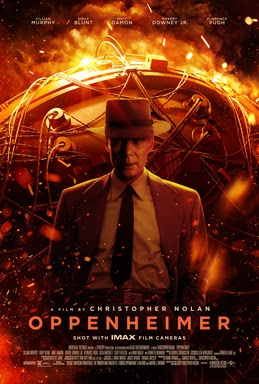
Oppenheimer--This biopic splits time the way its hero splits the atom. Narrative is fissionable to writer-director Christopher Nolan; he skips back and forth between episodes of Oppenheimer (Cillian Murphy) as a bumbling student, then as a philandering rising star in the new field of quantum physics, then as the determined yet haunted lord of Los Alamos, then as a post-bomb martyr to '50s era red-baiting. It glides along smoothly through its fractured scheme, beautifully shot by Hoyt van Hoytema in black and white and varyingly muted shades of color depending on period and point of view, and pushed along by a solemn Philip Glass-esque score by Ludwig Göransson.

Often crowned by a horizontal wide-brimmed preacher-style hat that makes him look like Brad Dourif in Wise Blood, Murphy uncannily captures the bursting, wide-eyed, near-ecstatic face that we see in photos of Oppenheimer. But he manages to give the performance a human dimension, with everyday foibles and touches of humor. He's not a pageant figure.

Murphy carries a star presence. But he's very ably supported by a huge, colorful gallery of star character players: Robert Downey Jr. as AEC Chairmen Lewis Strauss and Josh Hartnett as Ernest Lawrence and Benny Safdie as Edward Teller and Tom Conti as Albert Einstein and David Krumholtz as Isidore Rabi, Oppenheimer's menschy colleague who makes sure he eats and nudges his conscience, and Matthew Modine and Casey Affleck and Kenneth Branagh and Rami Malek and Alden Ehrenreich, to name only a few.

They're all entertaining, but two in particular jolt the movie to life: Florence Pugh as Oppenheimer's joyless lover Jean Tatlock and Matt Damon as the practical-minded, professionally unimpressed Leslie Groves, representing us laypeople in his deadpan, flummoxed scenes with Murphy. For a while it seems like Emily Blunt is underserved as Kitty Oppenheimer, but near the end she gets a juicy, angry scene opposite AEC lawyer Roger Robb (Jason Clarke), who has underestimated her. 

Other than maybe a few too many scenes of the young "Oppie" having visions that look like the psychedelic mindtrip at the end of 2001, there was no point where I found Oppenheimer less than absorbing. Few would suggest that this ambitious, superbly acted, superbly crafted film isn't a major, compelling work, a vast expansion on Roland Joffé's watchable but modest Fat Man and Little Boy from 1989. If Nolan's film isn't quite completely satisfying, there could be two reasons.

One is that trying to arrive at a moral conclusion about this movie's hero seems impossible. Put (too) simply: on the one hand, Oppenheimer won World War II for the good guys and checked fascism (not checkmated it, alas) for more than half a century. On the other hand, his invention killed hundreds of thousands of people, and still has the potential to ruin the world for everybody. Both can be true, and the ambiguity is unresolvable.

Another problem with the film, however, is a matter of simple showmanship. Back in 1994, James Cameron brought his silly action picture True Lies to a point where Arnold Schwarzenegger and Jamie Lee Curtis kiss while, far in the distance, we see a mushroom cloud erupt on the horizon. Triumphant, but then Cameron pushed his luck, piling on one last struggle with the villain in a Harrier jet. I remember thinking (and writing) at the time that when your hero and heroine kiss in front of a mushroom cloud, the movie is over.

Oppenheimer, obviously a very different movie, is uneasily structured in the same way. The scenes leading up to the Trinity Test at White Sands in 1945 are riveting, pulse pounding. The explosion and the immediate aftermath, ending the war in Japan, is a stunning dramatic climax.

But then the movie keeps going, for another hour or so, detailing the war of spite and will between Strauss and Oppenheimer, and the revocation of Oppenheimer's security clearance. It's interesting, provocative material in itself, but it seems a little petty and trivial after the "I am become death; destroyer of worlds" stuff. Given Nolan's supposed consummate skill at scrambling sequence, couldn't he have somehow structured the movie to end with a bang and not a whimper?

Barbie--Something is rotten in the state of Barbieland. As this, her first live-action feature begins, our titular heroine finds herself haunted, right in the middle of raging dance parties at her Dreamhouse, by thoughts of death. Still more alarming, when she steps out of her pumps, her feet go flat to the ground.

To be clear, the Barbie in question, played by Margot Robbie, is "Stereotypical Barbie," the blond, inhumanly thin and leggy iconic version of the Mattel doll. She shares the relentlessly cheery pink-plastic realm of Barbieland with countless other Barbies of every race and body shape and profession, all happy and accomplished and untroubled and mutually supportive. They're dimly aware of us in the "Real World"; they believe that their own harmony has created an example that has led to female empowerment and civil rights over here.

The Barbies also share Barbieland with Ken (Ryan Gosling) and countless variant Kens, as well as Ken's featureless friend Allan (a perfectly cast Michael Cera). But the guys exist entirely as accessories to the relatively uninterested Barbies. Ken's unrequited fascination with Barbie makes him subject, unlike the Barbies, to dissatisfaction.

Barbie goes for advice to "Weird Barbie" (Kate McKinnon), whose hair is frizzy and patchy and who's stuck in a permanent split. She's told that her troubles come from the dark feelings of somebody who's playing with her in our reality, so she sets out on a quest to the Real World, emerging in Venice Beach. Barbie connects with a mom and teenage daughter (America Ferrera and Ariana Greenblatt) whose relationship is strained; she's also pursued by the all-male board of Mattel, led by Will Ferrell. Ken, meanwhile, learns about our patriarchy, likes what he hears, and heads back to Barbieland alone to institute it, with himself at the top.

Mattel was founded in 1945, the same year as the Trinity Test, and there are probably feminist social critics who would argue that Barbie, invented in 1959 by Mattel co-founder Ruth Handler (well played by Rhea Perlman in the film), has wreaked only a little less havoc on the modern psyche than Oppenheimer's gadget. Even though I'm in exactly the right generational wheelhouse (I was born in 1962), my own childhood experience with Barbie was very limited, and thus so were my nostalgic associations with her.

Even so, this nutty fantasy, directed by Greta Gerwig from a brilliant script she wrote with Noah Baumbach, made me laugh from its inspired first scene to its Wings of Desire finish. Narrated in the droll, arch tones of Helen Mirren, it manages to come across as both an ingenious pop-culture lampoon/celebration and an unpretentious but surprisingly heartfelt deep dive into the implications of the Barbie archetype. I wasn't a big fan of Gerwig's 2019 version of Little Women, but here she builds her world with the freedom of, well, a kid playing with dolls, but also with the confidence and adult perspective of an artist.

Not everything in the movie works; in the second half the narrative gets a little lost at times in some very strange musical numbers/battle scenes, and the whole thing comes close to going on a bit too long. And it's hard to say just who this movie is for. It hardly seems intended for little girls; however smart, they're too young for the commentary about female identity to mean much to them yet. It seems more like it's meant for adult women with both a fondness for and an ambivalence toward Barbie.

No doubt there are those who would also complain that, however witty and self-effacing, the movie amounts to a feature-length commercial for the brand. But in the age of Marvel and other such franchises, it seems a little late to object to this.

The revelation in the film is Margot Robbie. It seems ridiculous that she's able, in the role of freaking Barbie, to give a performance of such subtlety and nuance and shading and quiet, unforced wistfulness, but she does. And she gets to deliver the best last line of the year.

Theater Camp--Joan, the founder of "AdirondACTS," a slightly gone-to-seed theater camp in upstate New York, has fallen into a coma. The job of keeping the struggling camp afloat falls to her decidedly non-theatrical "crypto bro" son Troy. Meanwhile the devoted instructors work with the exuberantly happy campers to mount the shows, including an original musical about the life of poor comatose Joan (Amy Sedaris). Needless to say, all does not go smoothly.

The creators of this Waiting for Guffman-esque "mockumentary" comedy, Molly Gordon, Nick Lieberman, Ben Platt and Noah Galvin, know the world they're depicting very well; all of them have been doing theater since they were small children. Gordon and Lieberman co-directed, from a script by all four; Platt and Gordon play Amos and Rebecca-Diane, the utterly enmeshed, co-dependent acting instructors and Galvin plays the low-profile tech director.

They capture the camaraderie and the sense of belonging that theater can give kids, and their affection for that world is unmistakable, but they're careful not to get too sentimental. The envies and resentments and passive-aggressive denigrations among theater folk, especially at this often professionally frustrated level, are vividly represented.

Getting laughs from the self-important vanities of theater people is pretty low-hanging fruit, I suppose, but Theater Camp is nonetheless often hilarious. The film also manages to get a little deeper at times, touching on the irony that while theater can create a haven and a community for misfit kids, this can generate its own clannishness and exclusionary snobbery, as in Amos and Rebecca-Diane's coldness toward the imbecilic but well-intentioned Troy, charmingly played by a sort of poor-man's Channing Tatum named Jimmy Tatro.

The real joy in Theater Camp, of course, is the acting: Platt, Gordon, Tatro, plus a few vets like Sedaris, Caroline Aaron and David Rasche bring the material to life. But as Glenn, the long-suffering backstage drudge who really ought to be onstage, Noah Galvin, who replaced Platt on Broadway in Dear Evan Hansen, is the revelation among the adults in the cast. He's a knockout.

The revelation among the kids playing the campers is, well, pretty much all of the kids playing the campers. There are some real singing, dancing and acting prodigies in this company. If there was a real theater camp somewhere with this kind of talent, their shows would sell out.

Friday, December 30, 2022

TOXIC CLOUD; TOXIC FRIENDSHIP

Now streaming...

White Noise--Noah Baumbach's adaptation of the Don DeLillo novel begins on the quaint campus of College-On-the-Hill, where mortality-haunted "Hitler Studies" prof Adam Driver lives with his wife Greta Gerwig and their talkative but deadpan blended brood. His wife's pill usage and other academic-life worries are intruded upon when the collision of a train with a tanker truck and the resulting "Airborne Toxic Event" requires the family and their neighbors to flee and take refuge in summer camps, Chinese restaurants and other makeshift shelters. Baumbach's style here seems to pay homage to other directors; the early college scenes suggest the twee formality of Wes Anderson, there's a big dose of the Close Encounters-era Spielberg later on, a hint of Jason Reitman's Juno here or of David Byrne's True Stories there. 

The movie feels large and consequential; there are many funny and fascinating passages, and the '80s period look is colorful. But while the story's elusive ambiguities are intriguing for a while, they gradually start to get irritating, particularly when it moves from the epic-scale first half to the more personal and anticlimactic second half. Still, the cast is strong, Driver is paradoxically both commanding and neurotic in the lead, and Gerwig is a doleful, troublingly erotic presence--at one point Driver's colleague Don Cheadle observes, accurately, that she has "important hair." 

The Banshees of Inisherin--Colm and Padraic live on a bleak island off the coast of Ireland in the 1920s. Artillery fire from the Irish Civil War can be heard from the mainland, but the islanders pay it less attention than they do the trouble that arises when Colm, a fiddler played by Brendan Gleeson, abruptly stops speaking to and socializing with his lifelong companion Padraic, a dairyman played by Colin Farrell. Colm admits, bluntly but without rancor, that he simply finds Padraic intolerably dull, and doesn't want to waste any more time drinking and talking with him when he could be working on his music. He'll still chat amiably with the other islanders, but something about the very presence of the dear, baffled Padraic seems symbolic to Colm of his life being squandered on triviality, and he'll go to extremes to reject it.

The great Martin McDonagh was really on to something here; it starts out as one of the most original, grimly funny and painful takes on friendship in some time. But as the conflict escalates, it's as if the writer-director remembers he's the Martin McDonagh of films like In Bruges and plays like A Behanding in Spokane, and feels obligated to take the story in a gruesome, Grand Guignol direction. It throws the balance off here as it didn't with In Bruges; it sours the movie's comic side and feels psychologically reductive to its tragic side.

Even so, Gleeson and (especially) Farrell are both sublime, as are Kerry Condon as Padraic's sensible sister and Barry Keoghan as his hapless backup friend. McDonagh narrowly missed making a masterpiece here, but these performances are not to be missed.

Friday, June 17, 2016

BRIAN'S SONG, & THE PER-FISH-TENCE OF MEMORY

Opening this weekend:

 
De Palma—For all the faults of his movies, even for all the supposed great faults of his character, I’ve always had a soft spot for director Brian De Palma. This isn’t always easy to defend—while the frequent charge that he’s a misogynist can’t, I think, be proven from his movies, the general smarminess and arrested adolescence that many of them give off is hard to deny.

But his filmmaking mastery is even harder to deny. There’s a lot of schlock and silliness on the list of his credits, but there are several enduring classics, too, and I find that scenes from even his worst misfires remain in my memory in a way that plenty of better movies don’t. This is because, of course, he’s a true cinema stylist, lavishing so much craft and obsessive care on even the most absurd or ugly content that it ends up charged with vivid atmosphere.

Noah Baumbach and Jake Paltrow apparently share this admiration. The documentary they made about him comes across, more than anything, as an act of obsessive fandom. The only talking head is the title character, sitting in front of a gray fireplace. First he talks about his background, a little, and then he talks about his films—every one of them, I think, at least briefly—and the films that influenced him. As he talks, clips and stills are mixed in. That’s pretty much the whole movie.

The austerity of Baumbach and Paltrow’s approach is shrewd, because the material on which they draw is so cinematically rich. The biographical material is fascinating—I certainly didn’t know that De Palma’s father was a famous osteopath, or that the director himself had been a science whiz as a kid—and the straightforward progression through his works gives a bird’s-eye view of his development. The clips offer some intriguing treasures, too, like the unused deus ex machina ending of 1998’s Snake Eyes that’s more interesting than anything that made it into the finished film.

As for his own psychology, the ruefully chuckling De Palma seems candid enough, in a general sort of way. But although he shares some eyebrow-raising autobiographical subtext to Dressed to Kill, overall he seems unwilling to go very deep. Unlike, say, 1994’s Crumb, this movie doesn’t strip its subject naked for us. He’s evasive about his sensibility toward women, for instance, saying only that it “always made sense” to him, in the context of the genre in which he was working. And indeed, adjusting for generational differences in the degree of graphic violence acceptable in a movie, it’s hard to see how Hitchcock, for the most obvious example, is less vulnerable to this charge than De Palma.

In any event, De Palma can lay claim, at least for me, to the highest praise a documentary about a moviemaker can earn. Like last year’s movie version of Hitchcock/Truffaut, it left me with an appetite to re-watch these movies. 


 Finding Dory—Pixar’s 2003 animated ichthyological smash Finding Nemo is one of the most beloved of all kid movies. But I think I enjoyed this sequel focusing on Dory, the cheery titular blue tang with the unreliable short-term memory who helped in the search for the title fish in the first film, even more.

This time Dory, voiced by Ellen DeGeneres, is trying to find her home and parents (Diane Keaton and Eugene Levy), from whom she was separated as a kid, and the worrywart clownfish Marlin (Albert Brooks) and his little Nemo are helping her. Once again they have to cross the ocean, this time to a marine center on the California coast. And once again they have to depend on the kindness of strangers, notably an octopus named Hank (Ed O’Neill), as well as a whale shark and a beluga. Dory is also amusingly guided by a voice from above—specifically, the voice of Sigourney Weaver.

The imperturbable, doggedly polite optimism and geniality of DeGeneres is center stage here, and deeply endearing. Her off-the-cuff, throwaway delivery, along with the mild kvetching of Brooks, is central to the movie’s balance. The theme, along with the Pixar/Disney standard of separation from loved ones, is the preciousness and vulnerability of memory, and the light touch of DeGeneres makes this moving, but not exhausting.

To Mesa Arts Center this Sunday, June 19…


 …comes a different iconic American filmmaker of the ‘70s and ‘80s: John Carpenter. The auteur plays a concert of his own music, both from his films and from a couple of recent studio albums. Check out my interview with him, on New Times blogs.

Monday, June 13, 2016

SHRIEK WEEK

In anticipation of De Palma, the upcoming documentary about the director by Noah Baumbach and Jake Paltrow, Phoenix Film Festival is presenting “De Palma Week,” June 13 through June 16 at Scottsdale 101. Three of De Palma’s major works will be screened, one each night at 7 p.m., followed on the final evening by a screening of the documentary. Admission to the first three evenings is just $5; tickets to the De Palma screening are not available for purchase, but must be won; there will be opportunities to do so at the three earlier screenings:


June 13: Carrie—De Palma’s 1976 version of Steven King’s novel, the first movie adaptation of King’s work, was a smash, and probably started the process of turning King into American horror’s household name. For this sad, scary fairy tale of a picked-on, outcast high school girl (Sissy Spacek) with telekinetic powers who raises hell at her senior prom, De Palma uses his characteristic tricks—spilt screens, slow motion, long sinuous tracking shots—to cast a dreamlike spell. Both Spacek and Piper Laurie as Carrie’s religious fanatic mother got Oscar nominations, and the young John Travolta, Nancy Allen and Amy Irving are also in the cast. The final jolt is a classic; I can remember the screams in the theater (including my own) when I saw it the first time.

 
June 14: Scarface—One of the signature American movies of the ‘80s, De Palma’s 1983 gangster saga reset the 1932 classic in Miami, and gave Al Pacino, hamming vigorously, the second most famous role of his career, that of Tony Montana, the Cuban refugee turned killer turned cocaine kingpin. As with so much of De Palma’s work, the film is loaded with bloody violence and carnage, presented in elegant, finely-constructed sequences. The pace bogs down some in the second half—until the wild shootout finale, that is, from which derives Pacino’s now-familiar catchphrase, as he’s about to let loose at his enemies with a comically enormous automatic weapon: “Say hello to my leetle friend!”

The June 15 offering was a “Viewer’s Choice,” between Dressed to Kill and Carlito’s Way. The online voting is completed, and though I like 1993’s Carlito’s Way, another gangster melodrama with Al Pacino, I’m glad the choice is: 

Dressed to Kill—De Palma’s 1980 homage to Hitchcock, this gruesome psychological thriller with Michael Caine, Angie Dickinson and Nancy Allen seems, in some ways, like the quintessential expression of De Palma’s twisted psyche, for better and worse. The sensibility of the movie, which De Palma also scripted, has aged poorly—both the horrifying brutality of the central murder sequence and the implications of the story’s twist ending are unsavory. But as an exercise in technique, it packs at least as much of a punch as it ever did.

Finally, on June 16, the series will conclude with the special screening of Baumbach and Paltrow’s documentary De Palma, which gives the man in question a chance to explain himself.

Go to PhoenixFilmFestival.com for details.