Showing posts with label ADAM DRIVER. Show all posts

Friday, September 27, 2024

GOOD COPPOLA, BAD COPPOLA

Opening this weekend:

Megalopolis--The buzz on this long-cherished, finally realized project by Francis Ford Coppola is that people either love or hate it. But you may find that duality stifling. I kind of hated this movie, and I also kind of loved it.

It's an epic with sci-fi, fantasy and surreal elements, set in a city called "New Rome." New Rome looks exactly like New York, if New York was shot in exquisitely burnished metallic tones by the Romanian cinematographer Mihai Malaimare Jr., and if the men wore '90s-George Clooney haircuts. Against this backdrop, Coppola develops a story that very loosely parallels the Cataline Conspiracy of 63 B.C., as chronicled by Sallust.

Cesar Catalina (Adam Driver) still wants to take over Rome, but in this version he's a visionary architect and urban planner who wishes to create a new utopian downtown full of futuristic, even surreal amenities, made possible by a building material called Megalon. His rival Mayor Cicero (Giancarlo Esposito) has, one might say, more modest ambitions for his town.

Trouble brews when Cicero's beautiful daughter Julia (Nathalie Emmanuel) goes to work for Cesar, and despite a dark secret involving Cesar's late first wife, he and Julia begin to fall in love. Into this basic conflict, rafts of supporting players and subplots and sub-subplots and digressions are interwoven, on the whole pretty chaotically.

The movie opens with a breath-quickening sequence in which Cesar stands on the ledge of the New Rome version of the Chrysler Building, leaning out, tempting gravity and stopping and starting time with the power of his will. The movie that follows seems to be Coppola trying to do the same with his art, and struggling with the awareness that time can't be suspended indefinitely.

It's a potent start, but after that Megalopolis splutters and flails for quite a while, with short, scattered, over-edited scenes that fail to draw us in, or sometimes even to communicate what's happening and who's who in relation to who. A half-hour or so in, I was starting to squirm, thinking this could be a really punishing disaster. Very gradually, however, a story begins to take shape that we can invest in.

The intent seems to be satirical, but Coppola's tone comes across as too earnest, even naive, for any real bite. The writer-producer-director sees our society as in decline, and he wants to have "A GREAT DEBATE ABOUT THE FUTURE." This seems like a worthy goal; our current debates about the future seem pretty lacking in greatness, with one side regarding the future as a place where Jesus will come back and then the elitists will be sorry, and the other side regarding the future as a place where maybe we'll get people's pronouns right.

Coppola certainly has broader, more robust, more soulful hopes for the future than these. But his utopian ideals are unspecific, beyond a sort of technocratic optimism. Cesar's "Megalon" (no relation, apparently, to Godzilla's old rival) is a conveniently vague plot device, and much of what Coppola shows us as evidence of our decline are lots of nubile young women partying too hard.

All this and more undoubtedly makes Megalopolis seem dubious, even campy. It's the kind of grand, glittering cinematic folly that we rarely see any more, because perhaps regrettably we don't have as many auteurs with the same level of delusional hubris as we did half a century ago. Yet it's hard to shake the sense that, at bottom, Coppola is right about contemporary society; that it is time for us to pull our collective heads out of our asses. And his sense of spectacle can get to you. His style here recalls everything from Orson Welles to Abel Gance to Koyaanisqatsi to Things to Come, and after he settles down, his movie begins to get exhilarating.

In no small part, undoubtedly, this is due to the uncommonly glamorous and vibrant cast. The roles are grievously underwritten--Dustin Hoffman in particular makes a fine, energetically weaselly entrance, but then his part seems unceremoniously truncated. But these actors inhabit their pageant figure roles and flesh them out with their own personalities.

Driver is excellent, again showing his ability to be eccentric and vulnerable while retaining the commanding presence of a leading man, and Esposito's pensive, wary eyes make a perfect, puny-spirited contrast to Driver's virility. Emmanuel is able to keep Julia from becoming too much of an idealized love object despite Coppola's gauzy presentation of her.

Shia LaBeouf has a juicy turn as Cesar's cousin and enemy Clodio, and Laurence Fishburne is a reassuring presence as Cesar's chauffeur, who also serves as the movie's Greek Chorus narrator. As Cesar's rich uncle Crassus, Jon Voight, despite his real-life political leanings, gives what seems like a gleeful parody of a certain recent president from the Big Apple, and it's fun to see veterans like Balthazar Getty, James Remar, Jason Schwartman, D.B. Sweeney and even Talia Shire among the supporting players.

It's possible that the strongest performance in the movie, however, is that of Aubrey Plaza, in the role of Wow Platinum, a TV financial reporter who has snaked her way into the lives of both Cesar and Crassus. Plaza isn't subtle as the lewd, scheming Wow, and from the beginning the character refuses to get buried by Coppola's grandiose conceptions. Every time she gets up to some juicy mischief, the audience comes happily to life.

Friday, December 30, 2022

TOXIC CLOUD; TOXIC FRIENDSHIP

Now streaming...

White Noise--Noah Baumbach's adaptation of the Don DeLillo novel begins on the quaint campus of College-On-the-Hill, where mortality-haunted "Hitler Studies" prof Adam Driver lives with his wife Greta Gerwig and their talkative but deadpan blended brood. His wife's pill usage and other academic-life worries are intruded upon when the collision of a train with a tanker truck and the resulting "Airborne Toxic Event" requires the family and their neighbors to flee and take refuge in summer camps, Chinese restaurants and other makeshift shelters. Baumbach's style here seems to pay homage to other directors; the early college scenes suggest the twee formality of Wes Anderson, there's a big dose of the Close Encounters-era Spielberg later on, a hint of Jason Reitman's Juno here or of David Byrne's True Stories there. 

The movie feels large and consequential; there are many funny and fascinating passages, and the '80s period look is colorful. But while the story's elusive ambiguities are intriguing for a while, they gradually start to get irritating, particularly when it moves from the epic-scale first half to the more personal and anticlimactic second half. Still, the cast is strong, Driver is paradoxically both commanding and neurotic in the lead, and Gerwig is a doleful, troublingly erotic presence--at one point Driver's colleague Don Cheadle observes, accurately, that she has "important hair." 

The Banshees of Inisherin--Colm and Padraic live on a bleak island off the coast of Ireland in the 1920s. Artillery fire from the Irish Civil War can be heard from the mainland, but the islanders pay it less attention than they do the trouble that arises when Colm, a fiddler played by Brendan Gleeson, abruptly stops speaking to and socializing with his lifelong companion Padraic, a dairyman played by Colin Farrell. Colm admits, bluntly but without rancor, that he simply finds Padraic intolerably dull, and doesn't want to waste any more time drinking and talking with him when he could be working on his music. He'll still chat amiably with the other islanders, but something about the very presence of the dear, baffled Padraic seems symbolic to Colm of his life being squandered on triviality, and he'll go to extremes to reject it.

The great Martin McDonagh was really on to something here; it starts out as one of the most original, grimly funny and painful takes on friendship in some time. But as the conflict escalates, it's as if the writer-director remembers he's the Martin McDonagh of films like In Bruges and plays like A Behanding in Spokane, and feels obligated to take the story in a gruesome, Grand Guignol direction. It throws the balance off here as it didn't with In Bruges; it sours the movie's comic side and feels psychologically reductive to its tragic side.

Even so, Gleeson and (especially) Farrell are both sublime, as are Kerry Condon as Padraic's sensible sister and Barry Keoghan as his hapless backup friend. McDonagh narrowly missed making a masterpiece here, but these performances are not to be missed.

Friday, December 31, 2021

FASHION VICTIMS

 One more for 2021; still in theaters...

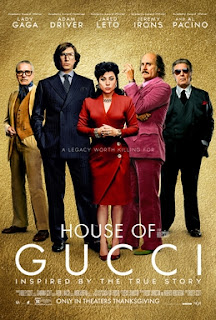
House of Gucci--Lady Gaga plays Patrizia Gucci in Ridley Scott's dramatization of the family turbulence leading up to the 1995 shooting of her husband Maurizio. She's deliciously ripe and amiable in the first half of the story, depicting how she and Maurizio (Adam Driver) met in Milan in the late '70s, how he was willing to renounce his fortune over the disapproval of his father Rodolfo (Jeremy Irons) for the marriage, and how Maurizio eventually did join the family business, helped to revive the venerable but declining brand, and engaged in internal intrigues with his Uncle Aldo (Al Pacino) and cousin Paolo (Jared Leto).

Gaga is also believable and sad, if inevitably less fun, in the second half, when Maurizio drifts away from her. She grows desperate, and, under the influence of a psychic (Salma Hayek), dangerous.

The leading lady is strong; whether that makes House of Gucci's 158 minutes worth sitting through is another matter. Scott's usual panache seemed to desert him here. The pacing is flat, and the effect is of a competent, expensive but unexciting TV movie.

Still, there's undeniable camp value in watching this star-studded cast spew their dialogue at each other, in English but with radio-comedy Italian accents. Driver makes some effort to underplay, and comes across respectably. Pacino hams away enjoyably, and Irons, who's starting to resemble the late-vintage Boris Karloff, manages some impressively suave nastiness.

The shocker is Leto, who turns the hapless Paolo's lines into aggrieved sing-song arias. It feels like he was trying to see how far he could go before Scott asked him to tone it down. Apparently that didn't happen.

Friday, November 15, 2019

REPORTS, LIARS, COPS...

Happy Friday everybody!

Check out my "Friday Flicks" column, online at Phoenix Magazine, with reviews of The Report...


...and The Good Liar...


Last weekend at Scottsdale International Film Festival I got to introduce the American premiere of the Austrian film Cops, about police violence in Vienna, and to moderate the Q&A with its director, Stefan Lukacs, known by his screen name "Istvan." Nice guy; remarkable film. Here's a picture of us together, just in case he becomes internationally famous in the next few years. Which is far from impossible.


Friday, December 15, 2017

JEDI HARD

Opening this week:


Star Wars: The Last Jedi--After a lively space battle at the opening to get us warmed up, the latest from the franchise picks up right where The Force Awakens left off. Scavenger-turned-warrior Rey (Daisy Ridley) has caught up with Luke Skywalker (Mark Hamill), now a recluse on a windswept island on some distant planet. She's been sent by his sister Leia (Carrie Fisher) to fetch him back into the struggle between The Resistance and the brutal "First Order."

While she pleads with Luke to get back in the game, Rey is also in psychic touch with Kylo Ren (Adam Driver), Leia and Han Solo's wayward son who is still in the service of the dreadful First Order overlord Snoke (Andy Serkis). Elsewhere in that galaxy far, far away, the last ragged remnant of the Resistance is trying to elude the First Order's ships, with the help of a desperate plan by former stormtrooper Finn (John Boyega), his new friend Rose (Kelly Marie Tran), hotheaded space ace Poe (Oscar Isaac) and others. This involves a detour to a Monte-Carlo-like casino planet, and then sneaking aboard the First Order's warship, none of which goes smoothly.

As with The Force Awakens, much of the pleasure in The Last Jedi comes from the attractively non-generic actors, saddled with cringe-inducing dialogue but at least allowed some welcome freedom to be funny at times. Through the character of the commoner heroine Rey, the story also takes a mild stab at acknowledging the dynastic bias that has been such a persistent part of the Star Wars series, and the attitudes on class that it would seem to imply. These movies are more fixated on the inherent importance of bloodlines than a documentary on the Royal Family, and the treatment of the revelations about Rey's lineage would have seemed quaint in the '30s.

But much amusement also comes, as with all Star Wars movies, from the marginal verisimilitude--such casually observed fauna as the elephant-seal/dinosaur-like creatures which provide Luke with sustenance, and the toad-like maintenance workers that keep up his domicile. The obligatory adorable creatures this time, by the way, are the porgs, beakless, wide-eyed seabirds with nesting-doll-shaped bodies.

I liked all of this, and I thoroughly enjoyed The Last Jedi. But as so often with big blockbuster movies it seemed too long to me. Since this is such a perennial cranky complaint from me, I was relieved to hear others saying the same as I left the screening. It isn't just a question of a tired backside; director Rian Johnson, to whom the script is solely credited, puts together one of those big climatic finales typical of the series, crosscutting between several strands of action and building to a noble act of self-sacrifice, and then...it turns out it's not the end at all. There's another whole act still to go, and another big climactic confrontation. And a very good confrontation it is, but by then we've had our emotional release. And also, our backsides are tired.

Despite the Gotterdammerung title, The Last Jedi is not slated to be the last of this Star Wars trilogy. It was, alas, the final film of Carrie Fisher, who has an imperturbably majestic mien here, and whose absence will be sorely felt in the series.

Even so, the best thing about the movie is Hamill. As Luke in the original films, he was sweet and likable but callow to the point of insubstantial; it was like Richie Cunningham at the center of a space opera. In The Last Jedi, with his scraggly hair and graying beard, his raspy voice and haunted, haggard eyes, he has a bearing that can fairly be called Shakespearean.


Ferdinand--Fox Animation and Blue Sky Studios are bravely opening this animated feature for kids the same weekend as The Last Jedi. Maybe the theory is that they'll get the spillover audiences if the Star Wars flick sells out.

In any case, it's a sweet film. It's an adaptation of Munro Leaf's 1936 children's book, with superb illustrations by Robert Lawson, about the gentle-souled bull in Spain who doesn't want to fight, he just wants to sit under his favorite cork tree and smell the flowers. Leaf and Lawson's tiny, beautiful classic (sometimes condemned for its hero's nonviolent nature) was already turned into a very faithful, Oscar-winning 8-minute cartoon short by Disney, Ferdinand the Bull, in 1938.

Turning it into a feature is another matter, of course. The story had to be embellished, and to some extent vulgarized. It's spun out into an escape thriller, as Ferdinand (voiced by John Cena) and his "calming goat" Lupe (Kate McKinnon) try to help the other bulls crash out of their corral, having figured out what will happen to them wether they win or lose in the ring.

It took me a while to warm up to this over-plotting, but happily the movie is willing to go silly. About the time that Ferdinand and his pals were engaging in a dance-off with the uppity German horses in the next stable over, I started to crack up. Said bulls are voiced, by the way, by the likes of Anthony Anderson, Bobby Cannavale, David Tennant and, of all people, Peyton Manning.

By the end, Ferdinand had won me over with its generous heart. Which, I must confess, did not stop me from having a hamburger the following day.

Friday, January 20, 2017

THE HAMBURGLAR

Opening this weekend:


The FounderNear the beginning of this chronicle history of the McDonald’s empire, we get a look at the hamburger stand in San Bernardino, California that started the chain. It’s 1954, and a long line of customers are waiting for a burger, fries and a Coke. We’re seeing it through the eyes of Ray Kroc (Michael Keaton), the underachieving Midwestern milk-shake machine salesman who’s visited hundreds of dreary drive-ins, diners and dives and knows he’s stumbled on to something big here.

Some might see this scene as the thrilling origin of a great American success story. Others might see it as the chilling start of a sci-fi horror film, like the moment that the zombies or the alien pods start to spread soulless conformity—Invasion of the Franchise People.

It’s both, of course. For better and worse, this is no minor episode in the history of America, or indeed of the developed world—as a friend of mine noted recently, it’s unlikely that most of us have ever met anybody who has never in their life eaten at McDonald’s. The makers of The Founder know this, and they go about their business with breezy speed and humor but, quite rightly, without irony.

Kroc, a hustler who’s never found quite the right hustle, talks his way into a job franchising the chain on behalf of the brothers Maurice “Mac” McDonald (John Carroll Lynch) and Dick McDonald (Nick Offerman), New Hampshire natives who had gone west in search of fortune. According to The Founder, the genial, conciliatory Mac and the quiet, wary purist Dick were just trying to run a good quality, profitable burger joint, but with the system he had designed—limited menu, choreographically precise preparation, ridiculously rapid service—Dick had essentially invented fast food.

The film tells how Kroc turned this concept into a third locus for American communities, alongside the city hall and the church—Keaton gets a ripe speech describing Kroc’s vision of the Golden Arches taking their place alongside the flag and the Cross in towns throughout America. Within a few years, he’s on his way to realizing this, and he’s also at war with Mac and Dick, who are still in control of the brand and slow to approve any of Kroc’s innovations.

The director is John Lee Hancock of The Rookie and The Blind Side, working from a script by Robert D. Siegel, the former Onion writer who scripted The Wrestler. There are lines and moments that hit a sour note in terms of period—the phrase “family friendly” somehow didn’t sound like 1954 to me, for instance. But I liked how conflicted Hancock and Siegel seem about their protagonist, an admirable entrepreneur and a selfish, hubristic S.O.B. at the same time. About midpoint, Kroc, who’s not too happily married, falls in love at first sight with the wife (Linda Cardellini) of a man with whom he’s doing business. The tension between the Norman Rockwell wholesomeness of Hancock’s style and the complex and unsavory sexual and economic subtext makes the scene really uncomfortable—and really interesting.

It’s doubtful that any of this could have anywhere near the same charge without Michael Keaton. He deploys his usual manic star persona, the jumpy guy who turns his bouncing-off-the-walls patter into a constant, disarming self-parody. But here he shades it to a character that’s not altogether likable, and he’s no less vibrant and riveting for that. 


PatersonThe title is the name of the setting—Paterson, New Jersey, home of, among other notables, the great modernist poet William Carlos Williams. It’s also the name of the hero (Adam Driver), who works there as a city bus driver and is also a poet—a contentedly unknown bard, jotting carefully-turned lines in the driver’s seat before his shift starts. As he composes, his verses (actually written by Ron Padgett) appear onscreen.

Jim Jarmusch’s idyll traces a week of this fellow’s pleasant routines—waking up in the mornings next to his gorgeous wife (Golshifteh Farahani), walking their jealous bulldog in the evenings, hanging out in a local bar. He witnesses a bit of minor drama here and there in the course of the week, and responds to it perfectly, and he himself suffers one painful but entirely survivable disaster.

As usual with Jarmusch, the hipster pose and the comic stoicism of the style help the whimsical sentiment to go down more easily. The movie is suspiciously rose-colored in its view of the heartsease of an unknown artist with a working life. Paterson (the guy, not the town) doesn’t require literary fame, because he’s vanity-free, and every other benefit that fame might bring to a person of moderate habits—comfort, stability, a beautiful and adoring lover—he already has.

It seems, in short, a lot like a famous person’s daydream of happy creative anonymity. But it’s such a serene and lovely daydream, and Driver is so sweet, that you’re likely to be drawn in.

When Paterson and his dizzy, cuddly wife go out to the movies, it’s to a revival showing of the 1932 masterpiece Island of Lost Souls, and as they leave, Paterson notes—very accurately—that his wife resembles the Panther Girl (Kathleen Burke) from that film. Who wouldn’t want some version of this guy’s life?