Showing posts with label JEREMY IRONS. Show all posts

Friday, December 31, 2021

FASHION VICTIMS

 One more for 2021; still in theaters...

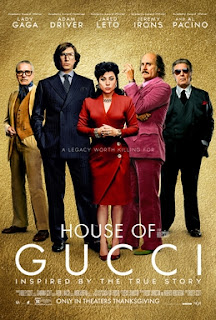
House of Gucci--Lady Gaga plays Patrizia Gucci in Ridley Scott's dramatization of the family turbulence leading up to the 1995 shooting of her husband Maurizio. She's deliciously ripe and amiable in the first half of the story, depicting how she and Maurizio (Adam Driver) met in Milan in the late '70s, how he was willing to renounce his fortune over the disapproval of his father Rodolfo (Jeremy Irons) for the marriage, and how Maurizio eventually did join the family business, helped to revive the venerable but declining brand, and engaged in internal intrigues with his Uncle Aldo (Al Pacino) and cousin Paolo (Jared Leto).

Gaga is also believable and sad, if inevitably less fun, in the second half, when Maurizio drifts away from her. She grows desperate, and, under the influence of a psychic (Salma Hayek), dangerous.

The leading lady is strong; whether that makes House of Gucci's 158 minutes worth sitting through is another matter. Scott's usual panache seemed to desert him here. The pacing is flat, and the effect is of a competent, expensive but unexciting TV movie.

Still, there's undeniable camp value in watching this star-studded cast spew their dialogue at each other, in English but with radio-comedy Italian accents. Driver makes some effort to underplay, and comes across respectably. Pacino hams away enjoyably, and Irons, who's starting to resemble the late-vintage Boris Karloff, manages some impressively suave nastiness.

The shocker is Leto, who turns the hapless Paolo's lines into aggrieved sing-song arias. It feels like he was trying to see how far he could go before Scott asked him to tone it down. Apparently that didn't happen.

Friday, February 19, 2016

RIGHT IN DER FUHRER'S FACE

Opening today:


RaceIt’s sort of surprising that the story of Jesse Owens hasn’t made it to the big screen before. By which I mean, of course, made it to the big screen via actors and sets and dialogue and all that. The track and field star’s triumphs at the 1936 Olympics in Berlin were powerfully chronicled in Leni Riefenstahl’s documentary Olympia. But it took eighty years for Owens to get the standard inspirational sports biopic treatment.

James Cleveland Owens—a grade school teacher misheard his initials as “Jesse” and the name stuck—was born in Alabama in 1913 but spent most of his youth in Cleveland, Ohio. He was already tying world records while he was still in high school. On the Ohio State team, under Coach Larry Snyder, he famously set three world records in one 1935 meet at Ann Arbor, Michigan, all in less than an hour.

The following year he went to the Berlin Olympics, where he took four gold medals, for the 100 meter sprint, the 200 meter sprint, the long jump and as part of the 400 meter relay team. Magnificent simply on an athletic level, what made these victories all the sweeter was that Owens, an African-American, achieved them quite literally under the nose of Adolph Hitler, and in the face of his racial ideologies.

Race—there’s just possibly a double meaning to the title—makes the point that Riefenstahl’s propaganda film, meant to celebrate the ascendant Nazis, nonetheless acknowledged the greatness of Owens in a way that, for instance, the White House didn’t do for decades after. Indeed, director Stephen Hopkins and the screenwriters, Joe Shrapnel and Anna Waterhouse, come uncomfortably close to making Riefenstahl (played by Carice van Houten) a heroine here. But the ironic point is well taken: the reception Owens got in Berlin, where he wasn’t segregated from the white athletes and where he was befriended by his German long jump opponent “Luz” Long, was superficially less ugly than he got at Ohio State and elsewhere in the U.S.

Complexities like this arise from the history; the movie itself is highly conventional sports-movie uplift, a little overlong and not always convincing in terms of period. Line after line—like “You’re an amazing girl” or “Good luck with that”—sound more Disney Channel than 1930s.

But the acting helps. Owens is played by a compact young actor named Stephan James, with a dulcet voice and a charming callowness. SNL alumnus Jason Sudeikis has a likable brassy manner as Larry Snyder, and there are enjoyable character turns by the likes of Jeremy Irons, William Hurt, Glynn Turman, David Kross.

More than any of this, however, Race works because of the story it tells. I wasn’t able to remain unmoved by it, at any rate. By the time the scenes at the Games arrived, I was as on the edge of my seat as if I’d been in the stands myself. 

Opening today at Harkins Valley Art in Tempe:


SouthboundThis horror anthology, set on various stops along a desert highway, features several grim, blood-splattered tales linked end-to-end in the manner of Schnitzler’s La Ronde. Different writers and directors handled each segment, but they’re certainly unified by a potent atmosphere of desert-southwest isolation, menace and futility. That’s on the upside.

Also on the upside, the special effects folks serve up some spectacular, scary demons. In general, this low-budget effort is a seamlessly made, technically impressive piece of work.

On the downside, the stories are a little vague and one-note. Because all the characters seem, not to put too fine a point on it, screwed from the start, the proceedings lack suspense or a sense that there’s much at stake.

The movie does, however, seem to have a cautionary message: Stay the hell out of the desert.
Friday, September 7, 2012

PLAGIARIZE ON THE PRIZE

Immature poets imitate; mature poets steal,” or so T. S. Eliot famously quipped. Maybe, but some writers have a hard time being so flippant on the subject of artistic theft (Eliot, it should be noted, was talking about inspiration and innovation, not true plagiarism). Even those of us who would never think of trying to pass off another’s work as our own on purpose—even if you didn’t get caught, there would be no pleasure in whatever success you attained—still live in terror of unconsciously appropriating a sentence, or a joke, or simply a turn of phrase from something we’ve read.

Thus the theme of The Words—the theft, by a writer, of someone else’s words—is troubling. It’s also potentially compelling, and while I’m still unable to tune into the star appeal that leading man Bradley Cooper clearly holds for many people, the movie, by the writing-directing team of Brian Klugman and Lee Sternthal, has a terrific supporting cast, and I went into it intrigued. The result, alas, is a good-looking movie that’s so banal and artificial, so enthralled by musty clichés about what an author’s life is supposed to look like, that the cautionary horror in the idea never takes hold.

Cooper plays Rory, an aspiring young writer living in Brooklyn who’s told by agents that his work is too subtle and “interior” to be published (really? I didn’t think there was any other kind of “literary” fiction). While they’re honeymooning in Paris—just like all struggling young writers get to do—Rory’s beautiful new wife (Zoe Saldana) buys him a beat-up leather portfolio in an antique shop.

One day while rummaging through it, he finds an old, yellowed typewritten manuscript of a novel tucked away in a hidden pocket—the novel, it turns out, he’d always wanted to write. He feels compelled to retype it, his wife reads it on his computer while he’s out and looks at him with new wonder, and before he knows it he’s handed it to an agent. It’s a smash, of course, wows the critics, wins awards, gets the book he actually did write sold. But pretty soon he’s confronted by an old man (Jeremy Irons) who lost a manuscript decades ago in Paris…


Though his lines aren’t any less forgettable and uninspired than anyone else’s, Irons gives them a muttering, ironic bite, like the sound of a damaged cello, that brings The Words whatever fun it has. The movie could have used a lot more of him. What really hurts, however, is the frame story through which it’s told: Yet another writer (Dennis Quaid) reading from his new novel The Words, and later telling the end to a sultry grad student (Olivia Wilde). This outer layer feels precious and evasive, and it leads the movie to an unsatisfying, anticlimactic finish—The Words ends not with a bang but with a whimper.

Um, I mean, not with a loud noise but with a soft, plaintive cry.