Showing posts with label ALBERT BROOKS. Show all posts

Friday, December 12, 2025

GOV STORY

Opening today:

Ella McCay--Emma Mackey shares initials with the character she plays here. The heroine of this latest from writer-director James L. Brooks is the Lieutenant Governor of an unnamed eastern state. When her boss, the beloved incumbent "Governor Bill" (Albert Brooks) is poached by the President--probably not our current President--for a cabinet post, Ella finds herself swept into the Governor's office, even though she comes across like a nervous college freshman at a job interview.

Narrated by Ella's aide Estelle (Julie Kavner), the movie explores the title character's wacky challenges and less wacky, more serious family dysfunctions, past and present. In flashback, we see her obsessively philandering father (Woody Harrelson) and long-suffering mother (Rebecca Hall) leave her to be parented by her adoring, fretful Aunt Helen (Jamie Lee Curtis). In the present, we see her hustler husband (Jack Lowden) go bonkers over the potential power and perks of Ella's new position.

We see her trying to navigate how to respond to her implication in perhaps the most inoffensive political scandal imaginable. And we see her trying to reconnect with her brilliant but reclusive younger brother (Spike Fearn), who suffers from severe anxiety disorder.

This hectic, haphazardly structured movie rattles along from one strand to another and back in the usual Brooks manner, warm and eccentric and open, with appropriate reserve, to the potential for human growth. I think what Brooks is after here is a sketch of what a genuinely virtuous person in modern American politics might look like; a Ms. Smith Goes to the State Capitol. Ella is a sort of American political Princess Myshkin or Doña Quixote, a hapless knight caught up in a whirlwind despite the most unimpeachable of intentions.

It's a great idea, and I enjoyed Ella McCay, but I'm not sure it hangs together convincingly. In part this has to do with Mackey's youthfulness, and the callow and somewhat ditzy nature of the character. The role requires somebody who can play both teenage and thirtysomething; Mackey is perfectly believable as the first, not so much as the second.

Also, not all of the plot strands pay off. The relationship between Ella and the ever-reliable Curtis as Aunt Helen is fully realized; so is the connection between our heroine and Brooks (Albert), hilariously weary as the pre-emptively compromised Governor Bill, and with Kavner's Estelle, and with Kumail Nanjiani as her stolid, loyal State Trooper bodyguard. But the scenes with Harrelson as the squirrelly Dad come off like a dead end, they don't really offer anything unexpected or add anything much to the story.

It's possible the movie's best, or at least most interesting, episode is one in which the title character doesn't appear. When Ella's troubled brother braves going outside to visit a former girlfriend (Ayo Edebiri) with whom he wants to re-connect, and the two struggle mightily to get around their tics and defenses to communicate the simple truth that they like each other, it feels like the essence of exasperating romcom complications boiled down to a single scene.

Friday, July 12, 2019

MISS HIT; LOVE LETTERS; TORN TURNS

Check out my "Friday Flicks" column, on Phoenix Magazine online, featuring reviews of the sweet indie Miss Arizona...


...and of  Nick Broomfield's Leonard Cohen documentary Marianne & Leonard: Words of Love...


RIP to the magnificent Rip Torn, somehow both chameleon and virile star persona, passed on at 88. Out of everything from King of Kings to You're a Big Boy Now to The Cincinnati Kid to The Man Who Fell to Earth to Cross Creek to City Heat and much more, some of Torn's most memorable performances are, for me, in otherwise misfired movies: His blustery senator in The Seduction of Joe Tynan ("I'm readin' from my pad..."); his loathsome, macho psychotic kidnapper in 1982's A Stranger is Watching; his good-naturedly full-of-it old salt in the lightweight 1985 John Candy comedy Summer Rental; his corrupt yet curiously likable Texan villain in 1987's Nadine.


My favorite Torn character of all, though, was Bob Diamond, the ebullient defender of Albert Brooks in the afterlife in 1991's Defending Your Life. Of his absence during one of the hero's hearings, Bob later apologetically explains that he was "trapped near the inner circle of fault." I hope that's not true for Torn now, and I hope I have somebody like Bob defending me.

I never met Rip Torn, alas, but I did once briefly meet Walter B. Russell Jr., the Korean War hero and Georgia State Representative that Torn played in 1959's Pork Chop Hill. That should count for something.

Friday, July 8, 2016

PET PROJECTS

Opening this weekend:


The Secret Life of Pets—When I open the garage door most evenings around six, I can hear the excited yelping and whining start. Then I walk into the house, and my dogs greet me with a joyous exuberance that, quite frankly, my human family rarely seems able to muster.

It’s always one of the best parts of my day, and the moments like it are the best parts of the new animated movie The Secret Life of Pets. The film’s key joke is that its characters—supposedly apartment-bound Manhattan pets—get out and have epic adventures of which their owners never know.

That’s a pretty good joke, and it’s a pretty enjoyable film, but the adventure we see is a bit contrived and over-plotted. It’s really the scenes, near the beginning and end, of loving interaction between pets and owners that carry an unexpected emotional weight—they can fill you with gratitude for being in a position to have nonhuman friends.

Our hero is Max (voiced by Louis CK), a little white-and-brown terrier who shares a walk-up with a young single woman. When she leaves in the morning for what must be a really high-paying job, Max passes the time, through the windows and across the fire escapes, with the neighboring pets, among them a blasé cat (Lake Bell) and a fuzzy white Pomeranian (Jenny Slate) with a crush on him.

One evening Max’s owner comes home with, horror of horrors, a new dog—Duke (Eric Stonestreet), a shaggy, intrusive mutt. They don’t hit it off at first, but when the two of them end up lost in the streets and threatened by Animal Control, they of course have no choice but to bond.

It’s at this point that The Secret Life of Pets gets in a bit over its head, with too many characters and plot points. Max and Duke fall in, for instance, with a band of homeless exotic pets living in the sewers, led by a cute but revolutionary rabble-rousing bunny, voiced by Kevin Hart in his usual tone of hilariously aggrieved indignation. Meanwhile the Pomeranian and Max’s other neighbors mount a rescue mission, eventually enlisting the aid of a falcon (Albert Brooks) and a basset hound (Dana Carvey) with wheels on his back legs.

There are also digressions involving a surreal visit to a sausage factory, and an attempt to find Duke’s previous owner. Most of these strands are strong and funny in themselves, but there are too many of them, and they encrust the movie with complications that require laborious resolution.

Two other complaints: This is the second animated kid movie I’ve seen in the last few weeks—Finding Dory was the other—that included a scene of a van with animals trapped inside it crashing off of a bridge and plunging into the water. Maybe movies aimed at this sort of demographic could consider going a bit easier on the Hal Needham-style car crash action?

And finally, this movie is one of many in the genre that continue the stereotype of the stupid and gleeful animal control officer. I get that the “Evil Dogcatcher” is a venerable archetype, but in reality these people provide an essential public service, and I’d guess that many of them are animal lovers. Also, as unfortunate as an animal in a pound may be, it’s still almost invariably better off than an animal lost in the streets, and the old idea of the happy-go-lucky stray dog or cat is, I think, pernicious—it has helped to perpetuate the idea of abandoning animals as a legitimate option. It’s time to humanely euthanize all of these clichés.


Wiener-Dog—The hapless wanderings of a domestic animal are also the basis for this very different movie, the latest from Todd Solondz.

The title character is a small, thick-bodied dachshund with a stoic face. Via unkind twists of fate and irresponsible human behavior, she falls in with a variety of wretched people. First there’s a disastrous stretch with a disagreeable older dad (Tracey Letts), younger French mom (Julie Delpy) and their sugary-voiced, obtuse, flute-playing, cancer-surviving son (Keaton Nigel Cooke). Then she’s reprieved by a self-esteem-less assistant (Greta Gerwig) from the vet’s office, and goes on a road trip with this doormat and her new sort-of-boyfriend (Kieran Culkin).

This is followed by an intermission “snipe” featuring a “Ghost Riders in the Sky”-style song, “The Ballad of Wiener-Dog,” by Marc Shaiman. This brief passage is the least excruciating part of the film.

It’s not made clear how the Wiener-Dog lands in her next home, that of a sad-sack screenwriting professor (Danny DeVito), nor how she gets from there to the home of an unhappy old woman (Ellen Burstyn) who names her “Cancer.” The Wiener-Dog is the center of some of these strands, while in others she’s little more than a perplexed observer. The only time in the movie that she takes any decisive action, it’s catastrophic.

It’s difficult for me to express how likable I found this dog, and how unlikable I found this movie. I can pretty much promise you that if you’re a mushy-brained, sentimental dog lover, you’ll despise it. I’m a mushy-brained, sentimental dog-lover, and I despised it.

But I think my dislike of Wiener-Dog didn’t derive only from my sappiness where dogs are concerned. It also has to do with the humans that Solondz creates, and the somehow self-conscious, manufactured ugliness and vapidity he imposes on them. Solondz is by no means without skills as a filmmaker—a fine eye and a superb sense of fitful comic timing—and there are grimly funny episodes and images here. But his misanthropy seems forced and unconvincing, like that of a teenager going through a “cynical” phase.

The most jolting moment in Wiener-Dog, for me, came at the end of the credits: “AMERICAN HUMANE ASSOCIATION MONITORED SOME OF THE ANIMAL ACTION. NO ANIMALS WERE HARMED DURING THOSE SCENES.” The implications of this (trademarked!) phrasing are distressing. If any movie could ever be worth harming an animal, this one sure wasn’t it.

Friday, June 17, 2016

BRIAN'S SONG, & THE PER-FISH-TENCE OF MEMORY

Opening this weekend:

 
De Palma—For all the faults of his movies, even for all the supposed great faults of his character, I’ve always had a soft spot for director Brian De Palma. This isn’t always easy to defend—while the frequent charge that he’s a misogynist can’t, I think, be proven from his movies, the general smarminess and arrested adolescence that many of them give off is hard to deny.

But his filmmaking mastery is even harder to deny. There’s a lot of schlock and silliness on the list of his credits, but there are several enduring classics, too, and I find that scenes from even his worst misfires remain in my memory in a way that plenty of better movies don’t. This is because, of course, he’s a true cinema stylist, lavishing so much craft and obsessive care on even the most absurd or ugly content that it ends up charged with vivid atmosphere.

Noah Baumbach and Jake Paltrow apparently share this admiration. The documentary they made about him comes across, more than anything, as an act of obsessive fandom. The only talking head is the title character, sitting in front of a gray fireplace. First he talks about his background, a little, and then he talks about his films—every one of them, I think, at least briefly—and the films that influenced him. As he talks, clips and stills are mixed in. That’s pretty much the whole movie.

The austerity of Baumbach and Paltrow’s approach is shrewd, because the material on which they draw is so cinematically rich. The biographical material is fascinating—I certainly didn’t know that De Palma’s father was a famous osteopath, or that the director himself had been a science whiz as a kid—and the straightforward progression through his works gives a bird’s-eye view of his development. The clips offer some intriguing treasures, too, like the unused deus ex machina ending of 1998’s Snake Eyes that’s more interesting than anything that made it into the finished film.

As for his own psychology, the ruefully chuckling De Palma seems candid enough, in a general sort of way. But although he shares some eyebrow-raising autobiographical subtext to Dressed to Kill, overall he seems unwilling to go very deep. Unlike, say, 1994’s Crumb, this movie doesn’t strip its subject naked for us. He’s evasive about his sensibility toward women, for instance, saying only that it “always made sense” to him, in the context of the genre in which he was working. And indeed, adjusting for generational differences in the degree of graphic violence acceptable in a movie, it’s hard to see how Hitchcock, for the most obvious example, is less vulnerable to this charge than De Palma.

In any event, De Palma can lay claim, at least for me, to the highest praise a documentary about a moviemaker can earn. Like last year’s movie version of Hitchcock/Truffaut, it left me with an appetite to re-watch these movies. 


 Finding Dory—Pixar’s 2003 animated ichthyological smash Finding Nemo is one of the most beloved of all kid movies. But I think I enjoyed this sequel focusing on Dory, the cheery titular blue tang with the unreliable short-term memory who helped in the search for the title fish in the first film, even more.

This time Dory, voiced by Ellen DeGeneres, is trying to find her home and parents (Diane Keaton and Eugene Levy), from whom she was separated as a kid, and the worrywart clownfish Marlin (Albert Brooks) and his little Nemo are helping her. Once again they have to cross the ocean, this time to a marine center on the California coast. And once again they have to depend on the kindness of strangers, notably an octopus named Hank (Ed O’Neill), as well as a whale shark and a beluga. Dory is also amusingly guided by a voice from above—specifically, the voice of Sigourney Weaver.

The imperturbable, doggedly polite optimism and geniality of DeGeneres is center stage here, and deeply endearing. Her off-the-cuff, throwaway delivery, along with the mild kvetching of Brooks, is central to the movie’s balance. The theme, along with the Pixar/Disney standard of separation from loved ones, is the preciousness and vulnerability of memory, and the light touch of DeGeneres makes this moving, but not exhausting.

To Mesa Arts Center this Sunday, June 19…


 …comes a different iconic American filmmaker of the ‘70s and ‘80s: John Carpenter. The auteur plays a concert of his own music, both from his films and from a couple of recent studio albums. Check out my interview with him, on New Times blogs.

Friday, January 16, 2015

ROBOTS & GANGSTERS & BEARS, OH MY!

Opening this weekend:


Spare Parts—A down-on-his-luck substitute science teacher at a Phoenix high school reluctantly inherits the job of advising the robotics club. He finds his handful of students to have talent, ingenuity and heart. They are also undocumented, and have various personal challenges. They enter their low-budget, scraped-together robot submersible in an underwater robotics competition for college students at UC Santa Barbara.

George Lopez plays the teacher—actually a conflation of two guys—in this triumph-of-the-underdogs comedy-drama, based on a true story. Carlos PenaVega of Big Time Rush leads the quartet of guys, all charming, who play the team, with the grownups represented by the likes of Marisa Tomei, Esai Morales and Jamie Lee Curtis as the wry, amused principal.

Directed by Sean McNamara from a script by Elissa Matsueda, based on “La Vida Robot,” a 2005 article by Joshua Davis in Wired, Spare Parts is one hundred percent out of the standard Stand and Deliver or Hoosiers inspirational high school drama playbook. As such, it’s perfectly well executed, crisply paced, energetically acted, with obligatory crises and touches of sweet humor and romance.

What makes it different from other films of this sort is that it puts a human face on the plight of undocumented kids in the US, trying to get somewhere in life, and in some cases—like that of Oscar Vasquez, the main kid here—to serve this country, and blocked by the obtuse idiocies of our immigration policy. At the end of Spare Parts, when we’re shown the real-life outcomes of the team’s stories, it’s hard not to be moved by them. As such, this very conventional movie could help to win the hearts and minds of mainstream audiences.

A side note: The film is mostly set in here in west Phoenix, in and around Carl Hayden High School. But it was mostly shot in Albuquerque—probably thanks to the obtuse idiocies of this state’s production-tax-incentive policy—and it looks it. Just as the U.S. hurts itself economically by shutting out kids like these, so Arizona missed out on some of the economic benefits of this uplifting Arizona story.


A Most Violent Year—The setting is New York, and the year referred to is 1981, a record-breaker for violent crime in the Big Apple. Our hero is Abel Morales (Oscar Isaac), who was set up in business by the gangster father of his wife (Jessica Chastain). Abel runs a fleet of fuel-oil trucks which regularly get hijacked, in broad daylight, by the thugs of his business rivals.

But Abel is determined not to be a crooked businessman. His wife, on the other hand, is perfectly comfortable calling on her family connections, especially after their children are threatened.

Written and directed by J. C. Chandor of the impressive All Is Lost, A Most Violent Year seems intended as a stylistic throwback to the crime dramas from around the period it depicts—something dark and brooding directed by Sidney Lumet or maybe Stuart Rosenberg, with cinematography by Gordon Willis or Andrzej Bartowiak. The star, almost certainly, would have been Al Pacino.

The young Pacino is, at least, who Isaac seems to be channeling with his quiet, intense performance; Chastain is perhaps trying for Faye Dunaway. Albert Brooks shines as their long-suffering, ironically upbeat lawyer, a role that might have been played, in 1981, by, say, Albert Brooks.

Chandor gives the story an authentic feel, nothing too hokey or melodramatic, and his revulsion to violence seems genuine. More importantly, his tacit critique of the way other movies in this genre romanticize violence is well taken. But there was something about Abel’s naïve and slightly sanctimonious protestations of purity that I found comical—in the context of his career choice, it’s like he’s a fisherman determined never to get wet.

This engrossing, polished movie is, somehow, both a tease and a scold. As well-conditioned audience members, we want to see Abel retaliate violently against the thugs—the movie seems almost to tremble on the verge of gratifying this wish, yet Chandor is telling us that, at bottom, we’re wrong to want this. He’s right, of course, but the moviegoer’s bloodthirsty heart wants what it wants.


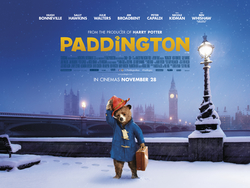
Paddington—Based on the children’s books by Michael Bond, this story of a civilized, courteous, marmalade-loving bear from “Darkest Peru” who winds up in London on the platform at Paddington Station is cute and funny, with first-rate use of CGI, cleverly-directed, Rube-Goldberg-like slapstick, and some good, silly, free-floating gags. Sally Hawkins and Hugh Bonneville are excellent as the heads of the upper-middle-class family that takes him in, and Jim Broadbent, Peter Capaldi and Julie Walters contribute nice turns as well.

The movie is even a little bit touching. Bond claimed he was inspired by the sight of tagged refugee children in the train stations during WWII, and the theme of hospitality to strangers runs through Paddington too, without heavy-handedness.

The only serious trouble into which the movie runs us the introduction of a villainess, a nutty museum taxidermist (Nicole Kidman) who wants to mount a specimen of Ursa Marmalada. This Cruella de Vil knockoff is gratuitous, and a bit overly grim for the tone of the tale.

Still, this strand allows us the sight of Kidman in a blond China-doll 'do, with really chic bangs, plus a good-natured send-up of the star’s ex. So it isn’t a total loss.

Friday, December 21, 2012

MIDDLE-AGED CRAZIES

With This is 40, Judd Apatow brings two memorable supporting characters from his 2007 hit Knocked Up to center stage: Debbie and Pete, the heroine’s bickering sister and brother-in-law. It appears that the reason they were such successful characters in the earlier film is precisely because they were supporting characters. This is 40 is well-acted, and it’s not without laughs and strong scenes. But watching these two squabble for more than two hours is, ultimately, more ordeal than pleasure.


L.A. fashion boutique owner and mother of two Debbie, played by Leslie Mann—Mrs. Apatow—is a blonde beauty and a bright-eyed, freaky obsessive. Pete, played by Paul Rudd, manages a struggling record label (he’s gambled big on a Graham Parker album). He’s emotionally recessive in the face of the intensity of his wife and daughters. He regularly retreats to the bathroom when he doesn’t need to relieve himself, just to play handheld electronic games. But he’s not safe from his wife’s intrusion even there.

Even so, for some reason Pete comes off less sympathetically than Debbie, maybe because the underlying dynamic seems to be that he’s no longer in love with his wife—he sometimes fantasizes about being a widower—yet she’s still desperately fascinated by him. In real life, of course, Pete’s trapped and overloaded feelings could awaken compassion, as could his terror at the prospect of admitting to Debbie that they’re on the brink of ruin. But in the movies, even with the always-appealing Rudd playing him, he just seems like a detached skunk who’s not trying. When we see him weeping in his car at one point, the moment falls surprisingly flat.

The movie centers, way too loosely, on the lead-up to a joint 40th and “38th” birthday party for Pete and Debbie, respectively. But it pursues a profusion of subplots, from Debbie’s troubles with her shop employees (Megan Fox and Charlyne Yi) to the growing pains and Lost fixation of her older daughter (Maude Apatow, who’s excellent) to the daddy issues that fuel Debbie and Pete’s dysfunction. Pete’s Dad (Albert Brooks) is a jolly, outrageous deadbeat—with toddlers from his more recent wife!—who shamelessly leeches off his son. Debbie’s Dad (John Lithgow) is the ultimate absentee, a hotshot spinal surgeon who can’t even confidently remember the names of his granddaughters.

I like Apatow, a lot. Knocked Up and The 40-Year-Old Virgin are already classics, I think, two of the best American comedies of the past decade. But his instincts are way off here. He tries to give every little strand, down to Debbie’s efforts to quit smoking or Pete’s cupcake addiction, its own story arc and payoff, and it’s just too much. He lets scenes play too long, and overindulges what appear to be improvisations until they become unfunny.

There’s a lot that’s good about This is 40, and with some fairly merciless cutting it could probably have been made into a decent movie. Not a great one, though, I don’t think. The core situation—affluent married people find themselves facing middle age without having attained a perfectly satisfactory life—isn’t exactly unique, and it lacks the urgency of Apatow’s earlier films. After all, at least they aren’t still virgins.


Make no mistake, the athletic and acrobatic feats captured on film in Cirque du Soliel: Worlds Away are enough to make you believe in superheroes. The performers in the circus franchise’s feature film come across like some other, higher species; some Nietzschean improvement on Homo Sapiens. What they do with their bodies doesn’t seem possible, and yet there they are, clearly doing it.

Considering how jaw-dropping their abilities are, and their beauty and erotic presence, it’s hard to understand why the movie is a bit of a bore. The franchise, started in the early ‘80s by a pair of Canadian street performers, has grown into a worldwide empire, with shows on six continents. It’s a contemporary take on the circus—no animals, a New-Agey, music-driven style and unifying themes to the performances. Worlds Away, directed by Andrew Adamson of Shrek, showcases the seven Cirque du Soleil productions in Las Vegas alone.

I have friends who are serious fans and repeat customers of the live shows, but even they admit that the videos of the performances just aren’t the same. I’m inclined to believe them—I can see how witnessing this stuff live could be overwhelming. But while watching this movie, more than once my chin began to droop toward my chest.

There’s a little bit of story to Worlds Away. An extremely cute gamine (Erica Linz) goes to the circus. In the middle of the act, a hunky aerialist (Igor Zaripov) makes eye contact with her and, distracted by her extreme gamine cuteness, misses his trapeze and plummets into the ring. But instead of going splat, he plunges right through the dirt, and the gamine, rushing to his aid, falls through after him.

She finds herself in a strange alternative avant-garde circus dimension. For the rest of the movie she wanders, accompanied by a grim-looking clown (John Clarke) with a bad case of bed head, from tent to tent, in search of her hunk. Some of her encounters are visually magical—like a lovely staging of “Octopus’s Garden”—and all are eye-popping demonstrations of physical skill and prowess.

But this slender thread of plot isn’t enough to disguise what Cirque du Soleil: Worlds Away really is—a commercial, first of all, but also a concert movie. And I would propose that the concert movie, with a handful of rule-proving exceptions, may be the most wearying of all film genres, blunting as it does both the immediacy and excitement of live performance and the narrative pull of cinema.

Oh yeah, it’s in 3-D. I honestly can’t remember one particularly striking effect that this added to the film.