Showing posts with label LEONARD COHEN. Show all posts

Friday, July 15, 2022

COVER STORY

In theaters this weekend, a couple of compelling documentaries:

Hallelujah: Leonard Cohen, A Journey, A Song--Arguably the most beautiful popular song of the 20th Century in English, both lyrically and melodically, Leonard Cohen's signature work has proven itself as a standard. It's a testament to its power that, even though we hear more than ten different artists performing it in this absorbing documentary, it doesn't get old.

Released to little initial notice on Cohen's 1984 album Various Positions, it gradually gained ears as it was performed by Bob Dylan, John Cale, Jeff Buckley, Myles Kennedy, Bono, Brandi Carlile, Eric Church, Alexandra Burke and others. The use of Cale's version on the soundtrack of Shrek in 2001, and the inclusion of Rufus Wainwright's exquisite cover on that movie's soundtrack was a tipping point for the song as a spiritual anthem for our time; k. d. lang magnificently eulogized Cohen with it in 2017, and at our national nadir after the election of the 45th president, Kate McKinnon, nominally in the guise of a defeated Hillary Clinton, salved us with it in 2016 on Saturday Night Live.

Perhaps wishing to avoid infecting the song with topical politics, this movie, directed by Dayna Goldfine and Dan Geller, excludes that wretched, moving moment. It includes biographical material on Cohen, but as it progresses it focuses increasingly on the life which the song itself took on. Aside from its endless interpreters, Cohen himself never really stopped writing it; one of the talking heads claims that he filled notebook after notebook with about 180 verses.

Gabby Giffords Won't Back Down--Music is also central to this documentary, directed by Julie Cohen and Betsy West, about the former Congresswoman from Arizona's 8th District. Shot by a deranged gunman outside a supermarket in Tucson in 2011, at a massacre in which six people were killed, Giffords, the main target of the attack, received a critical brain injury resulting in aphasia, greatly inhibiting her speech.

But she could still sing, and that was one of the ways by which therapists helped her on her slow, exhausting road to reclaim her ability to communicate. Tunes from "And She Was" by Talking Heads to Tom Petty's "Won't Back Down" to "Que Sera, Sera" to Bowie's "Space Oddity"--in reference, of course, to her husband, former astronaut and current U.S. Senator Mark Kelly--are used on the soundtrack to move the narrative forward, both to poignant and lighthearted effect. But more importantly, there's a sense of exhilaration and liberation when Giffords, who strains to find the simplest spoken words, cuts loose freely in song.

The movie packs an infuriating punch, because it shows how much vibrancy and radiant ease Giffords lost to her injury. She's one of the countless casualties of this country's gun insanity that should each, in and of themselves, have been enough to spur reform. But it's also inspiring to see how little, in the face of what she's suffered, she seems to have lost to bitterness and rage, and how much of her spirit and fierce charisma she's won back.

On VOD this week:

Glasshouse--The world has been ravaged by a plague which leaves people without memory, even of their own names. The members of a family--severe mother (Adrienne Pearce), three beautiful daughters (Jessica Alexander, Anja Taljaard and Kitty Harris) and an afflicted son (Brent Vermuelen)--hunker down inside a huge, palatial greenhouse and practice quasi-religious rituals about memory. They venture outside in rather Victorian-looking breathing apparatus, and pick off any approaching strangers with sniper rifles. Then one day the alluring eldest daughter brings a hunky injured man (Hilton Pelser) in, finds he is not a "forgetter" and, as you can imagine, trouble ensues.

The twists get more twisty, and more unsavory, as the story progresses. Directed by Kelsey Egan in and around a South African conservatory building--the script was written, by Egan and Emma Lungiswa de Wet, with this location in mind--the film is deliberate, but it has an atmosphere of unhealthy eroticism that recalls Don Siegel's 1971 period drama The Beguiled. It's the most interesting post-apocalyptic yarn in quite a while.

At the Laemmle in L.A., and on demand:
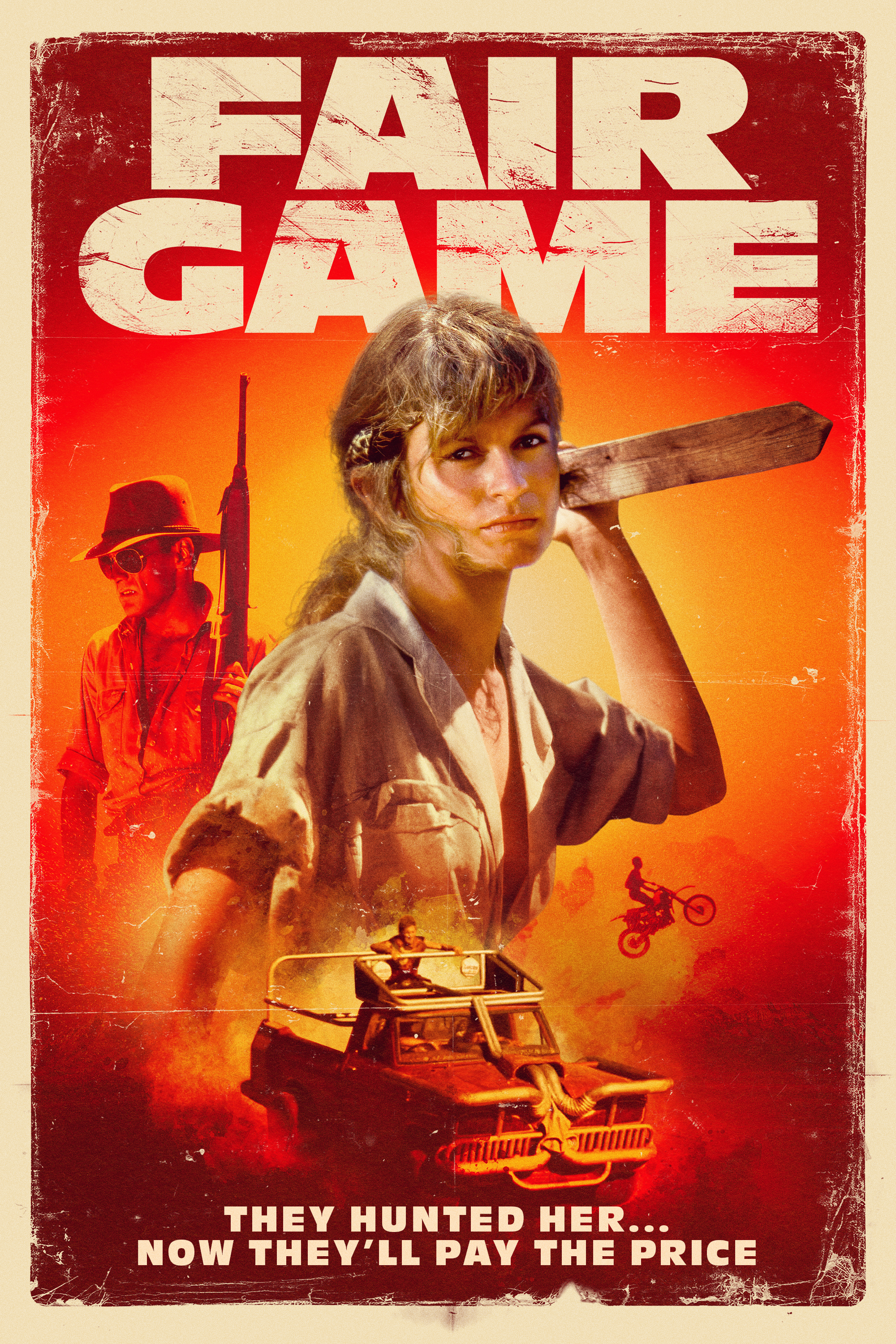
Fair Game--The heroine of this Australian actioner of 1986 is Jessica (Cassandra Delaney), a Julie-Christie-esque beauty with big '80s hair who runs a wildlife refuge in the outback and lives on it in an isolated cabin. The villains are a trio of kangaroo poachers who terrorize and assault her and trash her home.

Most of us wouldn't need to hear more than "kangaroo poachers" to want to see these guys pulverized, but the gleeful performances of Peter Ford, David Sandford and Barry Sparks manage to elevate our bloodlust even further. Enjoying a re-release from Dark Star, this "Ozploitation" melodrama, reportedly and believably a favorite of Quentin Tarantino and an inspiration for Death Proof, is bluntly directed by Mario Andreacchio. It's shot with richness and nuance by Andrew Lesnie, and packed with that maniacal stunt work characteristic of Australian action flicks of that period. Despite what she endures, our heroine remains defiantly brave throughout, and it would be absurd to deny how satisfying it is when she turns the tables on her tormentors.

Except that for me, as usual with revenge dramas...it's not quite sufficient. Death, even painful death, wasn't enough for my spiteful heart; I wanted these guys to suffer more humiliation and degradation at Jessica's hands. But Fair Game comes closer to a gratifying payback than most.

Friday, July 12, 2019

MISS HIT; LOVE LETTERS; TORN TURNS

Check out my "Friday Flicks" column, on Phoenix Magazine online, featuring reviews of the sweet indie Miss Arizona...


...and of  Nick Broomfield's Leonard Cohen documentary Marianne & Leonard: Words of Love...


RIP to the magnificent Rip Torn, somehow both chameleon and virile star persona, passed on at 88. Out of everything from King of Kings to You're a Big Boy Now to The Cincinnati Kid to The Man Who Fell to Earth to Cross Creek to City Heat and much more, some of Torn's most memorable performances are, for me, in otherwise misfired movies: His blustery senator in The Seduction of Joe Tynan ("I'm readin' from my pad..."); his loathsome, macho psychotic kidnapper in 1982's A Stranger is Watching; his good-naturedly full-of-it old salt in the lightweight 1985 John Candy comedy Summer Rental; his corrupt yet curiously likable Texan villain in 1987's Nadine.


My favorite Torn character of all, though, was Bob Diamond, the ebullient defender of Albert Brooks in the afterlife in 1991's Defending Your Life. Of his absence during one of the hero's hearings, Bob later apologetically explains that he was "trapped near the inner circle of fault." I hope that's not true for Torn now, and I hope I have somebody like Bob defending me.

I never met Rip Torn, alas, but I did once briefly meet Walter B. Russell Jr., the Korean War hero and Georgia State Representative that Torn played in 1959's Pork Chop Hill. That should count for something.

Friday, November 11, 2016

EAGLES AND MONSTERS AND GIRLS, OH MY!


Opening in the Valley this weekend:


The Eagle HuntressThough it’s full of engaging people using their real names, it’s a stretch to call this feature from director Otto Bell a documentary. Sure, it has a bit of National Geographic-style narration, spoken by Daisy Ridley, but it’s full of scenes that have clearly been staged, and the narrative may have been shaped dramatically in the macro sense, too. It’s more in the tradition of movies like Flaherty’s Nanook of the North or Merian Cooper’s Chang and Grass—cultural documentary techniques in the service of epic-romantic storytelling.

The setting is northwestern Mongolia, among the ethnic Kazakhs that live on the steppes. The heroine is Aisholpan, a teenage girl who takes up the culture’s ancient practice of hunting with eagles. In jolting, visually magnificent sequences, we see her capture a young raptor from its nest, train it, compete with it in a regional festival, and eventually go hunting with the bird for real.

She does all this with the enthusiastic help of her adoring father, but we’re also shown talking heads of some sour guys—one of them reminded me of Bill Murray—who don’t like the idea of a girl encroaching into a traditionally male activity. It’s hard to know to what extent the old-boy opposition to Aisholpan may have been exaggerated for dramatic purposes—the guys at the festival don’t seem all that upset by her—but it is effective.

In any case, it would be difficult not to delight in and admire the pink-cheeked, smiling Aisholpan, with her guileless confidence. If you, or maybe a daughter or niece or kid sister, could use a story of a woman breaking into a man’s field these days, this might be a movie to consider. But be forewarned, there are scenes of an eagle attacking a fox. The footage is electrifying, but for younger kids, or anyone sensitive to animal suffering, it may be tough to watch. 


The MonsterSingle mom Kathy (Zoe Kazan) is driving her daughter Lizzy (Ella Ballentine) down a disused stretch of road through a forest. They have an accident, and while they’re waiting for help, writer-director Bryan Bertino builds the tension and dread in excruciating increments. Very gradually, the two become aware they’re under siege in their car from the title character, an unexplained fangy abomination.
                                  
Gruesome and pretty grueling horrors ensue in this focused, fairy tale-like shocker. But they’re interspersed with flashbacks to Lizzy’s home life with the alcoholic, screwed-up Kathy that are so appalling (and convincing) that the gory monster stuff seems almost like a nice break by comparison.

Kazan (Elia’s granddaughter) and Ballentine are both impressive. Ballentine, who’s in her mid-teens, manages to suggest, without pushing it, that her awful environment has left her with a touch of arrested infantilism, so when she struggles to be brave in the face of irrational menace it’s particularly moving.

A note about that menace—he/she/it is played, blessedly, by a guy in a suit (Canadian stuntman Chris Webb), not by a sterile CGI ghost. It helps that it’s quite a good suit, and that Bertino deftly keeps it in the shadows most of the time. But even if it was a corny, fake-looking suit, I think the solidity, the presence, of the monster would give this creature feature a punch we rarely get to see anymore.
 
RIP to the great Leonard Cohen.

Is “Hallelujah” maybe the most beautiful song lyric of the 20th Century in English?

Saturday, October 15, 2016

A NOBEL CAUSE

Since the startling announcement that Bob Dylan was awarded this year’s Nobel Prize for Literature, there have been a few dissenting arguments, like this one and this one.


As far as I can tell the case against a Nobel for Dylan is twofold—on the one hand, that there are writers who’ve been laboring in obscurity, sometimes in developing countries, that could use the exposure and the money more, and on the other hand that he’s not a writer, he’s a lyricist, and the power of his writing is inseparable from its musical context.

I can sort of see the former argument, I suppose. But I’m still glad Dylan won, because I’m thinking of all the scoffing and eye-rolling I received in my twenties when I gushed about him as one of the great 20th-Century American poets. For me, it’s not an acknowledged elder statesman of American pop culture being gratuitously honored, it’s the goofy, wise-assed, frizzy-haired kid with the braying-goat voice from half a century ago being vindicated, along with everybody who could hear something dazzling and beautiful in his haywire words and cadences.

As to the second argument, though—lyricists aren’t writers? Really? W.S. Gilbert wasn’t a writer? George M. Cohan wasn’t a writer? Irving Berlin and Cole Porter? Woody Guthrie? Frank Loesser? Sheldon Harnick? Tom Lehrer? Johnny Cash? Jacques Brel? Smokey Robinson? Leonard Cohen? Neil Diamond? Carole King? Merle Haggard? Bill Withers? Judy Collins? Dolly Parton? Stephen Sondheim? Bob Gaudio? Frank Zappa? Billy Joel? Lyle Lovett? Ice-T?

If Dylan, or anyone else on that list, or any of three hundred others that could be named, don't qualify as writers, than I guess I’d rather not be a writer. I’d rather be whatever it is they are.

Saturday, February 13, 2010

A BRONZE IN MEN’S SONNETEERING

The Winter Olympics, one of the few sporting events in which I take the slightest interest, kicked off last night in Vancouver with the usual kitschy pageantry—although it was pretty kick-ass to hear k.d. lang sing Leonard Cohen’s “Hallelujah.”


The Games proper commence today. The Wife is a Winter Games fanatic, & will likely be parked in front of the TV for many hours.

This was not the case in 2002, however—that year, I dragged her up to Salt Lake City to experience the Games live. She had often said that she’d always wanted to go, & I doubted that they’d ever be geographically closer to us. I managed to score tickets for exactly one event: Women’s Freestyle Skiing.

We had been out here in Arizona for more than a decade by that time, so long that we had forgotten how much winter can suck—we had to buy winter coats for the trip. But we remembered it fast as we hiked up the snowy mountain to the venue in Deer Valley, froze our asses off in the bleachers while we watched the lovely Australian Alisa Camplin sail to the Gold Medal...


...& then trudged our way back down to the shuttle buses.

That same day, on the sidewalk in front of the lodge, I saw Mitt Romney dancing to the music of a Dixieland band. This was the most Caucasian sight I ever expect to behold.

That night, back in our hotel in Salt Lake, while The exhausted Wife slept, I wrote this sonnet:

Though she despises snow, and might not wear,
To save her life, a pair of skates or skis,
She pulled a tasseled hat over her hair
And wrapped herself in vinyl and fake fleece.
Then, pluming silver steam out of her smile,
She rode on trains and buses, and her feet,
On shifting snow, that dizzy, final mile,
To take, at last, her own Olympic seat.
And shivering in authenticity,
She took her role as spectator with grace,
Subject, like the skiers, to gravity,
And likewise eager for her downhill race.
Four hours hence, back in her hotel bed,
She'd had it with Olympics--so she said.