Showing posts with label QUENTIN TARANTINO. Show all posts

Wednesday, January 17, 2024

THE BOOK WAS BETTER

One more list for 2023: Time once again to post the list of books I moved my lips to during the year just past. As always, this doesn't include articles, short stories, comic books, poems, cereal boxes, Bazooka Joe wrappers, road signs, scoreboards, skywriting, graffiti, or "the room":


N or M? by Agatha Christie

Anti-Semite and Jew by Jean-Paul Sartre

The Long March by William Styron

Hyperion by Friedrich Hölderlin

Are You There God? It's Me, Margaret by Judy Blume

Understudy for Death by Charles Willeford

The Coven by E. Howard Hunt

What Makes Sammy Run? by Budd Schulberg

Once Upon a Time in Hollywood by Quentin Tarantino

The Making of Another Major Motion Picture Masterpiece by Tom Hanks

The White Mountains by John Christopher

The City of Gold and Lead by John Christopher

The Pool of Fire by John Christopher

As usual, I must start by sheepishly noting how embarrassingly short this list is; nowhere near the optimistic length I was hoping for at the beginning of the year. But it was still a fine year's reading, kicking off with the appallingly still-relevant Anti-Semite and Jew, one of several books I pulled off the shelves at my late sister's house in Virginia as momentos when The Kid and I were back there in January for her's and my brother-in-law's funeral (my sister and her husband died less than a month apart).

The only book-length work I've ever read by Sartre, it offers, in its earlier chapters, the best, most concise distillation of the bigoted mindset that I've ever read. In the later chapters Sartre gets pretty deep in the weeds about the motivations of "inauthentic" Jews in ways that seemed to me presumptuous. But it's still an extraordinary read.

Another I pulled from my sister's shelves was Budd Shulberg's What Makes Sammy Run? This turned out to be the first of three novels in a row I read about moviemaking, all by inarguable Hollywood insiders. The title character of Schulberg's famous 1941 yarn is the conniving Brooklyn-born hustler Sammy Glick, who runs up the ladder from newspaper copy boy to studio mogul, exploiting and stepping on everybody in his path.

Supposedly Sam Goldwyn offered Schulberg money to keep the book from being made into a movie; it remains unproduced as a feature to this day, though it was done as an early TV play and a successful Broadway musical. Goldwyn is said to have called it "doublecrossing the Jews," though as Schulberg pointed out, most of Sammy's victims in the story are also Jewish. In any case, Sammy's deviousness and sociopathic mendacity are an American archetype that transcends race. My biggest take-away from the book was that, bad as Sammy is, he's still less odious than our 45th President.

Tarantino's Once Upon a Time in Hollywood is his 2021 reimagining, as a popular '70s-era paperback, of his own 2019 movie set in Tinseltown (and elsewhere) in 1969. As with the movie, it freely mixes real-life figures with fictitious characters, movies, TV shows and incidents, sometimes ridiculing sacred cows (Bruce Lee, most notably), sometimes forging into the realm of alternate history.

The book is not, however, a "novelization" in the usual sense; though he uses the same characters as in the movie, he presents them mostly in different episodes. The boyish wishful-thinking fantasy of revisionist violence with which he climaxes the film is referred to only in passing in the novel, around mid-point, while backstories and interior perspectives are explored in detail. I loved the film, but even if you didn't, you might like the book; I think I liked it a little better.

There's a sort of guileless stylistic freedom with which Tarantino writes prose fiction that I found highly enviable. For instance, throughout the novel he keeps describing a (fictitious) episode of the (real) '60s TV show Lancer on which his faded cowboy star hero has a juicy guest role as a villain. As Tarantino omnisciently describes the episode's plot, and warms to it, said plot gradually, and seemingly without conscious transition, takes over the narrative so that we no longer seem to be reading a story-within-a-story; we're just reading a good ripping western yarn.

Then when we shift back to the Hollywood story, it seems similarly artless and unfussy. This unpretentious feel may, of course, be an effect that Tarantino carefully worked to attain. But I doubt it; I think he's just lucky enough not to know better; blessedly unfettered by the "rules" of fiction writing.

Third in my unofficial Hollywood trilogy was The Making of Another Major Motion Picture Masterpiece by Tom Hanks. This one, which traces the genesis, development and shooting of a big-budget superhero flick based on a '60s-era underground comic, is also stuffed with stories-within-the-story, including two well-done fake vintage comic books, one a gung-ho '40s WWII-era flamethrower tale and the other a parody of it from the San Francisco underground scene of the '60s.

I understand the reviews for this shaggy-dog debut novel were cool at best, but I really enjoyed it. As drama it's a little mild, admittedly, with most of the characters, and especially the movie's good guy director, behaving quite respectfully and decently toward each other in a distinctly Hanksian manner. I found this sort of refreshing, and the author's digressions and obsessively-imagined worlds came to life for me. The book's overriding point seems to be that movies are made not so much by visionary artists as by relentless problem solvers.

Perhaps not surprisingly, therefore, his most vivid creation is his portrait of an insufferable young actor who's cast in the male lead and instantly paralyzes the production with his raging narcissism and unprofessionalism. The novel could have used more of this guy, and inevitably it makes you wonder if Hanks was thinking of anybody in particular.

Also, I appreciated that Hanks threw a shout-out to my beloved hometown of Erie, Pennsylvania (where he also set his directorial debut That Thing You Do!). 

Elsewhere on this blog I commented on The Coven by E. Howard Hunt and William Styron's The Long March. My year-end choice was more relaxing; I finally got around to John Christopher's "Tripods" trilogy of The White MountainsThe City of Gold and Lead and The Pool of Fire, which I'd been curious about since elementary school. Good stuff; I would have enjoyed them greatly back in my younger days. That's what I get for being lazy.

I also took on Hölderlin's Hyperion (1797), which, like The Long March, I picked up at the VNSA book sale. It's a philosophical yarn--it probably influenced Nietzche and Heidegger more than it did other novelists--written in a heightened poetic language, hence pages and pages of rhapsodizing about Love and Nature and the Beauty of Greece (where Hölderlin never set foot) and the superiority of classical Greek culture to modern culture. It can wear you down after a while, even if you more or less share his feelings.

A sample: At one point the titular hero is holding forth to his lover Diotima:

“‘Let me,’ I cried, ‘let me be yours, let me forget myself, let all the life of the body and spirit in me fly but to you; but to you, in blissful, endless contemplation! O Diotima! So did I once stand, too, before the shadowy divine image that my love created for itself; before the idol of my lonely dreams; I nourished it faithfully; I animated it with my life, with my heart’s hopes I refreshed it, warmed it, but it gave me nothing save what I had given, and when I had become impoverished, it left me poor; and now! Now I have you in my arms and I feel the breath of your breast, and feel your eyes in mine, your beautiful presence flows into all my senses, and I can bear it, now I possess all that is most glorious, and tremble no longer, yes! Truly I am not he who I was, Diotima! I have become like you, and divinity plays with divinity like children playing together!’”

To which Diotima replies:

“‘But try to be a little calmer,’ she said.”

That was my favorite line in the book.

Friday, November 17, 2023

TROUBLE WITH THE CARVE

Opening this week:

Thanksgiving--Slasher movies of the '70s and early '80s were often holiday-themed. Black Christmas, Halloween, My Bloody Valentine, Silent Night, Deadly Night, New Year's Evil and April Fool's Day are all examples, while Friday the 13th and Happy Birthday to Me, though not strictly about holidays, are still tied to special dates and the convenient unity of time they provide. But Thanksgiving was somehow the major holiday the genre seemed to miss.

There actually were a couple of little-remembered attempts--Home Sweet Home in 1981 and Blood Rage in 1987. But neither seemed to count, perhaps because they didn't use the holiday in the title, or perhaps because they didn't sufficiently exploit the gruesome possibilities offered by the day's rituals. Whatever else may be said about it, the newly-made but self-consciously old-school slasher picture Thanksgiving works hard to include every classic Turkey Day trope.

A shoppers' riot and stampede at a store that shouldn't be open on Thanksgiving leads to bedlam and grisly death in a small Massachusetts town. "One Year Later"--as a subtitle traditionally informs us--a figure in the mask and garb of a Pilgrim skulks around exacting vengeance on those deemed responsible for the disaster. Everything eventually converges in a ghastly sit-down dinner.

The film traces its inception back to 2007, when two movies, the Robert Rodriguez shocker Planet Terror and Quentin Tarantino's stunt thriller Death Proof, were released as a double feature under the joint title Grindhouse. In and around the two features, the show included several "fake trailers" for fictitious grindhouse-style movies. Two of these have already wagged the dog as the basis for real features, Machete (2010) and Hobo With a Shotgun (2011); Thanksgiving marks the third.

Directed by Eli Roth, the Thanksgiving trailer in Grindhouse captured the nastiest, most low-rent atmosphere of a vintage gore movie, complete with scratched, faded footage, some really sleazo shocks, and the smarmy, glottal tones of the narrator (Roth himself?). You could almost believe it wasn't a put-on.

The new feature, directed by Roth from a script by Jeff Rendell, doesn't try for this level of faux-authenticity. The setting is contemporary, the budget clearly comfortable, and cell phones and social media figure prominently in the plot. But the movie still has a nice old-fashioned pace and structure and flavor, and the nostalgia of this is much of what makes it unsavory fun.

I'll admit that in recent years I've largely lost my stomach for slasher flicks. Moreover, I thought Roth's 2002 debut feature Cabin Fever was an interesting misfire at best, and I took a pass on his 2005 torture flick Hostel. But he strikes an affectionate tone here, and he employs techniques that distance us from compassion for the victims. Most simply and effectively, he makes many of them, especially the early ones, deeply and amusingly unsympathetic.

The cast is livened up by some veterans, like Patrick Dempsey, Rick Hoffman and Gina Gershon, and the "final girl" (Nell Verlaque) has a lovely presence, and unlike so many heroines back in the day, she fights back, resourcefully and successfully. It was also great to see Lynne Griffin, the first victim from 1974's Black Christmas--and the Hamlet figure in the Bob and Doug McKenzie movie Strange Brew--in a bit here.

Most notably, the film keeps it light. As with two other movies from earlier this year, Cocaine Bear and RenfieldThanksgiving goes in for extreme, over-the-top splatter effects, and they aren't scary, nor do they seem meant to be. They aren't even all that gross. There's no visceral substance to them; the bodies of the victims go to pieces like gingerbread men, and the effect, seemingly deliberate, is cartoonish slapstick. We're about as likely to take their suffering seriously as that of Wile E. Coyote.

Maybe it's how entertainment like this works best: as a sort of anarchic Punch and Judy show, using humans instead of puppets. Like Thanksgiving dinner, it wouldn't be healthy to consume this sort of thing every day, but about once a year, it can hit the spot.

Friday, July 15, 2022

COVER STORY

In theaters this weekend, a couple of compelling documentaries:

Hallelujah: Leonard Cohen, A Journey, A Song--Arguably the most beautiful popular song of the 20th Century in English, both lyrically and melodically, Leonard Cohen's signature work has proven itself as a standard. It's a testament to its power that, even though we hear more than ten different artists performing it in this absorbing documentary, it doesn't get old.

Released to little initial notice on Cohen's 1984 album Various Positions, it gradually gained ears as it was performed by Bob Dylan, John Cale, Jeff Buckley, Myles Kennedy, Bono, Brandi Carlile, Eric Church, Alexandra Burke and others. The use of Cale's version on the soundtrack of Shrek in 2001, and the inclusion of Rufus Wainwright's exquisite cover on that movie's soundtrack was a tipping point for the song as a spiritual anthem for our time; k. d. lang magnificently eulogized Cohen with it in 2017, and at our national nadir after the election of the 45th president, Kate McKinnon, nominally in the guise of a defeated Hillary Clinton, salved us with it in 2016 on Saturday Night Live.

Perhaps wishing to avoid infecting the song with topical politics, this movie, directed by Dayna Goldfine and Dan Geller, excludes that wretched, moving moment. It includes biographical material on Cohen, but as it progresses it focuses increasingly on the life which the song itself took on. Aside from its endless interpreters, Cohen himself never really stopped writing it; one of the talking heads claims that he filled notebook after notebook with about 180 verses.

Gabby Giffords Won't Back Down--Music is also central to this documentary, directed by Julie Cohen and Betsy West, about the former Congresswoman from Arizona's 8th District. Shot by a deranged gunman outside a supermarket in Tucson in 2011, at a massacre in which six people were killed, Giffords, the main target of the attack, received a critical brain injury resulting in aphasia, greatly inhibiting her speech.

But she could still sing, and that was one of the ways by which therapists helped her on her slow, exhausting road to reclaim her ability to communicate. Tunes from "And She Was" by Talking Heads to Tom Petty's "Won't Back Down" to "Que Sera, Sera" to Bowie's "Space Oddity"--in reference, of course, to her husband, former astronaut and current U.S. Senator Mark Kelly--are used on the soundtrack to move the narrative forward, both to poignant and lighthearted effect. But more importantly, there's a sense of exhilaration and liberation when Giffords, who strains to find the simplest spoken words, cuts loose freely in song.

The movie packs an infuriating punch, because it shows how much vibrancy and radiant ease Giffords lost to her injury. She's one of the countless casualties of this country's gun insanity that should each, in and of themselves, have been enough to spur reform. But it's also inspiring to see how little, in the face of what she's suffered, she seems to have lost to bitterness and rage, and how much of her spirit and fierce charisma she's won back.

On VOD this week:

Glasshouse--The world has been ravaged by a plague which leaves people without memory, even of their own names. The members of a family--severe mother (Adrienne Pearce), three beautiful daughters (Jessica Alexander, Anja Taljaard and Kitty Harris) and an afflicted son (Brent Vermuelen)--hunker down inside a huge, palatial greenhouse and practice quasi-religious rituals about memory. They venture outside in rather Victorian-looking breathing apparatus, and pick off any approaching strangers with sniper rifles. Then one day the alluring eldest daughter brings a hunky injured man (Hilton Pelser) in, finds he is not a "forgetter" and, as you can imagine, trouble ensues.

The twists get more twisty, and more unsavory, as the story progresses. Directed by Kelsey Egan in and around a South African conservatory building--the script was written, by Egan and Emma Lungiswa de Wet, with this location in mind--the film is deliberate, but it has an atmosphere of unhealthy eroticism that recalls Don Siegel's 1971 period drama The Beguiled. It's the most interesting post-apocalyptic yarn in quite a while.

At the Laemmle in L.A., and on demand:

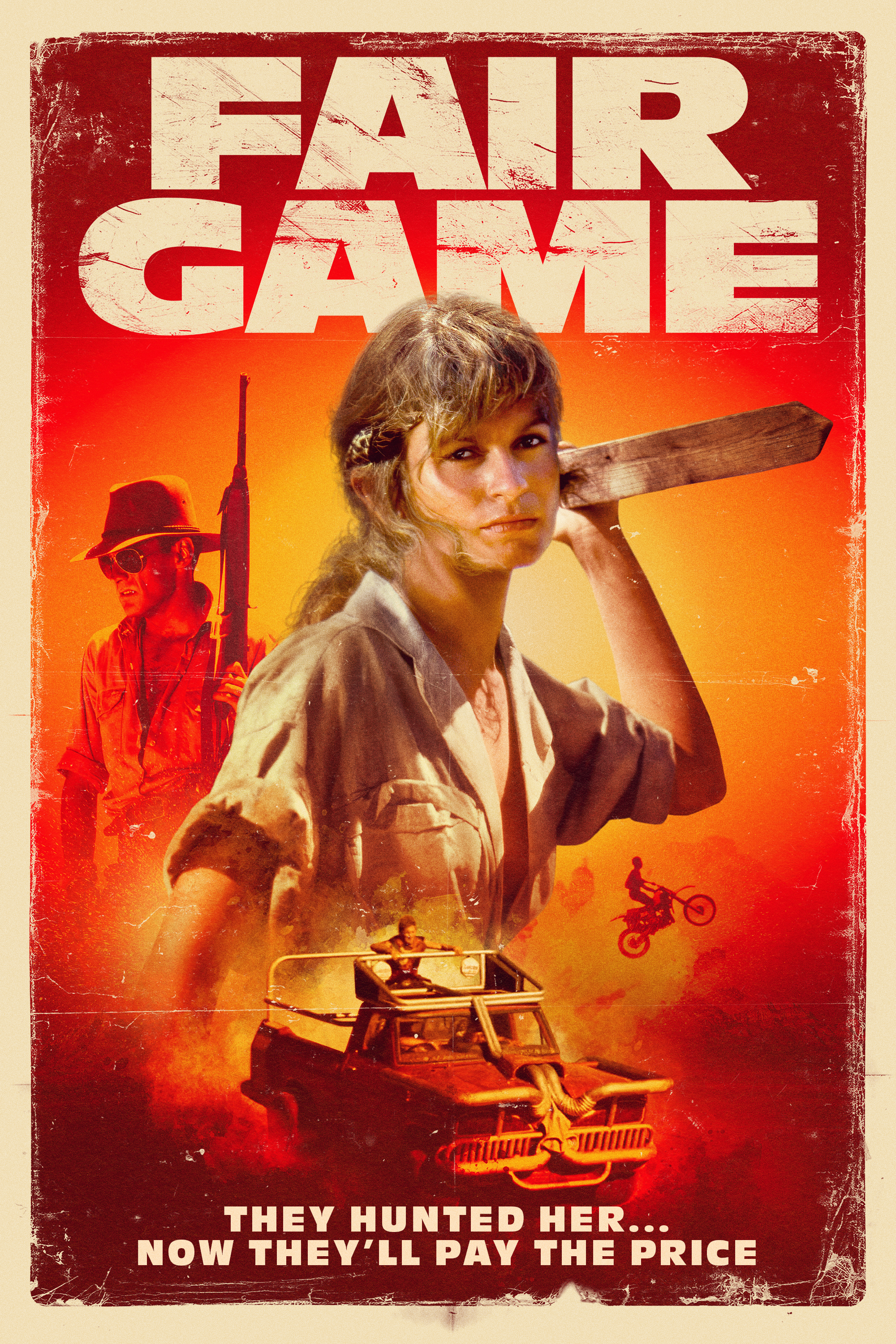
Fair Game--The heroine of this Australian actioner of 1986 is Jessica (Cassandra Delaney), a Julie-Christie-esque beauty with big '80s hair who runs a wildlife refuge in the outback and lives on it in an isolated cabin. The villains are a trio of kangaroo poachers who terrorize and assault her and trash her home.

Most of us wouldn't need to hear more than "kangaroo poachers" to want to see these guys pulverized, but the gleeful performances of Peter Ford, David Sandford and Barry Sparks manage to elevate our bloodlust even further. Enjoying a re-release from Dark Star, this "Ozploitation" melodrama, reportedly and believably a favorite of Quentin Tarantino and an inspiration for Death Proof, is bluntly directed by Mario Andreacchio. It's shot with richness and nuance by Andrew Lesnie, and packed with that maniacal stunt work characteristic of Australian action flicks of that period. Despite what she endures, our heroine remains defiantly brave throughout, and it would be absurd to deny how satisfying it is when she turns the tables on her tormentors.

Except that for me, as usual with revenge dramas...it's not quite sufficient. Death, even painful death, wasn't enough for my spiteful heart; I wanted these guys to suffer more humiliation and degradation at Jessica's hands. But Fair Game comes closer to a gratifying payback than most.

Wednesday, October 16, 2019

FORSTERY

Robert Forster passed on last week, at 78; even though his hair had gone gray and thinner, the verve and sharp edge of his acting made him seem at least ten years younger.


Like many actors, the soulfully craggy-faced fellow with the accent that sounded like pure Chicago--though he hailed from Rochester, New York--paid the bills over the years with a great deal of low-rent dreck, often elevating it by his very presence. But his few and far between career highlights were such that they've given him the legacy of a true star.

The son of an elephant trainer for Ringling Brothers and Barnum & Bailey Circus, Forster studied history the University of Rochester, but was lured away from pursuing a career in law when he followed a pretty coed into a theatre audition. His film career started on a high-profile note, when he was poached away from a brief tenure on Broadway to appear opposite Marlon Brando in Reflections in a Golden Eye.

Roles opposite the likes of Gregory Peck in The Stalking Moon or Anthony Quinn in The Don is Dead followed; so did his lead in Haskell Wexler's 1969 verite classic Medium Cool. Alas, this was followed by two failed TV series in the early '70s, and soon Forster's career was in decline. Despite the occasional starring role in an A-list production like 1979's The Black Hole, by the late '70s and throughout the '80s and early '90s many of Forster's credits were in stuff like Satan's Princess and Maniac Cop III.


Things changed in 1997, when Forster was cast as the stoic bail bondsman Max Cherry in Quentin Tarantino's best movie, his Elmore Leonard adaptation Jackie Brown. Cherry assists the title character, played by Pam Grier, in her elaborate scheme to trick the deadly arms dealer for whom she smuggles money in and out of Mexico. Forster's thunderstruck expression when Cherry sees the imperious Jackie emerging from a lockup may be the single most effective portrayal of love at first sight in all of movies.

Max Cherry was the performance for which Forster got his Oscar nomination, and it will probably, and deservedly, be remembered as the signature role of his career. Even so, I have a favorite from the lean part of Forster's career: his star turn as the perplexed police detective Dave Madison in Lewis Teague's 1980 Alligator. Helped by the thoughtful dialogue of John Sayles, Forster turns what could have been a routine lead in a routine creature feature into a sly and even touching character study.


He kept acting for more than twenty years after Jackie Brown, and while the work was steady and probably more lucrative, it was only a little better in terms of quality; there were lots of forgettable supporting parts in action movies, and there were still credits like Dragon Wars and Rise: Blood Hunter. He did well on TV, with roles on Breaking Bad and Karen Sisco and Last Man Standing, and the reboot of Twin Peaks.

As you can likely guess, I'm a fan. Forster had a low-key, unpretentious everyman persona with an underlying tinge of melancholy. At his best, he was deeply lovable. This past weekend I caught up with one of his very last movies, 2018's What They Had, in which he plays a devoutly Catholic husband and father struggling to care for his dementia-afflicted wife (Blythe Danner) at home. It's the kind of role he should have gotten to play more often.

I met Forster once, by the way; more than a decade ago at the Phoenix Film Festival, I introduced a not-very-good crime film in which he appeared, and ran the Q&A with him after the screening. I introduced him so effusively that when he stepped up to shake my hand he gave me a quizzical look, as if he wondered if my enthusiasm was a put-on. It wasn't.

Friday, July 26, 2019

GREEN CHEESY

Check out my "Friday Flicks" column, online at Phoenix Magazine, this week featuring my reviews of Quentin Tarantino's Once Upon a Time...in Hollywood...


 ...and of the unsettling German horror film Luz, playing this weekend at Filmbar...


Your Humble Narrator really mooned it up last weekend, in celebration of the 50th anniversary of Apollo 11; The Wife made me a present of this boss new shirt...


...and my film historian pal Richard put on a fantastic lunar-themed movie night, starting with an 1898 Georges Melies short, The Astronomer's Dream, in which a rapacious moon descends and devours the Astronomer's telescope, among other things...


...as well as Excursion to the Moon, Segundo de Chomon's 1908 Pathe rip-off of the Melies Trip to the Moon...


...and 1935's lovely Fleischer cartoon Dancing on the Moon, in which newlyweds of various species take a pleasure cruise to the satellite...


...for just a dollar per couple (a tomcat gets separated from his new bride, alas). He also showed us a silent Hal Roach short, A Moony Mariner, with Billy Dooley pressed into service as an astronaut.

Then for the feature, we got Richard Cunha's hilarious 1958 saga Missile to the Moon (or Invasion de la Luna, as it's called in this Spanish-language lobby card)...


...featuring fabulous moon-maidens, as well as a terrifying giant spider...


...and rather Gumby-like rock men...


Ah, but I didn't stop there. No, on my own last weekend I watched a British double feature; first the likably inane 1969 lunar noir from Hammer, Moon Zero Two...


...and then the 1970 dinosaurs-and-caveman epic When Dinosaurs Ruled the Earth...


...which is, after all, also a Moon movie; it's supposedly about the birth of the Moon.

So, here's my last moon-oriented posting (for a while):


Out on Blu-ray this month is Space: 1999, the two-season British TV series from 1975, produced by Gerry and Sylvia Anderson of Thunderbirds. The premise is that a terrible explosion in the title year has blasted the Moon out of Earth orbit and sent it sailing through space like a futuristic Flying Dutchman. The roughly three hundred inhabitants, led by Martin Landau, Barbara Bain and Barry Morse, encounter strange alien worlds, always hoping they might be able to colonize one, always disappointed.

Released during lean times for sci-fi geekspost-Star Trek, pre-Star WarsSpace: 1999 was eagerly anticipated. Revisiting the show now, my memory of it from back then was confirmed: It's dreadful. The production was first-rate, with near-state-of-the-art special effects for the time, cool spaceships and sets and costumes and attractive series regulars. The guest stars were big-name Brits, from Ian McShane to Brian Blessed to Leo McKern to Margaret Leighton to Billie Whitelaw to Roy Dotrice to Peter Cushing and Christopher Lee, if you please, to name just a few. But the earnest humorlessness of the atmosphere was oppressive, and to say the pacing was glacial is to insult the promptness of glaciers.

In the second season, a sexy shape-shifting alien played by Catherine Schell was added, as were some attempts at jocular humor, and this obvious play at dumbing-down was somehow just embarrassing. But Space: 1999 did have one splendid feature, albeit in its first season only: The opening title sequence. There would be a blaring fanfare of bombastic music, and then a fast-cut montage of scenes from the episode to follow. If only the shows themselves could have captured some of the excitement of those openings.

Thursday, August 30, 2018

BACK TO THE GRINDSTAFF

Last week we paid tribute to the late Douglas Grindstaff, the brilliantly imaginative sound effects man whose contribution to the atmosphere of the original Star Trek would be hard to overstate. But I think Grindstaff deserves at least one more monster, so...

Monster-of-the-Week: ...let's acknowledge the "neural parasite" that attacks poor Spock in the second-season episode "Operation--Annihilate!"


In one interview I found, Grindstaff claimed that he produced the creature's icky sounds by using samples of kissing.

While we're on the subject of Star Trek, check out...Quentin Tarantino's Star Trek!

Thursday, January 15, 2015

ONE MORLOCK FOR THE ROAD...

RIP to Rod Taylor, who starred in The Time Machine and The Birds


…and more recently, in Quentin Tarantino’s Inglourious Basterds, played the small role of Winston Churchill…


…and who passed on late last week. Since the Morlocks from The Time Machine already served as a Monster-of-the-Week a while back…

Monster-of-the-Week: …this week let’s give the nod to the “Starving Morlock” movers who haunt Sheldon’s dreams in The Big Bang Theory