Showing posts with label TOM HARDY. Show all posts

Friday, June 21, 2024

I DON'T WANT A PICKLE...

Opening this weekend:


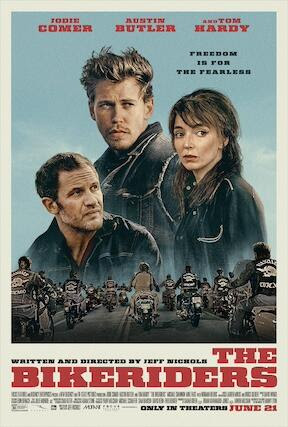
The Bikeriders--There are many variations within the genre, but overall, biker movies tend to fall into two broad categories. There are those, exemplified by The Wild One (1953), in which the bike gang is seen from the point of view of mainstream society, and those, like The Wild Angels (1966) or Easy Rider (1969), where mainstream society is seen from the point of view of the bikers.

This new "wheeler" manages to have it both ways. Adapted by writer-director Jeff Nichols from the 1967 book by photojournalist Danny Lyon, the film traces the growth of a fictitious Chicago area club, The Vandals, based on The Outlaws, with whom Lyon embedded off and on throughout the '60s. It's very much an insider's view, focusing less on riding action than on the tempestuous relationship between Johnny (Tom Hardy), the club's founder, and Benny (Austin Butler), his beautiful, stoic, monosyllabic right-hand man. The Vandals begins as a racing and social club--Johnny, a truck-driving family man, is initially inspired by seeing The Wild One on TV--but criminality and ugly violence gradually creep in. 

Wisely, however, Nichols makes a mainstream viewpoint central to the film as well. The story is narrated to Lyon (Mike Faist) by Kathy (Jodie Comer), a respectable young working-class woman who stumbles into a biker bar one night to meet her girlfriend, and is unimpressed, not to mention understandably scared, by what she sees. She's unimpressed, that is, until she gets a look at the angelic Benny at the pool table, and can't keep an infatuated smile off her face. Despite Benny's anomie and recklessness, before long he and Kathy are a couple, and she's in competition with Johnny for Benny's devotion.

The beguiling Jodie Comer's Kathy is the live wire in The Bikeriders. A Brit of course, Comer lays on a Chicago accent as thick as a deep dish pizza as Kathy tells us, in hilariously bemused terms, about both the follies of bike gang life and her own folly in loving the seemingly emotionless, self-destructive Benny. Her sensible, self-deprecating take is pre-emptive to how many of us in the audience may feel, and keeps The Bikeriders from skidding into cornball melodrama.

None of this is to say that the movie's other elements aren't top-notch. It's full of fine performances: Hardy, sporting a sort of buzzy, mild-mannered Brando voice, has a quietly tragic appeal as Johnny. By the nature of his character, Butler is asked to play Benny very close to the vest, but he brings a star presence to the part. Damon Harriman, Boyd Holbrook, Emory Cohen and others are strong in supporting parts, and Norman Reedus drops in as "Funny Sonny," an unnerving representative of a California club. As the frazzled Zipco, who wanted to serve in the Army, Michael Shannon makes his big monologue a knockout.

The Bikeriders is also one of the best-looking movies of the year, stunningly shot in Grant Wood-esque midwestern tones by Adam Stone. Like the biker pictures from the period it depicts, it seems to be made up of images of real people, objects and places, lovingly captured but rock-solid. In our computer-generated era, this is refreshing; for all its brutality, this movie takes the world in a love embrace.

Monday, October 11, 2021

VENOM EMBROIDERY

Now in the multiplexes:


Venom: Let There Be Carnage--The King of the Rumbly Distorted Voice, Tom Hardy, is back in the dual role of Eddie Brock and Venom, the alien "symbiote" with whom he shares body-space. Eddie and Vennie have developed a bickering domestic relationship since the 2018 Marvel movie Venom; Vennie is constantly nagging his host to let him eat the brains of human "bad guys" like a kid begging a parent for permission to get a tattoo.

In this sequel, some of the Big V's genetic material gets blended with serial killer Cletus Kasady (Woody Harrelson), who bears Eddie a grudge. Cletus turns into an uber-Venom-ish monster called Carnage, who looks like he stepped out a Francis Bacon triptych. He busts out of prison and liberates his girlfriend Shriek (Naomie Harris), who can yell really loud, and the two of them go on a wild, vengeful rampage in San Francisco.

With his vague working-class Mid-Atlantic accent (he wears a Detroit Lions jacket even though he lives in the Bay area), Hardy's Eddie is a rather recessive leading man; mostly he's a serviceable straight man to Venom. But Harrelson puts on an entertaining show as usual, and Harris is freaky and memorable. Andy Serkis directed, working in a style of headlong visual shorthand that keeps the story flying forward like a driverless speedboat, and using the San Fran locations to good advantage.

But when I tell you what I liked best about Venom: Let There Be Carnage, it will make me sound just like the old guy that I am: It's an hour and 37 minutes long. That's right, this Marvel movie is a freaking hour and a half long. It doesn't have five endings; it doesn't keep you in your seat for more than two hours in fear that you won't feel like you got enough for your money. Make no mistake, there's plenty of weird, near-surreal action. The movie doesn't skimp, but it doesn't overload our plate, either.

Friday, July 21, 2017

NOT JUST ANOTHER DAY AT THE BEACH

Opening this weekend:


Dunkirk--In the hair-raising opening scenes of this historical epic from Christopher Nolan, a young English soldier tries to make it to the title town's beach alive, and just barely succeeds. Aside from surviving, all he really wants to do is find a peaceful place to evacuate his bowels. This is the sort of human detail that many war movies leave out, or treat jocularly, but realities like this are the core of Dunkirk.

Well-played by a newcomer named Fionn Whitehead, the character is listed in the credits as "Tommy," but his name hardly matters. He's an everyman--an everykid, really--and the other young soldiers he meets, played by Aneurin Barnard and One Direction's Harry Styles, are similarly generic. Nolan's script, clearly by design, offers no real characterization, presumably on the theory that backstory, in these circumstances, would be grotesquely irrelevant.

Instead, Nolan relies on his actors to fill in the stock figures. Since the cast includes such vets as Mark Rylance, Kenneth Branagh, Cillian Murphy, James D'Arcy and Tom Hardy, it need hardly be said that this proves a sound strategy.

Almost everything Nolan tries here seems to work. The movie focuses on the evacuation of hundreds of thousands of English and French soldiers, surrounded by the German army and threatened from the air by the Luftwaffe, across the Channel to England in late May and early June of 1940. Nolan cuts between three main strands, "The Mole," aka the breakwater where soldiers like Tommy waited days to be picked up by Navy vessels, "The Sea," in which we follow one of the "Little Ships of Dunkirk," the small civilian commercial and private crafts that took to the Channel to rescue the trapped men, and "The Air," in which we follow three RAF pilots in Spitfires trying to down German airplanes before they can bomb or strafe the evacuees.

The dialogue, sparing to begin with, battles the ambient noise, Hans Zimmer's brooding, gut-vibrating score, and (for us Yanks especially) thick accents, to the point that after a while I mostly gave up and just tried to follow what was going on by context. Similarly, because of the differing travel times required for the three modes of Channel crossing, Dunkirk employs another of those intricately non-chronological time-schemes, as in Momento, so that Nolan can use crosscutting to maximum emotional effect. And while emotional it certainly is, I must confess that in the final third of the film I found myself disoriented at times by where we were in this reticular narrative. But that may have just been me.

In any case, it didn't detract from the overall impact of Dunkirk, which at its best has something like the sweep and punch of the great silent war epics (I saw the film on an IMAX screen, by the way, and recommend this format if it's available to you). The performances, the incongruously gentle hues of Hoyte van Hoytema's exquisite cinematography, and the sustained assurance of Nolan's direction all combined to make this sad, terrifying yet ultimately uplifting story one of the more potent movie experiences I've had in a while.

Friday, January 8, 2016

MEN IN THE WILDERNESS

Opening in the Valley today:


AnomalisaA middle-aged man from L.A. flies into Cincinnati for a speaking gig. He’s the author of a popular tome on customer service, and people murmur his name when he walks into his hotel lobby. He checks into his room, tips the bellhop, orders some room service, calls an ex-girlfriend who lives in town. The setting is mundane and his behavior is entirely unremarkable, though a deep sadness and loneliness suffuses the atmosphere.

All of this, by the way, is depicted in painstakingly detailed stop-motion animation. For a while, I thought that this was the object of the cinematic experiment—could stop-motion lend its sense of stylized wonder even to this sort of naturalistic, slice-of-life drama?

But eventually [spoilers coming, by the way], the tension at the heart of this strange story becomes clear, as we realize that everybody in the movie except our hero, Michael, speaks in the same voice. Michael speaks in the gentle British-accented tones of David Thewlis, but his wife and young son on the phone, the ex-girlfriend, the cabbie, the desk clerk, people on TV, and everybody else speaks in the unnerving adult male voice of Tom Noonan.

It’s clear that this is how Michael’s been hearing the world for a long time, because he springs into action when he suddenly hears an unfamiliar voice passing in the hall. He tracks it down to a young woman named Lisa (Jennifer Jason Leigh) who’s staying in the hotel. Lisa’s a sweet, slightly dowdy woman with poor self-esteem. Lisa—who is an anomaly, get it?—and a girlfriend (with the usual voice) have come from Akron to hear Michael speak, so she’s starstruck when he begs her to spend time with him.

Written by Charlie Kaufman (based on his own radio play), who co-directed with animator Duke Johnson, this solipsistic fantasy grows even more bizarre from there on, in the manner of Kaufman’s earlier pop-absurdist weirdness like Being John Malkovich or Synecdoche, New York. It’s also sexually graphic, with results that are both touching and surprisingly erotic.

This won’t be everybody’s cup of tea, obviously, but on its own terms it’s among the strongest and most emotionally charged pictures of the year. Kaufman takes his time, letting the freaky conceits establish themselves gradually, and also allowing Michael’s terrible sense of isolation to become overpowering.

Lisa is the movie’s greatest success. She’s tremendously likable, and in the face of Michael’s rather predatory neediness, Kaufman, Johnson and Leigh make us feel urgently protective of her.


The RevenantProbably because there’s a part of me that still thinks of him as that little kid from the sitcom, the adult Leonardo DiCaprio is an ongoing amazement to me. In this adaptation of Michael Punke’s 2002 novel DiCaprio is entirely credible as Hugh Glass, the frontiersman who, on an ill-fated pelt-hunting expedition in South Dakota in 1823, was savaged to the point of death by a bear, then abandoned by the men charged with staying with him. Horrifically wounded, he nonetheless dragged himself across hundreds of miles of wilderness, for the sake of survival and revenge.

This historical incident (it was also the basis for 1971’s memorable Man in the Wilderness, with Richard Harris) has been embellished, giving Glass an even more spaghetti-western-ish motive for his vengeance. Director Alejandro G. Innaritu stages scene after scene of gruesome and grueling violence—Indian attacks, the bear mauling, murders, scalpings, disemboweling animals to sleep in their carcasses—with undeniable primal force.

The final clash between Glass and his chief enemy (Tom Hardy, who’s superb) is a standard action-movie grapple, and somehow banal. But on balance, The Revenant is potent stuff, and vividly acted by DiCaprio, Hardy and Will Poulter as the young Jim Bridger.

I couldn’t help but notice, however, that Inarittu’s previous film, the rhapsodically received Birdman, was about a movie star prepared to end his own life because his acting career wasn’t going quite as well as he’d hoped. This time Inarittu gives us a hero who literally crawls out of his own grave, eats raw meat and cauterizes his own wounds with gunpowder just to keep breathing. It’s kind of hard to pin down Inarittu’s philosophy.

Friday, May 15, 2015

THRUSH HOURS, RUSH HOURS

Opening today:


Pitch Perfect 2The 2012 comedy to which this is the sequel was set in the world of collegiate competitive a cappella groups. It had adorable young actresses, beautiful singing, and catty wit offset by a bit of heart, so on the whole, it was a fun couple of hours. It also had—and was, for me, marred by—some self-conscious, heavy-handed gross-out gags.

Pitch Perfect 2’s excuse for a plot has our heroines the Barden Bellas accidentally disgracing themselves at a Kennedy Center performance in front of the President. They’re pariahs in the a cappella community, but aim to redeem themselves at an international competition in Copenhagen. As they prepare for this, all sorts of wacky stuff happens, along with a bit of undemanding romance.

At the center of the ensemble, once again, is the charmingly commonsensical Anne Kendrick as Beca, supported by Brittany Snow, Rebel Wilson, Ester Dean, Hana Mae Lee and the rest of the gang from part one, along with additions Hailee Steinfeld and Chrissie Fit. Reprising their roles from part one are John Michael Higgins and Elizabeth Banks as two cheerfully inappropriate play-by-play commentators.

Banks also took over directing duties this time, replacing the original’s Jason Moore, and I think the results are looser, sillier and funnier. Banks sustains the comic energy through some nutty extended sequences, like a competition between four vocal groups, and the big numbers have some spectacle and punch. The script, again by Kay Cannon, is dense with quizzical, non-sequitur verbal jokes that play surprisingly well, and when Kendrick and her pals sing a wistful version of her improbable hit “Cup Song” around the campfire, it manages even to be a little touching.

About the music: A friend of mine expressed doubt that the songs here were truly a cappella—it sounded to him like bass and percussion enhancement had been added. He could be right, and if he is I suppose I would find that a disappointing cheat. But even so, it sounds good.


Mad Max: Fury Road1982’s Mad Max 2: The Road Warrior is, I believe, arguably the best action movie ever made, at least of the chase variety. It would probably be somewhere in my top twenty or thirty favorite movies. So this follow up had a lot to live up to.

Set in the Down Under outback, The Road Warrior, a sequel to the 1979 low-budget actioner Mad Max, depicts a not-too-distant future in which the world economy has collapsed in the wake of a global fuel shortage. Society in the desert has returned to tribalism and savagery, and gasoline is the only currency left for the marauding brutes that rocket along the desolate highways in motorcycles and hopped-up cars. A small, fortified colony of reasonably civilized people have developed a refinery, and are trying to move the cache of gas they’ve generated to a safe location near the sea, but they can’t get past the besieging army of the masked, hot-rod-riding warlord Humungus.

To the reluctant rescue comes the title character, the mysterious “road warrior” known as Max, played by Mel Gibson. This soul-wounded loner agrees to drive the armored tanker-truck for the colonists and fend off the onslaught of the freaky gas-pirates. The resulting climactic sequence, full of thrilling and often horrifying stunt work and the sustained kinetic direction of George Miller, is, for my money, the most headlong, jaw-dropping, Wagnerian motor-vehicle chase ever put on film.

The 1985 sequel Mad Max Beyond Thunderdome wasn’t as good, and with the new film clearly employing heavy doses of CGI effects, I had my doubts that Miller could recapture the earlier classic’s remarkable quality. And he doesn’t, quite—The Road Warrior remains without peer. But happily, Mad Max: Fury Road is still a very potent action movie, and the second best of the series.

Miller has lost none of his directorial panache—Fury Road casually offers up everything from two-headed lizards to human dairy farming to combat inside a raging haboob. Along with this grotesque yet epic visual imagination, there’s a certain grandiosity, tinged with irony but still visceral, to Miller’s staging of violent action that is one-of-a-kind. His cutting has the speed and dazzle of modern action masters like, say, Paul Greengrass, but it also has a clarity and precision that give it a Rube Goldberg comic dimension, and a relentless momentum. There’s simply no filmmaker quite like him.

Fury Road benefits from having, like Road Warrior, a relatively straightforward storyline. Max finds himself helping similarly haunted, one-armed driver Charlize Theron transport a handful of the “breeders”—who look like refugees from a Victoria’s Secret ad—of a masked, rumbly-voiced warlord very similar to Humungus, to safety, wherever that might be. The path leads through a seemingly endless supply of bizarre vehicular killers.

As for Tom Hardy, he cuts a serviceably lively figure as Max, but—much as it galls me to admit it—he doesn’t have the electric presence of Mel Gibson. Unlike the somehow sullen Hardy, Gibson’s Max seemed…well, mad. Maybe he wasn’t acting.

Monday, July 23, 2012

CAPETOWN

Just as it was difficult to discuss 2008’s The Dark Knight out of the shadow of the heartbreaking loss of Heath Ledger, so it’s likely to be difficult, for a while at least, to discuss The Dark Knight Rises out of the context of the horror at the multiplex in Colorado. As it happened, I was unable to attend the screening of the film before it opened, so unlike many of my fellow critics, I saw it—Sunday morning, in a theater maybe one-third full—with the Aurora shootings in my head.

But in terms of the movie, all the tragedy proves is how much easier it is to be a supervillain than a superhero. The real world squeezes the “super” part out of super-villainy, however—it’s terrifying when somebody tries to realize that sort of large-scale, comic-book-style mayhem, but in the end it’s also sordid and pathetic and wretched. It isn’t grand or epic.

And, except to express sympathy to the victims and their loved ones, it probably isn’t worthy of even as many words as I’ve already given it. So let’s turn to a far less important subject—the movie itself.

I wish I could report that the new Batman flick by Christopher Nolan, from a script he wrote with his brother Jonathan, is a masterpiece, but I can’t. As with the earlier film, it’s a severely uneven mixed bag, polished and handsome but preposterously overlong, confusing, glutted with enough ideas for three or four movies but way too many for one. Like many, many big Hollywood blockbusters of the last couple of decades, it’s fascinating, even thrilling in fits and starts, but wearying in the aggregate.

Batman hasn’t been seen since the end of Dark Knight. Wayne Industries is in the red, and Bruce Wayne (Christian Bale), ravaged both physically and spiritually by the tragic events of the last movie, is going through a Howard Hughes-ish recluse phase. Alfred (Michael Caine) keeps pestering Bruce like a Jewish mother to get out and find a nice girl, even if it’s the second-story gal Catwoman (Anne Hathaway), who’s managed to filch a string of pearls belonging to Bruce’s mother.

The principal dastardly duties here fall to a certain Bane, played by the very good Brit actor Tom Hardy, here wasted behind a mask. Bane is like a mash-up of post-Boomer pop villainy, with elements of Darth Vader, The Predator, Hannibal Lecter and especially The Lord Humungus from The Road Warrior—he speaks in the same mushy rumble. But I can’t say I found him as scary as any of the above.

Bane is up to something with a huge crew of henchmen in the sewers of Gotham. Eventually he cuts the city off from the outside world and holds its inhabitants hostage for weeks with a nuclear bomb, while imprisoning Bruce in a hellhole prison overseas.

So there are explosions and chases and fistfights and shootouts and abductions and flashbacks and escapes, between and during which the actors spout pages and pages of exposition, much of it hard to follow even when it’s comprehensible, which for me was maybe about half the time. Things aren’t much easier on a thematic level—politically, the movie flails incoherently, coming across one minute like an Occupy rant and the next like Wall Street propaganda. Scene after scene is propulsive and exciting in itself, but often I was unsure what had happened, or what I should want to happen.


What redeems The Dark Knight Rises is what redeems most overworked movies, if anything does—the acting. Bale is better, or at least less annoying, than he was in the last film, though he’s still using that stupid raspy growl when he has the cape and mask on. Between him and Hardy, much of the dialogue sounds like it’s coming through blown stereo speakers.

There’s no performance on the level of Ledger’s in the previous film, but Caine, Morgan Freeman and Gary Oldman each get a few minutes to show what they’re capable of without breaking a sweat. Hathaway is certainly not repellent in her Catwoman get-up, but Marion Cotillard casts an even stronger seductive spell as a rival love interest for Bruce.

But it’s Joseph Gordon-Levitt, as an intrepid young Gotham cop, who develops more of a relationship with the audience than anybody else in The Dark Knight Rises. If there’s another film in the series, there’s reason to believe he’ll figure prominently, and that wouldn’t be a bad thing.

RIP to Al Franken’s laid-back early writing and performing partner Tom Davis, passed on too young at 59.