Showing posts with label EMORY COHEN. Show all posts

Tuesday, December 23, 2025

ONE PADDLE AFTER ANOTHER

In the multiplexes on Christmas Day:

Marty Supreme--The Marty here is Marty Mauser, a Lower East Side kid of the early '50s. The supremacy in question is at, of all things, table tennis, or ping pong. He is already an insolently prodigal talent at the sport, with designs on becoming a world champ.

Marty himself wouldn't limit his supremacy merely to table tennis; he's already intolerably cocksure about his ability to do pretty much anything he wants. Even though he could, by his own estimation, "sell shoes to amputees," he despises his job in his uncle's shoe store, regarding it as far beneath him. When some journalists in London point out a retired has-been movie star (Gwyneth Paltrow) of the Norma Shearer or Grace Kelly sort, now respectably married to a rich businessman, he decides to seduce her, not because he's ever heard of her--he hasn't--but because why not?

Directed by Josh Safdie from a script he wrote with Ronald Bronstein--loosely based on the exploits of real-life table tennis master Marty "The Needle" Reisman--this film chronicles a little less than a year's worth of Marty's chaotic, farcical yet sometimes sinister misadventures. The task of reviewing it gives rise to glib descriptions like: It's as if Joseph Heller, Philip Roth, Mordechai Richler and David Mamet were locked up together and forced to write a sports movie without being allowed to sleep.

This doesn't quite do Marty Supreme justice; the movie is a true original. But it gives a hint of the flavor. It's a comic, shocking, inspirational epic of midcentury Jewish hustling. And it's built around another jolting, instant-classic performance by Timothée Chalamet in the title role.

Although he's ably supported by Paltrow, Fran Drescher, Abel Ferrara, Kevin O'Leary, Odessa A'zion, Sandra Bernhard, Emory Cohen and many others, it's Chalamet's party on an acting level. Pasty and zit-pocked, his Marty is somehow both shameless and recklessly heroic, a liar with a streak of the sociopathic--he may carry a touch of Sammy Glick from What Makes Sammy Run? as well--alongside a passionate sense of self-regard and integrity. I couldn't help but root for him.

Safdie's storytelling is similarly expansive. The movie delivers antic, slapstick violence, eroticism and tragedy while sustaining a unified tone. Marty can make scandalous quips about the Holocaust, and minutes later Safdie gives us a bizarre Holocaust flashback that's disturbing and moving. Safdie uses anachronistic musical selections, yet he maintains a sense of period. It's a remarkable achievement.

It's also a very loud, abrasive, unrelenting movie--even though it covers months, it has almost the feel of real time--and I wouldn't blame anyone who found it a bit much. But it explores a great subject: brash, self-promoting American hustlers. And it gets at a great truth: that for better or worse, brash, self-promoting American hustlers have a way of getting what they want. For a while, at least.

Friday, June 21, 2024

I DON'T WANT A PICKLE...

Opening this weekend:


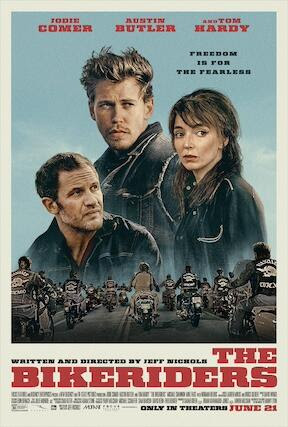
The Bikeriders--There are many variations within the genre, but overall, biker movies tend to fall into two broad categories. There are those, exemplified by The Wild One (1953), in which the bike gang is seen from the point of view of mainstream society, and those, like The Wild Angels (1966) or Easy Rider (1969), where mainstream society is seen from the point of view of the bikers.

This new "wheeler" manages to have it both ways. Adapted by writer-director Jeff Nichols from the 1967 book by photojournalist Danny Lyon, the film traces the growth of a fictitious Chicago area club, The Vandals, based on The Outlaws, with whom Lyon embedded off and on throughout the '60s. It's very much an insider's view, focusing less on riding action than on the tempestuous relationship between Johnny (Tom Hardy), the club's founder, and Benny (Austin Butler), his beautiful, stoic, monosyllabic right-hand man. The Vandals begins as a racing and social club--Johnny, a truck-driving family man, is initially inspired by seeing The Wild One on TV--but criminality and ugly violence gradually creep in. 

Wisely, however, Nichols makes a mainstream viewpoint central to the film as well. The story is narrated to Lyon (Mike Faist) by Kathy (Jodie Comer), a respectable young working-class woman who stumbles into a biker bar one night to meet her girlfriend, and is unimpressed, not to mention understandably scared, by what she sees. She's unimpressed, that is, until she gets a look at the angelic Benny at the pool table, and can't keep an infatuated smile off her face. Despite Benny's anomie and recklessness, before long he and Kathy are a couple, and she's in competition with Johnny for Benny's devotion.

The beguiling Jodie Comer's Kathy is the live wire in The Bikeriders. A Brit of course, Comer lays on a Chicago accent as thick as a deep dish pizza as Kathy tells us, in hilariously bemused terms, about both the follies of bike gang life and her own folly in loving the seemingly emotionless, self-destructive Benny. Her sensible, self-deprecating take is pre-emptive to how many of us in the audience may feel, and keeps The Bikeriders from skidding into cornball melodrama.

None of this is to say that the movie's other elements aren't top-notch. It's full of fine performances: Hardy, sporting a sort of buzzy, mild-mannered Brando voice, has a quietly tragic appeal as Johnny. By the nature of his character, Butler is asked to play Benny very close to the vest, but he brings a star presence to the part. Damon Harriman, Boyd Holbrook, Emory Cohen and others are strong in supporting parts, and Norman Reedus drops in as "Funny Sonny," an unnerving representative of a California club. As the frazzled Zipco, who wanted to serve in the Army, Michael Shannon makes his big monologue a knockout.

The Bikeriders is also one of the best-looking movies of the year, stunningly shot in Grant Wood-esque midwestern tones by Adam Stone. Like the biker pictures from the period it depicts, it seems to be made up of images of real people, objects and places, lovingly captured but rock-solid. In our computer-generated era, this is refreshing; for all its brutality, this movie takes the world in a love embrace.