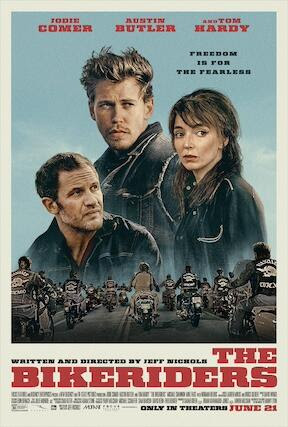
The Bikeriders--There are many variations within the genre, but overall, biker movies tend to fall into two broad categories. There are those, exemplified by The Wild One (1953), in which the bike gang is seen from the point of view of mainstream society, and those, like The Wild Angels (1966) or Easy Rider (1969), where mainstream society is seen from the point of view of the bikers.
This new "wheeler" manages to have it both ways. Adapted by writer-director Jeff Nichols from the 1967 book by photojournalist Danny Lyon, the film traces the growth of a fictitious Chicago area club, The Vandals, based on The Outlaws, with whom Lyon embedded off and on throughout the '60s. It's very much an insider's view, focusing less on riding action than on the tempestuous relationship between Johnny (Tom Hardy), the club's founder, and Benny (Austin Butler), his beautiful, stoic, monosyllabic right-hand man. The Vandals begins as a racing and social club--Johnny, a truck-driving family man, is initially inspired by seeing The Wild One on TV--but criminality and ugly violence gradually creep in.
Wisely, however, Nichols makes a mainstream viewpoint central to the film as well. The story is narrated to Lyon (Mike Faist) by Kathy (Jodie Comer), a respectable young working-class woman who stumbles into a biker bar one night to meet her girlfriend, and is unimpressed, not to mention understandably scared, by what she sees. She's unimpressed, that is, until she gets a look at the angelic Benny at the pool table, and can't keep an infatuated smile off her face. Despite Benny's anomie and recklessness, before long he and Kathy are a couple, and she's in competition with Johnny for Benny's devotion.
The beguiling Jodie Comer's Kathy is the live wire in The Bikeriders. A Brit of course, Comer lays on a Chicago accent as thick as a deep dish pizza as Kathy tells us, in hilariously bemused terms, about both the follies of bike gang life and her own folly in loving the seemingly emotionless, self-destructive Benny. Her sensible, self-deprecating take is pre-emptive to how many of us in the audience may feel, and keeps The Bikeriders from skidding into cornball melodrama.
None of this is to say that the movie's other elements aren't top-notch. It's full of fine performances: Hardy, sporting a sort of buzzy, mild-mannered Brando voice, has a quietly tragic appeal as Johnny. By the nature of his character, Butler is asked to play Benny very close to the vest, but he brings a star presence to the part. Damon Harriman, Boyd Holbrook, Emory Cohen and others are strong in supporting parts, and Norman Reedus drops in as "Funny Sonny," an unnerving representative of a California club. As the frazzled Zipco, who wanted to serve in the Army, Michael Shannon makes his big monologue a knockout.
The Bikeriders is also one of the best-looking movies of the year, stunningly shot in Grant Wood-esque midwestern tones by Adam Stone. Like the biker pictures from the period it depicts, it seems to be made up of images of real people, objects and places, lovingly captured but rock-solid. In our computer-generated era, this is refreshing; for all its brutality, this movie takes the world in a love embrace.


