Showing posts with label ARMIE HAMMER. Show all posts

Friday, February 11, 2022

NILE BE YOUR HUCKLEBERRY

Opening only (and worth seeing in) the multiplexes this weekend...
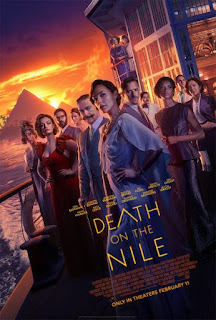
Death on the Nile--The prologue to Kenneth Branagh's sumptuous new adaptation of Agatha Christie's 1937 novel offers us some backstory on an iconic element of Hercule Poirot's image. It's very much like an origin story in a superhero movie.

It's hard to say how much this episode will be to the liking of hardcore Christie purists, just as it was hard to say how such enthusiasts would feel about Branagh's previous outing as the vain, dapper, extravagantly mustachioed Belgian super-sleuth with the OCD tendencies and the potent "little gray cells"; in 2017 he directed and starred in a flashy Murder on the Orient Express. Now Poirot is cruising down the title river in a palatial paddleboat full of shifty frenemies of a rich beauty (Gal Gadot) and her rakish new husband (Armie Hammer). There are cryptic clues and overheard motives and skulkings around Abu Simbel. It all culminates in murder, and among the suspects are Annette Bening, Letitia Wright, Dawn French, Jennifer Saunders, Tom Bateman, Russell Brand, Ali Fazal, Emma Mackey, Sophie Okonedo and others.

The script, as with Orient Express, is by Michael Green, and once again there's a sense that he and Branagh are gleefully shaking up Christie's staid and bigoted worldview, trying to get to her to roll in her grave (the film has, anyway, the blessing of her great-grandson, Executive Producer James Prichard, who runs Agatha Christie Limited). While the plot, in outline, and the solution to the mystery are essentially the same as in the novel and the enjoyable all-star movie version of 1978 with Peter Ustinov as Poirot, this is still a very free adaptation, with characters added, subtracted and altered for the sake of greater diversity in race and sexuality.

The period sets and costumes are luxurious, as is the cinematography of Haris Zambarloukos, who brought a very different look to Branagh's Belfast. The direction also has plenty of Branagh's characteristic flamboyance and old-school theatrics. Christie was fascinated by the setting (in addition to this book she also set a novel, 1944's Death Comes as the End, in ancient Egypt), so whatever she thought of the characterizations, she might well have liked this movie's lush Egyptian atmosphere; the camera takes in the sights on the riverbanks, and even snoops around below the surface at times.

It may be that contemporary audiences (and critics) will find this a laborious throwback, but I found it not only an opulent, sometimes sexy treat, but also surprisingly emotional; far more so than the 1978 version. This element comes, mostly, from Branagh's heartfelt performance. At key points his Poirot rises to the level of the tragic, like his Shakespeare did in that one great speech about the penknife in 2018's otherwise badly uneven All Is True. In both cases, it's the kind of masterly acting that likely won't get award nominations, but will richly reward attentive viewers. Provided, of course, that we use our little gray cells.

Tuesday, March 23, 2021

OH, FOR CRISIS SAKE

In theaters and streaming:

Crisis--With so many to choose from in the world right now, let me narrow it down: The title refers to the opioid crisis. Writer-director Nicholas Jarecki (of Arbitrage)  bounces between three strands, two of which eventually converge. The settings are Detroit and Montreal, tacitly making the point that while the southern border of the U.S. gets the hype as a sieve for drug trafficking, probably mostly for racist reasons the same activity, rapidly rising at the U.S./Canada border, gets much less attention.

Armie Hammer plays a wound-up undercover FBI agent trying to set up a complicated fentanyl bust between Armenian gangsters on the Detroit side and a powerful Montreal kingpin. His younger sister, played by Lily-Rose Depp, waiflike daughter of Johnny, is a junkie. Evangeline Lilly plays a single mother, herself a recovering addict, who loses her adored 16-year-old son to an apparent overdose. The devastated woman begins to probe the tragedy and soon learns that there may be more to it.

The third and most Ibsen-esque of the plotlines involves Gary Oldman as a college professor with a long history of more or less rubber-stamping studies for a big pharma company. When, thanks to a bit of over-diligence by one of his assistants, he gets an ominous result on a test for a new, supposedly non-addictive painkiller, the company tries to suppress his finding and he quickly finds himself bribed with funding and simultaneously threatened with loss of tenure, character assassination, etc.

Currently beleaguered by creepy scandal, Hammer gives a strong performance. I've sometimes found him a lackluster presence in his earlier films, but he has a bristling, vivid anger here that gives his scenes a charge, even though they're the most cop-movie conventional. Evangeline Lilly (whose name somehow sounds like a big pharma company) shows serious chops, getting across the woman's grief with painful believability. 

Even so, it's Oldman, in the least demonstrative of the three lead roles, who effortlessly walks off with the movie. With zero telegraphing, he shows us a person of ordinary character, maybe even a bit of a smug hack, who winds up in a deeply frightening position requiring moral courage.

Finally, a word should be said for the bad guys; Greg Kinnear as Oldman's boss, Veronica Ferres and Martin Donovan as the pharma honchos and Guy Nadon as the Quebecois gangster are all scary. They're as close as a realism gets to supervillians, and they're entirely convincing.

Friday, August 14, 2015

THE SPY'S THE LIMIT

Opening this weekend:


The Man From U.N.C.L.E.The feature knockoff of I Spy back in 2002 would have been a lousy movie in any case, but it was the more galling if you had any affection for the original series. The same went for the 1999 version of Wild Wild West, and the 2008 version of Get Smart.

I was at an advantage when it came to the new movie version of The Man from U.N.C.L.E., directed by Guy Ritchie, and based on the hit espionage series which ran on NBC from 1964 to 1968. Unlike the aforementioned three shows, I hardly ever watched U.N.C.L.E. as a kid, and therefore had no particular nostalgic investment in it.

The show, you may recall, concerned an international agency (United Network Command for Law and Enforcement) in which spies from either side of the Cold War set aside their differences and cooperated to thwart the evil designs of T.H.R.U.S.H. (Technological Hierarchy for the Removal of Undesirables and the Subjugation of Humanity). Two such agents were American Napoleon Solo (Robert Vaughn) and Soviet Illya Kuryakin (David McCallum), supervised by dry Brit Mr. Waverly (Leo G. Carroll).

I watched the old show a little in recent weeks in anticipation of the film. It’s on the slovenly and feeble side, but the acting, both of the regulars and the guest stars, was droll and good-natured, and so was some of the writing. If I had been a bigger fan, maybe I would be outraged by Ritchie’s film version. It’s a mixed bag, with style and panache in the directing and designs and acting thrown together with tiresome, even tasteless ideas. But for me, the style and panache won out.

It’s an origin story, about how Napoleon and Illya meet as enemies and are forced to work together to retrieve an atom bomb from some surviving Nazis, and for about the first half of the movie the two of them brawl and bicker. This is tedious, but not as tedious as the chase of all-terrain vehicles in the rain that climaxes the film. And the slightly campy tone taken toward a Nazi torturer feels a little queasy, too.

But Ritchie’s mastery of scrambling and de-scrambling strands of action through omniscient camera moves, split screens, chronology juggling and wild crosscutting give the film a lot of headlong momentum to get us past these missteps. So does a heavy dose of mid-‘60s period flavor from the cars and the fashions on the several beauties in the cast to the punchy, sexy soundtrack.

Probably the biggest upside, though, is the performance of Henry Cavill as Napoleon. Cavill seemed like a cipher to me as Superman, but here he has a grand time imitating the ironically stentorian cadences of Robert Vaughn, and he more or less carries the film.

Armie Hammer manages Illya’s accent well, but the anger issues with which the character is stuck here cheat him out of the chance to show his suave side. Hugh Grant comes into the story late as Waverly, and his line readings are a breath of fresh air, though it’s distressing to think that Grant is now old enough to play a Leo G. Carroll part.

Anachronism watch: The phrases “low tech” and “skill set” are spoken in this movie. Likely, in the mid-‘60s?


Straight Outta ComptonAs to the historical accuracy of this chronicle of N.W.A., I’m certainly not hip hop historian enough to have an opinion. I was a fan of several of the guys from the seminal late-‘80s “gangsta rap” ensemble, but mostly on the basis of their movie work. I liked the music a lot, but didn’t think it provided the healthiest set of life influences, and I must say that little in this movie suggests to me that I was wrong about that.

Besides, to a white kid from rural Pennsylvania, it would have somehow felt oddly presumptuous buying those albums, like something I couldn’t pull off. I would have felt like a poseur (if all the white boys had felt that way back then, those guys would have gotten much less wealthy).

What I can say is that the movie, directed by F. Gary Gray, is juicy entertainment, full of terrific acting and music and laughs and heart. It follows the familiar show-biz-legend movie template—an insanely meteoric rise from rough origins, exhilarating success, too much too soon, conflicts and feuds and tragedy and reconciliation. It plays out against the backdrop of L.A. in the turbulent '80s/‘90s, with its constant threat of violence and terror, both from gangs and from the goonish occupying force of the CRASH-era LAPD.

Ice Cube and Dr. Dre were among the producers of Straight Outta Compton, and Gray directed the former in Friday and the latter in Set It Off, so it may not be surprising that these two—played by O’Shea Jackson, Jr. (Ice Cube’s real-life son, or possibly clone) and Corey Hawkins, are presented as the best artists. But the emotional center of the film is a little-known actor named Jason Mitchell as Eric “Eazy-E” Wright, the weed-dealing hustler who launched Ruthless Records, and, even though he was strained and unmusical, managed to make his mark as a performer as well. Mitchell has a touchingly pensive quality as Eazy-E; it’s not hard to believe it when he bonds with Ruthless manager Jerry Heller (the target of Ice Cube’s notorious anti-Semitic swipe in “No Vaseline”), played here by Paul Giamatti. They’re both fretters.

Nobody in the movie comes across as perfect, nor does anybody—except, maybe, for the baleful Suge Knight (R. Marcus Taylor)—come across like a villain. Everybody seems, rather, like they’re in over their heads, blindsided by the intensity and breadth of the reaction to their music and the fame and fortune it brought. The title, after all, is Straight Outta Compton, not Gradually Outta Compton.

Wednesday, July 3, 2013

MASKED AND ANSWERED

There’s always been something vaguely insulting about the very title The Lone Ranger. It’s applied, after all, to the least lonely of heroes, the one with the most patient and devoted sidekick ever.


Alas, it’s an awkward time for sidekicks. Or, rather, it’s an awkward time for pop heroes with nonwhite sidekicks. Two superhero movies of recent years, the misbegotten Green Hornet and the otherwise enjoyable Iron Man 2, have featured ugly fistfights breaking out between the hero and the sidekick—the Asian Kato in the case of the Hornet, the black Rhodey in the case of Iron Man.

It’s not hard to guess at a subtext for these tiffs—an overflow of race-based resentment at losing top dog status on one side, and at playing second fiddle on the other.

Now comes a new, big-budget screen treatment of arguably the greatest sidekick since Sancho Panza: Tonto, Indian pal of the mysterious masked title character in The Lone Ranger. The pair originated as radio heroes in the thirties, concocted by the same Detroit-based team that later came up with The Green Hornet (supposedly the Ranger’s grand-nephew). Tonto unabashedly gets top billing in the new film, because he’s played by Johnny Depp, and he’s the narrator and, really, the central character.

Depp’s idea is to make Tonto a slightly crazy put-on artist, self-consciously playing the stoic, monoslyllabic, article-challenged Indian for the whites he encounters. It’s in the long tradition of the racial clown who parodies the bigotries against him.

Given the wisdom of casting an Anglo in the in the role in the first place, this was probably the best approach open to Depp, and he has some lovely, funny moments, but on the whole the characterization doesn’t come into focus. The performance feels tentative, unsure; it isn’t among his best.

As the Masked Man himself, Armie Hammer doesn’t fare much better. In order to make him the butt of Tonto’s jokes, the part has been written as callow and foolishly idealistic, which makes it a bummer to play. Still, Hammer’s warmth and appeal survive the movie. There are other fine actors in the cast, including Tom Wilkinson, Barry Pepper, Stephen Root and William Fitchner as a ghoulish Butch Cavendish, but the only one to rise above the general chaos is Helena Bonham Carter, unflappable as ever as a madam whose artificial leg is decorated with scrimshaw.

The chaos comes courtesy of the director, Gore Verbinski, who has a gift for wild, grand-scale slapstick. He stages some here, including a pretty enjoyable chase finale. But, as with his Pirates of the Caribbean sequels, he flings too many diverse ingredients into the stew, and the results are incoherent.

The movie makes reference to sources ranging from The Searchers to The Wild Bunch to Butch Cassidy and the Sundance Kid to the spaghetti westerns to, in the frame story, Little Big Man and The Princess Bride, all blown up into cartoony shtick. This eclecticism needn’t be a fault, could indeed be a virtue, but Verbinski also tries for somber scenes invoking the actual genocidal horror of the Old West. Something about shoving this stuff up alongside comedy broad enough—and dumb enough—for some old Bob Hope farce feels deeply unsavory.

In short, this Lone Ranger is a mess—a fascinating, occasionally brilliant, but ultimately miserably unsatisfying mess. At one point Silver the horse—an unusually beautiful and expressive animal, by the way—drops a pile onto the desert and, sure enough, we get to see the unconscious Lone Ranger dragged through this horse crap. That pretty much sums up the movie.

Friday, November 11, 2011

G-MAN

One of the more alarming things I notice, as my half-century mark approaches, is how many people I’ve watched not only grow up from childhood, but turn the corner & begin the march toward middle-age themselves. There aren’t many more striking examples of this than Leonardo DiCaprio.

I remember when he was the little kid on Growing Pains, & the period when he appeared in movies like The Quick and the Dead & Total Eclipse & his voice had that grating, screechy sound to it, & then his relatively dignified tenure as a teen idol in the wake of Titanic. I never thought I’d be able to take him seriously as anyone older than twenty-three, but within a few years there he was, fine as Howard Hughes in Scorcese’s The Aviator, & over The Departed & Shutter Island & Inception & others he gradually stopped being an overgrown ingĂ©nue & became an intelligent, substantive leading man.


Now, at 37, DiCaprio plays the title character in J. Edgar, Clint Eastwood’s episodic biopic of the FBI dark lord. In much of his footage he clumps around his office, dictating his memoirs to a string of subordinates, his boyish, full-cheeked features buried under jowly, chalky-skinned old-age makeup. Hard as it is to believe, Leonardo DiCaprio doesn’t seem ridiculous playing a man in his seventies.


He’s just as believable playing Hoover in his twenties, scooting around D.C. in 1919 on a bicycle, stalking communists for the Department of Justice, or struggling, against a ham-fisted tradition, to get some semblance of scientific method into American criminal investigations, or gingerly negotiating with his steely mother (Judi Dench) for her approval. By this account, Edgar doesn’t seem to have had much of a father figure; his old man, played in a very brief but memorable turn by Jack Donner, seems to have wandered in from a Gothic horror movie.

We see the middle-vintage Hoover, gradually amassing power with the help of his platonic Lady Macbeth, Helen Gandy (Naomi Watts), or bonding with his inseparable deputy Clyde Tolson (Armie Hammer), & eventually learning how to politely blackmail Attorneys General & Presidents. In a quiet way, DiCaprio gives Hoover a complex character—he truly believes in & aspires to his own wholesome-gangbuster vision, but he also knows very well that he’s faking it, & it terrifies him.

Aside from the performances of DiCaprio & his costars, J. Edgar is less successful—it’s a hurried, harried, cluttered chronicle history, fast-paced without any particular dramatic urgency. Eastwood is skillful enough, & Hoover’s story is astounding enough, that the film can’t fail to be interesting & watchable. But the script, by Dustin Lance Black, is a lesser piece of work than his screenplay for Milk. Black & Eastwood hustle us, with little context, past some of the more colorful Hoover highlights—Emma Goldman, Bruno Hauptmann, Alvin Karpis. But the movie’s real interest is Hoover’s personal life, particularly as regards his longtime companion Tolson.

Though the depictions of Hoover & Tolson’s intimate life are necessarily speculative, Black & Eastwood remain mum as to whether their relationship was ever consummated. Still, the movie’s best scenes are built on what seems reasonably evident, even from their public life: that they were a married couple. The relevance of this, from Black & Eastwood’s point of view, is presumably that Hoover’s style as Director of the FBI—his bullying, secretive paranoia, his intense image-consciousness—arose inevitably from his psychology as a closeted man. This is the hypothesis which occurs to many of us armchair shrinks from reading even a superficial account of Hoover’s career, so I don’t know that it qualifies as any great insight by itself.

It does link to a great & terribly relevant subject, though: that part of the American national psyche that allowed Hoover to thrive for so long. This, I’m afraid, is just what the movie misses, & it’s why J. Edgar, though well-made & rich in period detail, never really becomes an epic. The movie is never deliberately campy—there is a crossdressing scene, but strikingly it comes at a solemn, tragic moment—and I appreciated that Eastwood & Black don’t mock Hoover for the pain & misery that, perhaps, helped to produce his outrages. But I don’t know that their movie ever fully acknowledges the pain & misery that he inflicted on others.