Showing posts with label HARIS ZAMBARLOUKOS. Show all posts

Friday, September 15, 2023

PHANTOM VENICE

Opening today:

A Haunting in Venice--Kenneth Branagh returns as Hercule Poirot in this gothic, which he also directed. It's 1947 here, and the vain, dapper sleuth with the elaborate mustache has retired from detective work in gradually reviving postwar Venice. He's pulled back into the game by his old acquaintance, mystery novelist Ariadne Oliver (Tina Fey), who asks him to debunk, if he can, a supposed clairvoyant (Michelle Yeoh) at a seance after a Halloween party in a beautiful but decaying palazzo.

The seance is intended to conjure the ghost of the daughter of the opera singer hostess (Kelly Reilly), drowned the previous year, but the palazzo has a sinister history beyond this; it's supposedly cursed and haunted. The nonbelieving Poirot naturally is buying none of it, but his skepticism is rattled by the unsettling events of the evening, which include an attempt on his own life.

This is Branagh's third lavish outing as Agatha Christie's elegant gumshoe, after Murder on the Orient Express in 2017 and Death on the Nile in 2022, all three of them scripted by Michael Green. Though Green borrows a few memorable elements from Christie's unusually nasty 1969 novel Hallowe'en Party, Haunting is essentially an original tale; in his amusing preface to the tie-in paperback re-issue of Hallowe'en Party (published under the movie's title), Green preemptively braces himself for the lambasting he's expecting from the hardcore Christie faithful for the movie's liberties.

I've been a Christie reader since high school, and can only say that much as I enjoy her work, I certainly don't regard it as sacred and inviolate. So Green and Branagh's alterations--made with the blessing of the Christie estate--bothered me not in the least. These include changing Ariadne Oliver, Christie's apple-addicted semi-autobiographical alter ego, into an American as a showcase role for Fey, who's a nervy, mischievous hoot and a fine foil for Branagh's sober Poirot. At one point she lets out a scream that could make Fay Wray proud, too.

The rest of the cast--including Reilly, Jamie Dornan,  Riccardo Scamarcio, Camille Cottin, Emma Laird, Ali Khan and Jude Hill, the kid from Branagh's Belfast--all commit to their skulking and lurking and exchanging of pregnant glances, and Yeoh really lets it rip as the medium. The sumptuous, shadowy palazzo setting, designed by John Paul Kelley and shot by Haris Zambarloukos, is properly both gorgeous and claustrophobically oppressive.

I'm generally very dense at whodunits, but about three-quarters of the way through A Haunting in Venice, I correctly guessed who the culprit was. Still, there were plenty of cunning revelations in the story that I didn't see coming. I don't think the mystery is as central to this picture, anyway, as the woozy, nightmarish atmosphere. In many ways this film seems to owe less to Christie than to Don't Look Now, Nicolas Roeg's great Venetian fever dream of 1973.

Despite the sly, enjoyable old dark house trappings, Branagh and Green decline to tip the material into overt camp. Green's literate dialogue--there's even a quick throwaway cribbing from Love's Labor's Lost--allows Branagh to deepen Poirot's response to the situation into a faith-versus-reason internal conflict, without letting the movie slide the other way into pretentiousness. I found Branagh's performance moving; he presents a convincing long dark night of the soul.

Friday, February 11, 2022

NILE BE YOUR HUCKLEBERRY

Opening only (and worth seeing in) the multiplexes this weekend...

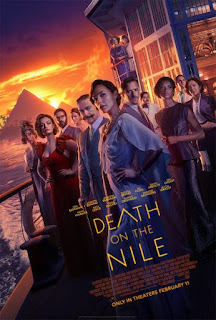
Death on the Nile--The prologue to Kenneth Branagh's sumptuous new adaptation of Agatha Christie's 1937 novel offers us some backstory on an iconic element of Hercule Poirot's image. It's very much like an origin story in a superhero movie.

It's hard to say how much this episode will be to the liking of hardcore Christie purists, just as it was hard to say how such enthusiasts would feel about Branagh's previous outing as the vain, dapper, extravagantly mustachioed Belgian super-sleuth with the OCD tendencies and the potent "little gray cells"; in 2017 he directed and starred in a flashy Murder on the Orient Express. Now Poirot is cruising down the title river in a palatial paddleboat full of shifty frenemies of a rich beauty (Gal Gadot) and her rakish new husband (Armie Hammer). There are cryptic clues and overheard motives and skulkings around Abu Simbel. It all culminates in murder, and among the suspects are Annette Bening, Letitia Wright, Dawn French, Jennifer Saunders, Tom Bateman, Russell Brand, Ali Fazal, Emma Mackey, Sophie Okonedo and others.

The script, as with Orient Express, is by Michael Green, and once again there's a sense that he and Branagh are gleefully shaking up Christie's staid and bigoted worldview, trying to get to her to roll in her grave (the film has, anyway, the blessing of her great-grandson, Executive Producer James Prichard, who runs Agatha Christie Limited). While the plot, in outline, and the solution to the mystery are essentially the same as in the novel and the enjoyable all-star movie version of 1978 with Peter Ustinov as Poirot, this is still a very free adaptation, with characters added, subtracted and altered for the sake of greater diversity in race and sexuality.

The period sets and costumes are luxurious, as is the cinematography of Haris Zambarloukos, who brought a very different look to Branagh's Belfast. The direction also has plenty of Branagh's characteristic flamboyance and old-school theatrics. Christie was fascinated by the setting (in addition to this book she also set a novel, 1944's Death Comes as the End, in ancient Egypt), so whatever she thought of the characterizations, she might well have liked this movie's lush Egyptian atmosphere; the camera takes in the sights on the riverbanks, and even snoops around below the surface at times.

It may be that contemporary audiences (and critics) will find this a laborious throwback, but I found it not only an opulent, sometimes sexy treat, but also surprisingly emotional; far more so than the 1978 version. This element comes, mostly, from Branagh's heartfelt performance. At key points his Poirot rises to the level of the tragic, like his Shakespeare did in that one great speech about the penknife in 2018's otherwise badly uneven All Is True. In both cases, it's the kind of masterly acting that likely won't get award nominations, but will richly reward attentive viewers. Provided, of course, that we use our little gray cells.

Friday, November 12, 2021

THINK YOU'VE GOT TROUBLES?

Opening this weekend:

Belfast--One day in 1969, nine-year-old Buddy is walking home through the teeming, friendly streets of his working-class, religiously-mixed neighborhood in the title city. Just before he gets there, a furious mob suddenly rounds the corner and starts smashing windows of his Catholic neighbors. Before long the streets are full of tanks and soldiers and barricades.

This is the beginning of "The Troubles," the decades-long strife between Protestants and Catholics in Belfast. But for Buddy (Jude Hill), the more pressing issues are his crush on a beautiful classmate, or which movie he'll be taken to see, or keeping straight which road his fire-and-brimstone (Protestant) clergyman recommends he take to avoid damnation.

We see the struggles of his beautiful, decent mother (Caitriona Balfe), to raise him and his siblings during the frequent and lengthy absences of his loving but financially nonchalant father (Jamie Dornan), and the gentle teasing between his mutually adoring grandparents (Judy Dench and Ciaran Hinds), all through Buddy's eyes. We also see his father's courageous refusal to be roped in to the mob by local protestant thugs, and we hear his parents debate whether to leave their beloved hometown.

The film, written and directed by Kenneth Branagh, is largely autobiographical; it's much like Branagh's version of John Boorman's great Hope and Glory (1987), about childhood fun during the Blitz. After a glimpse of modern-day Belfast, the movie is rendered in crisply beautiful black and white by cinematographer Haris Zambarloukos, with moments in vivid color when Buddy sees movies like One Million Years B.C. or Chitty Chitty Bang Bang, or when he's taken to see A Christmas Carol onstage.

The period detail is convincing, and the acting is terrific, with Dench and Hinds unsurprisingly filching big chunks of the movie as the grandparents. Their roles, especially Dench's, are arguably underwritten, but they let us see, without telegraphing, oceanic expanses of love and worry and pride behind their offhanded manner. Branagh confers a child's-eye glamor on Dornan and Balfe; the latter lets us see her passionate nature in a couple of scenes in which she dances. And young Hill is splendidly unfussy and direct as Buddy.

Not every aspect of Belfast works; Buddy's crush, for instance, doesn't build up much audience investment, and his siblings barely register. But the movie sneaks up on you emotionally. By the end I was in tears, very honestly won.

Also, any movie with a soundtrack made up of one Van Morrison tune after another is sure to be worth seeing, if only for that.