Showing posts with label GAL GADOT. Show all posts

Friday, February 11, 2022

NILE BE YOUR HUCKLEBERRY

Opening only (and worth seeing in) the multiplexes this weekend...
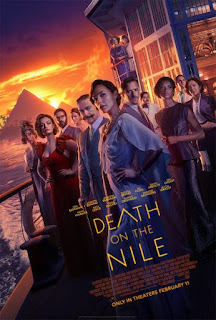
Death on the Nile--The prologue to Kenneth Branagh's sumptuous new adaptation of Agatha Christie's 1937 novel offers us some backstory on an iconic element of Hercule Poirot's image. It's very much like an origin story in a superhero movie.

It's hard to say how much this episode will be to the liking of hardcore Christie purists, just as it was hard to say how such enthusiasts would feel about Branagh's previous outing as the vain, dapper, extravagantly mustachioed Belgian super-sleuth with the OCD tendencies and the potent "little gray cells"; in 2017 he directed and starred in a flashy Murder on the Orient Express. Now Poirot is cruising down the title river in a palatial paddleboat full of shifty frenemies of a rich beauty (Gal Gadot) and her rakish new husband (Armie Hammer). There are cryptic clues and overheard motives and skulkings around Abu Simbel. It all culminates in murder, and among the suspects are Annette Bening, Letitia Wright, Dawn French, Jennifer Saunders, Tom Bateman, Russell Brand, Ali Fazal, Emma Mackey, Sophie Okonedo and others.

The script, as with Orient Express, is by Michael Green, and once again there's a sense that he and Branagh are gleefully shaking up Christie's staid and bigoted worldview, trying to get to her to roll in her grave (the film has, anyway, the blessing of her great-grandson, Executive Producer James Prichard, who runs Agatha Christie Limited). While the plot, in outline, and the solution to the mystery are essentially the same as in the novel and the enjoyable all-star movie version of 1978 with Peter Ustinov as Poirot, this is still a very free adaptation, with characters added, subtracted and altered for the sake of greater diversity in race and sexuality.

The period sets and costumes are luxurious, as is the cinematography of Haris Zambarloukos, who brought a very different look to Branagh's Belfast. The direction also has plenty of Branagh's characteristic flamboyance and old-school theatrics. Christie was fascinated by the setting (in addition to this book she also set a novel, 1944's Death Comes as the End, in ancient Egypt), so whatever she thought of the characterizations, she might well have liked this movie's lush Egyptian atmosphere; the camera takes in the sights on the riverbanks, and even snoops around below the surface at times.

It may be that contemporary audiences (and critics) will find this a laborious throwback, but I found it not only an opulent, sometimes sexy treat, but also surprisingly emotional; far more so than the 1978 version. This element comes, mostly, from Branagh's heartfelt performance. At key points his Poirot rises to the level of the tragic, like his Shakespeare did in that one great speech about the penknife in 2018's otherwise badly uneven All Is True. In both cases, it's the kind of masterly acting that likely won't get award nominations, but will richly reward attentive viewers. Provided, of course, that we use our little gray cells.

Friday, December 25, 2020

PROMISING WOMEN, VARIOUS AGES

 Merry Christmas everybody! In theaters today:

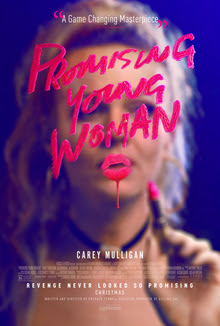
Promising Young Woman--Cassie, played by Carey Mulligan, is "promising" in a rather grim sense here: promising as prey. Guys find her alone in bars, tipsy and mumbling. They gallantly offer her a ride, then when the get her back to their places, they start to undress and assault her. At this point, she drops the bleary manner and they realize that she isn't drunk at all, and they're in trouble.

She was on track to graduate med school, but something bad happened, and now Cassie lives with her worried parents (Clancy Brown and Jennifer Coolidge) and works by day in a coffee bar. A pleasant young doctor (Bo Burnham) that she knew back in school buys coffee one day, and flirts with her, and she's pulled into a romance with him, but her secret nighttime hobby persists.

The feature directing debut of the English actress and writer Emerald Fennell, this revenge shocker explores the ugly truth that men widely regard an incapacitated woman as, quite literally, fair game; Cassie's would-be rapists react to her trap as if it's a mean and unfair trick. But Fennell is more ambitious than merely giving us the satisfaction of seeing the tables turned on these creeps. She's determined to have Cassie take on the whole structure that tolerates rape culture; the enablers, the passive witnesses, etc.

The results are quite convoluted and brutal and harsh. But Fennell and Mulligan maintain an edge of caustic wit that gives the film a charge. It ends with a smile, but not a smile that lets us off the hook.

WW84--Wonder Woman was introduced in the comics in 1941 to fight Nazis and Mussolini and other thugs of that period. Her first star vehicle in the movies, just three years ago, reset her origin story in the World War I era. This cheeky sequel, with Gal Gadot returning as Diana, has her living in Washington D.C. in the mid-'80s, working at the Smithsonian and not looking a day older than she did when Woodrow Wilson was president.

Diana befriends a supposedly dowdy, recessive coworker (Kristin Wiig), and runs afoul of a blustering TV conman (Pedro Pascal), a "Greed is Good," You-Can-Have-It-All type, who has stumbled upon the supernatural power to grant people's wishes, but who, of course, has never heard about being careful what you wish for. This same rather vague McGuffin allows Diana to reunite with her love interest from the earlier film, Steve Trevor (Chris Pine). Before the end of this two-and-half-hour tale, we get the origin of WW's Invisible Jet, and our heroine also has to grapple with a new iteration of one of her '40s-era enemies from the comics, the were-cat known as The Cheetah. 

Returning director and co-writer Patty Jenkins generates period through style as well as sets and costumes; the film often feels like an overstuffed '80s big-budgeter. I lived in D.C. in the late '80s, and neighborhoods where I worked are featured in a number of scenes, which gave me an extra nostalgic buzz. It's all a bit fuzzy around the edges, but it doesn't take itself too seriously, and like the first movie, though perhaps more so, it has a generous spirit. Gadot is good company once again, and Wiig brings both humor and unexpected anger to her role.

The TV fraud's worldwide mischief results in the appearance of a huge wall, of national and international chaos, and of the threat of nuclear war. It's just possible he's meant to remind us of somebody or other.

Friday, June 2, 2017

I AM WHAT I AMAZON

Opening this week:


Wonder Woman—DC's pioneering superheroine finally takes the lead in a feature film with this lavish origin story, set in the World War I era. The title character, Diana by name, has grown from a feisty little girl into the impressive adult form of Gal Gadot on the secret, hidden island of the Amazons, under the watchful eye of her Mom Queen Hippolyta (Connie Nielsen). Against Hippolyta's wishes, she's secretly trained as a warrior by her aunt, Antiobe (Robin Wright, sporting an accent to vaguely match Nielsen's and Gadot's).

One day Diana rescues daredevil American spy Steve Trevor (Chris Pine), who happens upon the island while escaping from the Germans. She's appalled when she learns of the ubiquity of war in the outside world, and she's convinced it's the malicious work of Ares the war god. She decides, again over Mom's objections, to let Trevor take her to the Front in Europe, where she plans to identify Ares, kick the crap out of him, and end war on Earth once and for all. She's not ambitious or anything.

With Trevor, she travels first to London and then, with a ragtag group of ethnically mixed sidekicks, to Belgium, and learns that shutting down war isn't as simple as it ought to be. She also runs afoul of various villains, among them a scarred chemist known as Doctor Poison (Elena Anaya, masked much as she was in Almodovar's superb The Skin I Live In).

Setting this movie during WWI, rather than having Wonder Woman battling the Nazis as she was originally created to do (the character debuted in the comics in 1941), initially seemed wrong to me, and there were moments where the dialogue and other details seemed off, period-wise. I'd guess that, among other reasons, the filmmakers wanted Diana to enter civilization at an even less emancipated time for her gender; they wanted her to encounter corsets and petticoats. They may also have wanted less familiar, less easily loath-able bad guys than the Nazis, so as to spread around the blame for warmongering more equitably among all humankind.

In any case, as the movie progressed my resistance to it quickly wore off. Wonder Woman isn't quite as slick as last year's Dr. Strange, but it's more touching, and like Dr. Strange, it's a non-facetious superhero flick that it's possible to wholeheartedly enjoy, almost from beginning to end. The movie is colorful and playful, even sunny at times, but better still there's a lack of cynicism to it, an openhearted, unembarrassed sense of decency and heroism that's highly gratifying after years of self-consciously "dark" comic-book sagas.

This tone is reflected in the warmth and emotional directness of Gadot's performance—she has a quick throwaway scene involving an ice cream cone that made me fall in love with her. The lack of coyness between her and Pine's Trevor is likewise refreshing. They don't tediously bicker or one-up each other.

Diana is so preoccupied with her mission that she barely seems to notice how she scandalizes the male authority figures she meets, ignoring their shock at her outspokenness as if it's too unimportant to acknowledge. And when she expresses disbelief at the matter-of-fact acceptance of war, she doesn't seem infantile, because director Patty Jenkins and the writers (Allan Heinberg among other hands) have structured the story so that we see our own civilization from her point of view.

The filmmakers grapple, while staying within a conventional template for this kind of movie, with the persistent limitation of superhero stories: The tendency to reduce all conflicts to a climactic brawl. That they don't prevail—the movie does indeed climax with a brawl, and one that's of questionable relevance to the vexing problem of the human tendency to make war not love—doesn't make the attempt any less honorable. 

Also opening in the Valley this week...


...is the historical drama Churchill, with the great Brian Cox playing the title role. I had the chance to chat with director Jonathan Teplitzky; you can read my interview on the New Times blog.

And Sunday evening at FilmBar Phoenix...


...is a showing of The Quiet Earth, the 1985 sci-fi classic from New Zealand, with an introduction and Q&A by co-writer and co-producer Sam Pillsbury. You can read my short article on this memorable flick on the Phoenix Magazine blog.

Friday, March 25, 2016

THE CAPES OF WRATH

Opening this week:

  
Batman v Superman: Dawn of Justice—The title sounds like a Supreme Court Case, but it just refers to a spat between the two biggest names in the DC superhero stable. The Man of Steel thinks Gotham’s Dark Knight is a creepy vigilante, while the Caped Crusader thinks that the near-omnipotence of Krypton’s Favorite Son represents an existential threat to all humankind. Can either be called wrong with perfect confidence?

This had possibilities, certainly, and a deft director in Zack Snyder. And the film has its moments. The acting is quite strong—Ben Affleck makes a brooding, intriguing, suavely attractive Bruce Wayne, and his costume gives a perfectly competent performance as Batman. He’s far more credible as a superhero here than he was as Daredevil back in 2003.

Henry Cavill makes a serviceable Superman—like most actors who have played this role, his charm doubles whenever he’s in Clark Kent drag—and Jesse Eisenberg darkens his persona as a manic, nattering Lex Luthor. A young Israeli actress named Gal Gadot is introduced as Wonder Woman; she doesn’t get much to do, but she is unquestionably a wonder.

Parts of the clash between the title icons are amusing, but mostly Batman v Superman is an overwrought, laborious, punishingly heavy slog. The conflict is muddled and lacking in urgency, there isn’t nearly enough humor, and, above all, the movie is too freakin’ long. It’s TOO. FREAKIN’. LONG. By at least twenty minutes, probably more.

Various theories can be advanced as to why so many blockbuster action movies insist on being so outrageously overlong. But I would rather this review, unlike Batman v Superman itself, remain brief. 


City of Gold—This documentary challenges the commonplace that good stories require conflict. It’s a portrait of Pulitzer-Prize-winning L.A. Times restaurant critic Jonathan Gold, and it has almost none.

For an hour and a half, we watch the pleasant fellow galumph around the Greater L.A. area, going to Mom and Pop ethnic restaurants where adoring owners serve him plates of delicious-looking food. He takes a brief side trip to New York to dine with his idol Calvin Trillin, but otherwise that’s pretty much the whole movie, in terms of content. None of the talking heads have an unkind word to say about him; no appalling personal tragedies are revealed.

Of course, we do learn that Gold is a chronic procrastinator. A newspaper columnist who procrastinates? What a shocker! And his environmentalist brother gently reproves him for his fondness for overfished varieties of sushi. That’s about as much Shakespearean drama as we get.

But director Laura Gabbert, abetted by Bobby Johnston’s fine score, keeps City of Gold gliding along enjoyably. Gabbert’s bird’s-eye dissection of L.A.’s neighborhoods is fascinating and undeniably glamorous, and the movie works as genteel food porn as well. Mere humans may feel a pang of envy at seeing someone so seemingly contented with and well-rewarded by his talents, but Gold comes across so unassumingly that it doesn’t deepen into resentment.