Check out my review of Supergirl...

...online at Phoenix Magazine.
Available to stream:

Superman and the Mole Men--The new Superman flick is "too woke," or so I'm hearing, in the opinion of Fox News and other commentators, mostly because of writer-director James Gunn pointing out in an interview that the Man of Steel is an immigrant. Fox host Tomi Lahren pronounced, without seeing the film, that it "went woke and will probably flop!"
She also sneered that "in his comments Gunn conveniently forgot to delineate between IMMIGRANTS and ILLEGALS, but that's par for the course..." [caps her's] This would be a more withering criticism if Lahren hadn't "conveniently forgot" that, um, Clark Kent aka Superman certainly is an illegal, undocumented alien, by any standard.
Other voices from around the MAGA-verse have similarly squawked, I understand. Why am I taking note of these dimwits rising to Gunn's well-dangled bait? Because I shudder to think what howling accusations of wokeness they would direct at the very first Superman feature film, 1951's Superman and the Mole Men. This very low-budget, 58-minute saga, produced for Lippert Pictures, was intended essentially as a pilot for the long-running syndicated TV series The Adventures of Superman (1952-1958) starring George Reeves. In terms of liberal social and civic values, this movie is woke like a grad student on Red Bull.
The story here unfolds not in Metropolis but in the small town of Silsby, "home of the world's deepest oil well." Indeed, they've drilled so deep in Silsby that they've encroached upon the underground civilization of the Mole Men. These dome-headed, furry little goobers, who have come to the surface to explore, make whatever they touch glow with phosphoresence (they're played, by the way, by little people including Munchkin veterans Jerry Maren, Billy Curtis and John T. Bambury, and "Philip Morris Bellboy" Johnny Roventini).

Clark Kent (George Reeves) and Lois Lane (Phyllis Coates) arrive in town to do a story for the Daily Planet about the well, only to find the company shutting it down, fearing radioactivity. As word spreads about the Mole Men, the townies quickly start to organize into a mob. Before long, it's clearly a job for Superman.
While movies don't come much more cinematically bare-bones than Superman and the Mole Men, it's heart-lifting to watch in the context of our current times, because it's clear-eyed about where the real threat in our society lies, when it it comes to aliens and other outsiders: with ourselves. Clark/Superman is sympathetic to the Mole People, and the villains in the story are the reckless, bloodthirsty, xenophobic townspeople, led by a gun-wielding bigmouth played by the great Jeff Corey. It's very easy to picture this guy in a red cap.

The conflict that this movie depicts, however crudely, between seething, reflexive hatred and fear of strangers and openminded welcome of them to our immigrant-made republic seems every bit as ingrained now as it was then, and of course that's depressing. What's cheering, however, is that Superman, at least this vintage of him, has been on the right side of this divide from the start: the side of Truth, Justice and the very best version of The American Way.
Opening in theaters today...

Superman--It's excellent, so a certain poet has told us, to have a giant's strength, but tyrannous to use it like a giant. Before James Gunn's Superman has started, the title character (David Corenswet) has pre-emptively interceded to stop the invasion of one country by another, without causalities and in near-certainty that in so doing he has prevented murder and oppression. It's obvious to him that he's done the right thing, but even so, his action strikes some as overbearing, and public opinion of the Man of Steel shifts.
This is all connected, it turns out, to the scheming of Lex Luthor (Nicholas Hoult) to neutralize Superman and consolidate sanctioned power. Superman ends up imprisoned and subjected to torture by kryptonite in an interdimensional "pocket universe" run by Lex. Clark Kent's girlfriend Lois Lane (Rachel Brosnahan) and her colleagues at the Daily Planet are on the case, as, with varying degrees of urgency, are Superman's pals in "The Justice Gang."
Best of all, he's got a dog on his side. Krypto, introduced in the comics in 1955, finally gets a proper live action screen treatment here, in a vivid CGI rendering. As in the comics, Gunn depicts the superdog as a sweet-natured and well-intentioned but not always well-behaved creature; he could use a PetSmart obedience class. But he's still a good boy.
Gunn's achievement with this new movie is considerable. The writer-director has managed to make a version that feels original and imaginative, but also authentic; it truly looks and feels like Superman, as much as the George Reeves or Christopher Reeve or Kirk Alyn films or any earlier versions. It's not a perfect movie by a long shot, but it's bold and fun and cheerfully messy; its virtues far outweigh its faults.
Gunn also explores some stimulating ideas here, as if in response to anyone who might wonder if this superficially naive American myth has anything left to teach us. Among these themes is the question--always relevant to interventionist-minded America--of whether omnipotence, even if it was possible and even if it was linked to genuinely good intentions, would inevitably lead to correct action.
It's hard, as it is so often with comic-book and fantasy films these days, not to read contemporary allegorical significance into them. In his spite and resentful envy, Lex seems a lot like our current president; on the other hand, in his calculated efforts to take over our military-industrial power structure, he also seems quite a lot like our current president's biggest donor. As played by Hoult, however, he's more appealing than either of them.
Hoult's performance is one of many in what feels like a truly ensemble cast. Corenswet is one of the few actors to play this role who are at least as charming as Superman as he is in Clark Kent drag. Gunn's attempt to give an explanation as to why nobody sees through Superman's transparent disguise is unnecessary, however; it's just an accepted convention, like a Shakespearean heroine undetectably disguising herself as a boy.
Brosnahan may be the sexiest of all Lois Lanes, or at least since Phyllis Coates back in the first season of the TV show, and she's plucky and loyal and lovable too. Skyler Gisondo makes a fine, competent Jimmy Olsen, Wendell Pierce gets little screen time as Perry White but feels right, and Pruitt Taylor Vince and Neva Hall are touchingly more rustic than usual as Clark's Smallville parents. On the superhero side, Edi Gathegi is a hoot as a dour, taciturn Mister Terrific; so is Nathan Fillion as a dyspeptic, self-impressed Green Lantern (of the Guy Gardner vintage).
This Superman is overambitious, and more than a little uneven. What I liked least about it was the pocket universe. It gets the movie in over its head, front-loading Lex with too much power. If he can puncture and fracture space and time like this, why should he worry about getting the government's permission for anything?
My distaste for this device goes beyond this point of plausibility, though. If anyone's asking (no one seems to be) I would invite superhero flicks to take a nice long break from dimensional portals, and time/space rifts and alternate universes (except with Dr. Strange, of course; that's his shtick). Also, from crumbling buildings. Enough with the crumbling buildings. It's time to shake off that post-9/11 mentality.
What I liked best about the movie, however, is what it isn't: It isn't "dark." It isn't brooding, or gritty, or cynical. The title character isn't, in the usual sense, cool; Superman uses words like "golly" and "gosh" and Gunn doesn't seem to mean it as camp, or to be more than gently mocking his hero. Even Lois rolls her eyes at Clark's guilelessness here, but he's unperturbed, and so was I, as a viewer. It's taken this genre a long time to work its way around to the idea that being an unabashed, unapologetic good guy is truly punk rock. But it's been worth the trip.

Sorry, Baby--Agnes, a young professor, lives alone in a farmhouse in the Massachusetts woods. It could be the setting for an old-school scary movie, but this film is about a more appallingly common sort of horror.
As the movie starts, Agnes (Eva Victor) is welcoming her best friend and former roomie Lydie (Naomie Ackie) for a visit. The two share a blankie on the couch and catch up on their lives, talking with hilarity about the follies of sex. They're having fun, but it's clear that something heavy from the past hangs in the air. Gradually, in chapters that flash back and forward, we learn what it is: Agnes is a survivor of sexual assault.
Written and directed by star Victor, Sorry, Baby is a spectacular debut, restrained and economical yet emotionally intense, poignant yet frequently funny, unpredictable yet believable from beginning to end. Again and again, Victor catches us off guard, using suggestion and distance to get across an outrage, or undercutting misery with quiet but insistent comedy, or with the unexpected restorative grace of a "really good sandwich."
Agnes is a tour de force role, and Victor is devastatingly good, one minute displaying crisp comic timing, another the depths of psychological distress. The supporting cast is mostly for support, but Ackie is a pleasure as usual. Lucas Hedges is serviceable as the neighbor guy that helps Agnes start rebuilding trust, and John Carroll Lynch, reliable as ever, has an excellent scene as the stranger with the sandwich. As a rabidly competitive professional rival to Agnes, Kelly McCormack may seem a little caricatured, but probably less so if you've spent much time around academics.
Victor seems determined not to let the movie be oppressive; to give full measure to the crime that it's depicting but also to the beauty and joy that Agnes takes in life in spite of her trauma and loss. We see her teaching a lit class, and get a hint of her love of and skill at what she does. We see her find a kitten in the street, and how this relationship jolts her soul awake. Somehow all this makes the crime against her more infuriating, not less.
The sequence at the end that explains the title suggests that Agnes may find the hovering, solicitous worry of her friends almost as much of a burden as what's she's suffered. No doubt that's a common feeling for survivors, but I couldn't help it; the movie made me feel the same way her friends do.
Somewhere, perhaps, some other critic may be writing a dissent, feeling a more graphic, less tacit dramatization of sexual abuse is called for. Maybe they're right. But it's hard for me to imagine a movie that generated more understanding of the impact of sexual abuse on a victim. It's one of the best films of the year.


From time to time Your Humble Narrator likes to sort through the stacks of old comic books of which he has far too many. A recent such rummage led me to reflect, on the last day of Black History Month, that I learned a fair amount of what little I know about black history not at school but from comics.
Although Adalifu Nama's Super Black: American Pop Culture and Black Superheroes (2011) is a lively and accessible study, its focus is deliberately narrow. As far as I can find, a comprehensive history of the black presence in comic books, both as characters and as artists, writers and publishers, is yet to be written. Reading up to review Marvel's Black Panther a few years ago, I came across a reprint of All-Negro Comics from 1947...

...which contained probably the earliest black superhero, Lion Man; even though the title was run out of business after only one issue, it left me wondering if it could have influenced the creation of T'Challa years later over at Marvel.
But in my collection, amongst the superhero, scary and funny titles, I found a number of civic-minded, non-fiction comics devoted to black history, most notably...

...the 169th issue of Classics Illustrated, Negro Americans: The Early Years, from 1969.
Classics Illustrated were highly abridged and expurgated adaptations of literary classics intended to interest kids in reading, and I was their success story: the dorky kid who actually became a bookworm at least partly because of the hours I spent poring over these mostly lame versions of Wells and Verne and Hugo and Melville and even Homer and Shakespeare.
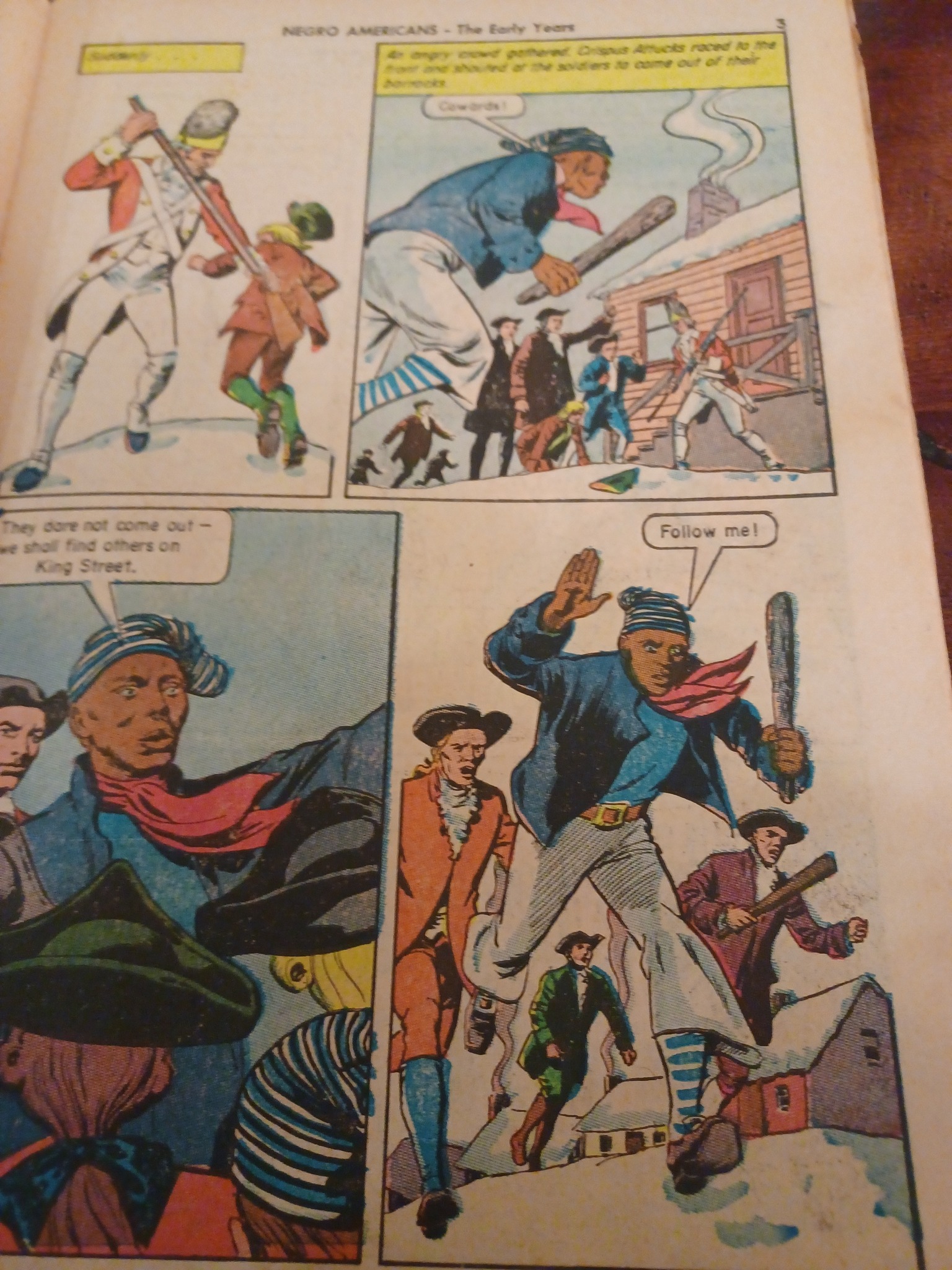
Negro Americans was different than the other Classics Illustrated titles, however, in that it wasn't based on a classic book; no author is credited. On the table of contents page it says "...we try to give accurate accounts of some of those black men and women who gave their talents and lives to their country during its formative years. Space allows us to show only a few of these black heroes...The efforts and triumphs of these black men and women live as their legacy to American heritage."
I bought this comic off the stands sometime in the early '70s, and learned from it--not from school--that Crispus Attucks was arguably the first man to die in the American revolution when he fell in the Boston Massacre...
...or about the advances in heart surgery by Daniel Hale Williams...

...among many other extraordinary accounts.

I also have the Classics Illustrated version of Uncle Tom's Cabin, from 1944...

..with better-than-average art for the series.

A while back I acquired (for a dollar an issue!) a full run of the Golden Legacy comics, a series of 16 books on black history published from 1966 to 1976. Most of them concern African-American history--Crispus Attucks, Harriet Tubman, Benjamin Banneker, Martin Luther King, Jr., arctic explorer Matthew Henson, Amistad mutineer Joseph Cinqué, and two volumes on Frederick Douglass, among others. But there are also issues on ancient African civilizations, on Toussaint L'Ouverture and the founding of Haiti, and on the ancestry of Dumas and Pushkin. Again, they didn't teach most of this stuff at my school.


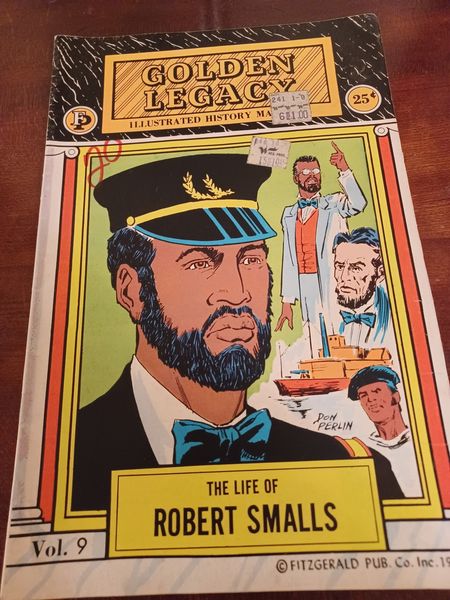

The art was pretty cool, too.
My stacks yielded a couple of '70s-era comics featuring Quincy, the everykid from Ted Shearer's newspaper strip...


They were published by King Comics, the periodical arm of King Features Syndicate. Along with Quincy's adventures with his white pal Nickels and others, the books featured educational content, teaching readers proper grammar, etc...

Moving away from educational comics, I found several issues of Midnight Tales, a creepy Charlton Comic that ran from 1972 to 1976. It's noteworthy not because of any specifically black content, but because the artist, the marvelous Wayne Howard (1949-2007), was probably the first African-American comic book artist to get a "Created by" credit on his title. Indeed, he was one of the first artists of any race to do so; comic books were usually uncredited in earlier decades.
In Midnight Tales Howard, in collaboration with writer Nicola Cuti, dreamed up Dr. Cyrus Coffin, aka "The Midnight Philosopher," who collected strange yarns with his beautiful raven-haired neice Arachne. I still think it would make a wonderful TV series on, say, the CW Network.
I love the macabre wit in Howard's artwork...


Or my favorite of his covers, from the first issue...


How much had Dr. Frankenstein been drinking when he made that mistake?
Finally, I came across a striking 1984 issue of All-Star Squadron, DC's superhero team-up title set in the 1940s. This particular story...

...is set against the real-life backdrop of the white mob violence against residents of the Sojourner Truth housing project in Detroit in 1942. More strikingly, it features black superhero Will Everett, aka Amazing Man, facing off against a hooded supervillain wonderfully called "Real American," who has the hypnotic power not only to turn the white citizens into mindless, violent racist rioters, but to have the same effect on some of Amazing Man's superhero allies.

Hard to imagine that some Republicans in congress wouldn't love to get their hands on that technology...
With Jurassic World Dominion opening this weekend, Your Humble Narrator has been more than usually preoccupied with dinosaurs, which is surely saying something. Thus, going through stacks of my old comics, I've noticed a recurrent motif:
Kona, Monarch of Monster Isle; Dell 1965:


Marvel Two-in-One, Marvel, 1983:

Judge Dredd; Eagle Comics 1984:

Aquaman; DC 1992:

Shanna the She-Devil; Marvel 2005:

And finally, Superman in Action Comics; DC 1991:

So, just as Anaïs Nin chronicled her erotic adventures in Paris, and as George Orwell recorded his experiences in the Spanish Civil War, I will here thrill you with a tale from the world of obsessive comic hoarding: I had long sought a copy of that Action Comics issue with the beautiful Kerry Gammill cover, and spent hours in various comic stores and junkshops digging through dusty boxes of old funnybooks hoping to turn one up, without success. I resisted the temptation to simply order one from Amazon or eBay on the grounds that it would be far more satisfying to find one through honest rummaging, and that if I cheated and ordered a copy online I would soon face the bitter comeuppance of then finding it, probably for less money.
But one day, with the kind birthday present of an Amazon gift certificate further weakening me, I broke down and ordered. No joke, TWO DAYS LATER, as I strolled the aisles of a junkshop, I spotted a box of comics, idly flipped through the first two or three in it, and...there it was. For about four dollars less.
So now I have two...

Opening this weekend...

The Batman--Time for yet another retelling of the tale of the poor little rich boy, orphaned by criminals, who dresses up as a bat and deploys gadgetry to fight crime. This version, we're assured, is "dark." Not colorful and campy, like the '60s-era TV show; not whimsical, like the Tim Burton series of the '80s and '90s; not epic and Wagnerian, like the more recent series featuring the laryngitic Christian Bale. Strange how durable and flexible this silly myth has proven.
This one is indeed dark, both literally and thematically; dim and shadowy and focused on hidden corruption. Directed by Matt Reeves from a script he wrote with Peter Craig, The Batman is set early in the career of Bruce Wayne (Robert Pattinson) as the Caped Crusader. His costume, gizmos and vehicles seem like works in progress, and his Gotham police ally James Gordon (Jeffery Wright) is a Lieutenant, not yet the Commissioner.
Gordon and The Batman are looking for The Riddler (Paul Dano), who is bumping off prominent members of Gotham's law enforcement community, and whose cryptic messages to our hero suggest that he's trying to drag some of the city's slimy secrets into the light. Gotham underworld figures like Carmine Falcone (John Turturro) and The Penguin (Colin Farrell, buried in makeup) are involved, as is young Selina Kyle (Zoe Kravitz), who's investigating the disappearance of her girlfriend. The lithe, acrobatic Selina dresses in cat-like gear and has an apartment full of cats; she is, you might say, a cat woman.
There's a lot to like about the movie. Grieg Fraser's cinematography has a dank and gloomy beauty, and seeing The Batman recoil in fear when he comes to the edge of a tall building or miscalculate a descent and clip himself painfully against an overpass is a highly agreeable counter to the parkour-style effortlessness of so many contemporary action heroes.
The actors are strong, too. Pattinson is low-key, but he has the same sallow, Byronic glamour he's shown in other roles, and he's sympathetic, as is Wright, and Andy Serkis as a fretful Alfred. Turturro and Farrell bring a realistic feel to their mobster parts, and Peter Sarsgaard makes his shady D.A. squirmy and weaselly but also pitiable.
The standouts are Dano and Kravitz; Dano's rather squalid take on the Riddler turns truly scary when he starts stretching his words out into deep, indignant bellows. He seems far less like a movie supervillain and more like the pathetic, yet more terrifying, attempts of real-life crazies to emulate a supervillain (as in Aurora, Colorado). Kravitz brings the movie a much-needed breeze of brisk but breathable fresh air. She's the audience surrogate in the film; despite her feats of derring-do she comes across as more sensible and relatable than anyone else.
Against all of these merits, The Batman is too long. It's way too freakin' long. It's nearly three hours of above-average moviemaking of its kind, but three hours is a heavy dose of shadows and fog. The brooding atmosphere suggests that we're in for devastating, morally challenging revelations, but what we get, while coherent, isn't especially surprising. And then, just as we seem to have gotten to the bottom of the case, the movie tacks on a blowed-up-real-good disaster finale that feels jarringly out of tune with the more intimate crime-story flavor of what has gone before.
I thought that superhero pictures were starting to cure themselves of their straining need to pile on climax after climax, seemingly in frantic fear that audiences will feel that they haven't been given enough for their money. The Batman is a step backward in this regard.
It occurred to me that The Batman feels, in atmosphere and pretensions, exactly like what was so sublimely spoofed by 2017's The Lego Batman Movie. It isn't every day that the target of a parody shows up five years after the parody itself.
Opening this weekend...

The Suicide Squad--Sort of a Dirty Dozen for the comic book world, The Suicide Squad is a team of DC supervillains offered suicide missions in return for reduced sentences. The premise debuted in 1959 in the team-up title The Brave and the Bold, and was revived in the late '80s. It made it to the movies in 2016 as Suicide Squad; this sequel adds a "The" to the title.
James Gunn directed this darkly comedic adventure, in which the Squad, led by Bloodsport (Idris Elba) under the direction of Colonel Flag (Joel Kinnaman) and Amanda Waller (Viola Davis), invades a small South American country which harbors a sinister alien force. Wild gory violence ensues, making Deadpool look like Paw Patrol.
The film is self-consciously brutal and cynical, as well as foul-mouthed and sexually frank; as such it can at times feel a bit wearyingly like reading the nihilistic yet energetic poetry of an angry sixteen-year-old. Yeah, yeah, you may want to say, life sucks, got it.
Even so, there's a lot to like in the film. Elba, who wisely plays it very straight, is always good company, and Margot Robbie, back as The Joker's jilted, cheerfully lethal girlfriend Harley Quinn, is as endearing as ever. Peter Capaldi only has one really juicy scene as a mad scientist, but he makes it count, and Jon Cena is quite droll as gung-ho '60s-era superhero Peacemaker. My own favorite is lovely, kindly Daniela Melchior as Ratcatcher, who can communicate with and command rats the way Aquaman can lead the fish.
I also loved Starro, the giant, colorful cyclopean starfish that menaces the team in the movie's nutty climax. He strongly resembles the aliens from the 1956 Japanese sci-fi flick known in the U.S. as Warning from Space, but he's a lot less benign.
Merry Christmas everybody! In theaters today:
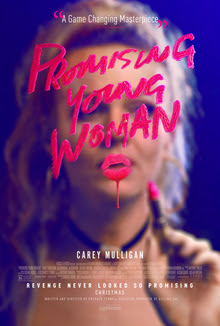
Promising Young Woman--Cassie, played by Carey Mulligan, is "promising" in a rather grim sense here: promising as prey. Guys find her alone in bars, tipsy and mumbling. They gallantly offer her a ride, then when the get her back to their places, they start to undress and assault her. At this point, she drops the bleary manner and they realize that she isn't drunk at all, and they're in trouble.
She was on track to graduate med school, but something bad happened, and now Cassie lives with her worried parents (Clancy Brown and Jennifer Coolidge) and works by day in a coffee bar. A pleasant young doctor (Bo Burnham) that she knew back in school buys coffee one day, and flirts with her, and she's pulled into a romance with him, but her secret nighttime hobby persists.
The feature directing debut of the English actress and writer Emerald Fennell, this revenge shocker explores the ugly truth that men widely regard an incapacitated woman as, quite literally, fair game; Cassie's would-be rapists react to her trap as if it's a mean and unfair trick. But Fennell is more ambitious than merely giving us the satisfaction of seeing the tables turned on these creeps. She's determined to have Cassie take on the whole structure that tolerates rape culture; the enablers, the passive witnesses, etc.
The results are quite convoluted and brutal and harsh. But Fennell and Mulligan maintain an edge of caustic wit that gives the film a charge. It ends with a smile, but not a smile that lets us off the hook.

WW84--Wonder Woman was introduced in the comics in 1941 to fight Nazis and Mussolini and other thugs of that period. Her first star vehicle in the movies, just three years ago, reset her origin story in the World War I era. This cheeky sequel, with Gal Gadot returning as Diana, has her living in Washington D.C. in the mid-'80s, working at the Smithsonian and not looking a day older than she did when Woodrow Wilson was president.
Diana befriends a supposedly dowdy, recessive coworker (Kristin Wiig), and runs afoul of a blustering TV conman (Pedro Pascal), a "Greed is Good," You-Can-Have-It-All type, who has stumbled upon the supernatural power to grant people's wishes, but who, of course, has never heard about being careful what you wish for. This same rather vague McGuffin allows Diana to reunite with her love interest from the earlier film, Steve Trevor (Chris Pine). Before the end of this two-and-half-hour tale, we get the origin of WW's Invisible Jet, and our heroine also has to grapple with a new iteration of one of her '40s-era enemies from the comics, the were-cat known as The Cheetah.
Returning director and co-writer Patty Jenkins generates period through style as well as sets and costumes; the film often feels like an overstuffed '80s big-budgeter. I lived in D.C. in the late '80s, and neighborhoods where I worked are featured in a number of scenes, which gave me an extra nostalgic buzz. It's all a bit fuzzy around the edges, but it doesn't take itself too seriously, and like the first movie, though perhaps more so, it has a generous spirit. Gadot is good company once again, and Wiig brings both humor and unexpected anger to her role.
The TV fraud's worldwide mischief results in the appearance of a huge wall, of national and international chaos, and of the threat of nuclear war. It's just possible he's meant to remind us of somebody or other.


