Showing posts with label WEIRD-ASS OLD COMICS. Show all posts

Tuesday, May 12, 2026

BARACK-NID

Time for another edition of my infrequently recurring feature "Weird-Ass Old Comics." This time, we're looking at...

...The Amazing Spider-Man, issue #583, from March of 2009. This is a much more latter-day vintage of comic than I would normally collect; obviously it was the presence of President (then President-Elect) Barack Obama, sharing the cover with Spidey, that made me pick it up. But I had never gotten around to reading it.

Last week Obama was the guest of Stephen Colbert in a prerecorded interview from the Obama Presidential Center, slated to open on June 19th in Chicago. The comic was shown on display at the Center--Colbert teased Obama about having been featured on a Spider-Man cover before Obama was (issue #573, November of 2008)--so I dug out my copy and read it.

Obama doesn't appear in the comic's main story, a sweet feature about Peter Parker's long-suffering office pal Betty Brant. Betty is weary of Petey's tendency to stand her up or be late, little knowing that he's off battling villains while she's waiting.

According to an editorial note, the brief "Bonus Back-Up Feature" about Obama, scripted by Zach Wells and drawn by Todd Nauck, was a last-minute add after the Marvel folks learned from an interview in The Telegraph that Obama was a fan of the webslinger. In the Colbert interview, Obama mentioned his superheroes of choice as a kid were Spider-Man and Batman, which made me swell with pride; same two for me.

In the short saga "Spidey Meets the President!" Petey, in D.C. to photograph the inauguration, switches into Spider-Man to prevent The Chameleon from impersonating Obama and becoming President 44. When Obama realizes that, his Secret Service detail notwithstanding, Spidey is the right man for the job and gives him the green light to take action, Spidey delivers the tale's best line: "Ya hear that Chameleon? The President-Elect here just appointed me...SECRETARY OF SHUTTIN' YOU UP!"

It was poignant to see the Obama interview last week, even though I'm not a 44 fanboy. I've always liked him, but he was never anywhere near as boldly progressive as I wanted him to be, or as I think he could have been, especially if he had acted decisively early on. I'm not at all sure Biden, doddering but clear-eyed and out of  f*cks, wasn't more decisive. Even so I think that, graded on the curve of what he accomplished versus what he was up against, Obama was likely the best American President of my lifetime.

But when you see a man of Obama's poise and grace and reflective intelligence and plain decency in contrast to what we have now, it's both terrifying and mortifying. If The Chameleon had successfully impersonated Obama's successor, we might well be better off.

Wednesday, August 6, 2025

TWOFER THE SHOW

Time, or possibly past time, for another edition of my very occasional recurring feature in which I discuss weird-ass old comics from my stacks. With The Fantastic Four: First Steps now in theaters, it's appropriate we check out an adventure of The Thing, with The Human Torch in support, paired with none other than...


...The Man of Bronze himself, Doc Savage. It's an issue of Marvel Two-in-One from November of 1976.

But wait, I hear you object (if you're a nerd), how can such a pairing be? The Doc Savage pulps were set in the 1930s and '40s, while The Fantastic Four began in the early '60s.

Well, Marvel finds a way. As the issue begins, we see storylines in two periods on either side of the pages, ingeniously paralleling each other across the decades...


Apparently this clever conceit wasn't thought sustainable, as a few pages in writer Bill Mantlo trumps up a time warp which drops Doc and his cronies together with The Thing and The Torch.


Perplexed as they are at each other's presence, they team up to take on Black Sun (later known as The Nth Man) in his debut appearance, a supervillain created when a power mad rich guy and his equally power mad son are joined into a single formidable fiend through the power of the stars.

It ends rather anticlimactically. But the beginning is quite an ingenious use of the Two-in-One format; a shame they didn't try to take the parallel plot gimmick all the way through to the end.

Tuesday, February 28, 2023

PANEL DISCUSSION

From time to time Your Humble Narrator likes to sort through the stacks of old comic books of which he has far too many. A recent such rummage led me to reflect, on the last day of Black History Month, that I learned a fair amount of what little I know about black history not at school but from comics.

Although Adalifu Nama's Super Black: American Pop Culture and Black Superheroes (2011) is a lively and accessible study, its focus is deliberately narrow. As far as I can find, a comprehensive history of the black presence in comic books, both as characters and as artists, writers and publishers, is yet to be written. Reading up to review Marvel's Black Panther a few years ago, I came across a reprint of All-Negro Comics from 1947...

...which contained probably the earliest black superhero, Lion Man; even though the title was run out of business after only one issue, it left me wondering if it could have influenced the creation of T'Challa years later over at Marvel.

But in my collection, amongst the superhero, scary and funny titles, I found a number of civic-minded, non-fiction comics devoted to black history, most notably...

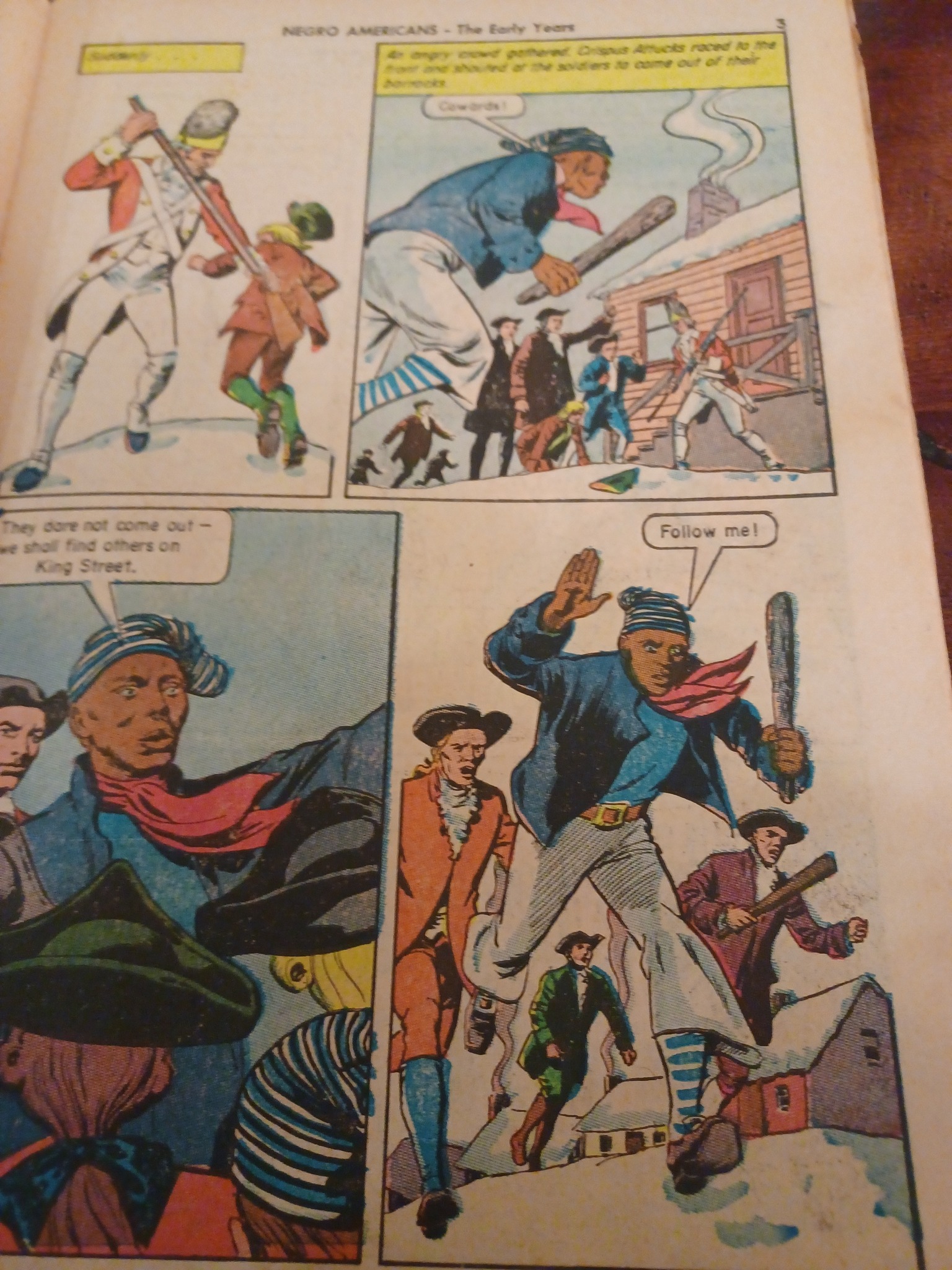
...the 169th issue of Classics Illustrated, Negro Americans: The Early Years, from 1969.

Classics Illustrated were highly abridged and expurgated adaptations of literary classics intended to interest kids in reading, and I was their success story: the dorky kid who actually became a bookworm at least partly because of the hours I spent poring over these mostly lame versions of Wells and Verne and Hugo and Melville and even Homer and Shakespeare.

Negro Americans was different than the other Classics Illustrated titles, however, in that it wasn't based on a classic book; no author is credited. On the table of contents page it says "...we try to give accurate accounts of some of those black men and women who gave their talents and lives to their country during its formative years. Space allows us to show only a few of these black heroes...The efforts and triumphs of these black men and women live as their legacy to American heritage."

I bought this comic off the stands sometime in the early '70s, and learned from it--not from school--that Crispus Attucks was arguably the first man to die in the American revolution when he fell in the Boston Massacre...

...or about the advances in heart surgery by Daniel Hale Williams...

...among many other extraordinary accounts.

I also have the Classics Illustrated version of Uncle Tom's Cabin, from 1944...


..with better-than-average art for the series.

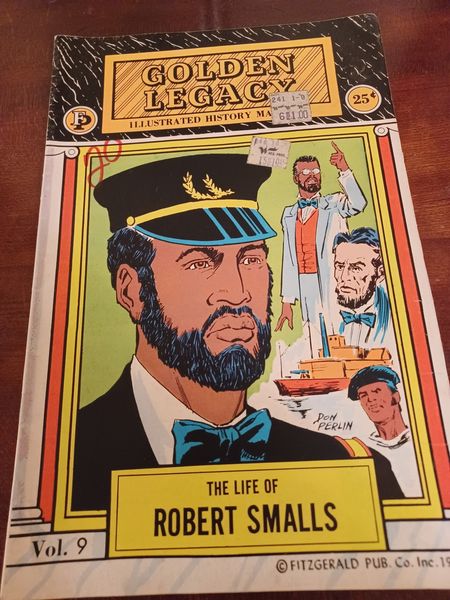
A while back I acquired (for a dollar an issue!) a full run of the Golden Legacy comics, a series of 16 books on black history published from 1966 to 1976. Most of them concern African-American history--Crispus Attucks, Harriet Tubman, Benjamin Banneker, Martin Luther King, Jr., arctic explorer Matthew Henson, Amistad mutineer Joseph Cinqué, and two volumes on Frederick Douglass, among others. But there are also issues on ancient African civilizations, on Toussaint L'Ouverture and the founding of Haiti, and on the ancestry of Dumas and Pushkin. Again, they didn't teach most of this stuff at my school.


The art was pretty cool, too.

My stacks yielded a couple of '70s-era comics featuring Quincy, the everykid from Ted Shearer's newspaper strip...


They were published by King Comics, the periodical arm of King Features Syndicate. Along with Quincy's adventures with his white pal Nickels and others, the books featured educational content, teaching readers proper grammar, etc...

Moving away from educational comics, I found several issues of Midnight Tales, a creepy Charlton Comic that ran from 1972 to 1976. It's noteworthy not because of any specifically black content, but because the artist, the marvelous Wayne Howard (1949-2007), was probably the first African-American comic book artist to get a "Created by" credit on his title. Indeed, he was one of the first artists of any race to do so; comic books were usually uncredited in earlier decades.

In Midnight Tales Howard, in collaboration with writer Nicola Cuti, dreamed up Dr. Cyrus Coffin, aka "The Midnight Philosopher," who collected strange yarns with his beautiful raven-haired neice Arachne. I still think it would make a wonderful TV series on, say, the CW Network.

I love the macabre wit in Howard's artwork...


Or my favorite of his covers, from the first issue...


How much had Dr. Frankenstein been drinking when he made that mistake?

Finally, I came across a striking 1984 issue of All-Star Squadron,  DC's superhero team-up title set in the 1940s. This particular story...

...is set against the real-life backdrop of the white mob violence against residents of the Sojourner Truth housing project in Detroit in 1942. More strikingly, it features black superhero Will Everett, aka Amazing Man, facing off against a hooded supervillain wonderfully called "Real American," who has the hypnotic power not only to turn the white citizens into mindless, violent racist rioters, but to have the same effect on some of Amazing Man's superhero allies.

Hard to imagine that some Republicans in congress wouldn't love to get their hands on that technology...

Wednesday, June 8, 2022

TAKE THIS JAW AND SHOVE IT

With Jurassic World Dominion opening this weekend, Your Humble Narrator has been more than usually preoccupied with dinosaurs, which is surely saying something. Thus, going through stacks of my old comics, I've noticed a recurrent motif:

Kona, Monarch of Monster Isle; Dell 1965:


Fantastic Four; Marvel 1975:


Jungle Action Featuring The Black Panther; Marvel 1975:

Marvel Two-in-One, Marvel, 1983:

Judge Dredd; Eagle Comics 1984:

Aquaman; DC 1992:

Shanna the She-Devil; Marvel 2005:

And finally, Superman in Action Comics; DC 1991:

So, just as Anaïs Nin chronicled her erotic adventures in Paris, and as George Orwell recorded his experiences in the Spanish Civil War, I will here thrill you with a tale from the world of obsessive comic hoarding: I had long sought a copy of that Action Comics issue with the beautiful Kerry Gammill cover, and spent hours in various comic stores and junkshops digging through dusty boxes of old funnybooks hoping to turn one up, without success. I resisted the temptation to simply order one from Amazon or eBay on the grounds that it would be far more satisfying to find one through honest rummaging, and that if I cheated and ordered a copy online I would soon face the bitter comeuppance of then finding it, probably for less money.

But one day, with the kind birthday present of an Amazon gift certificate further weakening me, I broke down and ordered. No joke, TWO DAYS LATER, as I strolled the aisles of a junkshop, I spotted a box of comics, idly flipped through the first two or three in it, and...there it was. For about four dollars less.

So now I have two...

Wednesday, August 25, 2021

POPE CULTURE

Like so many people of my generation, I've read and loved comic books since I was a small child. Over the last year or two, however, for some reason I've experienced a resurgence in my enthusiasm for weird-ass comics from the vintage of my own childhood and youth (and earlier), including titles I missed back then. Here, for instance, is an odd specimen I had never heard of, but which I turned up recently in the same junkshop stacks in which I found the Classics Illustrated version of Wild Animals I Have Known. This one is the 1982 Marvel Comic The Life of John Paul II.

"THE ENTIRE STORY!" the cover promises, "FROM HIS CHILDHOOD IN POLAND TO THE ASSASSINATION ATTEMPT!" This was, almost certainly, the only time that the face of JP2 ever shared a cover with the face of Spider-Man. I also love that the Pontiff gets his own little upper-left-hand corner box illustration...

...by which Marvel allowed browsers to flip through the rack and spot their favorites without pulling whole issues out, just like Spidey or Iron Man or She-Hulk or any other superhero. His superpower, I guess, is Infallibility when speaking Ex Cathedra.

Anyway, home with me it went.

This book has no ads or editorial content, no "Marvel Bullpen Bulletins" or "Stan Lee's Soapbox," no full-page strip advertisement in which the Pope uses Hostess Fruit Pies to outwit an enemy. The back cover...

...depicts the Papal Coat of Arms.

The script, by Marvel veteran Steven Grant (later of The Punisher), uses a sort of Citizen Kane structure, with an American reporter waiting for a Papal appearance at Yankee Stadium in 1979 ("Me? I'm a newspaper man--and The Pope is my beat!"), and thinking back over the Pontiff's life as Karol Wojtyla back in Poland. We learn of his love of sports...

...his youth in the theatre, his struggles as a seminarian during the Nazi occupation of Poland...

...his rise to Cardinal, then to Pope...

The comic is at pains to place its admiration for the Pope on a social and secular basis...


...lest anybody suppose that Marvel, of all entities, had gone into the business of Catholic proselytism.

According to the inside back cover, the comic came about when Gene Pelc, a Marvel rep in Tokyo, became friends with a certain Father Julian, a Polish priest serving in Japan. In 1980 Marvel had published a comic book biography of St. Francis (!) called Francis, Brother of the Universe. Father Julian liked it, and thought Marvel should try their hand at a comic-book bio of JP2 as well; Father Mieczyslaw Malinski, who had been a pal of the Pope's when he was still Karol From the Block, was made "Consulting Editor."

Despite the secular disclaimers, though, the result is on the hagiographic side; it's largely a reverent, uncritical account. Which was the tricky part for me, because...I've never been a big fan.

Don't misunderstand: Though I was raised Presbyterian, I come from a heavily Catholic town, went to a Catholic college, had close friends, teachers and mentors who were Catholic, dated and married Catholic women. I've always found the Catholic world seductive, from the dazzling theatricality of its rituals and trappings to the mind-expanding, soul-wounding power of its philosophy, theology and art. The cultural legacy of Catholicism, for beautiful and for horrible, for nightmarish and for glorious, is awe-inspiring to me.

But JP2? For me, always kind of meh.

After John Paul I offered a flicker (possibly illusory) of hope for a more progressive direction for the Church, JP2, while undeniably formidable and charismatic, marked a return to dour, paternalistic, my-way-or-the-highway conservatism. He always seemed to me like part of the Neocon Holy Trinity of the '80s, along with Ronald Reagan and Margaret Thatcher. Even back then I would have regarded him as the least hypocritical, most intellectually complex, and indeed most admirable of that trio, but nonetheless his hardline positions on issues like gay rights, abortion and birth control struck me as harmful, and still do.

But while it didn't completely change this feeling in me, this improbable collaboration between the Vatican and Marvel--and I'm afraid that the values and ideals promulgated by Stan Lee's cornball comic empire of the '80s are closer to my heart than those of the Vatican from the same period--made me take into consideration JP2's staunch insistence on human equality, his ecumenism, his opposition to the death penalty, his capacity for forgiveness, etc. And thus this comic taught me an embarrassing truth about myself: If Marvel Comics thinks you're OK, I'm likely to give you the benefit of the doubt.