Showing posts with label CLASSICS ILLUSTRATED. Show all posts

Tuesday, February 28, 2023

PANEL DISCUSSION

From time to time Your Humble Narrator likes to sort through the stacks of old comic books of which he has far too many. A recent such rummage led me to reflect, on the last day of Black History Month, that I learned a fair amount of what little I know about black history not at school but from comics.

Although Adalifu Nama's Super Black: American Pop Culture and Black Superheroes (2011) is a lively and accessible study, its focus is deliberately narrow. As far as I can find, a comprehensive history of the black presence in comic books, both as characters and as artists, writers and publishers, is yet to be written. Reading up to review Marvel's Black Panther a few years ago, I came across a reprint of All-Negro Comics from 1947...

...which contained probably the earliest black superhero, Lion Man; even though the title was run out of business after only one issue, it left me wondering if it could have influenced the creation of T'Challa years later over at Marvel.

But in my collection, amongst the superhero, scary and funny titles, I found a number of civic-minded, non-fiction comics devoted to black history, most notably...

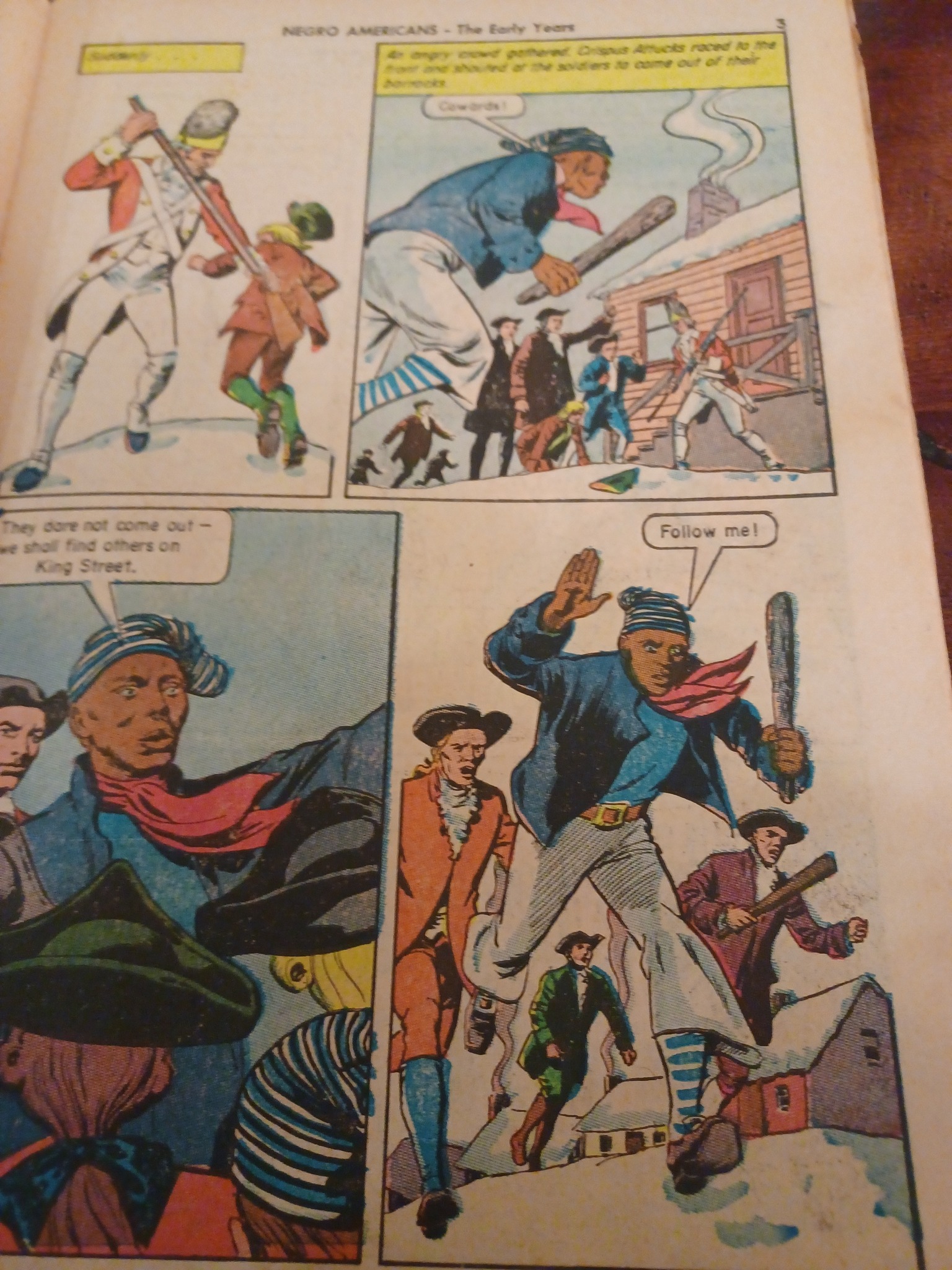
...the 169th issue of Classics Illustrated, Negro Americans: The Early Years, from 1969.

Classics Illustrated were highly abridged and expurgated adaptations of literary classics intended to interest kids in reading, and I was their success story: the dorky kid who actually became a bookworm at least partly because of the hours I spent poring over these mostly lame versions of Wells and Verne and Hugo and Melville and even Homer and Shakespeare.

Negro Americans was different than the other Classics Illustrated titles, however, in that it wasn't based on a classic book; no author is credited. On the table of contents page it says "...we try to give accurate accounts of some of those black men and women who gave their talents and lives to their country during its formative years. Space allows us to show only a few of these black heroes...The efforts and triumphs of these black men and women live as their legacy to American heritage."

I bought this comic off the stands sometime in the early '70s, and learned from it--not from school--that Crispus Attucks was arguably the first man to die in the American revolution when he fell in the Boston Massacre...
...or about the advances in heart surgery by Daniel Hale Williams...

...among many other extraordinary accounts.

I also have the Classics Illustrated version of Uncle Tom's Cabin, from 1944...


..with better-than-average art for the series.

A while back I acquired (for a dollar an issue!) a full run of the Golden Legacy comics, a series of 16 books on black history published from 1966 to 1976. Most of them concern African-American history--Crispus Attucks, Harriet Tubman, Benjamin Banneker, Martin Luther King, Jr., arctic explorer Matthew Henson, Amistad mutineer Joseph Cinqué, and two volumes on Frederick Douglass, among others. But there are also issues on ancient African civilizations, on Toussaint L'Ouverture and the founding of Haiti, and on the ancestry of Dumas and Pushkin. Again, they didn't teach most of this stuff at my school.


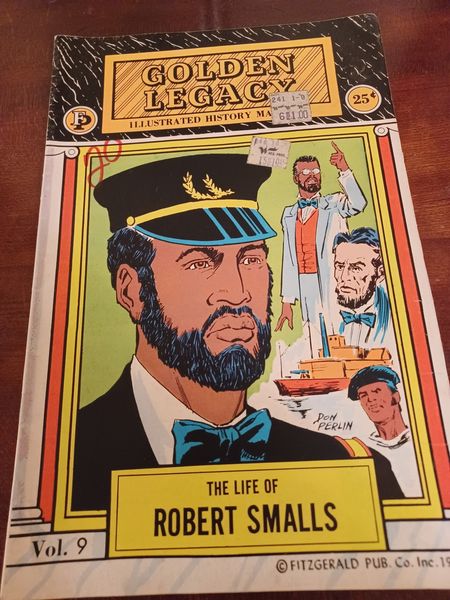

The art was pretty cool, too.

My stacks yielded a couple of '70s-era comics featuring Quincy, the everykid from Ted Shearer's newspaper strip...


They were published by King Comics, the periodical arm of King Features Syndicate. Along with Quincy's adventures with his white pal Nickels and others, the books featured educational content, teaching readers proper grammar, etc...

Moving away from educational comics, I found several issues of Midnight Tales, a creepy Charlton Comic that ran from 1972 to 1976. It's noteworthy not because of any specifically black content, but because the artist, the marvelous Wayne Howard (1949-2007), was probably the first African-American comic book artist to get a "Created by" credit on his title. Indeed, he was one of the first artists of any race to do so; comic books were usually uncredited in earlier decades.

In Midnight Tales Howard, in collaboration with writer Nicola Cuti, dreamed up Dr. Cyrus Coffin, aka "The Midnight Philosopher," who collected strange yarns with his beautiful raven-haired neice Arachne. I still think it would make a wonderful TV series on, say, the CW Network.

I love the macabre wit in Howard's artwork...


Or my favorite of his covers, from the first issue...


How much had Dr. Frankenstein been drinking when he made that mistake?

Finally, I came across a striking 1984 issue of All-Star Squadron,  DC's superhero team-up title set in the 1940s. This particular story...

...is set against the real-life backdrop of the white mob violence against residents of the Sojourner Truth housing project in Detroit in 1942. More strikingly, it features black superhero Will Everett, aka Amazing Man, facing off against a hooded supervillain wonderfully called "Real American," who has the hypnotic power not only to turn the white citizens into mindless, violent racist rioters, but to have the same effect on some of Amazing Man's superhero allies.

Hard to imagine that some Republicans in congress wouldn't love to get their hands on that technology...

Wednesday, July 21, 2021

MESSED-UP COMIC BOOKS I HAVE KNOWN

What follows here is the product of an extremely low-level case of buyer's remorse, about a half-century old. Sometime in the very early '70s, when I was eight or ten, I was poking around in an airport newsstand on a layover during a family trip. I don't remember which airport--somewhere in the south, most likely--or where we were going or headed back from, or why. I don't remember much about it at all, really, except for a comic book that I didn't buy: The Classics Illustrated version of Wild Animals I Have Known, by Ernest Thompson Seton.

Classics Illustrated was a long line of comic book adaptations of respectable literature put out by Gilberton and, later, Frawley Publishing from the early '40s until around the time of my airport layover. They were aimed, mostly, at boys, stuff like The Three Musketeers and The Last of the Mohicans, though they did do versions of Jane Eyre and Lorna Doone. The drawing was variable but often pretty bad; the colors were garish; the stories not only ridiculously abridged but also expurgated. The best thing about them, in many cases, was the dramatic painted covers (in this regard they were like Gold Key comics, which I also loved as a kid).

They were an influential part of my childhood: My stack included the line's numerous versions of the tales of Jules Verne and H.G. Wells, Dr. Jekyll and Mr. Hyde, Frankenstein, The Hunchback of Notre Dame, Moby Dick, The Odyssey, Julius Caesar and A Midsummer Night's Dream, among many others. Well, there was a rack of them in the newsstand, and I was able to secure a quarter from my Mom to buy one for the flight. But which to buy? I was drawn to Wild Animals I Have Known, with its striking orange-tinged cover featuring the snarling face of a wolf. But there was another one that I also wanted.

I think there may have been an application to my Mom for a second quarter so I could get both; it was declined. In the end I chose the other comic, not Wild Animals, as my purchase. What the other title was I cannot remember at all, but through all these years the cover of Wild Animals I Have Known stuck in my memory, though I never came across the comic again, or knew anything more about the book upon which it was based.

Then a few weeks ago I was going through a stack of old comics in a junkshop, and there it was: That same looming wolf face, in a near-mint copy. Classics Illustrated used a heavy, durable "slick" paper for their covers, with the result that used editions are often in much better shape than other old comics. Needless to say, I bought it.

And I took it home and read it. Good Lord. I made the right choice back at the newsstand.

Or maybe not; it was, in any case, memorable, which the comic I bought apparently wasn't.

Wild Animals I Have Known, the book, was published in 1898. Seton, a Brit who came to the U.S. after many years in Canada, was a naturalist and folklorist, and a co-founder of the Boy Scouts of America. He was one of the nature writers targeted by the likes of John Burroughs and Theodore Roosevelt in the long-running "nature fakers controversy" of the early 1900s, on the charge that he sentimentalized and anthropomorphized his subjects, attributing to animals such human traits as love, loyalty and self-sacrifice, as well as vengeance and spite.

Classic Illustrated's version of his best-known book is not, however, the warm and fuzzy collection I was expecting. It begins with this declaration:

"These stories are about real animals. Almost all meet a tragic end, for this is nature's law concerning wild things. But in each is the stamp of greatness."

He isn't kidding. Spoiler and trigger alert: I'm going to give away the endings of several of his tales, and if you're one of the many people who can't abide depictions of animal suffering or death, this won't be your cup of tea.

Take, for instance, "Lobo," the story of the wolf on the cover. Seton recounts how he was hired to kill this cunning and ferocious leader of a wolf pack by ranchers in New Mexico around 1890. The creature outwits several of his efforts to trap him, but finally our narrator uses Lobo's great love for his mate Blanca against him; she's the only wolf Lobo will permit to run ahead of him, allowing Seton to trap her. He kills Blanca...

...then drags her body over more traps, and the grief-stricken Lobo is ensnared the next day. Lobo submits to be taken back to the ranch alive and chained up, but...

"When morning dawned he was still there, but his spirit had gone. The old king wolf was dead."

That's the characteristically blunt final line.

Another heart-warmer is "Wully," about a Scottish sheepdog of tireless devotion to his master Robin. When they take their flock to market, a stampede occurs and scatters them. Wully gathers them in. Robin counts the sheep and tells Wully one is missing; the dog, "stung with shame," hurries off into the city to find the missing sheep. While he's gone, a kid recounts the flock and informs Robin that he miscounted; all 734 are accounted for.

To which the old git replies: "Wully won't come back until he finds another sheep, even if he has to steal it. That could make me a lot of trouble. I might even lose my job."

So the bastard leaves without him. Wully spends years homeless, then miraculously finds a new gig herding sheep, but he's damaged goods; he becomes a secret killer of sheep on neighboring farms, and at the end he leaps at the throat of the new master's daughter, leaving the guy no alternative but to strike him down. The last line:

"A second blow stretched him lifeless on the hearthstone where so long he had been a faithful and honored retainer."

Then there's "Raggylug," about a rabbit that lives in a swamp with his mother, who defends him from predators. He eventually learns to lead vicious dogs and other hazards against other rabbits intruding on his turf. At the end he and his mother are fleeing a fox, and she tries to escape by swimming across an icy pond. She doesn't make it...

"She drifted backward, and now her strength was spent. In a little while the weak limbs ceased to move and the soft brown eyes closed...when he got back to the pond he could not find his mother, for she slept in the arms of her friend, the water that tells no tales."

On the other hand, the final panel, informing us of Rag's own fate, is as as close as these stories come to a happy ending...

"Rag lived on in the swamp. He found a wife and raised many children and grandchildren who, perhaps, live there to this day."

And finally, for you horse lovers, there's "The Pacing Mustang," set back in New Mexico in the 1890s. It's about the efforts of a cowboy named Jo Calone to capture a black wild mustang who "paces" instead of gallops. The creature eludes many attempts to catch him before ultimately going full Thelma & Louise...


"...with the last of his strength, he made for the top of a cliff. There he sprang into the vacant air to land upon the rocks below--lifeless, but free."

After all this, we get the standard outro: "NOW THAT YOU HAVE READ THE CLASSICS ILLUSTRATED EDITION, DON'T MISS THE ADDED ENJOYMENT OF READING THE ORIGINAL, OBTAINABLE AT YOUR SCHOOL OR PUBLIC LIBRARY." Yeah, not so much.

Having said that, while I don't think I would have "liked" this comic had I read it back then, in the usual sense of the word, I don't think I would have would have been traumatized by it, either. I think I might have felt respected by its unflinching presentation of the tragic, and I think I might have agreed that Seton's animal characters had the "stamp of greatness."

One other observation, with regard to the "Nature Fakers Controversy": I suspect that, whatever specific exaggerations, projections or romanticizations Seton may have indulged in these stories, in general he and his fellow "sentimentalists" have been shown to be in the right over the last few decades. The factor that has shown them to be right, curiously enough, is the rise of home video.

Thousands and thousands of widely circulated amateur videos of pets and wild creatures alike have suggested, to a degree that precludes fakery and in ways that would previously have been dismissed, that animals share the same emotions, personalities and potentials as humans. Turns out that Seton and his ilk weren't "anthropomorphizing" at all; they weren't attributing human traits to animals, they were simply recognizing that such traits weren't exclusive to humans.

Sunday, May 9, 2021

ZOLAR POWER

Junkshop find; a Classics Illustrated comic I had not seen before...

...this 45-page adaptation of The Downfall (more accurately, La Debacle), Zola's 600-ish-page 1892 doorstopper about the Franco-Prussian War...


I would love to have been at the editorial meeting, back in 1955, where this was pitched as Classics Illustrated material: "Come on, it's got everything! Class relations! The Battle of Sedan! The collapse of Napoleon III! The fall of Paris! The kids'll love it!"

Thursday, February 6, 2014

IN A LEAGUE OF ITS OWN

Happy birthday to the great Jules Verne!


It's been easy for me to remember that February 8 is Verne's birthday since I noticed it in his bio page in the back of some Classics Illustrated comic as a kid, and was filled with bitter envy of my friend Mike, who shared that birthday. Had I known in those days that I share a birthday with Leonard Nimoy, it might have lessened my envy somewhat.

Anyway...

Monster-of-the-Week: ...in Verne's honor let's give the nod to that terrifying sea titan, the giant squid from 20,000 Leagues Under the Sea, as spectacularly depicted in Disney's fine 1954 adaptation...


...or on the cover of the album which I played endlessly as a kid...


Check out Kirk Douglas singing "Whale of a Tale."

Friday, January 31, 2014

HORSE/SHOW

Again, Happy (Chinese) New Year! My pal, the brilliant artist Vince Larue, made these gorgeous horses for The Kid, who was born in the previous Year of the Horse:


Check out my list, on Topless Robot, of 12 Nerdy Alternatives to the Super Bowl.

However you spend it, I hope everybody enjoys UberBowl Sunday. If, like me, you’re mostly indifferent to football, you’ll enjoy the quiet streets, sparsely populated movie theaters and short waits at restaurants. If you’re a fan, you’ll enjoy the festivity of the day, the excitement of the game and the spectacle of the show.

You may also be one of those who enjoy the Super Bowl commercials, those little exercises in corporate ego that often showcase dazzling skill in compressed cinematic narrative. Last year, one of the more popular ads was the “Team” commercial for the Hyundai Santa Fe, in which a put-upon little kid assembles a football team of other wimpy-looking kids engaged in various macho activities—wrestling bears, etc.

One kid is welding some big, round, suspended metal structure covered with what look like square shutters, making it for all the world resemble the sphere that heroes take to the Moon in The First Men in the Moon by H. G. Wells.


Can that possibly be what was intended—that he's planning a trip to the Moon?

Thursday, December 8, 2011

PLUCK THEM

RIP to Henry “Harry” Morgan, departed at 96. Famous for Dragnet & the later seasons of M*A*S*H—though his best work on M*A*S*H was a hilarious guest-shot, as an unhinged & racist general, in the earlier seasons—Morgan was one of those actors that are so familiar that it’s easy not to notice how genuinely good & skillful & quietly real they were. This shows up at times even in the many mostly dreary late-vintage M*A*S*H episodes, but abundantly among his many film roles—notably, as Henry Fonda’s partner in The Ox-Bow Incident (1943). A friend also pointed out to me that he & Jack Webb were the bad guys in the 1951 noir Appointment With Danger.
RIP also to actor Bill McKinney, who despite a long & varied career is best remembered by far as one of the rapists...

...in Deliverance (1972)—a terrifying performance which immortalized the phrase “squeal like a pig”—departed at 80, to disco (& also porn) veteran Andrea True, departed at 68, & to Dobie Gray of “Drift Away” fame, who has drifted away at 71.

RIP, also, to my love affair with Chick-fil-A. I’m not proud of this, but I really, really loved those freakin’ sandwiches. They’re probably my all-time favorite fast food. Until this changes, however, they’ve sold me my last bird, & in the meantime they can kiss my ass.

So, in recognition of Chick-fil-A’s rottenness…

Monster-of-the-Week: …how about this Brobdingnagian broiler, this ponderous piece of poultry, from the cover of a 1961 Classics Illustrated adaptation of Food of the Gods by H.G. Wells: