Showing posts with label WONDER WOMAN. Show all posts

Monday, October 6, 2025

HANS ACROSS AMERICA

Friday night Your Humble Narrator had excellent seats to one of the more peculiar orchestral concerts I've ever attended: The World of Hans Zimmer.

(apologies in advance for my atrocious performance photographs)

My pal Kate kindly offered me a ticket to the Arizona stop of the show's current U.S. tour, at Desert Diamond Arena in Glendale. I had never heard of it, but it clearly has a following; though not quite a sell-out, the place was full and the crowd screamed and cheered like they would have for Barry Manilow or Kenny G, at least.

At a glance, the audience members looked roughly like the folks you might see at a film festival. Zimmer, as you may know, is a prolific, Oscar-winning German composer of film scores, usually for big Hollywood blockbusters. He wasn't present at the concert, except in video segments during which his giant mug bantered with the maestro, Matt Dunkley, or chatted onscreen with the likes of Jerry Bruckheimer or Guy Ritchie. The show is a multi-media event, with lighting effects and video screens showing expressionistic patterns...

...or clips from the movies.

But the stars were the onstage performers; according to Dunkley, 60 musicians from 18 countries, from Ukraine to Brazil to Lithuania to Turkey to Israel to Kenya to Lebanon to Northern Ireland to the United States, playing and singing lengthy suites from Driving Miss DaisyThe RockGladiatorInterstellar, Dune, Pearl HarborThe Prince of Egypt, Wonder Woman and others. They made up, quite simply, the most glamorous-looking orchestra I've ever seen.

Kate got her tickets from the solo cellist, Timothée Berte-Renou, seen here, or rather not visible here, behind a column of otherworldly light...

Again, the photo does him zero justice, but the French native's long flowing hair and romance-novel costumes gave him quite the dramatic stage presence as his mournful strings essentially stood in for the voice of Billie Eilish in the Bond movie No Time to Die. He was one of the stars of the evening, but far from the only one.

The show's apparent strategy was to let top-notch classical musicians behave onstage like rock stars, dancing, mugging, emoting, interacting, working the crowd, goofing around. The audience ate it up. 

The finale was from The Lion King...


...and the encore was a rousing suite from Pirates of the Caribbean

Genius though Zimmer unquestionably is, after hearing such a generous helping of his music all at once, I must admit that a large percentage of his work seems a little on the unvaried side. Some of his scores are distinctive, like Driving Miss Daisy with its delightful if ear-wormy clarinet theme. But when it comes to his action and superhero movies, I'm not sure I could confidently identify, without the intros and clips, which solemn, brooding, bombastic score went with The Rock or Interstellar or a Batman flick. On their own merits, however, each of them is potent.   

On balance, The World of Hans Zimmer was one of the nerdier shows I've ever been to, and that is surely saying something. I had a blast.

Friday, December 25, 2020

PROMISING WOMEN, VARIOUS AGES

 Merry Christmas everybody! In theaters today:

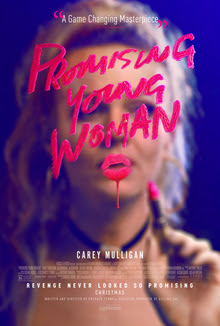
Promising Young Woman--Cassie, played by Carey Mulligan, is "promising" in a rather grim sense here: promising as prey. Guys find her alone in bars, tipsy and mumbling. They gallantly offer her a ride, then when the get her back to their places, they start to undress and assault her. At this point, she drops the bleary manner and they realize that she isn't drunk at all, and they're in trouble.

She was on track to graduate med school, but something bad happened, and now Cassie lives with her worried parents (Clancy Brown and Jennifer Coolidge) and works by day in a coffee bar. A pleasant young doctor (Bo Burnham) that she knew back in school buys coffee one day, and flirts with her, and she's pulled into a romance with him, but her secret nighttime hobby persists.

The feature directing debut of the English actress and writer Emerald Fennell, this revenge shocker explores the ugly truth that men widely regard an incapacitated woman as, quite literally, fair game; Cassie's would-be rapists react to her trap as if it's a mean and unfair trick. But Fennell is more ambitious than merely giving us the satisfaction of seeing the tables turned on these creeps. She's determined to have Cassie take on the whole structure that tolerates rape culture; the enablers, the passive witnesses, etc.

The results are quite convoluted and brutal and harsh. But Fennell and Mulligan maintain an edge of caustic wit that gives the film a charge. It ends with a smile, but not a smile that lets us off the hook.

WW84--Wonder Woman was introduced in the comics in 1941 to fight Nazis and Mussolini and other thugs of that period. Her first star vehicle in the movies, just three years ago, reset her origin story in the World War I era. This cheeky sequel, with Gal Gadot returning as Diana, has her living in Washington D.C. in the mid-'80s, working at the Smithsonian and not looking a day older than she did when Woodrow Wilson was president.

Diana befriends a supposedly dowdy, recessive coworker (Kristin Wiig), and runs afoul of a blustering TV conman (Pedro Pascal), a "Greed is Good," You-Can-Have-It-All type, who has stumbled upon the supernatural power to grant people's wishes, but who, of course, has never heard about being careful what you wish for. This same rather vague McGuffin allows Diana to reunite with her love interest from the earlier film, Steve Trevor (Chris Pine). Before the end of this two-and-half-hour tale, we get the origin of WW's Invisible Jet, and our heroine also has to grapple with a new iteration of one of her '40s-era enemies from the comics, the were-cat known as The Cheetah. 

Returning director and co-writer Patty Jenkins generates period through style as well as sets and costumes; the film often feels like an overstuffed '80s big-budgeter. I lived in D.C. in the late '80s, and neighborhoods where I worked are featured in a number of scenes, which gave me an extra nostalgic buzz. It's all a bit fuzzy around the edges, but it doesn't take itself too seriously, and like the first movie, though perhaps more so, it has a generous spirit. Gadot is good company once again, and Wiig brings both humor and unexpected anger to her role.

The TV fraud's worldwide mischief results in the appearance of a huge wall, of national and international chaos, and of the threat of nuclear war. It's just possible he's meant to remind us of somebody or other.

Friday, October 13, 2017

OIL RICH


A couple of gems open in the Valley this week:


Loving VincentThe producers stake an unusual claim for this Polish-British animated feature, six years in the making: that it’s the first completely oil-painted movie. Each of its 65,000 frames, we’re told, was meticulously hand-painted by a team of more than 100 artists, working over the previous frame’s image, all in the style of Vincent Van Gogh.

A documentary about the making of this quixotically crazy endeavor would be fascinating. As with Claymation back in the ‘70s and ‘80s, if you let yourself think too long about the labor you’re witnessing, you can start to feel overwhelmed and it can throw you out of the movie.

Happily, the movie itself isn’t just visually breathtaking, it’s also an engrossing little historical drama, well-acted by the Brit voice cast in a naturalistic manner. The story is set in 1891, the year after Van Gogh’s death, and centers on Armand Roulin (Douglas Booth), the young man in yellow from the famous portrait. Armand’s postmaster father Joseph, another Van Gogh subject, tasks his son with delivering a final letter from the genius to his brother Theo.

Armand travels from Arles to Paris, and then on to Auvers-sur-Oise, where Vincent died. Initially annoyed by the errand, Armand becomes increasingly fascinated as he delves into the mystery of Vincent’s death.

The directors, Dorota Kobiela and Hugh Welchman, working from a script they wrote with Jacek Dehnel, use Armand’s investigations to paint a portrait (if you’ll excuse the expression) of a truly loving Vincent. He’s beset with terrible emotional sufferings, certainly, but he’s sweet-natured and ecstatic in his visionary raptures.

But the thrill in the picture is seeing those immortal images brought to life. In the opening minutes alone, we get the Café Terrace, the Zouave reclining against the wall, Lieutenant Milliet, and so on, gliding easily into each other in service of the narrative.

I suppose there are cultural purists out there who might find using the works of one of the great figures in European art as, essentially, a storyboard, to be a crass, literal-minded stunt. But I was enchanted by this gloriously low-tech labor of love, both for Van Gogh and for the possibilities of the cinema.


Professsor Marston and the Wonder WomenThere’s something delicious about the knowledge that the furious accusations of mid-century anti-comics crusaders were, in at least one case, quite right. Wonder Woman, who debuted in 1941 in what would become DC Comics, really was rooted in fantasies of bondage, dominance and Sapphic power.

And not just fantasies, either, but realities. As we’re told in this amusing chronicle, the creator of the character, a Harvard-educated psychology professor named William Moulton Marston (writing under the name Charles Moulton), spun the Amazon by blending traits of the two women with whom he lived—his wife Elizabeth Holloway Marston, and Olive Byrne, a student and assistant who became the third member of their marriage.

It’s likely that the writer-director Angela Robinson (Herbie: Fully Loaded) has heated up the story a bit. But there are true elements that trump fiction, the juiciest being that before his comic-writing days, Marston was one of the developers of the systolic blood pressure test that led to the polygraph—in other words, he invented the Lasso of Truth in reality before he gave it to his heroine. As an adolescent in the ‘70s, watching the Lynda Carter TV version of Wonder Woman, I always found the Lasso of Truth shtick distinctly erotic; now I’d guess that Marston did too.

This movie’s historical accuracy is debatable, and some chapters work better than others, but Robinson has, any case, crafted maybe the wittiest and sweetest cinematic menage a trois in recent memory. Those looking for graphic sex will be disappointed—the threesome scenes, which involve a lot of dressing-up in theatrical costumes, are too tame and discreet for a Cinemax soft-core flick from the ‘90s. But something about their good-natured naïveté makes them sexy.

The charm in Professor Marston and the Wonder Women comes in the deadpan delivery of earnest dialogue by glamorous actors like Luke Evans as Marston and waif-like Bella Heathcote as Olive. There are nice supporting turns by Oliver Platt as early comic peddler Max Gaines and Connie Britton in a peculiarly flirtatious turn as early comic critic Josette Frank. We also see JJ Feild as fetish costumer Charles Guyette, here shown decking out Olive in a get-up very similar to Wonder Woman’s.

But the standout is Rebecca Hall as the brittle, unflappable (well, almost unflappable) Elizabeth. Her readings give a sharp edge even to lines that don’t have one built in, yet she somehow infuses them with a palpable undercurrent of love and emotional directness as well. I hate to resort to it, but indulge me: She’s a wonder.

Friday, June 2, 2017

I AM WHAT I AMAZON

Opening this week:


Wonder WomanDC's pioneering superheroine finally takes the lead in a feature film with this lavish origin story, set in the World War I era. The title character, Diana by name, has grown from a feisty little girl into the impressive adult form of Gal Gadot on the secret, hidden island of the Amazons, under the watchful eye of her Mom Queen Hippolyta (Connie Nielsen). Against Hippolyta's wishes, she's secretly trained as a warrior by her aunt, Antiobe (Robin Wright, sporting an accent to vaguely match Nielsen's and Gadot's).

One day Diana rescues daredevil American spy Steve Trevor (Chris Pine), who happens upon the island while escaping from the Germans. She's appalled when she learns of the ubiquity of war in the outside world, and she's convinced it's the malicious work of Ares the war god. She decides, again over Mom's objections, to let Trevor take her to the Front in Europe, where she plans to identify Ares, kick the crap out of him, and end war on Earth once and for all. She's not ambitious or anything.

With Trevor, she travels first to London and then, with a ragtag group of ethnically mixed sidekicks, to Belgium, and learns that shutting down war isn't as simple as it ought to be. She also runs afoul of various villains, among them a scarred chemist known as Doctor Poison (Elena Anaya, masked much as she was in Almodovar's superb The Skin I Live In).

Setting this movie during WWI, rather than having Wonder Woman battling the Nazis as she was originally created to do (the character debuted in the comics in 1941), initially seemed wrong to me, and there were moments where the dialogue and other details seemed off, period-wise. I'd guess that, among other reasons, the filmmakers wanted Diana to enter civilization at an even less emancipated time for her gender; they wanted her to encounter corsets and petticoats. They may also have wanted less familiar, less easily loath-able bad guys than the Nazis, so as to spread around the blame for warmongering more equitably among all humankind.

In any case, as the movie progressed my resistance to it quickly wore off. Wonder Woman isn't quite as slick as last year's Dr. Strange, but it's more touching, and like Dr. Strange, it's a non-facetious superhero flick that it's possible to wholeheartedly enjoy, almost from beginning to end. The movie is colorful and playful, even sunny at times, but better still there's a lack of cynicism to it, an openhearted, unembarrassed sense of decency and heroism that's highly gratifying after years of self-consciously "dark" comic-book sagas.

This tone is reflected in the warmth and emotional directness of Gadot's performance—she has a quick throwaway scene involving an ice cream cone that made me fall in love with her. The lack of coyness between her and Pine's Trevor is likewise refreshing. They don't tediously bicker or one-up each other.

Diana is so preoccupied with her mission that she barely seems to notice how she scandalizes the male authority figures she meets, ignoring their shock at her outspokenness as if it's too unimportant to acknowledge. And when she expresses disbelief at the matter-of-fact acceptance of war, she doesn't seem infantile, because director Patty Jenkins and the writers (Allan Heinberg among other hands) have structured the story so that we see our own civilization from her point of view.

The filmmakers grapple, while staying within a conventional template for this kind of movie, with the persistent limitation of superhero stories: The tendency to reduce all conflicts to a climactic brawl. That they don't prevail—the movie does indeed climax with a brawl, and one that's of questionable relevance to the vexing problem of the human tendency to make war not love—doesn't make the attempt any less honorable. 

Also opening in the Valley this week...


...is the historical drama Churchill, with the great Brian Cox playing the title role. I had the chance to chat with director Jonathan Teplitzky; you can read my interview on the New Times blog.

And Sunday evening at FilmBar Phoenix...


...is a showing of The Quiet Earth, the 1985 sci-fi classic from New Zealand, with an introduction and Q&A by co-writer and co-producer Sam Pillsbury. You can read my short article on this memorable flick on the Phoenix Magazine blog.