Showing posts with label CAREY MULLIGAN. Show all posts

Wednesday, December 13, 2023

FEEL THE BERNSTEIN

Now in the multiplexes; opening December 20 on Netflix:

Maestro--Bradley Cooper's imitation of Leonard Bernstein conducting is uncanny. Cooper captures Bernstein's histrionic, self-dramatizing, ecstatic style perfectly, and gets across how he used his gestures and facial expressions and body language not just to lead his musicians through a score but to tease the interpretation and intensity he wanted out of them.

The conducting scenes in this film, directed by Cooper from a script he wrote with Josh Singer, also suggest that the podium gave Bernstein a sense of liberation which he may have known in few other areas of his life. Cooper's performance, in general but particularly in these passages--especially a lengthy recreation of a celebrated performance of Mahler's "Resurrection Symphony"--is luminous.

I'll admit that it's taken me a while to come around where Bradley Cooper is concerned. But after A Star is Born and Nightmare Alley it was impossible to deny both his talent and the intelligence and heart with which he deploys it. Aided here by Kazu Hiro's amazing (and laughably controversial) prosthetic makeup, he gets across the conductor's mix of authority, of self-conscious, performative sophistication and of boyish wonder, and makes you see what made him beloved, both publicly and by his friends and family. You see what made him difficult, too.

Very wisely, Cooper chooses not to direct in the same florid manner that Bernstein conducted. Despite some flashy transitions, most of Maestro unfolds in long, sustained takes, beautifully shot by Matthew Libatique from a discreet distance; we're made almost into eavesdroppers at times. This directorial reserve balances the extravagant acting superbly.

The movie isn't a conventional biopic; there are no explanatory dates or places onscreen, no follow-up summary at the end, and only incidentally does it trace Bernstein's career highlights. The focus is on the relationship between Bernstein and the Costa Rican-born stage actress Felicia Montealegre (Carey Mulligan), who married him in 1951. The other characters, though well-drawn and convincingly played--Sarah Silverman is a good fit as Bernstein's sister Shirley--are decidedly subordinate to the leads.

According to the film, Montealegre was well aware, going in, that Bernstein was a gay man (though his affairs were not exclusively same-sex even before she came along). "Let's give it a whirl," she says breezily to him toward the beginning, and you think, uh-oh.

On the whole, they don't seem to have done too badly; they had three lovely kids, sensational careers, countless friends, and they seem to have profoundly loved each other. But entering into a marriage with somebody of uncongenial sexuality cannot come without turbulence, and this can only be compounded when they're a titanic cultural legend.

It's possible that even the movie itself succumbs to this, a little. With her brittle yet mirthful, keenly observant, wholeheartedly engaged line readings, Mulligan is marvelous; the spine and centering force of the movie (she's top-billed in the credits, even over Cooper). But we learn far less of Montealegre's remarkable career or her activism than we do about Bernstein. The movie sees her in relation to him, and doesn't always make clear how formidable she was in her own right, not just within the marriage but in the world at large.  Even when part of the point of the movie is the perils of putting yourself in the shadow of a legend, the person at the podium tends to get the attention.

Wednesday, November 22, 2023

SHORT PEOPLE GOT NOBODY

Opening in theaters today:


Saltburn--The title refers to the enormous, somewhat faded English country mansion in which most of the movie unfolds. But it may also suggest the proverbial pain of salt poured into a wound, as might be caused by the very sight of such a residence and the class system it represents.

Oliver Quick (Barry Keoghan), a slight, nebbishy scholarship student to Oxford, is befriended by a classmate, the blueblood Adonis Felix (Jacob Elordi), who invites him home for the summer to the title pile of bricks in 2007. Felix's family is a fairly gothic bunch--abstracted Dad Sir James (Richard E. Grant), blithe, cordial Mom Lady Elsbeth (Rosamund Pike) and addled wreck of a sister Venetia (Alison Oliver), along with the sneering biracial American cousin Farleigh (Archie Madekwe). Carey Mulligan is also around as Elsbeth's nutty parasitical friend Pamela, as is Paul Rhys as the imperious butler Duncan.

Rather quickly, Oliver finds himself enmeshed with each of the family members, and drawn into the intrigues and occasional casual decadence of their isolated and mysterious lifestyle. While Oliver initially seems like an honest but in-over-his-head parvenu, like Balzac's Rastingnac or Faulkner's Ben Quick, we gradually see that he has his own wormy, calculating, opportunistic side.

This is the second feature written and directed by Emerald Fennell of 2020's Promising Young Woman. If it's a sophomore slump, that probably says more about the incisive brilliance and focus of Promising Young Woman than it does about any shortfalls of its own. The fury that charged Fennell's first film was direct and uncomplicated. Seemingly wanting to get across something more subtle and nuanced about class, Saltburn flails around a bit and sometimes feels confused, overwrought, overlong, even borderline campy.

But stick with it. It ultimately adds up to a potent piece of moviemaking, and of storytelling. Shot with hallucinatory garishness by the marvelous Linus Sandgren, the movie brings its setting vibrantly to life; there's none of the comforting stodginess of, say, Downton Abbey to it. Better, Fennell's narrative is involving. Even as we sense the influence of everything from The Shining to Risky Business, we're also pulled into investment in a yarn we haven't seen before. And she doesn't let us down; despite the movie's gratuitous thrashing about, in the end the plot snaps together to a satisfying and fairly devastating point.

Fennell also gets uniformly superb performances from her cast. Probably the wittiest and most endearing is Rosamund Pike, but Barry Keoghan, maybe the single best thing about The Banshees of Inisherin, is spectacular here, giving a tour de force turn in a role that is not only wildly mercurial on an emotional and psychological level, but also required physical fearlessness. Saltburn may end up being most remembered for literalizing a common expression for finding somebody extremely attractive, but Keoghan's draining performance makes a splash. 


Napoleon--Returning to France, uninvited, from exile in Elba, the title character is confronted with a regiment of soldiers he used to command. "I missed you," he tells them, seemingly sincerely. Soon he's back in charge.

Apparently there is some historical basis for this scene; Napoleon is said to have had a fond and comradely relationship with his troops, despite his willingness to get them slaughtered. But to the casual viewer of this Ridley Scott epic, the moment may come as a surprise. Nothing in the movie prepares us for it. Played by Joaquin Phoenix, this Napoleon shows little affection or even interest toward anyone or anything apart from himself, and a certain almost adolescent erotic fixation on Josephine (Vanessa Kirby). In between campaigns, he makes rather unromantic attempts to impregnate her, and reacts with sullen outrage when they don't succeed.

Scott's movie, based on a script by David Scarpa, is largely a pageant of carnage. It begins with a graphic depiction of Marie Antoinette's meeting with Madame Guillotine, then shows us Napoleon navigating the deadly mayhem of the Revolution and the First Republic. It then traces him from battle to battle: Toulon, Austerlitz, Moscow and some of his other greatest hits, culminating, of course, against Wellington (Rupert Everett) at You-Know-Where.

This Napoleon isn't boring. It's entirely watchable and well-staged. Scott deploys his forces with the care of a child playing with toy soldiers on his bedroom floor. But it doesn't really hit hard emotionally; something is missing from it. Early on, we see a cannonball splat into the chest of a horse, and the resulting explosion of gore is so obviously computer-generated that, for me at least, it carried little shock (it has this in common with the splatter effects in Thanksgiving, which, exhaustingly enough, I saw the same day). This sort of detached unreality hangs over the movie's horrors, and the same detachment extends to the central character. 

While Phoenix holds our attention with his movie star charisma, it's as if he's working in a vacuum. Except here and there in his scenes with Kirby's drolly unflappable Josephine, Phoenix seems to be anomic, walled off from the other characters by his own narcissistic self-regard. Maybe that's deliberate; maybe Scott is trying to dramatize the Napoleon of Walter de la Mare's unforgettable poem:

What is the world, O soldiers?
It is I.
I, this incessant snow,
This northern sky.
Soldiers, this solitude
Through which we go
Is I.

In any case, the movie has a point to make about the appetite for an autocratic "strongman" leader that seems to inevitably arise in reaction to the messiness of democratic movements. It's a theme which would, admittedly, seem to have a slight smidge of relevance to our current times. It should be noted that, warmongering megalomaniac though he was, Napoleon was also a tremendously intelligent and curious person, which puts him in a very different category than our most notable current would-be Emperor.

Friday, January 6, 2023

WOMEN TALKING; WOMEN NOT TALKING

In theaters today:

Women Talking--In a hardcore religious farming colony, a group of men have been arrested for repeatedly tranquilizing and sexually violating women of all ages, including young children. The attacks have been attributed to ghosts or the Devil, or to "wild female imagination." With the farm to themselves for a couple of days before the men make bail, the minimally educated women sit around the barn and debate whether to forgive the men and carry on as before, to "stay and fight," or to leave the only home they've ever known. They've been told that if they leave, they will forfeit their place in the Kingdom of Heaven.

Written and directed by Sarah Polley from the novel by Miriam Toews--inspired by a real-life 2011 case at a Mennonite community of Canadian origin in Bolivia--this drama opens by calling itself, in subtitle, an act of female imagination. It certainly feels convincing. Superb actresses of all ages, ranging from Judith Ivey, Sheila McCarthy and a particularly forbidding Frances McDormand among the elders to Rooney Mara, Jessie Buckley and Claire Foy among the younger adults to some fine, lively women among the youth, embody the various responses, from seething, vengeful fury to sad acceptance.

Though the tone is inevitably somber, Polley's direction is deft, and she leavens the gloom with some high-spirited moments. Looking in from outside their world, many of us in the audience are likely to feel the most sympathy with the viewpoint of the enraged women who favor a violent response; the idea of a mass exodus from the scene of these atrocities sounds like a solid idea too. Forgiveness and a return to the status quo feels, in this instance, like a very distant third.

The movie also includes a token adult male, a gentle schoolteacher (Ben Whishaw, excellent as usual) not implicated in the attacks, who is allowed to take the minutes of their discussions because he can write. He's been to university outside the colony, and when a census-taker drives by in a car, blaring "Daydream Believer" by the Monkees, he softly sings along. The moment makes a pretty strong case for secular pop culture.

Now streaming:

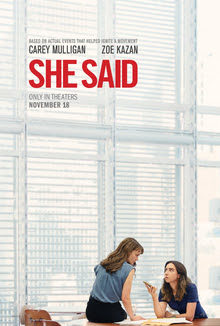
She Said--This chronicle of the struggle of New York Times reporters Jodi Kantor and Megan Twohey to break the Harvey Weinstein case could be seen as a sort of companion piece to Women Talking (Brad Pitt was among the Executive Producers on both). At one point in the investigation Kantor (Zoe Kazan) and Twohey (Carey Mulligan) wonder if anyone will care about the story if it runs. People did--the story, which ran in October of 2017, was not only one of the factors that led to Weinstein's arrest and conviction, it also helped get the #MeToo movement rolling.

The initial response to the movie, directed by Maria Schrader from a script by Rebecca Lenkiewicz (based on Kantor and Twohey's book), was less explosive, however; it bombed in the multiplexes in November. It's worth a watch, though. While it lacks the precision and tension of the greatest of investigative-journalist buddy pictures, All the President's Men, it's still an absorbing account, focusing on the extreme reluctance of the targets of Weinstein's savagery to be first to go on the record by name.

Schrader's direction generates a palpable atmosphere of the gloomy anxiety that life in the 45 era had for many of us, but probably more intensely for women, but we're spared graphic violence. While we hear a skin-crawling audio tape of Weinstein with one of the women, the actual assaults are kept offscreen. Much of the dramatic potency in the film derives from the stunned faces of Kazan and Mulligan as they interview the women; the horror that quietly registers in their eyes effectively takes the place of seeing what they're hearing.

Friday, December 25, 2020

PROMISING WOMEN, VARIOUS AGES

 Merry Christmas everybody! In theaters today:

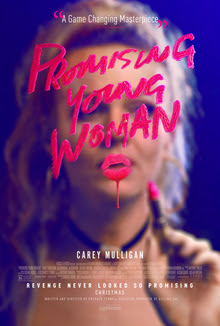
Promising Young Woman--Cassie, played by Carey Mulligan, is "promising" in a rather grim sense here: promising as prey. Guys find her alone in bars, tipsy and mumbling. They gallantly offer her a ride, then when the get her back to their places, they start to undress and assault her. At this point, she drops the bleary manner and they realize that she isn't drunk at all, and they're in trouble.

She was on track to graduate med school, but something bad happened, and now Cassie lives with her worried parents (Clancy Brown and Jennifer Coolidge) and works by day in a coffee bar. A pleasant young doctor (Bo Burnham) that she knew back in school buys coffee one day, and flirts with her, and she's pulled into a romance with him, but her secret nighttime hobby persists.

The feature directing debut of the English actress and writer Emerald Fennell, this revenge shocker explores the ugly truth that men widely regard an incapacitated woman as, quite literally, fair game; Cassie's would-be rapists react to her trap as if it's a mean and unfair trick. But Fennell is more ambitious than merely giving us the satisfaction of seeing the tables turned on these creeps. She's determined to have Cassie take on the whole structure that tolerates rape culture; the enablers, the passive witnesses, etc.

The results are quite convoluted and brutal and harsh. But Fennell and Mulligan maintain an edge of caustic wit that gives the film a charge. It ends with a smile, but not a smile that lets us off the hook.

WW84--Wonder Woman was introduced in the comics in 1941 to fight Nazis and Mussolini and other thugs of that period. Her first star vehicle in the movies, just three years ago, reset her origin story in the World War I era. This cheeky sequel, with Gal Gadot returning as Diana, has her living in Washington D.C. in the mid-'80s, working at the Smithsonian and not looking a day older than she did when Woodrow Wilson was president.

Diana befriends a supposedly dowdy, recessive coworker (Kristin Wiig), and runs afoul of a blustering TV conman (Pedro Pascal), a "Greed is Good," You-Can-Have-It-All type, who has stumbled upon the supernatural power to grant people's wishes, but who, of course, has never heard about being careful what you wish for. This same rather vague McGuffin allows Diana to reunite with her love interest from the earlier film, Steve Trevor (Chris Pine). Before the end of this two-and-half-hour tale, we get the origin of WW's Invisible Jet, and our heroine also has to grapple with a new iteration of one of her '40s-era enemies from the comics, the were-cat known as The Cheetah. 

Returning director and co-writer Patty Jenkins generates period through style as well as sets and costumes; the film often feels like an overstuffed '80s big-budgeter. I lived in D.C. in the late '80s, and neighborhoods where I worked are featured in a number of scenes, which gave me an extra nostalgic buzz. It's all a bit fuzzy around the edges, but it doesn't take itself too seriously, and like the first movie, though perhaps more so, it has a generous spirit. Gadot is good company once again, and Wiig brings both humor and unexpected anger to her role.

The TV fraud's worldwide mischief results in the appearance of a huge wall, of national and international chaos, and of the threat of nuclear war. It's just possible he's meant to remind us of somebody or other.

Friday, December 20, 2013

BANKS JOB, INSIDE MAN, WALKING TOUR

Opening in the Valley this weekend:


Saving Mr. Banks—It’s 1961, and P.L. Travers (Emma Thompson) doesn’t want to sell the movie rights to her novel Mary Poppins to Walt Disney (Tom Hanks). She’s afraid he’ll vulgarize it with music, animation and sentimentality. This movie, directed by John Lee Hancock, dramatizes how Disney and his cronies succeeded in wearing the prickly, exasperating Travers down, so that they could, indeed, vulgarize her book into a sentimental, partly animated musical.

Thompson is superb, as usual, as the impossible woman, but Hanks steals the picture with a delightful—and probably appallingly whitewashed—portrayal of the drawling, relentlessly genial Disney. With its terrific acting and its loving period detail—we get not only early-‘60s Hollywood but also flashbacks to early-20th-Century Australia, as we learn the author’s sad backstory—this is a highly enjoyable movie. It’s also, being a Disney picture, a rather unbecoming piece of company propaganda: Its message is that once you sign your soul over to Uncle Walt, your life will become a wonderful world of color. Vulgarization is salvation.


Inside Llewyn Davis—The latest from the Coen Brothers is also set against a backdrop of early-‘60s show business, albeit a very different one than that of Saving Mr. Banks—this time it’s the folkie scene in New York. Llewyn, stunningly played by Oscar Isaac, is a performer in the Village clubs. He sings and plays traditional-style folk songs beautifully, but he’s a chronic screw-up, basically homeless, sleeping on other people’s couches after gigs, impregnating women—including, possibly, the wife (Carey Mulligan) of his best friend (Justin Timberlake)—and even losing his benefactor’s cat on the streets. His blundering odyssey from New York to Chicago and back is infuriating to watch—it’s as if the Coens are deliberately trying to see how annoyed they can make us with a protagonist and still keep rooting for him. I almost began to wonder if they were trying to make people hate folk music (more than most do already).

But I, at least, did keep rooting for Llewyn (except in his encounters with animals), and while it’s far from the Coen’s best work, the movie, with its weird humor and unpredictable twists, has stuck in my head since I’ve seen it.


Walking With Dinosaurs 3-D—This feature was made using the same techniques as the popular BBC series aired in the US on the Discovery Channel: majestic live settings (Alaska and New Zealand) into which computer-generated, more or less scientifically-accurate dinosaurs are added, creating the sense of a live nature documentary about the extinct beasts. Unlike the documentaries, however, this movie adds corny voice-over dialogue to turn the story into a kids-friendly adventure. The coming-of-age plot follows a young Pachyrhinosaurus, called Patchi, who has a distinguishing (and occasionally musical) hole in his frill, through his perilous, predator-filled migrations, his conflict with his brother Scowler, his love for a pretty she-dino called Juniper, and his eventual rise through the herd hierarchy.

Justin Long provides the voice of Patchi, and the narration and commentary is provided by John Leguizamo as the bird that rides on his back. The blend of kidflick dramatics with the occasional harshness of the paleontological accuracy creates an odd effect, but the movie is great to look at—even some of the 3D effects are worthwhile—and the young audiences seem to respond to it.

Friday, May 10, 2013

TO GATSBY OR NOT TO GATSBY

It sounds like a joke: “The Great Gatsby, in 3-D.” What’s next, The Grapes of Wrath in 3-D? The Old Man and the Sea in 3-D? Catcher in the Rye in 3-D? What other high-school English class assignment classics could we watch in dorky dark glasses?


Oddly, though, it sort of works in the case of this Gatsby. The director of this new version of the F. Scott Fitzgerald tale is Baz Luhrmann, and he takes more or less the same approach to it that he did to Romeo & Juliet and Moulin Rouge and Strictly Ballroom—which is to say, a combination of Bollywood and Busby Berkeley on speed. So his lunging, plunging, swooping camera seemed to pack a little extra punch from the 3-D in a way that most recent offerings in the format—the superhero and animated flicks—have not.

Strictly in terms of plot, it’s a pretty faithful retelling of the 1925 novel about the title mystery man (Leonardo DiCaprio) who shows up at the ritzy end of Long Island. But it couldn’t be much farther away in tone from Fitzgerald’s famously balanced, plangent prose. Despite the solemn narration by Nick Carraway (Tobey Maguire), the style is all wild whip pans and fast cutting and undulating aerial shots that carry us from new money “West Egg” to old money “East Egg” and back, and sometimes all the way in to Manhattan.

Gatsby, a West Egger, throws decadent jazz-and-flapper parties in which he doesn’t usually participate. His neighbor and tenant Nick sees Gatsby gazing longingly at the “green light” across the bay, on the dock of the East Egg estate where Nick’s cousin Daisy Buchanan (Carey Mulligan) lives with her blueblood ape of a husband, Tom (Joel Edgerton). Needless to say, there’s some history there.

I’ve always been fond of this yarn, with its fairy-tale backstory. Like many durable American fables, it’s rooted in seriously adolescent notions, about reinventing yourself and impressing the girl of your dreams with grand gesture, but what gives it its power was that Fitzgerald knew, first-hand, that the fix was in when it came to Gatsby’s dream of making himself acceptable to the old money class—if he’d simply wanted to be rich or famous, he could have managed it easily enough, but he wanted to be One Of Them. That he wanted this for, from his point of view, the most gallant and romantic of reasons mattered not at all.

Once you’ve accepted that this is Baz Luhrmann’s Gatsby, not Fitzgerald’s, you’re likely to feel that this is the most successful adaptation of the story. It’s highly uneven—in particular, it runs out of steam toward the end—but it’s more satisfying, overall, than the drab 1949 version, starring Alan Ladd, and much more than the plodding 1974 version starring Robert Redford, and this has at least as much to do with the leading man as it does with Luhrmann.

Neither Redford nor Ladd was the real problem with their respective productions; both did their level best with the part. But neither of them captured the subtly frantic, terrified side of Gatsby’s psychology like DiCaprio does. This makes it possible, as it usually isn’t, to find some pity for Daisy, to see how even life with the cloddish, philandering Tom might offer her more breathing space than Gatsby’s obsessive devotion.

Even more than this, though, for the story to be convincing, Gatsby must have a radiant glamour that transcends acting, or even beauty. In one of the book’s most famous passages, Nick describes Gatsby’s smile:

He had one of those rare smiles with a quality of eternal reassurance in it, that you may come across four or five times in life. It faced, or seemed to face, the whole external world for an instant and then concentrated on you with an irresistible prejudice in your favor. It understood you just as far as you wanted to be understood, believed in you as you would like to believe in yourself.


When DiCaprio smiles into the camera here, he comes closer to capturing this quality than any previous Gatsby I’ve seen. Maybe it was just the 3-D.