Showing posts with label FRANCES MCDORMAND. Show all posts

Friday, January 6, 2023

WOMEN TALKING; WOMEN NOT TALKING

In theaters today:

Women Talking--In a hardcore religious farming colony, a group of men have been arrested for repeatedly tranquilizing and sexually violating women of all ages, including young children. The attacks have been attributed to ghosts or the Devil, or to "wild female imagination." With the farm to themselves for a couple of days before the men make bail, the minimally educated women sit around the barn and debate whether to forgive the men and carry on as before, to "stay and fight," or to leave the only home they've ever known. They've been told that if they leave, they will forfeit their place in the Kingdom of Heaven.

Written and directed by Sarah Polley from the novel by Miriam Toews--inspired by a real-life 2011 case at a Mennonite community of Canadian origin in Bolivia--this drama opens by calling itself, in subtitle, an act of female imagination. It certainly feels convincing. Superb actresses of all ages, ranging from Judith Ivey, Sheila McCarthy and a particularly forbidding Frances McDormand among the elders to Rooney Mara, Jessie Buckley and Claire Foy among the younger adults to some fine, lively women among the youth, embody the various responses, from seething, vengeful fury to sad acceptance.

Though the tone is inevitably somber, Polley's direction is deft, and she leavens the gloom with some high-spirited moments. Looking in from outside their world, many of us in the audience are likely to feel the most sympathy with the viewpoint of the enraged women who favor a violent response; the idea of a mass exodus from the scene of these atrocities sounds like a solid idea too. Forgiveness and a return to the status quo feels, in this instance, like a very distant third.

The movie also includes a token adult male, a gentle schoolteacher (Ben Whishaw, excellent as usual) not implicated in the attacks, who is allowed to take the minutes of their discussions because he can write. He's been to university outside the colony, and when a census-taker drives by in a car, blaring "Daydream Believer" by the Monkees, he softly sings along. The moment makes a pretty strong case for secular pop culture.

Now streaming:

She Said--This chronicle of the struggle of New York Times reporters Jodi Kantor and Megan Twohey to break the Harvey Weinstein case could be seen as a sort of companion piece to Women Talking (Brad Pitt was among the Executive Producers on both). At one point in the investigation Kantor (Zoe Kazan) and Twohey (Carey Mulligan) wonder if anyone will care about the story if it runs. People did--the story, which ran in October of 2017, was not only one of the factors that led to Weinstein's arrest and conviction, it also helped get the #MeToo movement rolling.

The initial response to the movie, directed by Maria Schrader from a script by Rebecca Lenkiewicz (based on Kantor and Twohey's book), was less explosive, however; it bombed in the multiplexes in November. It's worth a watch, though. While it lacks the precision and tension of the greatest of investigative-journalist buddy pictures, All the President's Men, it's still an absorbing account, focusing on the extreme reluctance of the targets of Weinstein's savagery to be first to go on the record by name.

Schrader's direction generates a palpable atmosphere of the gloomy anxiety that life in the 45 era had for many of us, but probably more intensely for women, but we're spared graphic violence. While we hear a skin-crawling audio tape of Weinstein with one of the women, the actual assaults are kept offscreen. Much of the dramatic potency in the film derives from the stunned faces of Kazan and Mulligan as they interview the women; the horror that quietly registers in their eyes effectively takes the place of seeing what they're hearing.

Saturday, December 25, 2021

THE THANE MAN

 Merry Christmas everybody!

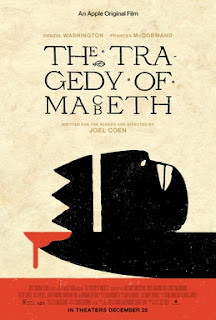
The Tragedy of Macbeth--Nothing says "Christmas" like a tale of witchcraft,  madness, tyranny and the murder of a guest by his host. So Joel Coen, working independently of his brother Ethan for the first time, has served us up an adaptation of Shakespeare's bad-juju masterpiece, with the great Denzel Washington in the title role and the great Frances McDormand as the Lady.

It's a fine-looking film, shot in lustrous black-and-white by Bruno Delbonnel on stylized, angular sets by Stefan Dechant, and it isn't saddled with any heavy-handed "interpretation." Still, it's full of choices I found disappointing.

All Three Witches, for instance, are played by the same actress, Kathryn Hunter, switching voices and contorting her body. She's brilliant, but the conceit doesn't come off authentically; it feels like an Oral Interpretation class exercise rather than true drama. As in Roman Polanski's 1971 version, the Thane of Ross is here portrayed as a scheming, side-switching Machiavel; in both versions this seems to me to dilute the central spiritual tragedy of the main characters.

There are successful aspects to the film: Coen's use of crows as a recurring motif is creepy and effective, for instance, and the confrontation with Young Siward is handled imaginatively. Stephen Root, excellent as usual, tosses off the Porter scene with no mugging.

On the whole, Polanski's Middle Ages bloodbath of '71 is a more satisfying version. But Coen's film has something Polanski's doesn't: true, charismatic stars in the leads. Washington keeps it reserved and quiet, but his internal power is commanding.

McDormand, on the other hand, lets it rip from her first scene, with terrifying intensity but also with lucidity and focus. You can see why her husband's reluctance to commit the dreadful deed wilts before her inexorable will; you can also see, appallingly, the psychological pit she's digging for herself. She's flawless. 

Whatever its shortfalls, this movie has two of the very best actors of their generation playing two of the greatest roles in Western drama. That's not something one should skip lightly.

Friday, February 12, 2021

VAN FICTION

Opening this weekend at Arizona Mills IMAX...


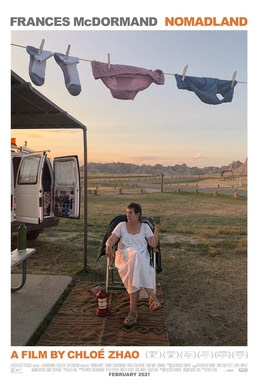
Nomadland--Frances McDormand is Fern, a widow left adrift after her gypsum mining village in Nevada becomes a ghost town. She wanders the western states in her beloved van, which she calls "Vanguard," following seasonal work, and connects with the subculture of van and RV nomads with a hub in Quartzsite, Arizona. She works cleaning state parks or in the kitchen at Wall Drug in South Dakota, at a beet harvest in Nebraska, at an Amazon facility in Nevada. She makes friends; a fellow nomad named Dave (David Strathairn) might even be a love interest, although Fern is cautious in such matters.

Scripted and directed by Chloe Zhao, this adaptation of Jessica Bruder's nonfiction book feels like a true original, heartwarming without sentimentality, maybe a hair slow but beautifully acted and shot. McDormand and Strathairn are the only two professional actors that I recognized; most of the rest of the cast, including "vandwelling" YouTube guru Bob Wells, use their own names and play themselves, with great warmth and poignancy. This gives the movie the quality of a documentary, but with a movie star presence at its center.

And it need hardly be said that McDormand is wonderful; Fern is another of her classic sensible yet frayed at the edges creations. She gets across Fern's aching sadness at finding herself at such a cosmically loose end, but she also shows us the exhilaration she feels at her independence. Whenever Fern is tempted with an offer of permanence, her instinct is to move on. Maybe when Kris Kristofferson observed that freedom is just another word for nothing left to lose, Fern's lifestyle is what he meant.

Also opening today...


Minari--Lee Isaac Chung wrote and directed this autobiographical chronicle of a Korean family struggling to start a farm in rural Arkansas in the early 1980s. Dad Jacob (Steven Yeun) is an expert "chicken-sexer" (able to quickly determine the sex of chicks at a hatchery and sort them). He's dragged his family from California to the south, to the horror of his pretty, pious wife Monica (Han Ye-ri), because he wants to start a produce farm specializing in Korean vegetables and fruits for what he perceives as a growing immigrant market in Dallas and Oklahoma City (the title refers to an herb popular in Korean cuisine).

The couple and their two young children, Annie (Noel Kate Cho) and David (Alan Kim) are eventually joined by a mischievous, fun-loving Grandma (Youn Yuh-jung), who doesn't seem to David to act like a grandma is supposed to. There's also a showcase role for Will Patton, as a religiously ecstatic, tongue-speaking farm hand trying to help Jacob realize his dream.

This may be the best film I've seen so far this year; a contemporary take on the early-'30s dramas about ordinary people up against agricultural and meteorological fate, like Murnau's City Girl or Dovzhenko's Earth. As in those films, the antagonists are largely elemental: water, fire, health. But Minari's characters aren't emblematic; they have a psychological subtlety and reality, and their passions and priorities also drive the conflict. The story-telling is simple, but the problems these people have with the land, and with each other, are anything but.


The Mauritanian--The title character, played with disconcerting charm by the Algerian-French actor Tahar Rahim, is Mohamedou Ould Salahi, who was held at Guantanamo Bay for a decade and a half, and tortured, without ever being charged with a crime, on suspicion of having been a recruiter for 9/11 terrorists. Jodie Foster and Shailene Woodley are the pro bono lawyers working to free Salahi under habeas corpus, and getting stonewalled by U.S. intelligence. Benedict Cumberbatch is the Marine officer assigned to prosecute Salahi, who finds himself equally stonewalled.

Directed by the capable Scotsman Kevin Macdonald, this is another of the surprisingly large class of political dramas like The Report or Official Secrets or Fair Game, which remind us of the constitutional outrages of the W. Bush administration, as well as the failure of the Obama administration to rectify most of them. Macdonald sets a unhurried pace, and generates a steadily waxing sense of almost Kafkaesque fury and horror. It's a well-acted, compelling movie and it can boil your blood. And it should.

Friday, January 4, 2013

GOOD WELL HUNTING

A small town in southwestern Pennsylvania is the setting of Promised Land. It’s not exactly flowing with milk and honey—it’s a broke, fading farm community. But it’s sitting on oceans of natural gas, so two corporate agents, Steve (Matt Damon) and Sue (Frances MacDormand) descend on the all-too-eager locals, offering what seems like a fortune in return for drilling rights.


Said rights, in this case, mean hydraulic fracturing or “fracking,” extremely deep drilling aided by the injection of chemically-enriched water, in order to release gas from beneath otherwise impenetrable rock. It’s a highly controversial technique, on the one hand suspected of polluting water tables—sometimes resulting in flammable water!—killing crops and livestock, and other environmental blight, but prized on the other hand for its promise of increased freedom from foreign oil.

A local schoolteacher (Hal Holbrook) raises concerns at a town meeting, and Steve and Sue’s deal—and Steve’s big promotion—are endangered. Their headache is increased by Dustin (John Krasinki) an engaging fellow who shows up in town with tales of fracking’s horrors, to which the townies, much to Steve and Sue’s fury, are clearly listening.

Scripted by Damon and Krasinski from a story by Dave Eggers, and directed by Gus Van Sant, Promised Land is a great-looking movie. Rather than focusing on the economic bleakness of the town, the cinematographer, Linus Sandgren, emphasizes the verdant beauty of the Pennsylvania countryside, suggesting what these people stand to lose in return for corporate chump change.

Van Sant’s touch is low-key and, as always, tinged with good-natured comedy, as is the acting, especially in the familiar bickering affection between Steve and Sue. There’s also an agreeable love interest for Damon—and maybe Krasinski as well—in the form of Rosemarie DeWitt as an attractive elementary school teacher, smiling with amusement at what a sitting duck she is for these out-of-town boys.

Also built into the material is a plot twist, and while it’s fairly cunning, I couldn’t decide if it helped or weakened the movie. Something weakens it, in any case—it’s watchable and inoffensive, but somehow it doesn’t deliver. While fracking is certainly made to seem reckless, the movie doesn’t work up that much of a lather about it, and it makes the point that if it isn’t natural gas, it’s going to be oil or coal (the idea of decreased consumption is dismissed). The real point, though, seems to be that the people who do this sort of unsavory work for energy (or tobacco, or pharmaceutical, or whatever) companies aren’t moustache-twirling villains; they’re likable folks trying to get ahead.

Anyone who found this surprising would have to be naïve—and if they drive a gasoline-powered car, or buy a fast-food hamburger, or for that matter type a movie review on a computer plugged into an electrical socket, they’d have to be hypocritical, as well. Still, there’s a difference, even if it’s only a slight difference, between using pernicious or questionable technology because it’s most of what’s viably available and actually participating in perpetuating that status quo.

Steve and Sue are pleasant, even endearing, but that doesn’t mean they aren’t doing what they’re doing, and Damon, Krasinski and Van Sant can’t seem to find a way to confront this dramatically without turning Promised Land sanctimonious. So they don’t quite confront it. They just let the gas leak out of the movie, with a mild, unconvincing sigh.

Wednesday, June 13, 2012

MALAGACHE TROIS

The Kid and I caught up with Madagascar 3: Europe’s Most Wanted.


The zoo animals—Ben Stiller as a lion, Chris Rock as a zebra, David Schwimmer as a giraffe, Jada Pinkett Smith as the hippo, etc.—are still trying to get back from Africa to New York, to re-take their places at the Central Park Zoo. This time, by wacky circumstance, they’re going by way of Europe, traveling with animals from a washed-up circus.

The movie’s no classic, but it’s kind of cute, in the frenetic, overproduced way of so many contemporary kids’ movies. It does contain two pretty splendid characters, however: One is Sonya, a mournfully deadpan dancing bear with whom an exuberant lemur falls in love—interspecies romance is rampant in these movies.


The other is the movie’s villainess, DuBois, a relentless, Vespa-borne juggernaut of an animal control officer from Monaco who chases our heroes across the continent, sometimes resorting to all fours herself to sniff their spoor—she covets the lion’s head for her trophy wall.


A terrific visual creation, DuBois is also well-voiced by Frances McDormand, who even gets to sing “Non, je ne regrette rien.”

RIP to Ann Rutherford, a prolific actress now best known for her small role as one of Scarlett’s sisters in Gone With the Wind, passed on at 94. I saw her a couple of years ago in Palm Springs, and even in her early ‘90s, she was quite the Hollywood vision in pink pantsuit and glam shades.


RIP also to Frank Cady, passed on at 96, best known for playing general store owner Sam Drucker in the Paul Henning universe—Petticoat Junction, Green Acres and The Beverly Hillbillies—and similar characters in dozens of TV shows and movies ranging from Rear Window to When Worlds Collide to The 7 Faces of Dr. Lao. Like a lot of people, I was startled to learn that he hadn’t passed on years ago.

Friday, June 8, 2012

THE MOON ALSO RISES

As much as any Tolkien geek or Star Trek nut, Wes Anderson delights in invented worlds of immersive detail. At times he’s like a little kid, showing you the pictures he’s drawn in a spiral-bound notebook. The difference is that his invented worlds aren’t fairy-tale domains or distant planets, they’re embellishments on twee upper-middle-class Boomer-era culture, especially as experienced by adolescents, and by the eternal adolescents that this culture produced.

The conceit of Anderson’s Royal Tenenbaums (2001) was that we were seeing enacted a Salinger-esque midcentury Manhattan novel. In The Life Aquatic With Steve Zissou (2004) he went so far as to invent marine species, like the “Sugar Crab” or the “Jaguar Shark” (charmingly stop-motion animated by Henry Selick), for his titular TV star/explorer hero to chronicle.


His latest, co-written with Roman Coppola, is Moonrise Kingdom, a pubescent star-crossed love story set on fictitious New England coastal islands in 1965, and it’s as obsessively imagined as the rest. Anderson gives us maps, fake meteorological history delivered by an authoritative-sounding Chorus (Bob Balaban), a warren-like house with an intricate floor-plan, a made-up scouting organization for boys called the “Khaki Scouts”—with its own magazine, Indian Corn—and a series of “young reader” novels pored over by the heroine that truly look like the sort of thing you’d have found on a Bookmobile in that era. The movie is a ‘60s childhood as it should have been, but also, specifics aside, as it sort of was.

Said heroine is twelve-year-old Suzy (Kara Hayward), whose cold-fish Dad (Bill Murray) and repressed Mom (Frances McDormand) are both lawyers. At first the stonefaced Suzy is a little creepy, peering through binoculars out the windows of her handsome home, but even though she’s capable of violent outbursts she’s no bad seed. She’s a romantic, keeping vigil for her beloved.

He arrives in the form of Sam (Jared Gilman) a runaway from a Khaki Scout camp on the island. A year earlier, he saw her as The Raven in a local production of Benjamin Britten’s Noye’s Fludde, and knew immediately he’d found the meaning of life. They talked only once, but she invited him to correspond, and he did not shirk.

The two of them run away together. Sam, an orphaned foster child, tries to impress her with his woodcraft, unaware that his ardor has already won her heart. They camp out, and she reads to him from her favorite books as he smokes a corn-cob pipe. Needless to say, their idyll drives the rest of the island into a tizzy.


Besides Suzy’s parents, the worriers include the earnest Khaki Scoutmaster (Edward Norton) and the slow-spoken, sad-sack Police Captain (Bruce Willis). The other Khaki Scouts treat the operation not as a search for two missing children but as a manhunt for potentially dangerous fugitives; they fan out, armed to the teeth.

More complications arise, including a Deus ex machina storm, and eventually a Social Services representative (Tilda Swinton in striking blue) and a Khaki Scout bigwig (Harvey Keitel) enter the action as well. Willis gives one of those performances that he’ll be remembered for after most of his action roles are likely forgotten, Norton is touching, the kids are excellent, and Murray and McDormand are effective even if they get less than usual to do here. Robert Yeoman’s water-color-ish cinematography is ravishing—there’s a shot of Willis crossing a church roof that has the austere devotional beauty of an image from Dreyer—and so is the music, by composers ranging from Alexander Desplat to Mark Mothersbaugh to Britten.

For me, Anderson has never topped his first two features, Bottle Rocket and especially Rushmore—one of my favorite movies—but Moonrise Kingdom, despite some clunky missteps toward the end, falls only a little short of these. Some parents may be uncomfortable with the (non-graphic) scenes of Suzy and Sam’s physical intimacy, and with the period-realistic tobacco habits of both Sam and the Scoutmaster, and in the course of the story an animal meets a jarringly awful (and gratuitous) fate that might be a deal-breaker for some kids (and some adults). But with these caveats duly noted, Moonrise Kingdom borders on the sublime.