Showing posts with label ASHLEY JUDD. Show all posts

Friday, January 6, 2023

WOMEN TALKING; WOMEN NOT TALKING

In theaters today:

Women Talking--In a hardcore religious farming colony, a group of men have been arrested for repeatedly tranquilizing and sexually violating women of all ages, including young children. The attacks have been attributed to ghosts or the Devil, or to "wild female imagination." With the farm to themselves for a couple of days before the men make bail, the minimally educated women sit around the barn and debate whether to forgive the men and carry on as before, to "stay and fight," or to leave the only home they've ever known. They've been told that if they leave, they will forfeit their place in the Kingdom of Heaven.

Written and directed by Sarah Polley from the novel by Miriam Toews--inspired by a real-life 2011 case at a Mennonite community of Canadian origin in Bolivia--this drama opens by calling itself, in subtitle, an act of female imagination. It certainly feels convincing. Superb actresses of all ages, ranging from Judith Ivey, Sheila McCarthy and a particularly forbidding Frances McDormand among the elders to Rooney Mara, Jessie Buckley and Claire Foy among the younger adults to some fine, lively women among the youth, embody the various responses, from seething, vengeful fury to sad acceptance.

Though the tone is inevitably somber, Polley's direction is deft, and she leavens the gloom with some high-spirited moments. Looking in from outside their world, many of us in the audience are likely to feel the most sympathy with the viewpoint of the enraged women who favor a violent response; the idea of a mass exodus from the scene of these atrocities sounds like a solid idea too. Forgiveness and a return to the status quo feels, in this instance, like a very distant third.

The movie also includes a token adult male, a gentle schoolteacher (Ben Whishaw, excellent as usual) not implicated in the attacks, who is allowed to take the minutes of their discussions because he can write. He's been to university outside the colony, and when a census-taker drives by in a car, blaring "Daydream Believer" by the Monkees, he softly sings along. The moment makes a pretty strong case for secular pop culture.

Now streaming:
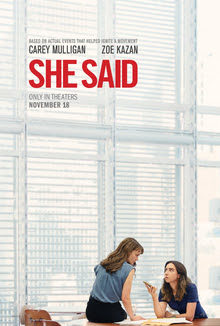
She Said--This chronicle of the struggle of New York Times reporters Jodi Kantor and Megan Twohey to break the Harvey Weinstein case could be seen as a sort of companion piece to Women Talking (Brad Pitt was among the Executive Producers on both). At one point in the investigation Kantor (Zoe Kazan) and Twohey (Carey Mulligan) wonder if anyone will care about the story if it runs. People did--the story, which ran in October of 2017, was not only one of the factors that led to Weinstein's arrest and conviction, it also helped get the #MeToo movement rolling.

The initial response to the movie, directed by Maria Schrader from a script by Rebecca Lenkiewicz (based on Kantor and Twohey's book), was less explosive, however; it bombed in the multiplexes in November. It's worth a watch, though. While it lacks the precision and tension of the greatest of investigative-journalist buddy pictures, All the President's Men, it's still an absorbing account, focusing on the extreme reluctance of the targets of Weinstein's savagery to be first to go on the record by name.

Schrader's direction generates a palpable atmosphere of the gloomy anxiety that life in the 45 era had for many of us, but probably more intensely for women, but we're spared graphic violence. While we hear a skin-crawling audio tape of Weinstein with one of the women, the actual assaults are kept offscreen. Much of the dramatic potency in the film derives from the stunned faces of Kazan and Mulligan as they interview the women; the horror that quietly registers in their eyes effectively takes the place of seeing what they're hearing.

Friday, September 12, 2014

RETALE

The main dolphin in the Dolphin Tale movies is tail-less. An injured bottlenose rescued in Florida, “Winter” was given a prosthetic tail which corrected her swimming motion, and became a star at the Clearwater Marine Aquarium. She played herself in 2011’s Dolphin Tale, a heavily fictionalized account of her life.


Winter’s back in Dolphin Tale 2, bereaved after the death, of old age, of a beloved tankmate. We’re shown how she bonds with a new foundling, an adorable baby bottlenose named Hope. Much of the movie’s focus, however, is on Sawyer (Nathan Gamble), the teen kid who found Winter in Part One, and his pal Hazel (Cozi Zuehlsdorff), the daughter of CMA’s founder (Harry Connick, Jr.).

These are pleasant enough kids, and some name players return to pick up a check as well—along with Connick, there’s Ashley Judd as Sawyer’s Mom, Kris Kristofferson as Connick’s Dad, and a smiling Morgan Freeman as the prosthetic designer, absolutely failing to convince us that he’s a curmudgeon. Surfer Bethany Hamilton, who lost an arm to a shark in 2003 and thus presumably feels some commonality with Winter, appears briefly as herself. Writer-director Charles Martin Smith turns up onscreen as well, as a cetological bureaucrat, and it’s nice to see him returning to his former, highly useful career as a character actor.

But for the kids in the audience, of course, the real stars of Dolphin Tale 2 are the animals—not just Winter and Hope but also a sea turtle and a comic-relief pelican. Smith could perhaps have used more of these creatures and less of the teen drama stuff, but he keeps things light and colorful, and at the end we’re shown real video footage of some of the rescues and releases depicted in the movie, seemingly just to quiet any suspicions we may have that this Tale is tall.

Friday, September 5, 2014

TWIN/FLYNN

New this week:


The IdenticalThe King of Rock n’ Roll might only have been the Prince of Rock and Roll if his twin brother hadn’t been stillborn. But as Elvis fans know, Jessie Garon Presley didn’t make it into the world alive. This movie wonders what might have happened if both brothers had survived, but nonetheless had been separated at birth.

Dirt-poor struggling parents (Brian Geraghty and Amanda Crew), barely able to care for one of their newborn twins in Depression-era Alabama, keep “Drexel Hemsley” but donate his brother Ryan to a kindly traveling evangelist (Ray Liotta!) and his wife (Ashley Judd) who are unable to have children of their own. The Reverend promises not to tell Ryan about his origin until the biological folks have died. Drexel goes on to become a star, but Ryan’s dad insists on grooming him for the ministry, even though the boy feels stirrings in his hips of a different calling when he hears roadhouse music. People are always telling Ryan how much he resembles Drexel, and eventually he hits the road with what would now be called a tribute act, and cleans up.

There’s an undeniable fairy-tale power to this premise that could have given it a Shakespearean wonder. But The Identical, though it appears to have had a fairly generous budget, comes across amateurish, emasculated, anachronism-riddled and inhibited. I can’t say I found it dull, but it’s been a while since a movie this cringe-inducingly kitschy got a wide release.

The moviemakers may themselves be evangelicals; Ryan is the most chaste and wholesome rock-and-roller imaginable—even Ricky Nelson and Frankie Avalon were bigger bad boys than this guy; it’s possible even Pat Boone was. Commendable though his behavior may be, it misses a major source of the appeal of rock music in general and of Presley in particular.

The movie’s religious interests also show up in the form of several apropos-of-nothing-much shout-outs to the State of Israel, and near the beginning, Rev. Liotta, preaching in a revival tent, tells his flock that black and white, Jew and gentile are all the same in the eyes of God. It’s uncertain if other categories of belief or race are included under this assertion; in any case, I found myself wondering how safe saying this would be, in Alabama in 1935, even for a white preacher.

The twins are both played, as adults, by Blake Rayne, who bears a good-enough-to-get-work-in-Vegas resemblance to the King, both physically and vocally. He’s also a rather sweet and likable screen presence, and the various hairstyles inflicted on him throughout the film increase both our sympathy for him and the comedy value of the movie.

As with That Thing You Do!, the music is ersatz—one of the movie’s many other (presumably unintentional) hilarities comes when the narrator (Ryan’s wife, played by the very cute Erin Cottrell), tells us that rock and roll may have been born the night that Ryan got up and sang in a roadhouse. Then the song he breaks into is presciently titled “Boogie-Woogie Rock n’ Roll"


The Last of Robin HoodA pop culture icon is much more convincingly embodied in this chronicle of the last years of Errol Flynn. By the mid-‘50s the star was getting a bit mature for swashbuckling even if he hadn’t wrecked himself with booze and other indulgences, which he had. But he was still a name, and a charmer, and managed to win the heart of a young dancer and bit player named Beverly Aadland, who became the last love of his life. His final feature, Cuban Rebel Girls, was a painful low-budget 1959 indie built both as a vehicle for Aadland and as propaganda for Fidel Castro.

Just how young Aadland was when she and Flynn first got together, he supposedly didn’t know, at least at first. Suffice to say she was seriously underage, passing as years older than she really was so that she could work in movies. This was all with the complicity of her hardcore stage mother Florence, once a dancing hopeful herself until an accident claimed one of her legs. Florence eventually became complicit in Beverly’s affair with Flynn, too.

Kevin Kline plays Flynn, Dakota Fanning plays Beverly and Susan Sarandon plays Florence in The Last of Robin Hood. While a few other actors are shooed past the camera—including Max Casella as the young Stanley Kubrick, who reputedly considered Flynn for Humbert Humbert in Lolita—the focus is on the psychodrama between the three leads, and the writing/directing team of Richard Glatzer and Wash Westmoreland manage it briskly, with a plausible feel for how this dance of ego and desperation and self-delusion and vicarious gratification and, yes, true love could be kept going.

Kline, already 16 years older than Flynn was when he died, looks far better than the star did in the period depicted, but he catches Flynn’s disarming mix of suavity and self-deprecation, and how he could use a hint of rueful insecurity over his faded glamour to his advantage. He’s excellent, but in the long run Fanning and Sarandon carry the movie with their tense, textured interchanges.

The movie is slight, and there are a few scenes—one involves two punks shooting at Sarandon with an air rifle—that teeter precariously on the edge of camp. But The Last of Robin Hood is well-paced, and its period flavor is generated resourcefully on what was probably a pretty modest budget. Best of all, it’s witty without being catty and heartless—it remembers that these people are human beings, and that one of them was a kid.

Friday, September 23, 2011

REPORPOISING

“From the studio and producers of The Blind Side.” That’s how Dolphin Tale is being marketed. This may strike you as a tenuous aesthetic connection, but it’s savvy advertising—Dolphin Tale, loosely based on true events, is another story of a wounded foundling becoming a star.


The young dolphin in question is injured when she runs afoul of a crab trap. She’s rescued & taken in by Clearwater Marine Aquarium in Florida, & her damaged tail is amputated soon after. Given the name Winter, the creature learns to swim by moving her rear stump left-right instead of up-down, & it turns out that this technique endangers her life by improperly building up the muscles around her spine.


How Winter got her groove back is, in a highly fictionalized form, the subject of Dolphin Tale. In the movie’s account, a lonely fatherless boy, Sawyer (Nathan Gamble), ditches summer school to hang out at the Aquarium with Hazel (Cozi Zuehlsdorff), daughter of the widowed Dr. Haskell (Harry Connick, Jr.) the vet in charge of Winter’s case. When Sawyer’s Mom (Ashley Judd) finds out about the ditching, she’s furious at first, but the charm of the aquarium & her son’s passion for his newfound interest breaks her down.

There’s talk of putting both Winter & the cash-strapped aquarium to sleep. But while visiting his war-wounded cousin at a Vet’s hospital, Sawyer meets Dr. McCarthy (Morgan Freeman), a designer of prosthetic limbs, & somehow talks him into attempting to craft a new stern for Winter. Getting the mammal (who Dr. McCarthy persists in referring to as a “fish”) to accept the uncomfortable appliance is a struggle.


Directed by character actor Charles Martin Smith, Dolphin Tale is a brightly-colored, slick piece of moviemaking, with corny humor & carefully engineered moments of uplift. The cast is big-name & talented—along with Judd, Freeman & Connick are Kris Kristofferson, Frances Sternhagen, Ray McKinnon & even Richard Libertini in a bit—but overall, the actors seem to be on autopilot. Freeman has a line or two that seems meant to suggest that the Doc is an eccentric curmudgeon, but you’d never know it from the performance. He just smiles amiably & cruises on through. He’s always pleasant company, but this isn’t a rich character.

It’s a shame that the filmmakers didn’t try to dramatize, beyond the most general terms, the technical challenges of the tail-making project—Apollo 13 showed that such details can be absorbing. But the thing is, Dolphin Tale is about the attempt to build an amputee dolphin a working tail. If you can’t emotionally invest a little in a quixotic effort like that, regardless of the movie’s gravitas or even, really, of its implications, you’re tougher than I.