Showing posts with label NEW YORK TIMES. Show all posts

Thursday, August 8, 2024

DINE AND DASH

In July Pete Wells, the restaurant critic for the New York Times, announced that he was stepping down from that job after 12 years. His principal reason was what the work had done to his cholesterol, blood pressure, blood sugar and weight. He noted the short life spans of legendary food writers like A. A. Gill and Jonathan Gold. But he also said, simply, that "I realized I wasn't hungry anymore. And I'm still not, at least not the way I used to be."

All this rang true in my experience.


For most of my years working for newspapers and magazines, I have principally been an entertainment writer, focusing on movie reviews with occasional forays into writing about theatre, television, music, books. But I've also written about dining, for various publications, for decades.

I was a fill-in restaurant reviewer at Phoenix New Times, where I also had a weekly food review/interview column called "Lunch Meet." I've reviewed or profiled many East Valley eateries for the Wrangler News, and more recently I wrote a monthly column called "Four Corners" in Phoenix Magazine, in which I reviewed four different restaurants from four ends of the Valley, for slightly over four years, until it was shut down by COVID. I've also written many food-related entries for "Best of the Valley" and features like that.

And fun and delicious as all of this was, I too have suffered burnout. I don't expect any sympathy for this, of course; as Wells hastens to add: "The first thing you learn as a restaurant critic is that nobody wants to hear you complain."

This is understandable. Restaurant reviewing is a quintessential example of Nice Work If You Can Get It. Nobody doing data entry or telephone customer service, let alone paving roads in the Arizona heat, should have to endure somebody whining about what a drag it is to eat at nice restaurants for free and then write about it.

The day I was offered the food writing gig at Phoenix Magazine, I was driving home from the doctor's office where I had just learned I had diabetes. I immediately accepted the offer. My pancreas was just going to have to learn to cope.

All the same, after a few years even that nice work can grow old. First of all, not every restaurant is good. It's not fun--at least, it isn't fun for me--to write negatively about a small business into which people have poured their heart and soul and fortune, and on which their dreams are riding.

Besides, poor food can be hard on you. Substandard, misfired meals can clobber your digestion and leave you feeling hung over and help expand your waistline, all without the compensatory pleasure of a culinary success. As Wells says, after a few years you may find you're not so hungry anymore.

Even when the food is good, however, writing about it, for me, was often difficult. Applied to food, adjectives tend to wear out fast through repetition. I adore a good burrito, but it's hard to find a new word to describe even the most heavenly burrito on the planet.

Truthfully, I have sometimes found this same syndrome creeping into my movie reviewing. For most of about nine years, that was my main job--going to see movies and then writing down my thoughts about them. No doubt, if you're a cinema lover, it beats work.

Still, it's not certain that spending your days sedentary, in a cold dark room, eating greasy popcorn and Dots and Junior Mints and drinking Dr. Pepper, is the surest ticket to health and well-being. Certainly there are many movie critics who lived to old age, but two of the most famous departed on the early side, Gene Siskel at 53 and Roger Ebert at 70.

After long stretches of movie reviewing, a sense can sometimes set in that you've seen, and reviewed, all the movies, just with different titles and actors, just as when you're reviewing restaurants, a sense can set in that you've written up all the burritos, just with different dining rooms surrounding them. In my full-time critic days, people used to sometimes say, wow, you're lucky, you get to see all the movies. 

I would agree that I was very lucky. But then remember, I would add, it's not that I get to see all the movies, it's that I have to see all the movies.

Again, I do understand how absurdly fortunate I've been to spend so much of my working life in these amusing pursuits, and I'm inexpressibly grateful for it. My only point in all this, I suppose, is that no matter how cushy a job is, in the end it's still a job. So I wish Pete Wells a happy, and hungry, post-reviewing life.

Friday, January 6, 2023

WOMEN TALKING; WOMEN NOT TALKING

In theaters today:

Women Talking--In a hardcore religious farming colony, a group of men have been arrested for repeatedly tranquilizing and sexually violating women of all ages, including young children. The attacks have been attributed to ghosts or the Devil, or to "wild female imagination." With the farm to themselves for a couple of days before the men make bail, the minimally educated women sit around the barn and debate whether to forgive the men and carry on as before, to "stay and fight," or to leave the only home they've ever known. They've been told that if they leave, they will forfeit their place in the Kingdom of Heaven.

Written and directed by Sarah Polley from the novel by Miriam Toews--inspired by a real-life 2011 case at a Mennonite community of Canadian origin in Bolivia--this drama opens by calling itself, in subtitle, an act of female imagination. It certainly feels convincing. Superb actresses of all ages, ranging from Judith Ivey, Sheila McCarthy and a particularly forbidding Frances McDormand among the elders to Rooney Mara, Jessie Buckley and Claire Foy among the younger adults to some fine, lively women among the youth, embody the various responses, from seething, vengeful fury to sad acceptance.

Though the tone is inevitably somber, Polley's direction is deft, and she leavens the gloom with some high-spirited moments. Looking in from outside their world, many of us in the audience are likely to feel the most sympathy with the viewpoint of the enraged women who favor a violent response; the idea of a mass exodus from the scene of these atrocities sounds like a solid idea too. Forgiveness and a return to the status quo feels, in this instance, like a very distant third.

The movie also includes a token adult male, a gentle schoolteacher (Ben Whishaw, excellent as usual) not implicated in the attacks, who is allowed to take the minutes of their discussions because he can write. He's been to university outside the colony, and when a census-taker drives by in a car, blaring "Daydream Believer" by the Monkees, he softly sings along. The moment makes a pretty strong case for secular pop culture.

Now streaming:

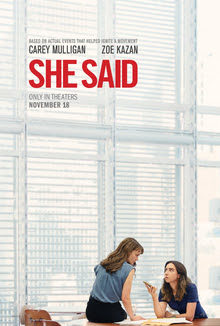
She Said--This chronicle of the struggle of New York Times reporters Jodi Kantor and Megan Twohey to break the Harvey Weinstein case could be seen as a sort of companion piece to Women Talking (Brad Pitt was among the Executive Producers on both). At one point in the investigation Kantor (Zoe Kazan) and Twohey (Carey Mulligan) wonder if anyone will care about the story if it runs. People did--the story, which ran in October of 2017, was not only one of the factors that led to Weinstein's arrest and conviction, it also helped get the #MeToo movement rolling.

The initial response to the movie, directed by Maria Schrader from a script by Rebecca Lenkiewicz (based on Kantor and Twohey's book), was less explosive, however; it bombed in the multiplexes in November. It's worth a watch, though. While it lacks the precision and tension of the greatest of investigative-journalist buddy pictures, All the President's Men, it's still an absorbing account, focusing on the extreme reluctance of the targets of Weinstein's savagery to be first to go on the record by name.

Schrader's direction generates a palpable atmosphere of the gloomy anxiety that life in the 45 era had for many of us, but probably more intensely for women, but we're spared graphic violence. While we hear a skin-crawling audio tape of Weinstein with one of the women, the actual assaults are kept offscreen. Much of the dramatic potency in the film derives from the stunned faces of Kazan and Mulligan as they interview the women; the horror that quietly registers in their eyes effectively takes the place of seeing what they're hearing.