Showing posts with label DENZEL WASHINGTON. Show all posts

Friday, August 15, 2025

RANSOM, KIND OF WONDERFUL

Opening in the Valley today at RoadHouse Cinemas in Scottsdale:

Highest 2 Lowest--In Spike Lee's latest, Denzel Washington feels very authentic as David King, a superstar music producer known as "the best ears in the business." You get the impression the performance may reflect a  showbiz type Washington has encountered more than once.

David is a reflexive glad-hander, smiling and chuckling and bantering, yet with a show of underlying gravity, easygoing yet earnest. He's a master of listening, or at least of looking like he's listening.

As the movie starts, David is maneuvering to buy back the record label he founded before it's taken over by a consortium that wants to make music with A.I. The early scenes have the feel of a glossy, glamorous show-business melodrama. But when David gets a call telling him his son has been kidnapped for ransom, the movie quietly downshifts into a thriller.

Then the story takes yet another, even more unsettling twist that puts it into the realm of a moral thriller (stop reading now if you don't want to know it). The kidnapper, it turns out, has napped the wrong kid; not David's son but the son of his beloved ex-con chauffeur and confidant Paul (Jeffrey Wright).

Just that quickly, David's sense of urgency to pay the multi-million-dollar ransom, with money otherwise slated for his business deal, simply evaporates. Eventually, David starts to grasp that not only is Paul's son's life at stake, so is own soul.

You may recognize the basic plot as that of Akira Kurosawa's High and Low (1963), of which this is a heavily embellished but unmistakable remake, with Washington in the Toshiro Mifune role. Time has shown that Lee attempting his own take on Kurosawa is not hubris; he's a master too.

Working from a script by Alex Fox, Lee keeps us on the edge of our seat even while he takes the time to explore character, and to use the New York locations for all they're worth. His approach is charged yet discursive, and the movie glides and swerves and rattles along like a subway ride, unpredictably but never incoherently, to a satisfying destination.

I well remember when Lee first showed up in American movies in the late '80s, and how brashly innovative his techniques seemed. He moved cinema forward. But here, as in his intriguing 2006 bank heist thriller Inside Man, his style seems old-school, loose, adaptable, almost classical.

Of course, none of this stylistic prowess would amount to much if Lee wasn't hugely abetted by Washington, Wright and the rest of the cast, including Ilfenesh Hadera as David's wife, Aubrey Joseph as his son, ASAP Rocky as a mysterious young rapper and John Douglas Thompson, Dean Winters and LaChanze as the cops. Also, Highest 2 Lowest is full of great songs and a driving, at times almost Riverdance-ish score by Howard Drossin. It's maybe the best soundtrack of the year, or possibly a close second to that of Sinners.

Tuesday, November 26, 2024

Saturday, December 25, 2021

THE THANE MAN

 Merry Christmas everybody!

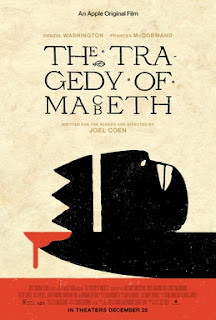
The Tragedy of Macbeth--Nothing says "Christmas" like a tale of witchcraft,  madness, tyranny and the murder of a guest by his host. So Joel Coen, working independently of his brother Ethan for the first time, has served us up an adaptation of Shakespeare's bad-juju masterpiece, with the great Denzel Washington in the title role and the great Frances McDormand as the Lady.

It's a fine-looking film, shot in lustrous black-and-white by Bruno Delbonnel on stylized, angular sets by Stefan Dechant, and it isn't saddled with any heavy-handed "interpretation." Still, it's full of choices I found disappointing.

All Three Witches, for instance, are played by the same actress, Kathryn Hunter, switching voices and contorting her body. She's brilliant, but the conceit doesn't come off authentically; it feels like an Oral Interpretation class exercise rather than true drama. As in Roman Polanski's 1971 version, the Thane of Ross is here portrayed as a scheming, side-switching Machiavel; in both versions this seems to me to dilute the central spiritual tragedy of the main characters.

There are successful aspects to the film: Coen's use of crows as a recurring motif is creepy and effective, for instance, and the confrontation with Young Siward is handled imaginatively. Stephen Root, excellent as usual, tosses off the Porter scene with no mugging.

On the whole, Polanski's Middle Ages bloodbath of '71 is a more satisfying version. But Coen's film has something Polanski's doesn't: true, charismatic stars in the leads. Washington keeps it reserved and quiet, but his internal power is commanding.

McDormand, on the other hand, lets it rip from her first scene, with terrifying intensity but also with lucidity and focus. You can see why her husband's reluctance to commit the dreadful deed wilts before her inexorable will; you can also see, appallingly, the psychological pit she's digging for herself. She's flawless. 

Whatever its shortfalls, this movie has two of the very best actors of their generation playing two of the greatest roles in Western drama. That's not something one should skip lightly.

Wednesday, November 22, 2017

LAWYERS & MISERS & DREAMBOATS, OH MY!

Opening today:


Roman J. Israel, Esq.--The title character is an L.A.-based civil rights attorney who makes a bad first impression. With thick glasses and a sad, moppy Afro, dressed in an ill-fitting old suit and clip-on tie, making unfiltered (if usually justified) insulting remarks, barking loud derisive laughter, Roman is a brilliant lawyer but a socially awkward misfit without family or close friends.

When his beloved, legendary partner dies, Roman lands at a hotshot criminal defense firm run by the slick Colin Farrell. Farrell's exasperated by his new associate, but too aware of his gifts, and maybe too conscience-haunted about his own lost idealism, to get rid of him. When one of Roman's cases goes tragically wrong, he yields at long last to the temptations of cynicism, and winds up in real trouble.

Writer-director Dan Gilroy is trying for a gripping legal drama in the vein of The Verdict. But while the story has its interesting aspects, it's too loosely structured and rambling to keep us on the edge of our seats, and Roman's plight in the movie's final quarter is unconvincingly dramatized.

While the film falls short as a thriller, however, it succeeds as a character study. Washington taps the prickly side of his own persona to create this maddening and lovable nerd-warhorse, who decides, disastrously, to try wealth and luxury on for size. If the plot were as vividly rendered as the title character and his moral lapse, Roman J. Israel, Esq. would be a classic. As it is, it's an interesting misfire.


The Man Who Invented Christmas--The man in question is Charles Dickens, played by Dan Stevens in this adaptation of Les Standiford's 2008 nonfiction book. Standiford's thesis is that by writing his "Ghost-Story of Christmas" A Christmas Carol in 1843, Dickens helped to bring the holiday, which had fallen somewhat into disuse in Britain, to something of the social importance it now holds, and particularly to its association with charity and liberality.

If this is true, then I think we can forgive him for the long-term downside of this. It's doubtful that Dickens, with his genial vision of helping the needy and partying with family and friends, could have foreseen Black Friday riots and holiday depression.

This is a fascinating story, but while the movie, adapted by Susan Coyne and directed by Bharat Nalluri, is watchable and amusing enough, it seems to me to have been dramatized in the most conventional and heavy-handed way. Like Shakespeare in Love, the film depicts literary inspiration as a direct line from what an author witnesses or overhears on the street to what he promptly runs home and scribbles into his work. But while Shakespeare in Love made a borderline-campy joke of this idea, The Man Who Invented Christmas suggests that it's getting at the Dickens psyche, as the author's imagination conjures up Scrooge, Marley, Fezziwig and other figures, and gets heckled by them.

The film tries to generate suspense over whether Dickens will allow Scrooge his change of heart and spare Tiny Tim at the end of the story, and further tries to link the Scrooginess in the author's own personality to his lifelong conflict with his big-talking, perennially broke father. Both of these ploys feel thin--it's hardly likely that Dickens ever conceived of A Christmas Carol ending with Scrooge unrepentant.

Still, there is plenty of enjoyable acting here. Christopher Plummer, who lent his voice to Herod the Great in last weekend's The Star, is such a natural as Scrooge that it seems odd he's never played the part before. Stevens is exuberant as Dickens, and gets across some of the frustration that anyone who writes for a living feels at interruption. Justin Edwards is likable as the long-suffering Dickens pal John Forster, and it's great to see vets like Miriam Margoyles as a housekeeper and Simon Callow as the illustrator John Leech. The best performance, however, is by Jonathan Pryce as the sweet, cadging fraud John Dickens, genuinely pained by his son's shame over him, but not about to let it stop him from having a good time.


Monday night The Kid and I went to Comerica Theatre for a concert by One Direction alumnus Niall Horan; you can check out my review on Phoenix Magazine online.

Sunday, December 25, 2016

ALL OF PITTSBURGH'S A STAGE

Merry Christmas everybody! Here’s part of what Santa brought you: 


FencesDenzel Washington directed and stars in this filming of August Wilson’s 1983 Tony and Pulitzer winning drama. He plays Troy Maxson, an African-American garbageman in 1950s Pittsburgh with a soul full of unresolved fury.

A superb baseball player as a youth, he was too old to make The Bigs by the time Jackie Robinson had broken through. He resents both his older son, a musician, and his younger son, a high school football star, for pursuing their dreams. Preemptively certain that the racist deck will be stacked against him—or maybe just envious—he works to scuttle the younger kid’s prospects of playing college ball. Troy is also keeping a wounding secret from his beloved, long-suffering wife Rose (Viola Davis) which leads to further heartache.

Working from a screen adaptation that Wilson completed before his death (reportedly with an uncredited rewrite by Tony Kushner), Washington doesn’t try to conceal the material’s theatrical origins. He only expands the locations a little from the play’s back-yard setting, and he certainly doesn’t tone down the heightened language and acting style. And as is often the case with movies made from one-set, small-ensemble plays, this was a shrewd move—the result is a highly satisfying focus on masterly performances.

There is fine work from the supporting cast, notably Mykelti Williamson as Troy’s brain-damaged brother, Russell Hornsby as the elder and Jovan Adepo as the younger son and Saniyya Sidney as Troy’s youngest child. Stephen McKinley Henderson is particularly solid as Troy’s devoted, worried friend.

But they’re all secondary to Washington and Davis, who played the roles opposite each other on Broadway in 2010, and who clearly haven’t lost their rapport. They’re able to get across the ways in which grief and bitterness can become so ingrained in a person—or a marriage—that it can coexist quite comfortably with humor, civility, even affection.

Though polished and skillful, this movie is in no way groundbreaking as cinema, and it’s maybe a hair longer than it needs to be. But it’s a chance to watch, quite simply, two of the greatest actors in America, in their prime, in roles worthy of their abilities. The quiet, steady intensity of the stars makes Fences, at its best, almost hypnotic.

Friday, September 23, 2016

BULLETS AND BABIES, DELIVERED

Opening this weekend:


The Magnificent SevenIn Rose Creek, some years after the Civil War, poor farmers hire a gunslinging warrant officer to defend them against the mining kingpin who’s trying to run them off. The gunslinger scrapes together six comrades, and they try to prepare the town for the attack of the mining man’s goons.

This variation—it’s only a remake in its broadest outlines—of the 1960 guy-movie classic from John Sturges (itself a reworking of Kurosawa’s 1954 Seven Samurai) has an entirely ersatz atmosphere. It feels like something staged daily for tourists at Old Tucson Studios, except that, like Lawrence Kasdan’s 1984 Silverado, it’s full of big-name actors.

Scene after scene (almost every scene, really) recalls some earlier western. A surprising number, starting from the opening town meeting in the church, bring to mind Blazing Saddles—there’s even a “beans scene,” though it lacks audible flatulence. There are nods to Kurosawa, too, notably a major borrow from Throne of Blood.

None of which is to say that this Magnificent Seven isn’t entertaining from beginning to end. Director Antoine Fuqua evokes the tidy, almost abstracted flavor of the genre at its most allegorically suggestive, and he gets terrific performances from his stars. 

Denzel Washington plays the gunslinger, roughly the equivalent of the Yul Brynner role in the earlier film. Chris Pratt is the wisecracking cardsharp, Ethan Hawke is a desiccated, war-shattered Southern gentleman, Byung-hun Lee is his knife-slinging traveling companion. Manuel Garcia-Rulfo plays a Mexican fugitive, Vincent D’Onofrio is a shaggy tracker, and Martin Sensmeier rounds out the Seven as an outcast Comanche.

Washington is poised and commanding, an authoritative axis around which the other six revolve. It would be easy to miss how quietly skilled he is, because his costars are so flashy—Pratt a likable wiseacre, Hawke shaky and soul-wounded, Garcia-Rulfo bright-eyed and vulpine, Peter Sarsgaard a study in twitchy mannerism as the creepy miner boss.

Lee and Sensmeier are less developed, but both of them are physically impressive. The only truly original characterization, however, is D’Onofrio, his voice croaky from disuse, his manner oddly guileless.

If I had a quibble with the movie—on its own corny terms—it’s that I was disappointed that Washington’s character had an old score to settle with the villain. Part of what was touching about the 1960 version is that Brynner and his cronies came to care about the locals, without the need for any backstory.


StorksLast weekend we had Bridget Jones belatedly expecting a baby; this weekend we have a saga of the avians traditionally in charge of delivering it. Like Arthur Christmas a few years back, this is another animated film that derives its comedy from literalizing a folklore motif—probably, in this case, a cover story to avoid telling kids where babies come from.

The birds have a history in Warner Brothers animation. In the Looney Tunes of the ‘40s and ‘50s, the stork (voiced by Mel Blanc) was a depicted as a bleary-eyed, hiccupping drunk, presumably having been unable to decline offers of cheer from delighted new parents, and the result was mis-delivered babies.

In the new film, from Warner Animation Group, the birds have shifted their delivery operations away from babies to consumer items, a la Amazon.com. The movie follows the quest of an up-and-coming stork, Junior (voiced by Andy Samberg) and Tulip (Katie Crowne), a human who grew up among the storks when she went undelivered to her family, to deliver a baby unintentionally produced at the request of a boy who wants a little brother. It’s a surreptitious delivery, as Junior knows that word of the screw-up would endanger the promotion he’s been promised by the corporate honcho stork (Kelsey Grammer).

Even though the story obeys, through Tulip, the standard animated kidflick trope of the misfit struggling to fit in, the adventures which ensue are quite off-the-wall and hard to summarize. Probably the funniest element of the film is the wolf pack—the Alpha and Beta are hilariously voiced by Keegan-Michael Key and Jordan Peele—able to organize itself into bridges and boats even more ambitious structures. As she flees, Tulip notes that she never saw this behavior in the nature shows.

Storks is so stuffed with peculiar ideas that some of them inevitably misfire. There’s a sense of equating babies with consumer products and procreation with acquisition that feels a little unsavory, even though it’s probably unintentional. But overall this is one of the more unpredictable and funnier animated features in awhile.

There’s a Lego short subject before the movie, by the way, a martial arts spoof called The Master in which the title character (voiced by Jackie Chan) clashes with a chicken. It’s good for a chuckle.