Friday, December 31, 2021

FASHION VICTIMS

 One more for 2021; still in theaters...

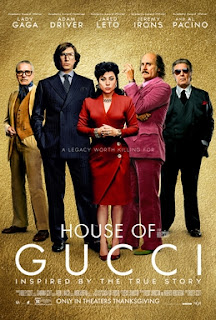
House of Gucci--Lady Gaga plays Patrizia Gucci in Ridley Scott's dramatization of the family turbulence leading up to the 1995 shooting of her husband Maurizio. She's deliciously ripe and amiable in the first half of the story, depicting how she and Maurizio (Adam Driver) met in Milan in the late '70s, how he was willing to renounce his fortune over the disapproval of his father Rodolfo (Jeremy Irons) for the marriage, and how Maurizio eventually did join the family business, helped to revive the venerable but declining brand, and engaged in internal intrigues with his Uncle Aldo (Al Pacino) and cousin Paolo (Jared Leto).

Gaga is also believable and sad, if inevitably less fun, in the second half, when Maurizio drifts away from her. She grows desperate, and, under the influence of a psychic (Salma Hayek), dangerous.

The leading lady is strong; whether that makes House of Gucci's 158 minutes worth sitting through is another matter. Scott's usual panache seemed to desert him here. The pacing is flat, and the effect is of a competent, expensive but unexciting TV movie.

Still, there's undeniable camp value in watching this star-studded cast spew their dialogue at each other, in English but with radio-comedy Italian accents. Driver makes some effort to underplay, and comes across respectably. Pacino hams away enjoyably, and Irons, who's starting to resemble the late-vintage Boris Karloff, manages some impressively suave nastiness.

The shocker is Leto, who turns the hapless Paolo's lines into aggrieved sing-song arias. It feels like he was trying to see how far he could go before Scott asked him to tone it down. Apparently that didn't happen.

Saturday, December 25, 2021

THE THANE MAN

 Merry Christmas everybody!

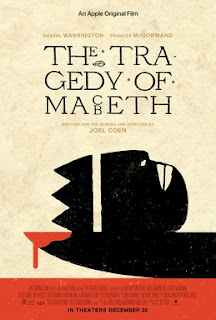
The Tragedy of Macbeth--Nothing says "Christmas" like a tale of witchcraft,  madness, tyranny and the murder of a guest by his host. So Joel Coen, working independently of his brother Ethan for the first time, has served us up an adaptation of Shakespeare's bad-juju masterpiece, with the great Denzel Washington in the title role and the great Frances McDormand as the Lady.

It's a fine-looking film, shot in lustrous black-and-white by Bruno Delbonnel on stylized, angular sets by Stefan Dechant, and it isn't saddled with any heavy-handed "interpretation." Still, it's full of choices I found disappointing.

All Three Witches, for instance, are played by the same actress, Kathryn Hunter, switching voices and contorting her body. She's brilliant, but the conceit doesn't come off authentically; it feels like an Oral Interpretation class exercise rather than true drama. As in Roman Polanski's 1971 version, the Thane of Ross is here portrayed as a scheming, side-switching Machiavel; in both versions this seems to me to dilute the central spiritual tragedy of the main characters.

There are successful aspects to the film: Coen's use of crows as a recurring motif is creepy and effective, for instance, and the confrontation with Young Siward is handled imaginatively. Stephen Root, excellent as usual, tosses off the Porter scene with no mugging.

On the whole, Polanski's Middle Ages bloodbath of '71 is a more satisfying version. But Coen's film has something Polanski's doesn't: true, charismatic stars in the leads. Washington keeps it reserved and quiet, but his internal power is commanding.

McDormand, on the other hand, lets it rip from her first scene, with terrifying intensity but also with lucidity and focus. You can see why her husband's reluctance to commit the dreadful deed wilts before her inexorable will; you can also see, appallingly, the psychological pit she's digging for herself. She's flawless. 

Whatever its shortfalls, this movie has two of the very best actors of their generation playing two of the greatest roles in Western drama. That's not something one should skip lightly.

Wednesday, December 22, 2021

UNCLE BOOK

Opening today:

The Tender Bar--J. R. Moehringer's 2005 memoir is the basis for this  coming of age story directed by George Clooney, from a script by William Monahan. J. R. (the excellent Daniel Ranieri as a kid; the perfectly acceptable Tye Sheridan as a youth) grows up in the run-down Long Island home of his run-down Grandfather (Christopher Lloyd at his most run-down). His single Mom (Lily Rabe) has retreated there, in common with other failed or struggling or stuck descendants of the house.

J. R.'s father (Max Martini) is barely in the picture; a radio disc jockey known as "The Voice," he's a mean and unreliable drunk, so this is likely for the best. In his absence, the narrator turns to his Uncle Charlie (Ben Affleck) as a surrogate father, and lucks out. Charlie, another inmate of the shabby Manhasset manse, maintains a mildly gruff pose, but is a pussycat who adores his nephew, slipping him a bill now and then and dispensing life wisdom about how to be an upstanding guy. He's also a bibliophile who runs a bar called "The Dickens" which is full of great literature that he encourages--dares, really--J. R. to read.

Apparently this educational strategy works out, because in the second half, the grown-up J. R. goes to Yale. We follow him there as he chases a gorgeous rich kid (Brianna Middleton) who likes him but doesn't take him seriously, though he can't get this through his head; we also see him break into the pages of the New York Times and begin his meteoric career. Through it all, he never loses his affection for The Dickens, its regulars, and the quietly tender Uncle Charlie.

There's nothing very wrong with any of this, but there's nothing very urgently dramatic about it, either. The scenes between J. R. and his sneering, contemptuous father are the only time the movie shows any real volatility. There's a pleasant, nostalgic rhythm to the first half, buoyed along easily by Affleck's keenly likable performance; the second half, with J. R.'s paysan parvenu adventures in college and beyond, feels more formulaic and tired.

The movie does feel like a throwback, however. Stories of kids striving to make good in the academic big leagues are now customarily not about straight white guys. J. R.'s success feels akin to stuff like The Paper Chase or A Small Circle of Friends. Clooney may not have been altogether at ease with how white The Tender Bar is, as he cast the longed-for rich beauty as biracial, though in the book Moehringer describes her as classically whitebread. There's nothing remotely implausible about J. R.'s (or anyone's) attraction to the movie version of the character, but this pointedly nontraditional casting feels more preemptive than period precise.

Friday, December 17, 2021

ALLEY WHOOP

Opening this weekend...

Nightmare Alley--"Geek" has now become roughly analogous to "nerd" or "extreme enthusiast." But the term once had horrific connotations; it was carny slang for a sideshow performer who would do ghastly acts--bite the heads off of live chickens, for instance--usually to feed an alcohol or drug habit. The bottom rung of show business (I almost wrote "the bottom rung of humanity" but then I remembered the 45th President and his cronies), this revolting occupation was the jumping-off point for William Lindsay Gresham's classic lower-depths novel Nightmare Alley (1946).

An atmospheric if softened-up movie of it was made in 1947 with Tyrone Power as Stan, the newbie carny who looks at the geek and knows he could never fall to such a degraded level. Bradley Cooper plays Stan in this gorgeously stylized new version from the great Guillermo del Toro, working from an adaptation he co-wrote with Sunset Gun maven Kim Morgan.

Stan, a drifter running away from something awful, makes himself useful as a laborer to a desolate midwestern carny. Soon he's learning the tricks of fortune-telling and mind-reading acts, which here are so talmudical that earning an honest living seems like it would be far easier. He learns how to calm down an angry cop, and how to dispose of a geek who's outlived his usefulness, and where to find a new one. 

And the work brings out Stan's creative side; soon he's designed a spectacular new "electric chair" act for the lovely Molly (Rooney Mara). He's also taught a weird sort of hustler ethic; the veteran fortune-teller Zeena (Toni Collette, magnificent as ever) warns him against doing a "spookshow," that is, actually faking a manifestation of a departed loved one.

This first half, set in the carny amongst its disreputable but mostly warm and likable denizens, is darkly delightful, visually sumptuous and full of terrific, potent acting and pungent dialogue. As with both the novel and the earlier film version, the second half, in which Stan leaves the carny to start a higher-end mentalist scam--and foolishly ignores Zeena's advice--is less engaging. His scenes as the hapless fly in the parlor of a lacquered, satanic psychoanalyst (Cate Blanchett), though entertaining enough, border on camp, and are a little oppressive after the buoyant, motley first act.

Still, this is a rich and absorbing melodrama. Actors seem to thrive in front of del Toro's camera, and alongside the leads and the wondrous Collette, scene-stealers here include Willem Dafoe as the candidly heartless boss, Ron Perlman as an avuncular carny and, perhaps best of all, David Strathairn as Pete, Stan's washed-up, gently rueful mentor. Even in the second half, there's a splendid quick turn by Mary Steenburgen, and Richard Jenkins is scary, and briefly piteous, as the cold-hearted tycoon for whom Stan puts on his spookshow.

Finally, a word should be said for Paul Anderson, as the geek. He plays the part to the hilt, yet without hamming, and with a dreadful glimpse of the human being he was.

Monday, December 13, 2021

BELFAST AND THE FURIOUS

Phoenix Film Critic Society, of which I'm always proud to note that I'm a founding member, has announced our 2021 award winners. Kenneth Branagh's autobiographical drama Belfast...

...won Best Picture, Best Director and three other awards; the new version of Dune also won five awards. Check out the full list here. As always, some of it reflects my voting, some doesn't, but there are lots of movies worth seeing on the list.

Friday, December 10, 2021

RE-MAKE OF OUR HEARTS

Opening this weekend:

West Side Story--The original 1961 film version of the 1957 Broadway musical has aged well, on the whole, but it has aged. The retelling of Romeo and Juliet in New York street gang dress still holds an audience beautifully, and the performances and numbers remain exciting, at their best electrifying. But the depiction of gangs can feel a bit quaint; the Jets, in particular, come across more like the Bowery Boys than like convincingly dangerous hoodlums, and the take on Puerto Rican culture is narrow. The dubbing sounds a little canned at times, and the orchestrations are over-symphonically lush.

That said, it remains a terrific picture, and it was hard to see a pressing need for a remake. But director Steven Spielberg and screenwriter Tony Kushner have given us one, and it's improbably superb, better than the original in some ways (not all), reimagined without laborious "reinterpretation"; new, yet somehow entirely faithful to the material.

It begins with urban renewal--Spielberg's camera gliding down and skulking around the wreckage of the slummy Upper West Side neighborhoods being cleared to make way for the Lincoln Center complex in the late '50s/early '60s. To those unmistakable, teasing opening bites of Leonard Bernstein's score, we see the Jets (Anglo gang) stealing cans of paint and making a sortie into the turf of the Sharks (Puerto Rican gang) for a reason that carries a shocking punch.

From there on, Spielberg and Kushner ingeniously, even playfully dramatize the economic and ethnic shifts that created the gang animosities, and give their movie a specific context that the original, with its almost fairy-tale Montague-and-Capulet conflict, only hints at. Other marginalized figures, like "Anybodys" (non-binary actor Iris Menas), get a deeper treatment here as well.

Stimulating as all this is, it would mean nothing if the music and acting were soulless. But somehow these numbers, some of them repurposed and reset, spring to life. Along with choreographer Justin Peck, Spielberg, again, deserves no small portion of the credit for this; he even gets the cars on the streets into the kinetic rhythms of the tunes.

But the actors are even more potent, most surprisingly in the treacherous lead roles. Who knew Ansel Elgort could sing like that? He plays Tony straightforwardly and guilelessly, and he and tiny newcomer Rachel Zegler, as Maria, throw themselves into their joy at each other with no mannerism or embarrassment, so that their pure and perfect love at first sight, always the difficult part of this story, almost becomes plausible.

Mike Faist brings a haunted undertone to his cocksure manner as Riff, and Ariana DeBose and David Alvarez are knockouts as Anita and Bernardo. If neither of them quite have the febrile glamour and sexiness of Rita Moreno and George Chakiris in the original, well, who could?

Moreno, by the way, appears here, not in a honorary cameo but in a real role--the equivalent of Doc the drugstore proprietor--and she nails it with guts and grace. She gave the best performance in the original, and one of the best here.

Friday, November 19, 2021

NET PROPHET

Opening this weekend:

King Richard--This biopic concerns the early rise of two of the greatest athletes of our time, Venus and Serena Williams. I found myself feeling a pang of sympathy for the casting director; how the hell is anyone supposed to find young actresses who plausibly suggest those two demigoddesses, and who presumably had to have at least some aptitude for tennis as well?

Saniyya Sidney and Demi Singleton got the parts, and play them well, with unaffected sweetness and physical confidence that brings the tennis scenes to life. But we catch a glimpse of the genuine articles in some video footage near the end, and realize that there's no replacement for them.

This doesn't matter much, however; the real focus of the film, as the title indicates, is Richard Williams, their father and, in their earlier years, their largely self-taught coach and manager. A security guard from Louisiana living in L.A., the elder Williams, played by Will Smith, is shown here to have essentially created his two world-beating prodigies from scratch.

The movie begins with him explaining to baffled white tennis coaches and sponsors he's trying to recruit that he wrote a plan to develop his girls into champs before they were born. Then he talked his wife Brandi (Aunjanue Ellis) into having two more children for this purpose (they both had children from previous relationships), and coached them rigorously, on dangerous, gang-infested neighborhood tennis courts in Compton.

You can hardly blame the guys listening to Williams for dismissing him as a crackpot, or even his disapproving neighbor for wondering if he's working them too hard. The point of the movie, however, is that almost everything Williams predicted came spectacularly true. It also shows him teaching them humility and good sportsmanship, almost tyrannically.

I think you'd have to have a piece of your soul missing not to find this story, briskly directed by Reinaldo Marcus Green from a script by Zach Baylin, at least a little bit moving and inspiring. The role fits Smith like a glove, both in his tireless positivity and his exhausting eccentricity, and we feel it when he gets angry at the racist condescension of the white tennis bigshots. And it's also hard not to love the character's preaching to his girls against unsportsmanlike braggadocio, and his disgust with abusively competitive tennis parents.

But there's no way around it, there's something crazy, almost science-fictional, about this story as well, as if the champs were cloned and programmed for their destiny. This sunny movie shows us happy, well-rounded, singing, squabbling little girls; if either Venus or Serena ever thought they might want to do something else with their lives we don't see it. Probably the world is full of sports parents with grandiose visions like this; what makes King Richard seem far stranger than fiction is that in this case the vision wasn't delusional.


Kurt Vonnegut: Unstuck in Time--This portrait arrives more than thirty years after it was begun. Over the decades of its gestation, the director, Robert B. Weide, became a talking head and a first-person presence in the film, explaining what Vonnegut means to him, how the project began, and (sort of) explaining the delay in completing it.

In this way it's a bit like many of Vonnegut's own books, especially his swansong novel Timequake, with his authorial intrusions that foreshadowed and influenced the "meta" techniques of contemporary lit. Weide, a veteran documentarian as well as a producer and director of Curb Your Enthusiasm, had idolized Vonnegut since high school, and wrote to him proposing the project in the '80s. The men hit it off, and as shooting continued they swiftly became close friends, maybe even best friends.

Thus, along with remarkable access to archival material--vivid home movies from the author's childhood and youth, marked-up manuscripts, rejection slips, drawings etc (and, be forewarned, some hard-to-watch wartime footage)--the interviews Weide captured of Vonnegut, teasing, ruminating, laughing inappropriately at grim stories, seem unusually candid and intimate. Vonnegut's children and stepchildren also appear, as well as friends and colleagues ranging from John Irving to Morley Safer, and generous chunks of his prose are heard, read by Sam Waterston when no recording of Vonnegut is extant.

Vonnegut has been much on my mind of late, as I had the opportunity to visit the Kurt Vonnegut Museum and Library in Indianapolis this past August; some of the artifacts I saw on display there are shown in the film. Although I've been a voracious Vonnegut reader since about the time that Weide started, I learned much from Kurt Vonnegut: Unstuck in Time. It's a chronicle of a remarkable life; it's also a chronicle of an enviable friendship.