Friday, August 12, 2022

GRAY FOX

Opening in theaters this weekend:

Mack & Rita--L.A. writer Mack (Elizabeth Lail) is 30, but has always been a 70-year-old lady at heart. She's faking it when she tries to act like a rowdy young party animal. In Palm Springs for the weekend with her girlfriends, she gazes longingly, from the line waiting to get into a club, at the relaxed older ladies enjoying themselves at the tables in front of the restaurant across the street.

Mostly because it gives her the opportunity to lie down (in what looks like a tanning bed), she tries an age regression therapy session offered in a tent alongside the road. When she emerges, she finds that it's had the opposite effect: age progression, albeit to about the most elegant version of a woman in her seventies you can find: Diane Keaton.

This version of Mack adopts the persona of "Aunt Rita" and goes about trying to reverse the process; she also notices an attraction between herself and her cute young dog-sitter (Justin Milligan) and falls in with a "wine club" of fun-loving saucy ladies around her age (Loretta Devine, Wendie Malick, Lois Smith and Amy Hill, all having fun). Wacky hijinks ensue.

Directed by Katie Aselton from a script by Paul Welsh and Madeline Walter, this is a variation on the seemingly inexhaustible genre of fantasies about people changing their age. Often such tales are about kids wanting to be adults; sometimes they're about adults recapturing childhood or youth. But I can't remember another story about a young adult wanting to be old, even if they get to be Diane Keaton old. As a sixty-year-old who seems a lot less youthful than the 76-year-old Keaton, I could warn Mack not to be in such a hurry. 

This movie is fluffy to the point of insipidity, most of the dialogue is feeble, and the idea is thin at feature length, padded out with montage sequences. But though it takes almost twenty minutes to get to her entrance, right in the middle of the picture is Diane Keaton; funny, sexy and stunning as ever. Nattering Annie Hall-style and gamely pratfalling, she single-handedly gives the movie a charge that almost justifies it.

But only almost. Keaton is one of our best movie stars, and she's been skillfully (and no doubt lucratively) elevating otherwise routine chick-flicks like this for a long time. But she's also a top-notch actress, and it's been a while since she's shown what she can do in really good material. No one can begrudge her the payoff from this sort of thing, but it would be nice to see her squeeze in something a bit more substantive.

One more note, for the dog lovers: Mack has a wonderful little dog called "Cheese" (voiced, in a mushroom-trip sequence, by Martin Short). In the first scene in which Cheese sees "Rita," he stares at her quizzically, for all the world as if he recognizes her but is baffled by her new appearance. It's the closest Keaton comes to being upstaged.

Friday, August 5, 2022

TRACK STAR

Opening this weekend:

Bullet Train--Brad Pitt plays one of several professional assassins riding the title vehicle on an overnight zip from Tokyo to Kyoto. Dubbed "Ladybug" by his dispatcher (Sandra Bullock), he's a lethal fellow with mad fighting and weapons skills, but he regards himself as a magnet for bad luck, and he's weary of his career and wants more positivity in his life.

This is Pitt in frumpy, glamor-debunking mode, decked out in a bucket hat, drab jacket and sneakers, with horn-rimmed nerd glasses. His manner is pleasant and unassuming; a central joke of the movie is that Ladybug clearly has no wish to hurt anyone. Pitt is very good company here, in the way that only a veteran movie star can be, and as a model for action movie heroes to come I heartily approve.

There are other strong actors here--Aaron Taylor-Young and Brian Tyree Henry as a team of bickering Brit killers, Hiroyuki Sanada and Andrew Koji as father-and-son assassins, Benito A Martinez Ocasio as a vengeful Mexican hit man, Zazie Beetz as a deadly concessions peddler, Joey King as a schoolgirl type with secrets, all chasing a briefcase McGuffin and trying to avoid the wrath of a shadowy Russian gangster known as "The White Death," not mention a pesky (if rather sweet-faced) boomslang snake on the loose. A few big names turn up in amusing cameos.

Yet all of this creditable work doesn't quite add up to a satisfying movie. Directed by David Leitch from a script by Zak Olkewicz adapted from a Japanese novel by Kotaro Isaka, Bullet Train feels like an exercise in nostalgia; it's like one of the innumerable '90s-era knockoffs of Tarantino, Robert Rodriguez or (especially) Guy Ritchie, full of savage yet "ironic" facetious violence and whip pans and cute but bloody flashbacks and characters engaging in detailed discussions of pop culture (Thomas the Tank Engine in this case).

It's well-crafted and perfectly watchable, as long as you aren't too squeamish. But for me, it lacked any real emotional stakes, and the homestretch grows overblown and tediously overextended. Compare it to 2018's underrated Bad Times at the El Royale, another faux-Tarantino throwback that had the same tongue in cheek, but a bit of heart in its chest as well.

Now on Prime  Video:

Thirteen Lives--It's the story of a rescue mission with the number thirteen in the title, and it's directed by Ron Howard. That's a pretty solid recipe for success.

In June of 2018 twelve members of a youth soccer team and their coach went on an outing into a cave in a provincial mountain park in northern Thailand. An unexpected early monsoon hit after they went in, the paths quickly filled up with water, and the boys were trapped, more than two miles into the narrow, twisty passages. The rescue efforts that followed over the next three weeks included participants ranging from Thai Navy Seals to U.S. Military to Brit rescue divers to a Bangkok-based engineer who figured out how to divert rainwater from sinkholes on the mountain, into the agricultural fields below. The movie asserts that more than 5,000 people from 17 countries pitched in.

Howard focuses on the Brits, nicely underplayed played by Colin Farrell, Viggo Mortensen and Tom Bateman, and an Australian diver, played by Joel Edgerton, who was called in because of the specifics of his medical background. Like Howard's best film, Apollo 13, this is a fairly deep dive (sorry about that) into the technical difficulties of the operation, and this attention to detail adds to the suspense rather than dragging on the pace.

The movie's a bit of a harrowing ordeal at times, especially for those of us with a claustrophobic streak, but it's just about impossible not to invest in it emotionally. And while it's inspiring, it may also leave you a little exasperated with our seeming inability to work together for the common good when it's not such an obviously urgent crisis. What a pity it's so hard for us to remember that, in the end, all humankind is one big Thai soccer team, hoping to get out of our respective caves.

Wednesday, August 3, 2022

RELAY RACE

The passing of the glorious Nichelle Nichols, my first crush...

...brought me back to a slightly embarrassing truth: Star Trek, as in the original Star Trek, has been my favorite TV show for more than fifty years now. I have vivid early memories from a couple episodes in the original run ("Arena" and "The Savage Curtain," stayed with me, no doubt because of their monster content). But it was when the series went into syndication in the early '70s that I became a full-on addict.

I saw every episode dozens, probably hundreds of times. I played with the action figures and (ineptly) built the plastic model kits. I had coloring books and jigsaw puzzles and View-Master slides and calendars and posters, including a poster of Ms. Nichols in her "Mirror, Mirror" costume that hung in my bedroom as adolescence approached. I made my parents take me (along with a like-minded nerdy cousin) to Warren, Ohio, to see William Shatner in Arsenic and Old Lace with the Kenley Players, and later to Fredonia, New York, to hear Gene Roddenberry give a lecture at SUNY.

The franchise was also a big reason why I became an avid reader: I read the James Blish Star Trek anthologies, and Blish's Spock Must Die! was, I think, the first full-length novel I ever bought for myself. I read Mission to Horatius by Mack Reynolds and the Gold Key Star Trek comics, not to mention the non-fiction books; Stephen E. Whitfield's The Making of Star Trek and David Gerrold's The Trouble With Tribbles and The World of Star Trek were sacred texts for me.

As I got older, while adding countless other obsessive pop culture enthusiasms, I never quite grew out of Star Trek. I even monetized it, a little; over the course of my writing and radio career I had the opportunity to meet and/or interview Walter Koenig, DeForest Kelley, James Doohan and Grace Lee Whitney.

Of course I realize that what I'm describing is a very routine level of fandom by Star Trek standards. I've never cosplayed, or learned Klingon, and only once, in reaction to the death of Leonard Nimoy, did I ever write a piece of parody fanfic (which I managed to get published). I never became a serious fan of any of the sequel shows (though I've enjoyed Star Trek: Discovery very much). But I still own a couple of Star Trek t-shirts, and I have a Gorn bobblehead on my desk, and I regularly watch the original series reruns; they're an ongoing source of amusement and comfort to me.

Which makes it peculiar whenever I discover that there are areas of Star Trek ephemera with which I am completely unfamiliar. Like for instance, The Mystery of Black Sulu and White Uhura.

No, really.

A couple of weeks ago The Wife was browsing in the vinyl section of a junkshop, and scored for me a piece of Trek merch I had never encountered: one of the albums in the Star Trek series from Peter Pan Records.

It was from 1979--it has a still from Star Trek: The Motion Picture on the cover--at which time I would have been unlikely to notice an album for kids.

On each side is an original story, performed radio-theater style (by uncredited actors who don't sound like the original cast members). And inside the sleeve is a read-along comic illustrating the tales. And in this rather nicely-drawn comic...Sulu appears, quite unmistakably, to be African-American, and Uhura appears to be white, indeed blond. Their roles are otherwise exactly as they were on the show, but their pigmentation is altered.


I was baffled at this. Certainly Star Trek has long been admired as, for its time, a pioneer in racial diversity on TV, but this didn't seem to make sense as part of that tradition, nor does there seem to be any other reason for the change. I looked online for guidance, to find that the oddity had, indeed, been noted on various fansites, though none I saw offered any explanation for it.

I did learn, however, that most of the audio dramas on the Peter Pan Trek records were written by Alan Dean Foster, the prolific sci-fi author who also wrote the Star Trek Log books, paperback adaptations of the cartoon series from the '70s (not to mention the original Star Wars novelization). I messaged Foster to ask if he knew anything about it.

His reply: "As to the miscoloring, I believe some of it was done overseas and no instructions were given to the artists."

As good an explanation as any, I guess, although the likenesses of Kirk, Spock and McCoy look impressively accurate. So do those of the uniforms, the sets and the Enterprise herself. Maybe whatever pictures were given to the overseas artists for reference didn't include Sulu and Uhura; a serious omission if so.

Anybody else ever heard of any other reason?

In any case, it's a testament to how iconic even the supporting characters in Star Trek are that this innocent, probably even well-intentioned variation seems so shockingly weird. On the other hand, maybe smoldering encounters of Black Sulu and White Uhura could be the basis for a whole new genre of fanfic.

Friday, July 22, 2022

YEP

Opening in theaters this weekend:

Nope--The terse title refers to the reaction that audiences often have when they're watching a horror movie, and the character is faced with investigating or confronting something scary: Nope. Nope, nope, nope. Onscreen, of course, the characters always do, and this movie is no exception.

The latest from Jordan Peele is set in Agua Dulce, a remote desert area north of L.A. (Vasquez Rocks, immortal location of countless films and TV shows including the "Arena" episode of Star Trek, is nearby). Peele's hero, once again played by Daniel Kaluuya of Get Out, is O.J., a horse wrangler for the movies who struggles to maintain the isolated ranch that's been in his family since the beginning of Hollywood. His actress/writer/singer/motorcyclist sister Emerald (Keke Palmer) works with him at times, though she can be as much an unreliable hindrance as a help.

Their father (Keith David) has recently died under weird circumstances, and gradually O.J. and Em become aware that their little corner of Agua Dulce is haunted by nothing less than a flying saucer. But while O.J.'s strong instinct is to say "nope" to exploring the matter further, Em's is to try to capture incontrovertible photographic or video evidence of the phenomenon, and she persuades her brother that it's the key to the ranch's solvency.

This basic synopsis does little justice to the richly imagined world in which Nope unfolds, however. Next door to the ranch, for instance, is "Jupiter's Claim," a western theme park run by Ricky (Steven Yeun), a former child actor and the veteran of a horrifying mishap on the set of a sitcom. O.J. has been selling off his horses to Ricky to stay afloat, but is hoping to buy them back.

Ricky's backstory is connected thematically to the main plot; Peele's persistent theme is the turbulent relationship between humans and other species, whether animal or alien. In formal terms, though, this strand is undeniably a digression. But, as with the digressions in, say, a Stephen King novel, I don't think the movie would work without it, or without Holst (Michael Wincott, growly as ever), the eccentric cameraman who agrees to help the siblings, or without Angel (Brandon Perea), the heartsick Fry's Electronics techie and UFO geek who worms his way into the project as well.

It also wouldn't work without Peele's careful, measured pacing. He teases us with a gradual accrual of creepy flourishes, even a pretty hair-raising red herring, so that when his extended big confrontation at the finale arrives, the thrills feel earned. And, like Get Out, the film is leavened with comedy--often macabre comedy--throughout.

With the help of Hoyte von Hoytema's sun-bleached pastel cinematography, Peele generates an atmosphere of preternatural Americana that inevitably recalls the work of the young Spielberg. Indeed, Nope is probably the best UFO movie since Close Encounters, though the sense of wonder is here tinged with the sinister and unwholesome.

A word should also be said for the leads. Palmer's Emerald is exuberant, exasperating and endearing. Kaluuya is strikingly laconic; his face slackening hilariously with dismay when he registers yet another setback, but remaining stoic. He spends a fair amount of his footage on horseback, and Peele showcases him like the star of a spaghetti western. In the middle of this sci-fi tale, the relatively short Kaluuya makes one of the more imposing and authoritative tall-in-the-saddle western heroes the movies have seen in quite a few years.

Monday, July 18, 2022

BEST PRACTICES

The July/August issue of Phoenix Magazine, now on the stands...


...features the 2022 "Best of the Valley" selections. Your Humble Narrator is proud to have been one of the authors. Try to guess which ones I wrote!

Friday, July 15, 2022

COVER STORY

In theaters this weekend, a couple of compelling documentaries:

Hallelujah: Leonard Cohen, A Journey, A Song--Arguably the most beautiful popular song of the 20th Century in English, both lyrically and melodically, Leonard Cohen's signature work has proven itself as a standard. It's a testament to its power that, even though we hear more than ten different artists performing it in this absorbing documentary, it doesn't get old.

Released to little initial notice on Cohen's 1984 album Various Positions, it gradually gained ears as it was performed by Bob Dylan, John Cale, Jeff Buckley, Myles Kennedy, Bono, Brandi Carlile, Eric Church, Alexandra Burke and others. The use of Cale's version on the soundtrack of Shrek in 2001, and the inclusion of Rufus Wainwright's exquisite cover on that movie's soundtrack was a tipping point for the song as a spiritual anthem for our time; k. d. lang magnificently eulogized Cohen with it in 2017, and at our national nadir after the election of the 45th president, Kate McKinnon, nominally in the guise of a defeated Hillary Clinton, salved us with it in 2016 on Saturday Night Live.

Perhaps wishing to avoid infecting the song with topical politics, this movie, directed by Dayna Goldfine and Dan Geller, excludes that wretched, moving moment. It includes biographical material on Cohen, but as it progresses it focuses increasingly on the life which the song itself took on. Aside from its endless interpreters, Cohen himself never really stopped writing it; one of the talking heads claims that he filled notebook after notebook with about 180 verses.

Gabby Giffords Won't Back Down--Music is also central to this documentary, directed by Julie Cohen and Betsy West, about the former Congresswoman from Arizona's 8th District. Shot by a deranged gunman outside a supermarket in Tucson in 2011, at a massacre in which six people were killed, Giffords, the main target of the attack, received a critical brain injury resulting in aphasia, greatly inhibiting her speech.

But she could still sing, and that was one of the ways by which therapists helped her on her slow, exhausting road to reclaim her ability to communicate. Tunes from "And She Was" by Talking Heads to Tom Petty's "Won't Back Down" to "Que Sera, Sera" to Bowie's "Space Oddity"--in reference, of course, to her husband, former astronaut and current U.S. Senator Mark Kelly--are used on the soundtrack to move the narrative forward, both to poignant and lighthearted effect. But more importantly, there's a sense of exhilaration and liberation when Giffords, who strains to find the simplest spoken words, cuts loose freely in song.

The movie packs an infuriating punch, because it shows how much vibrancy and radiant ease Giffords lost to her injury. She's one of the countless casualties of this country's gun insanity that should each, in and of themselves, have been enough to spur reform. But it's also inspiring to see how little, in the face of what she's suffered, she seems to have lost to bitterness and rage, and how much of her spirit and fierce charisma she's won back.

On VOD this week:

Glasshouse--The world has been ravaged by a plague which leaves people without memory, even of their own names. The members of a family--severe mother (Adrienne Pearce), three beautiful daughters (Jessica Alexander, Anja Taljaard and Kitty Harris) and an afflicted son (Brent Vermuelen)--hunker down inside a huge, palatial greenhouse and practice quasi-religious rituals about memory. They venture outside in rather Victorian-looking breathing apparatus, and pick off any approaching strangers with sniper rifles. Then one day the alluring eldest daughter brings a hunky injured man (Hilton Pelser) in, finds he is not a "forgetter" and, as you can imagine, trouble ensues.

The twists get more twisty, and more unsavory, as the story progresses. Directed by Kelsey Egan in and around a South African conservatory building--the script was written, by Egan and Emma Lungiswa de Wet, with this location in mind--the film is deliberate, but it has an atmosphere of unhealthy eroticism that recalls Don Siegel's 1971 period drama The Beguiled. It's the most interesting post-apocalyptic yarn in quite a while.

At the Laemmle in L.A., and on demand:

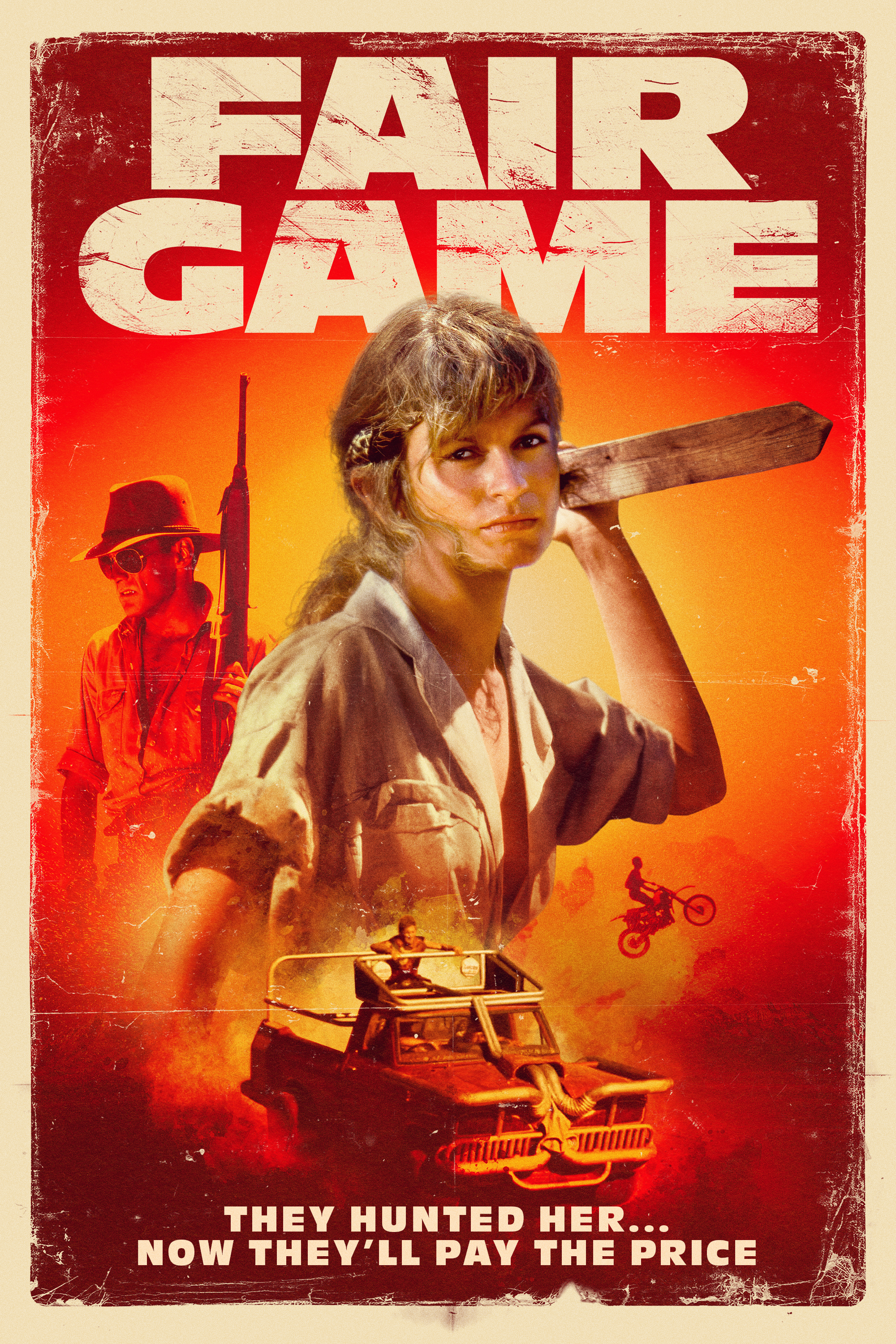
Fair Game--The heroine of this Australian actioner of 1986 is Jessica (Cassandra Delaney), a Julie-Christie-esque beauty with big '80s hair who runs a wildlife refuge in the outback and lives on it in an isolated cabin. The villains are a trio of kangaroo poachers who terrorize and assault her and trash her home.

Most of us wouldn't need to hear more than "kangaroo poachers" to want to see these guys pulverized, but the gleeful performances of Peter Ford, David Sandford and Barry Sparks manage to elevate our bloodlust even further. Enjoying a re-release from Dark Star, this "Ozploitation" melodrama, reportedly and believably a favorite of Quentin Tarantino and an inspiration for Death Proof, is bluntly directed by Mario Andreacchio. It's shot with richness and nuance by Andrew Lesnie, and packed with that maniacal stunt work characteristic of Australian action flicks of that period. Despite what she endures, our heroine remains defiantly brave throughout, and it would be absurd to deny how satisfying it is when she turns the tables on her tormentors.

Except that for me, as usual with revenge dramas...it's not quite sufficient. Death, even painful death, wasn't enough for my spiteful heart; I wanted these guys to suffer more humiliation and degradation at Jessica's hands. But Fair Game comes closer to a gratifying payback than most.

Friday, July 8, 2022

SNAILED IT

Opening this weekend:


Marcel the Shell With Shoes On--The title character is a teeny-tiny, rather generic-looking seashell with a single googly eye in his aperture and a tiny pair of shoes attached to his underside. He lives in a sunny AirBnB with his "Nan," a slightly larger shell named Connie, and the two of them devise ingenious ways to eke out a subsistence.

Once they were part of a larger community of other anthropomorphic random tidbits--other shells, cheese curls, Chex mix, pencil stubs. But lately they've been on their own, and supportive as Connie is, Marcel feels the loss of society keenly. Even Marcel's pet--a miniscule bit of lint named Alan that he leads around on a leash--doesn't make up for it.

The conceit is that we're seeing a documentary in which the director, Dean Fleischer-Camp, interviews and bonds with Marcel, and eventually helps him try to find the old gang, a process which involves Marcel and Connie's favorite TV star, Lesley Stahl of 60 Minutes. Marcel's piping, guileless yet keenly perceptive voice is provided by Jenny Slate, and Isabella Rossellini voices the firmly loving Connie.

Somewhere, I suppose, there's a critic working up a venomous pan of this animated feature, based on the viral 2010 online short and its sequels. But I'm not that critic. The movie has a paradisal atmosphere and is very, very funny, with sprightly timing of its visual gags and surprising verbal interplay, much of it probably improvised, between Slate and Fleischer-Camp (formerly Slate's significant other in real life). Yet from the start there's a hint of bittersweet melancholy to it as well, underscored by passages from Philip Larkin to "Peaceful, Easy Feeling."

Thor: Love and Thunder--Embodied once again by the jovial Chris Hemsworth, Marvel's version of the Norse deity must make a big personal adjustment in this latest adventure. The thunder god's beloved hammer Mjolnir, which formerly only he could wield, is now responding to his ex-girlfriend Jane Foster (Natalie Portman). Thor is now in a relationship with a perfectly nice battle axe, Stormbreaker, but he can't forget his old hammer, and the sight of his ex effortlessly swinging it takes some getting used to.

Thor and Jane, along with their pals Valkyrie (Tessa Thompson) and rock man Korg (director/co-writer Taika Waititi), must here work together to rescue a group of children abducted from New Asgard, a rather bougie beach town and tourist destination, into dark dimensions. The kidnapper is Gorr the God-Butcher (Christian Bale), a rasping, chalky-skinned, spectral figure whose religious disillusionment early on has led to his desire to, you know, butcher all the gods. Thor's appeal to Zeus (Russell Crowe) for help reveals a distinct lack of cross-cultural amity in the Olympian, who comes across like a tacky billionaire showman of the new school.

As in 2017's delightful Thor: Ragnarok, Waititi plays this material for goofy laughs; there are cosmic gags here worthy of Melies. It's very silly, but unlike Ragnarok, it isn't only silliness. Bale's Gorr is genuinely creepy, and the scenes in which the characters are faced with loss and love are emotionally substantive. Love and Thunder has an airbrushed-van rock-n-roll sensibility that Waititi doesn't mock; borderline-campy as the movie is, its use of "Sweet Child of Mine" can bring a tear to the eye.