Showing posts with label PALM SPRINGS. Show all posts

Wednesday, May 14, 2025

NOIR IN THE WORLD I'D RATHER BE

Now a quarter-century old, the Arthur Lyons Film Noir Festival in Palm Springs remains my favorite film festival in the country.

Held at the Camelot Theatre on Baristo, it specializes in crime movies, mostly from the '40s and '50s, mostly in black and white. Some of them are classics, familiar from Turner Classic Movies or other channels. But I go to see the obscurities, the oddball, forgotten quickies that rarely turn up on TV even in wee hours.

Here are three I caught this year:

Swell Guy (1946)-- The title role, ironically meant, is a celebrated war correspondent who returns to his wholesome small town. His family and the other townies welcome him as a hero; only his Mom (Mary Nash) drops her smile, and drops stitches from her knitting, when no one is looking, because she knows her son is a thieving, amoral creep. Sonny Tufts plays the great man; his name has long been almost a byword for bad actor, but he carries the movie pretty capably as the hale-fellow-ill-met, and he leads a cast that includes Ann Blyth, nearly as unlikable as she is Mildred Pierce, Ruth Warrick, William Gargan, Thomas Gomez and Millard Mitchell, along with Frank Ferguson and Charles Lane among the uncredited bit players. Directed by Frank Tuttle from a clumsy but sassy script by Richard Brooks (based on a play by Gilbert Emery), this uneven but fascinating yarn was presented in a sparkling new 35mm print; we were told that this showing was its debut before an audience.

Lust for Gold (1949)--This gripping, grimly funny western/noir hybrid is set and was partially shot in the Superstition Mountains here in the Phoenix area. It's about the fabled Lost Dutchman Mine, and stars Glenn Ford as Jacob Walz, the "Dutchman" (actually German) who claimed to have discovered gold in the Superstitions but took the location with him to his grave. The movie presents Walz as a slack-faced, dead-eyed rat-bastard, treacherous and murderous and spiteful but also stupid and gullible. He makes the title character in Swell Guy seem like a genuinely swell guy. Ford's not a favorite of mine, but he's excellent here; like a lot of bland nice-guy actors (Fred MacMurray is another good example) the chance to play a louse brings him to life. The presenter warned us that the movie had not one sympathetic character, and right he was; Ford is way outmatched in cool Machiavellian villainy by his leading lady, the exquisite Ida Lupino. The film is oddly structured, with the period western part set within a modern-day frame story of nearly equal screen time featuring William Prince, Paul Ford and Will Geer. The old west story is resolved by a dues ex machina; the modern story is resolved by a serpens ex machina. The cast includes Gig Young as Lupino's weakling hubby, Edgar Buchanan as Ford's partner, and, among the uncredited players, the likes of Arthur Hunnicutt, Will Wright, Hayden Rorke, Percy Helton and Jay Silverheels, among others. Hard to go wrong.

The film's version of the Lost Dutchman story is probably pure fiction, but that's fair enough, as none of the other versions are any more reliable. Nonetheless, the film opens with the following gobbledegook Certificate of Authenticity from Dan E. Garvey, then the Governor of Arizona, on AZ Governor's Office letterhead no less:

"The picture which you are about to see represents, to the best of our knowledge, the true facts concerning this unusual situation, as substantiated by historical records and legends of the State of Arizona."

Nice to know that it isn't only in today's political climate that legends could be used to substantiate facts.

Unmasked (1950)--This brief programmer from  Republic stars a fleshy, pre-Perry Mason Raymond Burr, indolently slimy as the editor of scandal sheet called The Periscope. He impulsively murders his mistress, then frames her husband (Paul Harvey) for it. This was the least of the three movies I made it to, but Burr puts on a good show, as does Harvey, as does Norman Budd as Burr's squirrely sidekick. And near the end, there's a wild fistfight, just to remind us it's a Republic picture.

Lots of fun, but alas, the relentless march of time is not treating this festival kindly. I've been going, not every May but most, since 2007, and for the first few years many of the screenings were attended by actors from the films; over time I got to see June Lockhart, Marsha Hunt, Ann Rutherford, Richard Anderson (not wearing socks!), Norman Lloyd, Robert Loggia and Ernest Borgnine, among others, including grown-up child actors like Billy Gray and Gordon Gebert.

Now that even these kids are getting a bit long in the tooth, the festival has had to resort to offspring. This year's guests included Errol Flynn's daughter and Joel McCrea's grandson.

Monday, May 12, 2025

FEASTIVAL

As in most Mays since 2007, Your Humble Narrator spent this past weekend in Palm Springs, at the Arthur Lyons Film Noir Festival...

...now in its 25th year; its late founder and namesake, mystery novelist and Palm Springs City Councilman Lyons, was still presenting when I first went there. Like every year, I got to see a couple of obscure gems at the Camelot Theatre this weekend.

More about these movies later, but first: food! Here is some of the yummy stuff we enjoyed. First, mushroom barley soup at Sherman's Deli...

Then sand dabs in lemon sauce with fettuccine at Sammy G's...

Then Rigatoni Capri at Kalura Trattoria...

Then back to Sherman's for knockwurst and eggs...

Plus cookies from Sherman's, and a date shake, as is traditional in that town. For the sake of both our health and our finances, it's probably just as well that we don't have access to these places year-round.

On a column near Sammy G's, we saw this beautiful local...


Some variety of spiny lizard, I think. My miserable photographic skills do him no justice. He looked pretty worn and battle-scarred, and his tail appeared to be stumped; it clearly wasn't his first rodeo.

Saturday, May 18, 2024

CORMAN VALUES

R.I.P. to the great Roger Corman.

Here's my utterly trivial Corman story: Back in 2000, I did an edition of my KTAR radio show Another Saturday Night by remote from a station in Palm Springs during the weekend of the Palm Springs International Film Festival. There were a few pretty big Hollywood stars there that year, and I had expressed confidence to my bosses at the station that I might be able to get a couple of them to sit down as guests on the show.

I wasn't.

One of the few guests of any stature that I was able to land was Rachel Samuels, who had directed a film in the festival called The Suicide Club with Jonathan Pryce and Paul Bettany, based on the Robert Louis Stevenson story, for the Irish division of Corman's Concorde Pictures (it was later lamely retitled The Game of Death). Samuels said the usual stuff about Corman; what a great opportunity he had given her, and how little he had paid her.

After the show, I went back to the hotel room to change into something more appropriate for dinner. While I was changing, The Wife, who was already in the bar downstairs, called me.

"You'll want to hurry. Roger Corman and his wife just came in."

I hurried. I took the promotional card for The Suicide Club with me. When I walked into the bar, there the great man was at a high top table, handsome and natty as ever, enjoying a drink with his lovely wife. I walked over and asked if he'd sign my card, telling him that I had just plugged the film on my radio show. He thanked me very graciously and signed my card.

I wish I could say I pushed the conversation, that we bonded and that he offered me a job--apparently he was known to do such things--but I was too shy and didn't want to intrude on his evening out. So I didn't. But the card still hangs, framed, next to my desk.


Last night my friend Richard and I had a Corman movie night; we watched the director's 1957 opus Not of This Earth.

The star is the late, incomparable Beverly Garland, at whose hotel in Burbank I stayed a couple of times; I once saw her, large and in charge, taking care of business with some underlings in the parking lot.

Here the ever-fabulous Bev is a nurse (she seriously rocks the uniform) menaced by Paul Birch as a creepy telepathic vampiric alien in cool shades that mask his hypnotic blank eyes. The monotonic fellow is from the planet Davanna, which has been devastated by radiation and needs Earthlings--who he refers to as "sub-humans"--for our blood.

This truly nutty picture is quintessential Corman, scripted by Charles B. Griffith and Mark Hanna, with an eerie animated title sequence and a cast that includes Corman's repertory company members Jonathan Haze (of The Little Shop of Horrors), and Dick Miller (of A Bucket of Blood) as a vacuum cleaner salesman. There's also a small alien monster, created by the marvelous low-tech creature craftsman Paul Blaisdell; sort of a tentacled flying flapjack that settles on to a victim's head like an oversized hat, then sucks the blood out of his noggin.

Thank you for this and all the other wacky and wonderful times, sir. Peace and joy eternal to you.

Thursday, May 16, 2024

A BRIDGE TOO NOIR

This past weekend Your Humble Narrator made his way west to attend the 25th annual Arthur Lyons Film Noir Festival at the Camelot Theatre in Palm Springs, California.


As in past years, the fest offered a slate of black-and-white crime films from the '40s and '50s. Also as in past years, some of them inevitably strained the definition of noir; this year's schedule included a Sherlock Holmes movie, 1944's The Scarlet Claw, and a Western, Day of the Outlaw (1959). But so what? The definition of noir as a genre is nebulous anyway. The point is that the chance to see cool old flicks like these on a movie screen doesn't come along every day. For sheer entertainment, this may be the most reliably enjoyable film festival in the country.

Also on the schedule were such familiar entries as the John Garfield boxing drama Body and Soul (1947), Anthony Mann's outstanding and still relevant 1949 immigration thriller Border Incident, with George Murphy and Ricardo Montalban, and the hard-boiled thrillers Dead Reckoning (1947) and The Enforcer (1951), both starring noir king Humphrey Bogart. But some of us are most likely to be drawn to the relative obscurities.


This year, for instance, brought the opportunity to see No Man of Her Own (1950). In his onstage introduction to the film at the Camelot, TCM Noir Alley host Eddie Muller repeatedly referred to star Barbara Stanwyck as "the greatest actress in movie history." I'd certainly put her in the top five, anyway, and she's in fine, intense form in this adaptation of the classic Cornell Woolrich novel I Married a Dead Man (originally published under his pseudonym, William Irish).

She plays the heck out of a down-on-her-luck pregnant woman who, through circumstances generously described as coincidental, is able to pass herself off as the new daughter-in-law of a wealthy couple whose son has just died. Despite the obvious absurdities of the plot, the film is engrossing and even moving because of Stanwyck's impassioned star performance, and a fine supporting cast including John Lund, Jane Cowl, Phyllis Thaxter, Richard Denning, Milburn Stone, Carole Matthews as no-nonsense femme fatale and Lyle Bettger in a despicable turn as Stanwyck's sneering blackmailer.

The movie also had, for me, a madeleine of Proustian remembrance: Though I hadn't thought about it in years, the scene in which Stanwyck and Thaxter are upended in a train crash came back to me from childhood with the vividness of an acid flashback. I don't think I saw any of the rest of it back then, but that tidbit had been waiting in the memory banks to be revived for at least half a century.


Other gems this year included Escape in the Fog (1945), with the adorable young Nina Foch dodging Axis spies in San Francisco, and the compelling Southern thriller Woman in Hiding, from 1950.


The woman in question is Ida Lupino, who realizes she's made a major mistake marrying creepy Stephen McNally before the honeymoon even starts. Lupino's delicate beauty contrasts with her gutsy, heartfelt spirit, and director Michael Gordon manages a Hitchcock-worthy sequence set in the stairwell of a hotel. The cast includes, along with Lupino's real-life husband Howard Duff, a bit role by Joe Besser, a later-vintage replacement member of the Three Stooges.


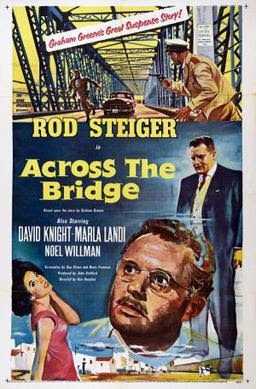
But maybe the real oddity of the schedule was Across the Bridge (1957), a British feature based on a Graham Greene short story and starring a mannered and sweaty Rod Steiger--with a German accent, no less!--as a short-fused white-collar criminal dodging extradition in a Mexican border town. On his way south he's thrown another man, who he resembles, off the train and stolen his passport, but he ends up with this guy's soulful-faced spaniel, Delores, dogging his footsteps (sorry) and gazing reproachfully up at him.

Directed by Ken Annakin, Across the Bridge was shown in Palm Springs in a fairly crappy digital copy, but the presenter assured us that they're working to get it properly restored. I hope they succeed. It's just about the most Graham Greene-ish thing ever, full of moral limbo south of the border and Mexican women wearing prominent crucifixes. And of course it's via "Delores" (suffering) that Steiger's rotten fugitive finds a fateful sort of redemption. In terms of performance, by the way, even full-tilt Stieger is no match for the beautiful Delores, who steals the movie like a dropped potato chip.

Friday, August 12, 2022

GRAY FOX

Opening in theaters this weekend:

Mack & Rita--L.A. writer Mack (Elizabeth Lail) is 30, but has always been a 70-year-old lady at heart. She's faking it when she tries to act like a rowdy young party animal. In Palm Springs for the weekend with her girlfriends, she gazes longingly, from the line waiting to get into a club, at the relaxed older ladies enjoying themselves at the tables in front of the restaurant across the street.

Mostly because it gives her the opportunity to lie down (in what looks like a tanning bed), she tries an age regression therapy session offered in a tent alongside the road. When she emerges, she finds that it's had the opposite effect: age progression, albeit to about the most elegant version of a woman in her seventies you can find: Diane Keaton.

This version of Mack adopts the persona of "Aunt Rita" and goes about trying to reverse the process; she also notices an attraction between herself and her cute young dog-sitter (Justin Milligan) and falls in with a "wine club" of fun-loving saucy ladies around her age (Loretta Devine, Wendie Malick, Lois Smith and Amy Hill, all having fun). Wacky hijinks ensue.

Directed by Katie Aselton from a script by Paul Welsh and Madeline Walter, this is a variation on the seemingly inexhaustible genre of fantasies about people changing their age. Often such tales are about kids wanting to be adults; sometimes they're about adults recapturing childhood or youth. But I can't remember another story about a young adult wanting to be old, even if they get to be Diane Keaton old. As a sixty-year-old who seems a lot less youthful than the 76-year-old Keaton, I could warn Mack not to be in such a hurry. 

This movie is fluffy to the point of insipidity, most of the dialogue is feeble, and the idea is thin at feature length, padded out with montage sequences. But though it takes almost twenty minutes to get to her entrance, right in the middle of the picture is Diane Keaton; funny, sexy and stunning as ever. Nattering Annie Hall-style and gamely pratfalling, she single-handedly gives the movie a charge that almost justifies it.

But only almost. Keaton is one of our best movie stars, and she's been skillfully (and no doubt lucratively) elevating otherwise routine chick-flicks like this for a long time. But she's also a top-notch actress, and it's been a while since she's shown what she can do in really good material. No one can begrudge her the payoff from this sort of thing, but it would be nice to see her squeeze in something a bit more substantive.

One more note, for the dog lovers: Mack has a wonderful little dog called "Cheese" (voiced, in a mushroom-trip sequence, by Martin Short). In the first scene in which Cheese sees "Rita," he stares at her quizzically, for all the world as if he recognizes her but is baffled by her new appearance. It's the closest Keaton comes to being upstaged.

Tuesday, May 17, 2022

JUST THE WAY YOU ARGYLE

Your Humble Narrator is back in the Valley after a quick trip to the Arthur Lyons Film Noir Festival in Palm Springs, California, where I caught up with this 1948 artifact:

The Argyle Secrets--William Gargan, as a wisecracking reporter, is beset by a variety of sinister types, from a femme fatale to a southern dandy with a swordcane to a politely murderous continental gent with a towering henchman. The McGuffin they're all after is an album containing a list of corporate bigwigs willing to play either side of the Allied or Axis fence, depending on who won World War II.

The writer-director is the great Cyril "Cy" Endfield, adapting his own 1945 radio play The Argyle Album from Suspense on CBS. The film version feels, indeed, like little more than an illustrated radio play, with narration and energetic rapid-fire dialogue powering its 65-minute running time. The characters spew detailed exposition at each other even while they're trying to kill each other.

Even with his face bruised and his hair mussed from the various beatings he endures, Gargan is jolly company in the lead, and the supporting cast is a joy: Jack Reitzen as the southern fop, Marjorie Lord as the mendacious beauty, Ralph Byrd as the disapproving police detective, Peter Brocco as one of the shady cronies, and Sgt. Schultz himself, John Banner, here trim and dapper, as the principal bad guy. In a supporting role is a young Barbara Billingsley, and if you've ever wanted see Mrs. Cleaver take a punch right to her adorable kisser, this is the picture that will fulfill your wish.

As with El Vampiro Negro at last year's festival, the restored print of this movie shown at Palm Springs is another collaboration between UCLA Film and Television Archive and The Noir Foundation, and like the Argentine film, The Argyle Secrets looks like a million bucks onscreen. Catch it if you get the chance.

While in Palm Springs, I enjoyed lunch at Sherman's Deli, egg salad and chopped liver on rye...

...dinner at Kalura Trattoria, tortellini panna rosa...

...then back to Sherman's for breakfast, eggs benedict with nova lox...

Yummy.

I also made a pilgrimage to my beloved roadside dinosaurs at Cabazon. When I was there in October they were painted Flintstones-style, with T-Rex as Fred and "Dinny" the sauropod as Dino. This week they were painted to extoll love and peace...


Hard to argue with that. But I'd like to see the Cabazon Dinos painted blue and yellow, maybe with a sunflower on T-Rex's chest...

Wednesday, November 3, 2021

ROADSIDE SCHOLAR

The Wife, The Kid and I spent the weekend before last in beautiful Palm Springs, so that Your Humble Narrator...

...could check out and review a couple of fascinating obscurities at the Arthur Lyons Film Noir Festival at the Camelot Theatre on Baristo.

On the way, we stopped in Quartzsite, Arizona, at Reader's Oasis Books...

...where I had stopped in May of 2019 in hopes of interviewing the celebrated "Naked Bookseller" Paul Winer, only to find the place closed and learn, upon calling his wife Joanne, that Winer had died in a hospice in Yuma just a couple of days earlier (here's the Phoenix Magazine story I wrote about him at the time). This time, I found the store open, and Joanne sitting disconsolately in the doorway, but alas, the place was without electrical power, and the books seemed dusty and dry. Heartbreaking. Nonetheless, I left with several volumes, including a Western paperback called The Man From Padera, by cowboy star Rory Calhoun.

Then we stopped for gas at Chiriaco Summit, California, and paid a quick visit to "William the Conqueror" (Patton's dog) at the Patton Museum there...

In Palm Springs, we had several fine meals, including lox and eggs at Sherman's...

On Saturday, after dropping the ladies off to shop at the outlet malls just west of Palm Springs, I headed back to the incredibly windy exit at Cabazon to visit my beloved roadside dinosaurs (famously featured in Pee-Wee's Big Adventure) to find they had been painted in Flintstones style...


Oh the indignity. "Dinny" looks rather irritable about it...

I went into the gift shop inside Dinny's belly to see if I could establish if the dinos are still under occupation by the anti-evolutionist crowd, and rather to my surprise, could find no evidence of it. There were no books, brochures, tracts or signage to that effect that I spotted, just standard toys, shirts, etc. It made me wonder if, maybe, the owners found their anti-evolutionist views bad for business and decided to self-suppress them, at least in the gift shop. 

In any case, sculptor Claude Bell's bas-relief depictions of earlier humans, which suggest a belief in evolution, may still be seen in the interior walls...


Outside, there's also this snake sculpture...

...and the huge, dinosaur-adorned sign of the Wheel Inn Restaurant...

It's now closed, alas, but I would have eaten there if it wasn't.

On the ride home we stopped in Quartzsite again for gas, and saw still more fauna I would like to have adopted...

Monday, October 25, 2021

DARK DEPTHS & DIZZY HEIGHTS

This past weekend Your Humble Narrator saw two real gems at this year's belated-from-May version of the Arthur Lyons Film Noir Festival:


El Vampiro Negro (The Black Vampire)--The "vampire" of the title is of a non-supernatural, psychological nature in this 1953 thriller from Argentina. It's another remake of Fritz Lang's M, loosely retold, although the child-killer still whistles "In the Hall of the Mountain King" when he sees little girls. Played by Nathan Pinzon--usually a comedy star--The Vampire is a nebbishy private teacher of English, tormented by his horrible compulsion.

The star is beautiful Olga Zubarry as a nightclub singer who has witnessed The Vampire disposing of a body, but initially avoids telling the police inspector (Roberto Escalada), not wanting the publicity for a reason that now seems quaint. The connection between our heroine and the handsome, repressed inspector, who has a paralyzed wife, sets up a plot payoff that fails to show up, and the movie, directed and co-written by the Uruguayan Roman Vinoly Barreto, rings other peculiar, convoluted but oddly effective variations on the M plot.

It's possible that the filmmakers attempt to pack too much story into the brief running time, and it's hard to quite pin down the movie's moral point of view. The acting is powerful, however, and the suspenseful flourishes toward the end work superbly.

The movie has a lush score by Juan Ehlert that perhaps sounds a little inappropriately idyllic. But the print shown in Palm Springs, restored by the UCLA Film & Television Archive in cooperation with the Noir Foundation, shows off the cinematography of Anibal Gonzalez Paz beautifully. See this one if you get a chance.

The Cruel Tower--"I'm studyin' to be a crook," says Casey (Steve Brodie) as he shuffles a marked deck. That way, he hopes, he won't end up like his late colleague Tony. That's how desperate the characters in this roiling 1956 melodrama are; becoming a crook would be an aspirational step up in workplace safety.

They're steeplejacks, you see; the guys who scale water towers and smokestacks and church steeples for maintenance and repair. For those of us with a lifelong terror of heights, this is tension enough, but the movie, directed by Lew Landers, mixes in a romantic triangle between the splenetic boss (Charles McGraw), the handsome, haunted young drifter (John Ericson) who falls in with the crew, and smiling, statuesque Mari Blanchard, often referred to here simply as "The Babe." There's also booze, sabotage, juke-joint brawling and a Mission right out of Guys and Dolls.

Along with Brodie, the terrific supporting cast includes Peter Whitney, Alan Hale, Jr., glimpses of Stafford Repp and Dick Rich, and a nice bit by Carol Kelly as a sassy, deeply unimpressed waitress. The script, by Warren Douglas (adapting a novel by William Brown Hartley) has some ripe noir flourishes; asked if The Babe knows that her lover is married, a character matter-of-factly replies "She's not stupid, she's just evil."

Friday, February 14, 2020

DUECE IN THE HOLE

Harkins Theatres pays tribute to the great Kirk Douglas Saturday with 1 p.m. screenings of Spartacus at several multiplexes; check out my "Friday Flicks" column about it...

  
...online at Phoenix Magazine. But the time has also come, I regret to say, to tell my one in-person Kirk Douglas story.

I've gotten out of the habit of using this blog to obsessively mention the passing of every pop-culture notable, but there have been some keenly-felt passings in recent months and weeks: singer/actor Jack Sheldon, for instance, of "I'm Just a Bill," and “Conjunction Junction” fame, also comedian Jack Burns, who I just recently saw in his one superb scene in The Night They Raided Minsky’s, and of course the great Terry Jones, in whose honor I had Spam at Oak’s Diner in Cave Creek...


And then, of course, there’s Kirk Douglas.


Kirk Douglas was, I think, my first movie star. If you had asked me, when I was a small child in the ‘60s and early ‘70s, to name a movie star, Kirk Douglas is probably the first, and for a while the only, name I could have given you. Even before John Wayne, I would have known that Kirk Douglas was both Spartacus in Spartacus and Ned Land in 20,000 Leagues Under the Sea, and at some level I believe I would also have understood that he somehow had a public identity, as Kirk Douglas, that was greater than either of those roles.

Douglas, who passed on last week at 103, was a very good, surprisingly versatile actor, but far greater than any acting skill was his famed larger-than-life charisma, his electrifying, tightly-coiled intensity that was always on the verge of tipping over into self-parody, yet also had an edge of the glamorously tragic. He’s been a lifelong favorite of mine, which is part of why I hesitate to tell the story of my one real-world encounter with him. Before you read on, I must warn you that this story may constitute a textbook case of Too Much Information.

Because this, you see, is the story of how I once took a shit in front of Kirk Douglas.

Back in 1999, I was covering a film festival in Palm Springs, California. The fest’s big draw was an appearance by screen legend Kirk Douglas, who was there to introduce his new film Diamonds, in which he played a former boxer who had been afflicted with a stroke. It wasn’t a particularly good movie, but Douglas was in it, along with Dan Aykroyd, Jenny McCarthy and no less than Lauren Bacall.


The screening was in the auditorium of Palm Springs High School, and The Wife and I arrived early, quite excited at the chance to see, live and in person, this major Hollywood icon that we had enjoyed on TV and on the big screen all our lives. We got good seats, and then I excused myself, suddenly feeling the rather urgent need to use the boys’ lavatory.

When I walked in, by now in a bit of rush, I noticed two things immediately.

One was that Kirk Douglas himself was standing at one of the sinks, looking in the mirror, fixing himself up for his appearance in front of the crowd.

The other was that, this being a high school lavatory, there were no doors on the stalls.

There was really no choice at that point, however. I betook myself to a stall near the end of the row, dropped my trousers, took a seat, and began to do my business, praying it would be a relatively quiet affair. At the sink, the great man splashed a little water on his face, straightened his tie, and then…we made solemn eye contact in the mirror.

There he was, one of the last great leading men of Hollywood’s Golden Age. There was Van Gogh in Lust For Life, there was Doc Holliday in Gunfight at the OK Corral, there was Colonel Dax in Paths of Glory, "Jiggs" Casey in Seven Days in May and Chuck Tatum in Ace in the Hole. There was freakin’ Spartacus himself, looking at me in what I perceived as mild contempt for daring to exercise this particular bodily function in his presence.

But he didn’t flee in hasty revulsion. He sized himself up in the mirror, decided he was prepared to meet his public, and strolled calmly out of the lavatory, leaving me alone with my shame. When I returned to my seat and told The Wife what happened, she looked at me with a similar reproachful disdain. When Douglas was introduced, I had a momentary fear he might tell the audience what he had just witnessed and invite them to vent their scorn at me. But he just cheerfully introduced the movie.

RIP, sir, and thank you for all the wonderful performances. Sorry that that was the only performance of mine you ever got to see. I hope that it is among the earthly memories you’re able to discard as you head for eternity.