Showing posts with label ARTHUR LYONS FILM NOIR FESTIVAL. Show all posts

Wednesday, May 14, 2025

NOIR IN THE WORLD I'D RATHER BE

Now a quarter-century old, the Arthur Lyons Film Noir Festival in Palm Springs remains my favorite film festival in the country.

Held at the Camelot Theatre on Baristo, it specializes in crime movies, mostly from the '40s and '50s, mostly in black and white. Some of them are classics, familiar from Turner Classic Movies or other channels. But I go to see the obscurities, the oddball, forgotten quickies that rarely turn up on TV even in wee hours.

Here are three I caught this year:

Swell Guy (1946)-- The title role, ironically meant, is a celebrated war correspondent who returns to his wholesome small town. His family and the other townies welcome him as a hero; only his Mom (Mary Nash) drops her smile, and drops stitches from her knitting, when no one is looking, because she knows her son is a thieving, amoral creep. Sonny Tufts plays the great man; his name has long been almost a byword for bad actor, but he carries the movie pretty capably as the hale-fellow-ill-met, and he leads a cast that includes Ann Blyth, nearly as unlikable as she is Mildred Pierce, Ruth Warrick, William Gargan, Thomas Gomez and Millard Mitchell, along with Frank Ferguson and Charles Lane among the uncredited bit players. Directed by Frank Tuttle from a clumsy but sassy script by Richard Brooks (based on a play by Gilbert Emery), this uneven but fascinating yarn was presented in a sparkling new 35mm print; we were told that this showing was its debut before an audience.

Lust for Gold (1949)--This gripping, grimly funny western/noir hybrid is set and was partially shot in the Superstition Mountains here in the Phoenix area. It's about the fabled Lost Dutchman Mine, and stars Glenn Ford as Jacob Walz, the "Dutchman" (actually German) who claimed to have discovered gold in the Superstitions but took the location with him to his grave. The movie presents Walz as a slack-faced, dead-eyed rat-bastard, treacherous and murderous and spiteful but also stupid and gullible. He makes the title character in Swell Guy seem like a genuinely swell guy. Ford's not a favorite of mine, but he's excellent here; like a lot of bland nice-guy actors (Fred MacMurray is another good example) the chance to play a louse brings him to life. The presenter warned us that the movie had not one sympathetic character, and right he was; Ford is way outmatched in cool Machiavellian villainy by his leading lady, the exquisite Ida Lupino. The film is oddly structured, with the period western part set within a modern-day frame story of nearly equal screen time featuring William Prince, Paul Ford and Will Geer. The old west story is resolved by a dues ex machina; the modern story is resolved by a serpens ex machina. The cast includes Gig Young as Lupino's weakling hubby, Edgar Buchanan as Ford's partner, and, among the uncredited players, the likes of Arthur Hunnicutt, Will Wright, Hayden Rorke, Percy Helton and Jay Silverheels, among others. Hard to go wrong.

The film's version of the Lost Dutchman story is probably pure fiction, but that's fair enough, as none of the other versions are any more reliable. Nonetheless, the film opens with the following gobbledegook Certificate of Authenticity from Dan E. Garvey, then the Governor of Arizona, on AZ Governor's Office letterhead no less:

"The picture which you are about to see represents, to the best of our knowledge, the true facts concerning this unusual situation, as substantiated by historical records and legends of the State of Arizona."

Nice to know that it isn't only in today's political climate that legends could be used to substantiate facts.

Unmasked (1950)--This brief programmer from  Republic stars a fleshy, pre-Perry Mason Raymond Burr, indolently slimy as the editor of scandal sheet called The Periscope. He impulsively murders his mistress, then frames her husband (Paul Harvey) for it. This was the least of the three movies I made it to, but Burr puts on a good show, as does Harvey, as does Norman Budd as Burr's squirrely sidekick. And near the end, there's a wild fistfight, just to remind us it's a Republic picture.

Lots of fun, but alas, the relentless march of time is not treating this festival kindly. I've been going, not every May but most, since 2007, and for the first few years many of the screenings were attended by actors from the films; over time I got to see June Lockhart, Marsha Hunt, Ann Rutherford, Richard Anderson (not wearing socks!), Norman Lloyd, Robert Loggia and Ernest Borgnine, among others, including grown-up child actors like Billy Gray and Gordon Gebert.

Now that even these kids are getting a bit long in the tooth, the festival has had to resort to offspring. This year's guests included Errol Flynn's daughter and Joel McCrea's grandson.

Monday, May 12, 2025

FEASTIVAL

As in most Mays since 2007, Your Humble Narrator spent this past weekend in Palm Springs, at the Arthur Lyons Film Noir Festival...

...now in its 25th year; its late founder and namesake, mystery novelist and Palm Springs City Councilman Lyons, was still presenting when I first went there. Like every year, I got to see a couple of obscure gems at the Camelot Theatre this weekend.

More about these movies later, but first: food! Here is some of the yummy stuff we enjoyed. First, mushroom barley soup at Sherman's Deli...

Then sand dabs in lemon sauce with fettuccine at Sammy G's...

Then Rigatoni Capri at Kalura Trattoria...

Then back to Sherman's for knockwurst and eggs...

Plus cookies from Sherman's, and a date shake, as is traditional in that town. For the sake of both our health and our finances, it's probably just as well that we don't have access to these places year-round.

On a column near Sammy G's, we saw this beautiful local...


Some variety of spiny lizard, I think. My miserable photographic skills do him no justice. He looked pretty worn and battle-scarred, and his tail appeared to be stumped; it clearly wasn't his first rodeo.

Thursday, May 16, 2024

A BRIDGE TOO NOIR

This past weekend Your Humble Narrator made his way west to attend the 25th annual Arthur Lyons Film Noir Festival at the Camelot Theatre in Palm Springs, California.


As in past years, the fest offered a slate of black-and-white crime films from the '40s and '50s. Also as in past years, some of them inevitably strained the definition of noir; this year's schedule included a Sherlock Holmes movie, 1944's The Scarlet Claw, and a Western, Day of the Outlaw (1959). But so what? The definition of noir as a genre is nebulous anyway. The point is that the chance to see cool old flicks like these on a movie screen doesn't come along every day. For sheer entertainment, this may be the most reliably enjoyable film festival in the country.

Also on the schedule were such familiar entries as the John Garfield boxing drama Body and Soul (1947), Anthony Mann's outstanding and still relevant 1949 immigration thriller Border Incident, with George Murphy and Ricardo Montalban, and the hard-boiled thrillers Dead Reckoning (1947) and The Enforcer (1951), both starring noir king Humphrey Bogart. But some of us are most likely to be drawn to the relative obscurities.


This year, for instance, brought the opportunity to see No Man of Her Own (1950). In his onstage introduction to the film at the Camelot, TCM Noir Alley host Eddie Muller repeatedly referred to star Barbara Stanwyck as "the greatest actress in movie history." I'd certainly put her in the top five, anyway, and she's in fine, intense form in this adaptation of the classic Cornell Woolrich novel I Married a Dead Man (originally published under his pseudonym, William Irish).

She plays the heck out of a down-on-her-luck pregnant woman who, through circumstances generously described as coincidental, is able to pass herself off as the new daughter-in-law of a wealthy couple whose son has just died. Despite the obvious absurdities of the plot, the film is engrossing and even moving because of Stanwyck's impassioned star performance, and a fine supporting cast including John Lund, Jane Cowl, Phyllis Thaxter, Richard Denning, Milburn Stone, Carole Matthews as no-nonsense femme fatale and Lyle Bettger in a despicable turn as Stanwyck's sneering blackmailer.

The movie also had, for me, a madeleine of Proustian remembrance: Though I hadn't thought about it in years, the scene in which Stanwyck and Thaxter are upended in a train crash came back to me from childhood with the vividness of an acid flashback. I don't think I saw any of the rest of it back then, but that tidbit had been waiting in the memory banks to be revived for at least half a century.


Other gems this year included Escape in the Fog (1945), with the adorable young Nina Foch dodging Axis spies in San Francisco, and the compelling Southern thriller Woman in Hiding, from 1950.


The woman in question is Ida Lupino, who realizes she's made a major mistake marrying creepy Stephen McNally before the honeymoon even starts. Lupino's delicate beauty contrasts with her gutsy, heartfelt spirit, and director Michael Gordon manages a Hitchcock-worthy sequence set in the stairwell of a hotel. The cast includes, along with Lupino's real-life husband Howard Duff, a bit role by Joe Besser, a later-vintage replacement member of the Three Stooges.


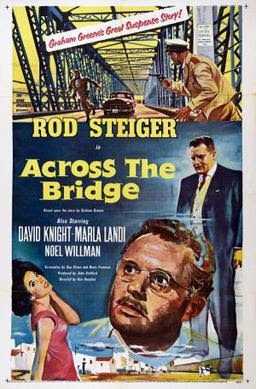
But maybe the real oddity of the schedule was Across the Bridge (1957), a British feature based on a Graham Greene short story and starring a mannered and sweaty Rod Steiger--with a German accent, no less!--as a short-fused white-collar criminal dodging extradition in a Mexican border town. On his way south he's thrown another man, who he resembles, off the train and stolen his passport, but he ends up with this guy's soulful-faced spaniel, Delores, dogging his footsteps (sorry) and gazing reproachfully up at him.

Directed by Ken Annakin, Across the Bridge was shown in Palm Springs in a fairly crappy digital copy, but the presenter assured us that they're working to get it properly restored. I hope they succeed. It's just about the most Graham Greene-ish thing ever, full of moral limbo south of the border and Mexican women wearing prominent crucifixes. And of course it's via "Delores" (suffering) that Steiger's rotten fugitive finds a fateful sort of redemption. In terms of performance, by the way, even full-tilt Stieger is no match for the beautiful Delores, who steals the movie like a dropped potato chip.

Tuesday, May 17, 2022

JUST THE WAY YOU ARGYLE

Your Humble Narrator is back in the Valley after a quick trip to the Arthur Lyons Film Noir Festival in Palm Springs, California, where I caught up with this 1948 artifact:

The Argyle Secrets--William Gargan, as a wisecracking reporter, is beset by a variety of sinister types, from a femme fatale to a southern dandy with a swordcane to a politely murderous continental gent with a towering henchman. The McGuffin they're all after is an album containing a list of corporate bigwigs willing to play either side of the Allied or Axis fence, depending on who won World War II.

The writer-director is the great Cyril "Cy" Endfield, adapting his own 1945 radio play The Argyle Album from Suspense on CBS. The film version feels, indeed, like little more than an illustrated radio play, with narration and energetic rapid-fire dialogue powering its 65-minute running time. The characters spew detailed exposition at each other even while they're trying to kill each other.

Even with his face bruised and his hair mussed from the various beatings he endures, Gargan is jolly company in the lead, and the supporting cast is a joy: Jack Reitzen as the southern fop, Marjorie Lord as the mendacious beauty, Ralph Byrd as the disapproving police detective, Peter Brocco as one of the shady cronies, and Sgt. Schultz himself, John Banner, here trim and dapper, as the principal bad guy. In a supporting role is a young Barbara Billingsley, and if you've ever wanted see Mrs. Cleaver take a punch right to her adorable kisser, this is the picture that will fulfill your wish.

As with El Vampiro Negro at last year's festival, the restored print of this movie shown at Palm Springs is another collaboration between UCLA Film and Television Archive and The Noir Foundation, and like the Argentine film, The Argyle Secrets looks like a million bucks onscreen. Catch it if you get the chance.

While in Palm Springs, I enjoyed lunch at Sherman's Deli, egg salad and chopped liver on rye...

...dinner at Kalura Trattoria, tortellini panna rosa...

...then back to Sherman's for breakfast, eggs benedict with nova lox...

Yummy.

I also made a pilgrimage to my beloved roadside dinosaurs at Cabazon. When I was there in October they were painted Flintstones-style, with T-Rex as Fred and "Dinny" the sauropod as Dino. This week they were painted to extoll love and peace...


Hard to argue with that. But I'd like to see the Cabazon Dinos painted blue and yellow, maybe with a sunflower on T-Rex's chest...

Wednesday, November 3, 2021

ROADSIDE SCHOLAR

The Wife, The Kid and I spent the weekend before last in beautiful Palm Springs, so that Your Humble Narrator...

...could check out and review a couple of fascinating obscurities at the Arthur Lyons Film Noir Festival at the Camelot Theatre on Baristo.

On the way, we stopped in Quartzsite, Arizona, at Reader's Oasis Books...

...where I had stopped in May of 2019 in hopes of interviewing the celebrated "Naked Bookseller" Paul Winer, only to find the place closed and learn, upon calling his wife Joanne, that Winer had died in a hospice in Yuma just a couple of days earlier (here's the Phoenix Magazine story I wrote about him at the time). This time, I found the store open, and Joanne sitting disconsolately in the doorway, but alas, the place was without electrical power, and the books seemed dusty and dry. Heartbreaking. Nonetheless, I left with several volumes, including a Western paperback called The Man From Padera, by cowboy star Rory Calhoun.

Then we stopped for gas at Chiriaco Summit, California, and paid a quick visit to "William the Conqueror" (Patton's dog) at the Patton Museum there...

In Palm Springs, we had several fine meals, including lox and eggs at Sherman's...

On Saturday, after dropping the ladies off to shop at the outlet malls just west of Palm Springs, I headed back to the incredibly windy exit at Cabazon to visit my beloved roadside dinosaurs (famously featured in Pee-Wee's Big Adventure) to find they had been painted in Flintstones style...


Oh the indignity. "Dinny" looks rather irritable about it...

I went into the gift shop inside Dinny's belly to see if I could establish if the dinos are still under occupation by the anti-evolutionist crowd, and rather to my surprise, could find no evidence of it. There were no books, brochures, tracts or signage to that effect that I spotted, just standard toys, shirts, etc. It made me wonder if, maybe, the owners found their anti-evolutionist views bad for business and decided to self-suppress them, at least in the gift shop. 

In any case, sculptor Claude Bell's bas-relief depictions of earlier humans, which suggest a belief in evolution, may still be seen in the interior walls...


Outside, there's also this snake sculpture...

...and the huge, dinosaur-adorned sign of the Wheel Inn Restaurant...

It's now closed, alas, but I would have eaten there if it wasn't.

On the ride home we stopped in Quartzsite again for gas, and saw still more fauna I would like to have adopted...

Monday, October 25, 2021

DARK DEPTHS & DIZZY HEIGHTS

This past weekend Your Humble Narrator saw two real gems at this year's belated-from-May version of the Arthur Lyons Film Noir Festival:


El Vampiro Negro (The Black Vampire)--The "vampire" of the title is of a non-supernatural, psychological nature in this 1953 thriller from Argentina. It's another remake of Fritz Lang's M, loosely retold, although the child-killer still whistles "In the Hall of the Mountain King" when he sees little girls. Played by Nathan Pinzon--usually a comedy star--The Vampire is a nebbishy private teacher of English, tormented by his horrible compulsion.

The star is beautiful Olga Zubarry as a nightclub singer who has witnessed The Vampire disposing of a body, but initially avoids telling the police inspector (Roberto Escalada), not wanting the publicity for a reason that now seems quaint. The connection between our heroine and the handsome, repressed inspector, who has a paralyzed wife, sets up a plot payoff that fails to show up, and the movie, directed and co-written by the Uruguayan Roman Vinoly Barreto, rings other peculiar, convoluted but oddly effective variations on the M plot.

It's possible that the filmmakers attempt to pack too much story into the brief running time, and it's hard to quite pin down the movie's moral point of view. The acting is powerful, however, and the suspenseful flourishes toward the end work superbly.

The movie has a lush score by Juan Ehlert that perhaps sounds a little inappropriately idyllic. But the print shown in Palm Springs, restored by the UCLA Film & Television Archive in cooperation with the Noir Foundation, shows off the cinematography of Anibal Gonzalez Paz beautifully. See this one if you get a chance.

The Cruel Tower--"I'm studyin' to be a crook," says Casey (Steve Brodie) as he shuffles a marked deck. That way, he hopes, he won't end up like his late colleague Tony. That's how desperate the characters in this roiling 1956 melodrama are; becoming a crook would be an aspirational step up in workplace safety.

They're steeplejacks, you see; the guys who scale water towers and smokestacks and church steeples for maintenance and repair. For those of us with a lifelong terror of heights, this is tension enough, but the movie, directed by Lew Landers, mixes in a romantic triangle between the splenetic boss (Charles McGraw), the handsome, haunted young drifter (John Ericson) who falls in with the crew, and smiling, statuesque Mari Blanchard, often referred to here simply as "The Babe." There's also booze, sabotage, juke-joint brawling and a Mission right out of Guys and Dolls.

Along with Brodie, the terrific supporting cast includes Peter Whitney, Alan Hale, Jr., glimpses of Stafford Repp and Dick Rich, and a nice bit by Carol Kelly as a sassy, deeply unimpressed waitress. The script, by Warren Douglas (adapting a novel by William Brown Hartley) has some ripe noir flourishes; asked if The Babe knows that her lover is married, a character matter-of-factly replies "She's not stupid, she's just evil."

Monday, May 13, 2019

BOOKSTORES, PYRAMIDS AND FILMS NOIR

This past weekend, May 9 through 12, marked the 20th annual Arthur Lyons Film Noir Festival in Palm Springs, California. So The Wife, The Kid and I headed west, me to check out the movies; the ladies to check out the shopping, and all of us to check out some fine dining.

On the way I planned to stop by and visit, and maybe interview, legendary “Naked Bookstore” owner Paul Winer at Quartzsite’s Reader’s Oasis Books…

 
It turned out, alas, I was two days too late; you can read my story about it here.

But since we were in Quartzsite, we took a minute to visit the grave of the famed camel driver Hi Jolly; here’s me and The Kid at that distinctive monument…


As for the Noir Festival, it offered rare showings of a couple of obscure gems, both in beautiful new 35-millimeter prints (hopefully they’ll both show up soon on TCM). 1956’s The Scarlet Hour


 …starred sultry Carol Ohmart, cheating on her abusive husband James Gregory with sap Tom Tryon; it also featured early scene-stealing by the young Elaine Stritch. And there was the wonderful moment when Gregory, renting a car for some shady business, asked rental guy for “the most inconspicuous car you’ve got." And if all that wasn’t enough, Nat “King” Cole appears in it, and sings. 


Richard Fleischer’s Trapped (1949), which begins like a docu-drama with a stentorian narrator, turns into a good lurid melodrama with just-as-sultry Barbara Payton, in the clinch with Lloyd Bridges as an escaped counterfeiter. Bridges is a brute here, but fabulously dapper; when we first see him he’s brought into the warden’s office at the federal penitentiary, but he looks like he’s dressed for lunch at the Brown Derby. He keeps getting into fights throughout the film, and I wanted him to knock it off, because I hated to see his outfits get messed up.

Caught up with this one belatedly:


Pokemon: Detective PikachuAlmost twenty years ago it fell to me to review, for New Times, one of the animated Pokemon movies. It was an alienating experience, sitting there, watching the incomprehensible action up on the screen, all the while aware that it was perfectly comprehensible to the kids around me in the theatre. Now I’ve seen the franchise’s first live-action feature film, and I’m only slightly less perplexed.

For the uninitiated, a Pokemon—the term derives from “Pocket Monster”—is any of a large selection of strange creatures, variously fuzzy or downy or scaly, featured in Japanese video games and trading cards and toys and TV cartoons and so on. Some of them fly, some swim, others are quadrupedal, with what look like giant cloves of garlic growing out of their backs.

Certainly the most famous is Pikachu, a furry yellow sort-of-cat with red cheeks and a tail that resembles a bolt of electricity. He’s the star of this new film, a mystery set in an alternate reality in which humans and Pokemon co-exist.

The story starts with Tim (Justice Smith), a human kid, traveling to “Ryme City” after hearing of the death of his estranged police detective father. He soon meets his father’s companion Pikachu, here rendered in CGI and voiced by Ryan Reynolds. In a grand film noir tradition, Pikachu’s an amnesiac. The two of them team up with obligatory plucky young reporter Kathryn Newton to probe a convoluted intrigue involving the escape of a powerful dragon/kangaroo/dinosaur-like Pokemon called “Mewtwo” from a research facility.

That’s about as coherently as I can summarize the plot. Besides, if you’re a Pokemon buff you don’t need me to summarize it for you, and if you’re not, you need it even less. All I can say is that it’s an impeccably well-made movie in the modern style, briskly edited and scored, with the CGI seamlessly intermingled with the live-action cast and settings. The nattering of Reynolds is amusing at times, the human leads are likable, and such veteran character actors as Bill Nighy and Ken Watanabe turn up in supporting parts. And any movie that gets Bill Nighy a paycheck can’t be all bad.

Friday, May 3, 2019

WHITE CROW; DARK MOVIES

Happy Friday everybody! Check out my "Friday Flicks" column this week, online at Phoenix Magazine, for my review of the Ralph Fiennes/David Hare drama The White Crow...


...as well as a preview of this year's Arthur Lyons Film Noir Festival in Palm Springs.


Have a great weekend everybody!

Monday, June 1, 2015

NOIRS, NERDS, STRAYS, STROGANOFF, QUAIL EGGS, CLU GULAGER...

A variety of stuff to catch up on:


This Saturday night I had the honor to be the auctioneer at a charity auction at Phoenix Comicon (my pal Gayle was supposed to do it, but couldn’t, and volunteered me). Various pieces of comic art and memorabilia were auctioned off for the excellent children’s literacy charity Kids Need to Read. I was very intimidated, and I doubt I have a career at Sotheby’s ahead of me, but I got good laughs and several thousand dollars were raised. I’d love to know where these nerds get all this money.

One item which went for more than $200 was a football from the Comicon booth at Super Bowl FanFest in February, which had been signed by a bunch of famous comic book artists (Neal Adams among them). I said “Who’d’ve thought you’d see a roomful of geeks fighting over a football?”

This was not, however, the most startling thing that happened this Saturday. Earlier that day, The Wife and The Kid and I were leaving to go to lunch, and saw an adorable little black-and-white Chihuahua wandering up the sidewalk. The Kid was able to coax her over, and she turned out to be very friendly and sweet, and seems well fed. She had a collar, no tag, and we took her to the Humane Society where they scanned her and determined she didn't have a chip, either.

So, at least for the moment, we have three Chihuahuas at Casa de los Chihuahuas.


The other two, Lily and Eddie, are unimpressed, but coping. We’d like to keep her, although she’s such an affectionate, well-socialized little character that she shows every sign of having been well cared for and loved, and I hate to think what her person or people may be going through.

RIP to Dan Mer, manager of the Tempe Improv during its best years, who passed on in his sleep last weekend. I got to know Dan when I was calendar editor at the Phoenix New Times, and when that paper laid me off in 2001 he immediately offered me a job as his in-house publicist. My thirteen months at the Improv—I left in 2002 for a job with more regular hours—offered me some of the most fascinating and memorable experiences of my working life. Dan could be a demanding boss, but he was brilliant and loyal. I learned a great deal from him and I owe him a great deal.

On a less personal note, last Tuesday I also said farewell to Mesa’s Landmark restaurant, stopping in for one more lunch order of truly delicious stroganoff and one more trip to the famed salad room for a plate of kumquats, hearts of palm, pickled watermelon and, of course, tiny hard-boiled quail eggs. Whoever supplied that venerable eatery, which closed yesterday, with quail eggs must be crying in their beer today (I took a half-pint home with me). I’ll miss it, though it always somehow suggested to me an evangelical’s idea of the afterlife.


Finally, I’m only now getting around to reporting on the 16th Annual Arthur Lyons Film Noir Festival in Palm Springs, which I attended two weekends ago. Although this year’s schedule included such familiar selections as The Big Clock and On Dangerous Ground, for the true cinematic scavenger, the real highlights of the Noir Festival are the rarely-shown obscurities. This year I saw two such prizes.

 
One was a newly restored Library of Congress print of Joseph Losey’s 1951 American version of M, Fritz Lang’s 1931 German classic about a child murderer for whom both the police and the underworld are hunting. I had long wanted to see this film, and while few would suggest it’s in the same league with Lang’s masterpiece, or that David Wayne’s performance in the lead compares to Peter Lorre’s riveting turn in the original, it’s a fascinating curio, shot in the Bunker Hill section of L.A., with a superb cast of character vets—Howard Da Silva, Martin Gabel, Luther Adler, Raymond Burr, Steve Brodie, Jim Backus and Norman Lloyd, who was the guest for the Q&A afterwards, vigorous and confident at 100 years old!


The other rarity I saw was Chicago Calling, also from 1951, and also shot in the grittier districts of downtown L.A. This poignant yarn about an alcoholic loser (Dan Duryea), desperately trying to keep the phone that’s about to be removed from his apartment long enough to get an important call he’s expecting from Chicago, barely qualifies as a noir—hardly any violence, and only the pettiest of crimes.

In the course of the story Duryea bonds with a little boy (Gordon Gebert) who offers him the money to pay the bill. Gebert, best known as Janet Leigh’s son in the 1949 Christmas romance Holiday Affair, was the guest at this screening. Now 71, he looks like a million bucks, and had a fantastic adult career as an architect and teacher after attending MIT and Princeton. It was nice to hear a story like this from a child actor.

Still, when you consider that two of this year’s guests were a 100-year-old character actor and a 71-year-old former child actor, it’s wistfully clear that the relentless march of time is starting to make finding guests harder on the Noir Festival organizers.

I also had the good luck to meet another favorite of mine, longtime movie and TV vet Clu Gulager. The actor was there with his son, the talented director John Gulager, talented daughter-in-law Diane Goldner, and charismatic grand-dog Apollo to watch movies, record archival interviews with guests, and soak up well-earned adulation.

It doesn’t rain in Palm Springs very often. But while we were there, the resort town managed a couple of days of gray, drizzly showers.

Such weather was appropriate for the festival, of course, but with The Wife and The Kid, the rain wasn’t as big a hit. What was good noir-ish atmosphere for me was an annoyance for them, raining them out of the Thursday evening street market on Palm Canyon, the highlight of the trip as far as The Wife is concerned, and keeping The Kid out of the hotel’s pool. But we did, at least, manage several sublime meals—scrumptious Italian at Johnny Costa’s, superlative steak and salmon at LG’s Steakhouse and knockout knockwurst and eggs, among other goodies, at Sherman’s Deli.

Naturally, by the time we were headed home Saturday evening, there was scarcely a cloud in the sky.