Halloween is next Tuesday, so...
Monster-of-the-Week: ...it seems like this week's honoree should be one of the all-time classics. So how about...
...Karloff's Frankenstein Monster, in this masterly, iconic rendition from the recently late and much-lamented Famous Monsters of Filmland cover artist Basil Gogos.
Happy (and safe) All Hallows' Eve everybody!
Thursday, October 26, 2017
Tuesday, October 24, 2017
HERCULEAN LABORS
It was a busy and oddly Italianate weekend for Your Humble
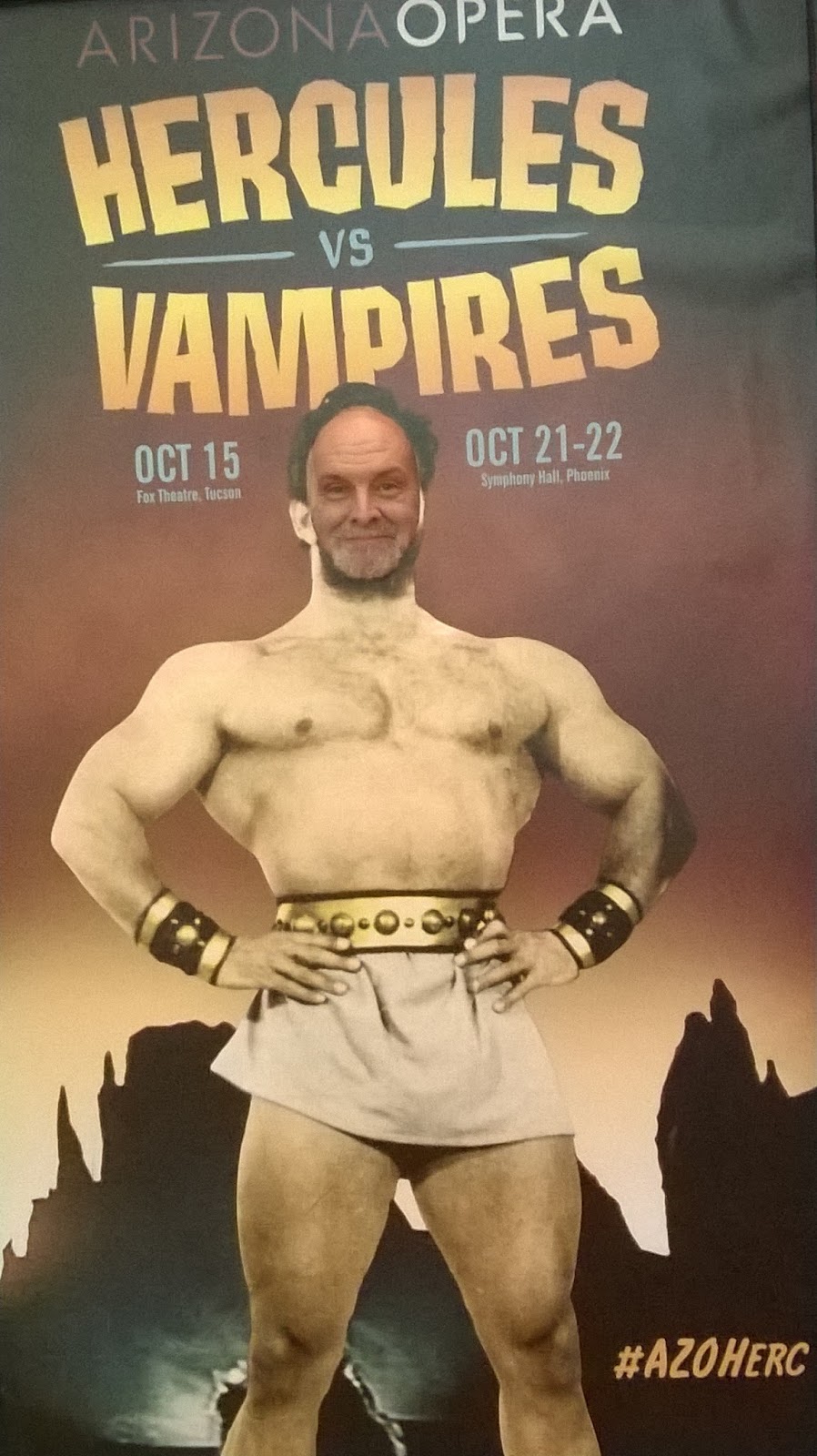
Narrator. Luckily, I had the stamina to get through it, as this rare shirtless
photo of me demonstrates…
Sunday afternoon my pal Dave and I saw Arizona Opera’s Hercules vs. Vampires, Patrick
Morganelli’s operatic setting of the 1961 Mario Bava “peplum” Hercules in the Haunted World, performed
live to a screening of the film. It was a great time, from the show itself to
the witty pre-show Q&A by Morganelli to the wacky props in the lobby with
which we were encouraged to play...
All of this came on the heels of my adventure up north the
previous day.
Despite having lived in Phoenix
nearly 26 years, and despite having had its virtues extolled to me multiple
times from multiple sources, I had never visited the city of Prescott, an hour and half to the north.
Never, that is, until they offered me pizza.
When I was asked to judge the inaugural edition of Prescott
Pizza Palooza, a fundraiser for Prescott Meals on Wheels, this was a duty I did
not shirk. I mentioned this honor to my pal Richard, one of the town’s
extollers, and he kindly offered to drive me up to and drop me off at the event. He did not, however, join me for
pizza, as there was a German restaurant nearby at Lynx Lake
he wanted to try.
The event, held on a blocked-off street adjacent to Courthouse Square,
featured six pizzerias. For fifteen bucks, you got ten tastings—a great deal in
any case, and all the more so when you know the money’s going to a good cause.
Only two of the pizza-makers there were local—Mama’s Artisan Pizzeria in Prescott Valley
and Two Mamas’ Pizza near downtown Prescott.
The rest were familiar chains: Papa John’s, Rosati’s, Pizza Hut and…
…Little Caesar’s.
There were four categories of competition—traditional,
exotic, gluten-free and dessert. Trying to pace myself, over the three hours or
so I was there I dutifully sampled at least one slice of everything that was in
competition—something like 13 pieces in all—although toward the end I was just
taking a bite or two and dumping the rest. I’m capable of serious eating, but I
felt pretty woozy by the end, and I belched audibly, twice, while chatting with the lady who planned the event (she just
laughed, which made me feel all the more like an uncouth lout).
It wasn’t a blind tasting, but insofar as I can be unbiased,
I really think that the best bites I had all day came from the local joints,
especially Mama’s Artisan’s luscious ricotta-topped Mama’s Pesto Especial. I
was pleased to see that my voting was reflected in the outcome; both Mama’s
Artisan and Two Mamas’ were among the winners. In coming years, I would hope to
see more local, independent pie-makers represented, and maybe some from
elsewhere in the state or region, but in any case it was a fun and delicious way
to spend a gloriously cool, sunny Saturday.
Then, when I got back to Phoenix in early evening, The Wife and
The Kid requested to be taken to California Pizza Kitchen for dinner. Fish tacos
for me.
Friday, October 20, 2017
HOTSHOTS, HITMEN & HERCULES
Opening this week:
Only the Brave—Wildland firefighting is regarded, on the whole, as more strenuous and demanding than structure firefighting, and usually more dangerous. But it isn’t more cinematic. A structure firefighter with a hose gets to enact one of the iconic cinematic dynamics—shooting at an enemy. But the methods of wildland firefighters, while no less agonistic, are subtler—digging in the dirt, cutting trees and brush with chainsaws, and sometimes, counterintuitively for us laypeople, actually setting fires.
This is what we get in the firefighting sequences of Only the Brave, the story of the Granite Mountain Hotshots, the wildland crew connected to the Prescott, Arizona fire department. Nineteen of these young men—all but one member of the active crew—died in the Yarnell Hill Fire in June of 2013, in the worst loss of firefighters since 9/11, and the worst loss of wildland firefighters since the ‘30s.
There’s terrifying spectacle, certainly, in a wildfire, but the response to it is guys hiking, digging, sawing. So the meat of the film is less this drudgery than the lives of hotshots, and especially that of Brendan “Donut” McDonough (Miles Teller), who was assigned as a lookout that day and thus became the Ishmael of the Granite Mountain Hotshots. McDonough had a history of substance abuse and petty crime until he became a hotshot, and was mentored by Granite Mountain Superintendant Eric Marsh (Josh Brolin).
Despite the hopeful outcome of McDonough’s story, there’s no good way to present this material that isn’t horrifying and heartbreaking, and director Joseph Kosinski doesn’t try. There’s a sense of restraint and dignity to his work, and that of the actors. The flavor for much of the movie’s length is that of a John Ford/Howard Hawks/Raoul Walsh male bonding drama, and there’s action and humor and touching sentiment and inspirational uplift, but a somber tinge hangs over it, at least for viewers who know where the story’s heading.
This is reflected in Brolin’s performance. The movie’s Marsh has a look in his eyes that suggests a foreknowledge of disaster, and a sad acceptance of it. It’s an old-school star turn in the Henry Fonda vein, one of Brolin’s best. He even gets a Sam Shepherd-ish Oscar-clip monologue about the flaming bear that haunts his dreams. But Teller also does strong work in the “tenderfoot” role of McDonough, Taylor Kitsch throws a charge into his scenes as hotshot Christopher Alan MacKenzie, and Jeff Bridges, as wildland chief Duane Steinbrink, has a great moment, a small groan of grief that’s like a gut punch.
I had the opportunity to talk with Kosinksi and Brolin before the film’s opening, and they both stressed how they spent a lot of time in Prescott with the families and friends of the hotshots, and became close to them, in order to achieve authenticity. But this may have led the filmmakers, in understandable deference to the feelings of the survivors, to omit or soften errors or interpersonal conflicts within the crew that maybe had a bearing on the disaster. The climactic scenes, though inevitably powerful, also leave it unclear as to what led to the decisions that placed the crew in the path of the fire.
Partly, no doubt, this is because it remains unclear even from reports of the official investigations. But in terms of the movie’s narrative, it’s just confusing, and it’s about all that keeps this well-crafted, well-acted movie from feeling like a triumph.
You can check out my interviews with Brolin and Kosinski, by the way, on the New Times blog.
On a lighter note...
Killing Gunther—Saturday Night Live alumnus Taran Killam wrote, directed and stars in this broad, zany comedy about murder. Killam plays Blake, a high-end assassin leading a plot to kill a legendary veteran hitman known as Gunther (Arnold Schwarzenegger).
Blake's team includes a bomber (Bobby Moynihan), a sniper (Hannah Simone), an insufferable tech whiz (Paul Brittain), a poisoner (Aaron Yoo) and other wacky specialists. The central absurd gag is that Blake has hired a film crew to chronicle the mission, so that as with The Office and Modern Family, this movie can employ faux-documentary devices, including straight-to-the-camera monologues.
It's possible that Killing Gunther simply suffers from unfortunate timing; its bloody shootings and mayhem didn't seem as funny to me right now as they might have at another time. That said, just about any six or seven minute stretch of this movie would make a servicebly amusing SNL sketch, and is good for a few chuckles. The cast is strong, but Schwarzenegger, who doesn't show up until quite late in the proceedings, probably shows more gleeful comic energy than anyone.
Killam's principal comedic mechanism here is deflation. Again and again, someone will be on the verge of a dramatic flourish, and they'll be interrupted, or forget what they were going to say, and the mood will be broken. It's as if the anger under the gags is at life's failure to be like the movies.
One more note: In case you haven't had your fill of me, you can check out my very short article, on The PHiX, about Arizona Opera's production of Hercules vs. Vampires this weekend.
Only the Brave—Wildland firefighting is regarded, on the whole, as more strenuous and demanding than structure firefighting, and usually more dangerous. But it isn’t more cinematic. A structure firefighter with a hose gets to enact one of the iconic cinematic dynamics—shooting at an enemy. But the methods of wildland firefighters, while no less agonistic, are subtler—digging in the dirt, cutting trees and brush with chainsaws, and sometimes, counterintuitively for us laypeople, actually setting fires.
This is what we get in the firefighting sequences of Only the Brave, the story of the Granite Mountain Hotshots, the wildland crew connected to the Prescott, Arizona fire department. Nineteen of these young men—all but one member of the active crew—died in the Yarnell Hill Fire in June of 2013, in the worst loss of firefighters since 9/11, and the worst loss of wildland firefighters since the ‘30s.
There’s terrifying spectacle, certainly, in a wildfire, but the response to it is guys hiking, digging, sawing. So the meat of the film is less this drudgery than the lives of hotshots, and especially that of Brendan “Donut” McDonough (Miles Teller), who was assigned as a lookout that day and thus became the Ishmael of the Granite Mountain Hotshots. McDonough had a history of substance abuse and petty crime until he became a hotshot, and was mentored by Granite Mountain Superintendant Eric Marsh (Josh Brolin).
Despite the hopeful outcome of McDonough’s story, there’s no good way to present this material that isn’t horrifying and heartbreaking, and director Joseph Kosinski doesn’t try. There’s a sense of restraint and dignity to his work, and that of the actors. The flavor for much of the movie’s length is that of a John Ford/Howard Hawks/Raoul Walsh male bonding drama, and there’s action and humor and touching sentiment and inspirational uplift, but a somber tinge hangs over it, at least for viewers who know where the story’s heading.
This is reflected in Brolin’s performance. The movie’s Marsh has a look in his eyes that suggests a foreknowledge of disaster, and a sad acceptance of it. It’s an old-school star turn in the Henry Fonda vein, one of Brolin’s best. He even gets a Sam Shepherd-ish Oscar-clip monologue about the flaming bear that haunts his dreams. But Teller also does strong work in the “tenderfoot” role of McDonough, Taylor Kitsch throws a charge into his scenes as hotshot Christopher Alan MacKenzie, and Jeff Bridges, as wildland chief Duane Steinbrink, has a great moment, a small groan of grief that’s like a gut punch.
I had the opportunity to talk with Kosinksi and Brolin before the film’s opening, and they both stressed how they spent a lot of time in Prescott with the families and friends of the hotshots, and became close to them, in order to achieve authenticity. But this may have led the filmmakers, in understandable deference to the feelings of the survivors, to omit or soften errors or interpersonal conflicts within the crew that maybe had a bearing on the disaster. The climactic scenes, though inevitably powerful, also leave it unclear as to what led to the decisions that placed the crew in the path of the fire.
Partly, no doubt, this is because it remains unclear even from reports of the official investigations. But in terms of the movie’s narrative, it’s just confusing, and it’s about all that keeps this well-crafted, well-acted movie from feeling like a triumph.
You can check out my interviews with Brolin and Kosinski, by the way, on the New Times blog.
On a lighter note...
Killing Gunther—Saturday Night Live alumnus Taran Killam wrote, directed and stars in this broad, zany comedy about murder. Killam plays Blake, a high-end assassin leading a plot to kill a legendary veteran hitman known as Gunther (Arnold Schwarzenegger).
Blake's team includes a bomber (Bobby Moynihan), a sniper (Hannah Simone), an insufferable tech whiz (Paul Brittain), a poisoner (Aaron Yoo) and other wacky specialists. The central absurd gag is that Blake has hired a film crew to chronicle the mission, so that as with The Office and Modern Family, this movie can employ faux-documentary devices, including straight-to-the-camera monologues.
It's possible that Killing Gunther simply suffers from unfortunate timing; its bloody shootings and mayhem didn't seem as funny to me right now as they might have at another time. That said, just about any six or seven minute stretch of this movie would make a servicebly amusing SNL sketch, and is good for a few chuckles. The cast is strong, but Schwarzenegger, who doesn't show up until quite late in the proceedings, probably shows more gleeful comic energy than anyone.
Killam's principal comedic mechanism here is deflation. Again and again, someone will be on the verge of a dramatic flourish, and they'll be interrupted, or forget what they were going to say, and the mood will be broken. It's as if the anger under the gags is at life's failure to be like the movies.
One more note: In case you haven't had your fill of me, you can check out my very short article, on The PHiX, about Arizona Opera's production of Hercules vs. Vampires this weekend.
Thursday, October 19, 2017
ROCK OPERA
This weekend Arizona Opera presents Hercules vs. Vampires...
...Patrick Morganelli's musical setting of Mario Bava's goofy but visually lush 1961 sword-and-sandal fantasy Ercole al Centro della Terra (known in English as Hercules in the Haunted World). So...
Monster-of-the-Week: ...this week's honoree is Procrustes, here depicted as an ambulatory rock...
...but still up to his traditional shtick of stretching people, or chopping them down, in order to get them to fit in bed.
...Patrick Morganelli's musical setting of Mario Bava's goofy but visually lush 1961 sword-and-sandal fantasy Ercole al Centro della Terra (known in English as Hercules in the Haunted World). So...
Monster-of-the-Week: ...this week's honoree is Procrustes, here depicted as an ambulatory rock...
...but still up to his traditional shtick of stretching people, or chopping them down, in order to get them to fit in bed.
Friday, October 13, 2017
OIL RICH
A couple of gems open in the
Valley this week:
Loving Vincent—The producers stake an unusual claim for this Polish-British animated
feature, six years in the making: that it’s the first completely oil-painted
movie. Each of its 65,000 frames, we’re told, was meticulously hand-painted by
a team of more than 100 artists, working over the previous frame’s image, all
in the style of Vincent Van Gogh.
A documentary about the making of
this quixotically crazy endeavor would be fascinating. As with Claymation back
in the ‘70s and ‘80s, if you let yourself think too long about the labor you’re
witnessing, you can start to feel overwhelmed and it can throw you out of the
movie.
Happily, the movie itself isn’t
just visually breathtaking, it’s also an engrossing little historical drama,
well-acted by the Brit voice cast in a naturalistic manner. The story is set in
1891, the year after Van Gogh’s death, and centers on Armand Roulin (Douglas
Booth), the young man in yellow from the famous portrait. Armand’s postmaster
father Joseph, another Van Gogh subject, tasks his son with delivering a final
letter from the genius to his brother Theo.
Armand travels from Arles to
Paris, and then on to Auvers-sur-Oise, where Vincent died. Initially annoyed by
the errand, Armand becomes increasingly fascinated as he delves into the
mystery of Vincent’s death.
The directors, Dorota Kobiela and
Hugh Welchman, working from a script they wrote with Jacek Dehnel, use Armand’s
investigations to paint a portrait (if you’ll excuse the expression) of a truly
loving Vincent. He’s beset with terrible emotional sufferings, certainly, but
he’s sweet-natured and ecstatic in his visionary raptures.
But the thrill in the picture is
seeing those immortal images brought to life. In the opening minutes alone, we
get the Café Terrace, the Zouave reclining against the wall, Lieutenant
Milliet, and so on, gliding easily into each other in service of the narrative.
I suppose there are cultural
purists out there who might find using the works of one of the great figures in
European art as, essentially, a storyboard, to be a crass, literal-minded
stunt. But I was enchanted by this gloriously low-tech labor of love, both for
Van Gogh and for the possibilities of the cinema.
Professsor Marston and the Wonder Women—There’s something delicious about the knowledge that the furious accusations
of mid-century anti-comics crusaders were, in at least one case, quite right. Wonder
Woman, who debuted in 1941 in what would become DC Comics, really was rooted in
fantasies of bondage, dominance and Sapphic power.
And not just fantasies, either,
but realities. As we’re told in this amusing chronicle, the creator of the
character, a Harvard-educated psychology professor named William Moulton
Marston (writing under the name Charles Moulton), spun the Amazon by blending
traits of the two women with whom he lived—his wife Elizabeth Holloway Marston,
and Olive Byrne, a student and assistant who became the third member of their
marriage.
It’s likely that the
writer-director Angela Robinson (Herbie:
Fully Loaded) has heated up the story a bit. But there are true elements
that trump fiction, the juiciest being that before his comic-writing days, Marston
was one of the developers of the systolic blood pressure test that led to the
polygraph—in other words, he invented the Lasso of Truth in reality before he gave
it to his heroine. As an adolescent in the ‘70s, watching the Lynda Carter TV version
of Wonder Woman, I always found the
Lasso of Truth shtick distinctly erotic; now I’d guess that Marston did too.
This movie’s historical accuracy is
debatable, and some chapters work better than others, but Robinson has, any case,
crafted maybe the wittiest and sweetest cinematic menage a trois in recent memory. Those looking for graphic sex will
be disappointed—the threesome scenes, which involve a lot of dressing-up in
theatrical costumes, are too tame and discreet for a Cinemax soft-core flick
from the ‘90s. But something about their good-natured naïveté makes them sexy.
The charm in Professor Marston and the Wonder Women comes in the deadpan
delivery of earnest dialogue by glamorous actors like Luke Evans as Marston and
waif-like Bella Heathcote as Olive. There are nice supporting turns by Oliver
Platt as early comic peddler Max Gaines and Connie Britton in a peculiarly flirtatious
turn as early comic critic Josette Frank. We also see JJ Feild as fetish
costumer Charles Guyette, here shown decking out Olive in a get-up very similar
to Wonder Woman’s.
But the standout is Rebecca Hall
as the brittle, unflappable (well, almost
unflappable) Elizabeth. Her readings give a sharp edge even to lines that don’t
have one built in, yet she somehow infuses them with a palpable undercurrent of
love and emotional directness as well. I hate to resort to it, but indulge me: She’s
a wonder.
Subscribe to:
Posts (Atom)