Showing posts with label JOSH BROLIN. Show all posts

Monday, August 18, 2025

ORIGINAL SHIN

Your Humble Narrator caught up with a couple more, still in the multiplexes:

Shin Godzilla--For some reason, this 2016 Japanese monster spectacular has currently received a wide release in the multiplexes. Like 2023's Godzilla Minus One, it's a free-standing entry, unconnected to the other films in The Big G's franchise. Also like Godzilla Minus One, it's marvelous, and worth taking the trouble to see on a big screen.

It's a very different film than the ruminative, chastened period piece G-1, however. Shin Godzilla is contemporary and feverishly-paced, with a satirical edge. Apparently taking inspiration from the Tohoku earthquake and Fukushima nuclear disaster of 2011, directors Hideaki Anno (who wrote the script) and Shinji Haguchi focus on what it would be like if something like this really happened; the political and bureaucratic minutiae of the response to a gigantic creature rising from Tokyo Bay and wreaking mayhem in the city.

In rapid-cut sequences, plastered with ironically detailed subtitles, we see the prime minister and his civil and military advisors weighing options and glumly wishing the problem would go away. At least as much of the film unfolds in offices or conference rooms, or in corridors with long West Wing-style "walk-and-talks," as in the rampaging monster's wake.

Eventually the burden of stopping the titan falls to Rando Yaguchi (Hiroki Hasegawa), leading a team of "lone wolves, nerds, misfits" from different government departments who drop decorum and speak candidly with each other. There's also a lovely and cheeky American envoy (Satomi Ishihara) trying to help before the U.S. decides to hit Godzilla (and Japan) with another nuke.

The special effects sequences here, though sparing, are superb. When we first see the title character, he's crawling on all fours and has a slack jaw and buggy fish eyes. As the movie progresses, he gradually evolves into a dark, radioactively glowing, thuggish-looking version of the familiar icon. He's less endearing than previous versions, but I couldn't help it, when his attackers start getting to him toward the end, I still couldn't help but feel a pang of sympathy for the poor guy.

Also, Shin Godzilla employs passages from Akira Ifukube's unforgettable score for the original 1954 Gojira. In Japan, that music must be as familiar as the Jaws or Rocky themes.

Weapons--In the middle of the night, a bunch of little kids in a prosperous-looking middle class Pennsylvania suburb get out of bed and leave their homes, running through the streets with their arms out to their sides like wings. It turns out they're all from the same 3rd-grade class. Only one kid shows up at school the next morning. Not surprisingly, their young teacher (Julia Garner) falls under suspicion from their panicked parents; before long somebody has painted the word "WITCH" on the side of her car.

That's the set up for this horror tale from writer-director Zach Cregger, and it's undeniably a strong hook. It's so strong, indeed, that as the movie progressed, I found myself thinking "this better be good." I was prepared to be furious if the compelling premise dribbled away into ambiguity, offering no clear explanation of the mystery.

I'm glad to say that this doesn't happen. The secret at the heart of the story, told Tarantino-style in lengthy chapters from the point of view of various characters--the teacher, a devastated father (Josh Brolin), the principal (Benedict Wong), a cop (Alden Ehrenreich), a petty criminal (Austin Abrams), the remaining kid (Cary Christopher)--finally is revealed. It's a conventional horror movie explanation, I suppose, but at least it's coherent, and it leads to a potent, gruesomely funny climactic payoff.

Cregger's characters are particularly sympathetic because none of them are paragons; Garner shines as the teach, who drinks too much and is empathetic to her students to a degree that her mealy-mouthed principal thinks is unprofessional. Brolin gives a convincing portrait of the kind of parent whose fear makes him highly vocal. But the most memorable performance is by Amy Madigan, who doesn't show up until about midpoint, then easily steals the movie with a hilarious yet spellbinding turn.

Friday, August 20, 2021

DAD CHOKES

Opening at Harkins Camelview at Fashion Square today...

Flag Day--Based on Jennifer Vogel's 2004 memoir Flim-Flam Man, this is roughly the zillionth telling of one of the perennial American dramas: The relationship with the father. The author's often-absent dad, John Vogel, was a career criminal in the '80s with everything from bank robbery to arson to counterfeiting on his record; he was also a sensitive, loving person who sketched, and who introduced his daughter and son to Chopin and marinated steaks.

Sean Penn, who directed and who plays John Vogel, makes us see how both of these personalities can exist, albeit uncomfortably, in one guy. It's one of his most painfully believable performances since his turn in The Falcon and the Snowman back in 1985; like that guy, Penn's John Vogel is one of those people who are both repellently obnoxious and charismatic, somehow at the same time. He's a hustler in the grand Willy Loman tradition, insisting, when asked what he does for a living, that he's "an entrepreneur," with many irons in the fire at any given time.

Penn's daughter Dylan Penn is impressively un-histrionic and sympathetic as the grown-up version of Jennifer, taking over for a couple of first-rate younger actresses who play her earlier vintages. The director's son, Hopper Penn, effectively plays Jennifer's little brother as an adult.

Stylistically, the movie generates superbly convincing period atmosphere, and it has a '70s art-cinema vibe. It's like something by Terence Malick, with lots of leisurely montages cut to melancholy songs and deliberately grainy, home-movie-ish footage, and heavy use of Dylan Penn's voice-over narration. Virtually a catalog of severe family dysfunction, it's a bitterly sad story, but seen strictly in terms of Jennifer's accomplishment, it's a pretty inspirational story, too.

I wondered why Jennifer's beleaguered Mom (Katheryn Winnick) didn't get more sympathy, until her inaction during a crisis about midpoint in the film makes it harder to like her. Overall, though, the movie is yet another illustration of the tremendous, and tremendously unfair, emotional advantage that fathers tend to wield in the family dynamic, and in the Western narrative tradition. 

Friday, April 27, 2018

THE WRATH OF GODARD

Opening this weekend:


Godard Mon Amour--The "mon" in the title refers to Anne Wiazemsky (Stacy Martin), Godard's much younger second wife and the star of his 1967 La Chinoise. Directed by Michel Hazanavicius of The Artist, Godard Mon Amour chronicles the years of Godard and Wiazemsky's marriage. The particular focus is on the anti-De Gaulle demonstrations of May 1968, and the miseries Godard (Louis Garrel) inflicted on his wife, his friends and himself during that period, in his flailing attempts to be an authentic revolutionary.

Shot in gorgeous, sunny tones by Guillaume Shiffman, the film is well-acted, funny, sexy at times, and has a buoyant energy that is, if not Godardian, at least an amusing parody of the style. There are also nods to Woody Allen, like a redo of the subtitle gag from Annie Hall or, a la Stardust Memories, people asking Godard if he'll go back to making funny movies. And there are fourth wall gags, both overt and subtle, as when Godard is complaining about tracking shots just as Hazanavicius is in the midst of tracking up the length of Anne's sunbathing bikini-clad body.

In terms of its story, however, Godard Mon Amour most reminded me of Sullivan's Travels, the 1941 Preston Sturges comedy about a film director (Joel McCrea) of lightweight entertainments who hits the road as a bum to enrich his artistry by learning first hand about hardscrabble "real life." Sullivan ultimately comes to the conclusion that he can best serve mankind by making them laugh, but the humorless Godard we get here isn't about to reach that epiphany.

Hazanavicius derives much deadpan comedy from seeing Godard rant about the class struggle while dining with his friends at posh restaurants or romping with Anne in their beautiful Parisian apartment, and of course by snubbing admirers and behaving rudely toward the few actual working class people with whom he interacts. If the aim of the film, based on a book by Wiazemsky and also known under the title Le Redoubtable, is to depict Godard as an insufferably posturing, petulant, self-loathing douche, it succeeds mightily.

How fair any of this is I couldn't say; I don't even know how faithful Hazanavicius is to Wiazemsky's own, presumably subjective, account. But in general, fury at the inability to escape one's own middle-class sensibility is a very common phenomenon among middle-class lefty intellectuals, and it's a great subject, especially for comedy.  Hazanavicius makes his Godard the butt of this joke, but isn't able to make his hero likable in the process, as Godard himself might have.


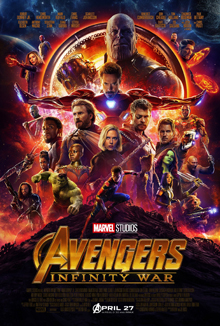
Avengers: Infinity War--A big ogreish alien called Thanos (Josh Brolin) feels a strong need to de-clutter. Specifically, he wants to destroy half of all the living beings in the universe. To do this, he must capture six "Infinity Stones" stashed around the cosmos, including a couple on Earth, and implant them on his big armored gauntlet thingy. Opposed to his plan are both Iron Man's and Captain America's estranged factions of the Avengers, the Wakandans from Black Panther, the Guardians of the Galaxy, Spider-man, Dr. Strange, and other Marvel stars and bench players.

This Gotter-half-dammerung free-for-all, largely based on a limited-run comic series from the early '90s, was directed by the brothers Joe and Anthony Russo, who also helmed two of the earlier Captain America flicks. Unless you're a hardcore Marvel brand loyalist, there's a good chance you could get lost now and then in the specifics of the eye-crossing multi-strand narrative. But the Russos do a capable job of keeping the basic conflict clear, and they keep the big action set-pieces coming.

Over the last few years, Marvel has given us some half-dozen genuinely fun, delightful pictures, like Ant-Man, Guardians of the Galaxy the first, Dr. StrangeSpider-Man: Homecoming, and Thor: Ragnarok, leading up to this year's grand slam Black Panther. For me, Infinity War was a slight step down from these, probably because it's such an overstuffed all-star spectacular that it inevitably lacks a certain balance and focus, and also because the plot and the stakes are so cosmically, apocalyptically heavy.

Even so, the actors manage to find more playfulness than might be expected. There's some serious charisma in this cast: Robert Downey, Jr.'s top billing feels right, he seems to just naturally assume a leading man status in this ensemble. But his costars come across strongly too--Chris Hemsworth's harried Thor, Benedict Cumberbatch's suavely low-key Dr. Strange, Chadwick Boseman's quiet, bashfully authoritative Black Panther with his elegant entourage, the peerlessly soulful Elizabeth Olsen's Scarlet Witch, and Mark Ruffalo's chagrined Bruce Banner, who's having a bit of trouble getting a rise out of his inner green self.

A few of the stars seem to get lost in the shuffle of this movie's ambitions, among them the recessive Captain America of Chris Evans, Anthony Mackie's Falcon and the Black Widow of Scarlett Johansson. And when Scarlett Johansson is one of the less vivid presences in a movie, you know there's glamour going on.

It will be interesting to see how this movie is received by casual fans. Even allowing that mortality is highly flexible in comics, there are surprising losses here, and a resolution that seems inconclusive in the Empire Strikes Back vein. I enjoyed Infinity War, but it left me thoroughly unsatisfied, just as it was supposed to.

Friday, October 20, 2017

HOTSHOTS, HITMEN & HERCULES

Opening this week:
 

Only the BraveWildland firefighting is regarded, on the whole, as more strenuous and demanding than structure firefighting, and usually more dangerous. But it isn’t more cinematic. A structure firefighter with a hose gets to enact one of the iconic cinematic dynamics—shooting at an enemy. But the methods of wildland firefighters, while no less agonistic, are subtler—digging in the dirt, cutting trees and brush with chainsaws, and sometimes, counterintuitively for us laypeople, actually setting fires.

This is what we get in the firefighting sequences of Only the Brave, the story of the Granite Mountain Hotshots, the wildland crew connected to the Prescott, Arizona fire department. Nineteen of these young men—all but one member of the active crew—died in the Yarnell Hill Fire in June of 2013, in the worst loss of firefighters since 9/11, and the worst  loss of wildland firefighters since the ‘30s.

There’s terrifying spectacle, certainly, in a wildfire, but the response to it is guys hiking, digging, sawing. So the meat of the film is less this drudgery than the lives of hotshots, and especially that of Brendan “Donut” McDonough (Miles Teller), who was assigned as a lookout that day and thus became the Ishmael of the Granite Mountain Hotshots. McDonough had a history of substance abuse and petty crime until he became a hotshot, and was mentored by Granite Mountain Superintendant Eric Marsh (Josh Brolin).

Despite the hopeful outcome of McDonough’s story, there’s no good way to present this material that isn’t horrifying and heartbreaking, and director Joseph Kosinski doesn’t try. There’s a sense of restraint and dignity to his work, and that of the actors. The flavor for much of the movie’s length is that of a John Ford/Howard Hawks/Raoul Walsh male bonding drama, and there’s action and humor and touching sentiment and inspirational uplift, but a somber tinge hangs over it, at least for viewers who know where the story’s heading.

This is reflected in Brolin’s performance. The movie’s Marsh has a look in his eyes that suggests a foreknowledge of disaster, and a sad acceptance of it. It’s an old-school star turn in the Henry Fonda vein, one of Brolin’s best. He even gets a Sam Shepherd-ish Oscar-clip monologue about the flaming bear that haunts his dreams. But Teller also does strong work in the “tenderfoot” role of McDonough, Taylor Kitsch throws a charge into his scenes as hotshot Christopher Alan MacKenzie, and Jeff Bridges, as wildland chief Duane Steinbrink, has a great moment, a small groan of grief that’s like a gut punch.

I had the opportunity to talk with Kosinksi and Brolin before the film’s opening, and they both stressed how they spent a lot of time in Prescott with the families and friends of the hotshots, and became close to them, in order to achieve authenticity. But this may have led the filmmakers, in understandable deference to the feelings of the survivors, to omit or soften errors or interpersonal conflicts within the crew that maybe had a bearing on the disaster. The climactic scenes, though inevitably powerful, also leave it unclear as to what led to the decisions that placed the crew in the path of the fire.

Partly, no doubt, this is because it remains unclear even from reports of the official investigations. But in terms of the movie’s narrative, it’s just confusing, and it’s about all that keeps this well-crafted, well-acted movie from feeling like a triumph.

You can check out my interviews with Brolin and Kosinski, by the way, on the New Times blog.

On a lighter note...


Killing GuntherSaturday Night Live alumnus Taran Killam wrote, directed and stars in this broad, zany comedy about murder. Killam plays Blake, a high-end assassin leading a plot to kill a legendary veteran hitman known as Gunther (Arnold Schwarzenegger).

Blake's team includes a bomber (Bobby Moynihan), a sniper (Hannah Simone), an insufferable tech whiz (Paul Brittain), a poisoner (Aaron Yoo) and other wacky specialists. The central absurd gag is that Blake has hired a film crew to chronicle the mission, so that as with The Office and Modern Family, this movie can employ faux-documentary devices, including straight-to-the-camera monologues.

It's possible that Killing Gunther simply suffers from unfortunate timing; its bloody shootings and mayhem didn't seem as funny to me right now as they might have at another time. That said, just about any six or seven minute stretch of this movie would make a servicebly amusing SNL sketch, and is good for a few chuckles. The cast is strong, but Schwarzenegger, who doesn't show up until quite late in the proceedings, probably shows more gleeful comic energy than anyone.

Killam's principal comedic mechanism here is deflation. Again and again, someone will be on the verge of a dramatic flourish, and they'll be interrupted, or forget what they were going to say, and the mood will be broken. It's as if the anger under the gags is at life's failure to be like the movies.

One more note: In case you haven't had your fill of me, you can check out my very short article, on The PHiX, about Arizona Opera's production of Hercules vs. Vampires this weekend.

Friday, February 5, 2016

AUSTEN POWER

Opening today:


Back in 2009 Jane Austen collaborated with another young writer. A fellow named Seth Grahame-Smith added cannibal ghouls and martial arts action scenes to Austen’s 1813 masterpiece Pride and Prejudice, and called the results Pride and Prejudice and Zombies. The stunt was a hit, giving Grahame-Smith a career, and starting a less-than-welcome vogue for such literary or historical “mashups”—Sense and Sensibility and Sea Monsters followed, for instance, as did Grahame-Smith’s own Abraham Lincoln, Vampire Hunter.

Even though her participation was posthumous and without consent, from a literary point of view Austen was the winner in this odd collaboration. I listened to the audiobook of P&P&Z (excellently read by the droll, deadpan Katherine Kellgren) some years ago on a road trip, and as it went into its homestretch, I noticed myself sighing with impatience every time the text shifted to a horror scene. Such are Austen’s chops that I would have preferred to drop the ludicrous zombie gimmick and just hear how her story turned out—even though I’d already read it.

Still, on its own terms this one-joke book was a reasonably funny joke, and now it’s been made into a fairly lavish movie. Adapted and directed by the American Burr Steers (of 17 Again), it departs freely from Grahame-Smith’s storyline, but considering what he did to Austen, Grahame-Smith hardly has grounds to complain.

Wary-eyed Lily James of last year’s Cinderella plays heroine Elizabeth Bennett. As in the book, Lizzy and her sisters are in the market for well-to-do husbands, but they have also been trained in the fighting arts of the East, allowing them to wield swords and dismember any hungry undead that should wander into a country dance or accost them as they’re on their way to make a social call. Sam Riley, excellent as the title character’s sidekick in Maleficent, here plays Darcy, who can’t help but fall for Lizzy despite his pride.

Most of the other major characters are retained, though often in wildly different form. The scoundrel Wickham (Jack Huston), for instance, is a proponent of a zombie appeasement scheme, while haughty Lady Catherine (Lena Headey) is a formidable zombie-hunter with a chic eye-patch. Charles Dance gets to play Mr. Bennett relatively straight, but Matt Smith camps up Mr. Collins to a sketch-comedy degree.

In short, P&P&Z the movie is outrageously silly. It isn’t very scary, but the squeamish should be forewarned that unlike 2013’s World War Z it is quite gory at times, with some inventively gruesome sight gags.

Overall, I thought it sustained itself for its entire length a little better, maybe, than the book, because it brings the material more of a sense of…well, female empowerment. Masterly as Jane Austen’s works are, there’s something troubling about the way these tales of near-powerless women anxiously waiting for husbands are often used by modern readers as fantasy fodder—a romanticizing of social and economic strictures to which Austen, for all her talent, had no choice but to conform.

It would be a little much to call P&P&Z, by contrast, a feminist film. Admittedly, the warrior-woman archetype comes with its own set of male fantasies and presumptions. But something about the movie’s Regency-era ladies arming themselves under their Empire waist gowns feels bracing and liberating. It seems possible, somehow, that Jane would approve.


Hail, Caesar!George Clooney never seems happier onscreen than when he gets to act like a buffoonish clod of the first order. And the Coen Brothers have repeatedly been happy to indulge him—in Intolerable Cruelty, in Burn After Reading, in O Brother, Where Art Thou?

They do so again in this spoof of midcentury Hollywood. Clooney plays Baird Whitlock, a leading man in the Victor Mature/Charlton Heston/Kirk Douglas high-testosterone mold, who gets kidnapped right off the set of the titular Biblical epic.

The kidnappers are a cadre of rather well-heeled communist screenwriters who’ve decided to take a break from their usual business of inserting Red content into movies and to step up their game by demanding ransom from “Capital Pictures.” Baird’s a boob, but he’s an agreeable sort, and when he listens to his captors hold forth on politics he has to admit that maybe they have a point.

This notion—what if Malibu commies really acted the way the McCarthy-ites thought they did?—has possibilities. Much as I enjoyed Trumbo, there’s probably something healthy in blowing a raspberry at its easy pieties (Louis CK provides that service within that film). The trouble in Hail, Caesar! is that these scenes, and many others during the film’s first half, dawdle on forever and land with a thud.

Whole strands, like the one involving Scarlett Johansson as an Esther-Williams-ish “aqua-musical” star, add little to the movie beyond length. And there are extended set pieces, like the one in which a cowboy star (Alden Ehrenreich) struggles to deliver a line in a “sophisticated” comedy, that simply aren’t the riot the Coens seem to think they are. The movie looks great, and it has a funny line here or a lyrical image there, but for a long time it refuses to take off.

But then it does. Typically when a Coen picture goes wrong, it does so in the second half—after a brilliant beginning, the story collapses over the Brothers’ stubborn distaste for providing dramatic payoffs. But Hail, Caesar! rewards patience with a painfully slow opening act. About the time that a film editor (Frances McDormand) learns an important safety tip for her profession, the movie starts to find genuine laughs, and some heart, too.

The real star isn’t Clooney but a growly Josh Brolin as studio boss “Eddie Mannix,” who, like his real-life namesake at MGM, serves as a “fixer,” managing the crises and scandals of Capital’s stable. A straight shooter, Eddie’s been offered a job in aviation that would have regular hours and dignity, but he enjoys cleaning up after his rambunctious wards.

Brolin keeps it low-key and holds the picture together, while several other cast members—Ehrenreich, Veronica Osorio as a Carmen Miranda-type musical star, Tilda Swinton as identical-twin Hedda Hopper types—nail their goofy scenes. By the time we get to Channing Tatum in sailor drag, in a double-entendre-packed On the Town-style dance number called “No Dames,” the movie is on a pretty full-fledged roll.

What makes act two of Hail, Caesar! unexpectedly a little touching is its peculiarly un-ironic concern with spirituality. It’s a while before we realize, for instance,  that when Eddie, a devout Catholic who wearies his priest with too-frequent visits to the confessional, consults Catholic, Protestant, Jewish and Orthodox authorities about the Hail, Caesar! script, he isn’t just covering his ass, he honestly wants to know if they’re getting the theology right.

Eventually it becomes clear that Eddie is troubled by the disconnect between the triviality of what his industry produces and the satisfaction he takes in his work—he wants a justification by faith. I wonder if the Coens want this too. For them, faith and the movies seem to be the same thing.