Showing posts with label ELIZABETH OLSEN. Show all posts

Friday, May 6, 2022

WHEN YOU'RE STRANGE

Opening this weekend:

Dr. Strange in the Multiverse of Madness--On the one hand, I'm a little over the Marvel "Multiverse." On the other hand, this newest adventure of Marvel's mystical mage is a lot of fun.

For those who may be unacquainted with this conceit in the "Marvel Cinematic Universe," I'll summarize as best I understand it: The Multiverse is the premise that our reality exists alongside countless concurrent realities in other dimensions, complete with other versions of ourselves and the people we know, including our favorite superheroes, and that many of these alternate realities are similar, but none are quite identical. When we dream, according to this movie, we're really experiencing a taste of the lives of other versions of ourselves.

The Multiverse has already played a major role in two previous entries, 2018's dazzling animated flick Spider-Man: Into the Spider-Verse, where it was wittily used to explore racial, gender and other variations on comic book themes, and last year's Spider-Man: No Way Home, where it was used as an amusing excuse to mingle the actors and situations from various "reboots" of the franchise. In both cases, it was also a spoof (and a servicing) of the familiar, OCD nerd need to make every "canonical" version of a pop culture franchise at least technically consistent with every other version (Star Wars and Star Trek fans sometimes demand this too).

Enjoyable as both of those earlier movies were, I'm afraid that the Multiverse has the effect, for me, of diluting the dramatic stakes. Death has always been negotiable in superhero stories, of course, but in Multiverse-heavy yarns, major characters--iconic characters--are killed off, or lose their heroic status, and it doesn't feel like it matters that much, because there's an apparently endless and easily accessible supply of replacements from other Universes.

Thus I don't know how sustainable the Multiverse gimmick is for me; even though I greatly enjoyed the original 2016 version of Dr. Strange, I went to this sequel a little grumpily. It turned out to be a non-stop, vigorously imaginative blast.

This time the surgeon-turned-sorcerer Stephen Strange (Benedict Cumberbatch) is called away from the wistful experience of attending the wedding of his ex (Rachel McAdams) to come to the defense of America Chavez (Xochitl Gomez), a teenage girl who has innate magical powers she can't control. She's pursued by Scarlet Witch (Elizabeth Olsen), who for some reason needs the kid to obtain a book that will allow her to steal the life, including two little boys, of a suburban-mom version of herself in another Universe. (All of this is related, I understand, to a Marvel TV show called WandaVision that I haven't seen.) Strange and his allies attempt to prevent this; tentacled Lovecraftian abominations interfere with his efforts.

Or something like that. Big-name Marvel characters from other franchises turn up, sometimes in new versions, sometimes in versions we've seen. Epic surreal action scenes leap giddily from Universe to Universe. And if you sense more than a nod or two to the Evil Dead flicks, it probably won't surprise you that the director is Sam Raimi, back after a hiatus from directing features. His wild headlong style is as exhilarating as ever, as is his flair for macabre slapstick, and both are splendidly abetted by a driving score from Danny Elfman.

Cumberbatch plays Strange with his usual old-school movie star suavity and aplomb, and Gomez is charming as America. The standout in the cast, however, is Olsen, who keeps her voice down and makes Scarlet Witch intimidating, but also poised and glamorous, with a strong undercurrent of the sorrowful.

Friday, April 27, 2018

THE WRATH OF GODARD

Opening this weekend:


Godard Mon Amour--The "mon" in the title refers to Anne Wiazemsky (Stacy Martin), Godard's much younger second wife and the star of his 1967 La Chinoise. Directed by Michel Hazanavicius of The Artist, Godard Mon Amour chronicles the years of Godard and Wiazemsky's marriage. The particular focus is on the anti-De Gaulle demonstrations of May 1968, and the miseries Godard (Louis Garrel) inflicted on his wife, his friends and himself during that period, in his flailing attempts to be an authentic revolutionary.

Shot in gorgeous, sunny tones by Guillaume Shiffman, the film is well-acted, funny, sexy at times, and has a buoyant energy that is, if not Godardian, at least an amusing parody of the style. There are also nods to Woody Allen, like a redo of the subtitle gag from Annie Hall or, a la Stardust Memories, people asking Godard if he'll go back to making funny movies. And there are fourth wall gags, both overt and subtle, as when Godard is complaining about tracking shots just as Hazanavicius is in the midst of tracking up the length of Anne's sunbathing bikini-clad body.

In terms of its story, however, Godard Mon Amour most reminded me of Sullivan's Travels, the 1941 Preston Sturges comedy about a film director (Joel McCrea) of lightweight entertainments who hits the road as a bum to enrich his artistry by learning first hand about hardscrabble "real life." Sullivan ultimately comes to the conclusion that he can best serve mankind by making them laugh, but the humorless Godard we get here isn't about to reach that epiphany.

Hazanavicius derives much deadpan comedy from seeing Godard rant about the class struggle while dining with his friends at posh restaurants or romping with Anne in their beautiful Parisian apartment, and of course by snubbing admirers and behaving rudely toward the few actual working class people with whom he interacts. If the aim of the film, based on a book by Wiazemsky and also known under the title Le Redoubtable, is to depict Godard as an insufferably posturing, petulant, self-loathing douche, it succeeds mightily.

How fair any of this is I couldn't say; I don't even know how faithful Hazanavicius is to Wiazemsky's own, presumably subjective, account. But in general, fury at the inability to escape one's own middle-class sensibility is a very common phenomenon among middle-class lefty intellectuals, and it's a great subject, especially for comedy.  Hazanavicius makes his Godard the butt of this joke, but isn't able to make his hero likable in the process, as Godard himself might have.


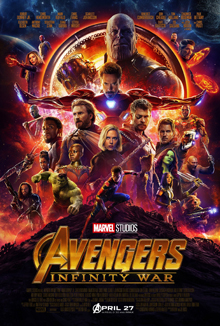
Avengers: Infinity War--A big ogreish alien called Thanos (Josh Brolin) feels a strong need to de-clutter. Specifically, he wants to destroy half of all the living beings in the universe. To do this, he must capture six "Infinity Stones" stashed around the cosmos, including a couple on Earth, and implant them on his big armored gauntlet thingy. Opposed to his plan are both Iron Man's and Captain America's estranged factions of the Avengers, the Wakandans from Black Panther, the Guardians of the Galaxy, Spider-man, Dr. Strange, and other Marvel stars and bench players.

This Gotter-half-dammerung free-for-all, largely based on a limited-run comic series from the early '90s, was directed by the brothers Joe and Anthony Russo, who also helmed two of the earlier Captain America flicks. Unless you're a hardcore Marvel brand loyalist, there's a good chance you could get lost now and then in the specifics of the eye-crossing multi-strand narrative. But the Russos do a capable job of keeping the basic conflict clear, and they keep the big action set-pieces coming.

Over the last few years, Marvel has given us some half-dozen genuinely fun, delightful pictures, like Ant-Man, Guardians of the Galaxy the first, Dr. StrangeSpider-Man: Homecoming, and Thor: Ragnarok, leading up to this year's grand slam Black Panther. For me, Infinity War was a slight step down from these, probably because it's such an overstuffed all-star spectacular that it inevitably lacks a certain balance and focus, and also because the plot and the stakes are so cosmically, apocalyptically heavy.

Even so, the actors manage to find more playfulness than might be expected. There's some serious charisma in this cast: Robert Downey, Jr.'s top billing feels right, he seems to just naturally assume a leading man status in this ensemble. But his costars come across strongly too--Chris Hemsworth's harried Thor, Benedict Cumberbatch's suavely low-key Dr. Strange, Chadwick Boseman's quiet, bashfully authoritative Black Panther with his elegant entourage, the peerlessly soulful Elizabeth Olsen's Scarlet Witch, and Mark Ruffalo's chagrined Bruce Banner, who's having a bit of trouble getting a rise out of his inner green self.

A few of the stars seem to get lost in the shuffle of this movie's ambitions, among them the recessive Captain America of Chris Evans, Anthony Mackie's Falcon and the Black Widow of Scarlett Johansson. And when Scarlett Johansson is one of the less vivid presences in a movie, you know there's glamour going on.

It will be interesting to see how this movie is received by casual fans. Even allowing that mortality is highly flexible in comics, there are surprising losses here, and a resolution that seems inconclusive in the Empire Strikes Back vein. I enjoyed Infinity War, but it left me thoroughly unsatisfied, just as it was supposed to.

Friday, May 6, 2016

SUPERFEUD

Opening this week: 


Captain America: Civil WarIn March it was Batman and Superman that couldn’t get along; now it’s the gang over at Marvel. The U.N. wants the Avengers to agree to regulation. Iron Man (Robert Downey, Jr.) thinks it’s a good idea. Captain America (Chris Evans) doesn’t want anyone telling him what he should and shouldn’t do.

I’ve become a bit of a curmudgeon about the current run of superhero flicks; technically eye-popping though they are, most of them seem overlong and humorless to me. That’s true of Civil War too, but I will say I enjoyed it more than Batman v Superman. About midpoint the quarrel leads Iron Man and his pals into a brawl with Cap and his pals at an airport, and the goofy, semi-slapstick action and the trading of corny quips between adversaries really conjured up the fun of reading an old-school comic. For once, the movie didn’t feel like Wagner without the arias.

The point of contention between Iron Man and Cap is, I suppose, a fair dramatization of a central conflict in the American attitude toward the rule of law, especially international law. But whichever side with which you may sympathize ideologically, there’s little doubt of which leading man wins this Civil War from an acting standpoint—Downey is as manically vibrant as ever, while poor Evans is as pleasantly bland a leading man as you can find in American movies right now.

Also adding some liveliness is Paul Rudd, returning as Ant-Man, Chadwick Boseman as Black Panther, and Tom Holland as another new Spider-Man. Spidey gets a new Aunt May his time, too—Marisa Tomei. Yes, that’s right; since the first Spider-Man flick back in 2002 the role of Aunt May has gone from Rosemary Harris to Sally Field to Marisa freakin’ Tomei. It’s a bit of a jolt to realize that Aunt May is two years younger than I am (and looks at least ten years younger).

Friday, May 1, 2015

TYPE A PERSONALITIES

Opening this week:


Avengers: Age of UltronThe big-budget superhero blockbusters of the last decade or so are not, I confess, my favorite genre. I loved Sam Raimi’s first two Spiderman movies and the first two Iron Man flicks as well, and the first Captain America movie, the period piece, had some flavor. But as these and other series have extended and expanded and intermingled with each other, bloat and rote have begun to set in.

Don’t get me wrong; I always find something in all of them to enjoy—there are always exciting scenes and entertaining performances, or, if nothing else, Scarlett Johansson to look at. But for me, there’s a certain hyper-seriousness to the writing of the recent Marvel and DC spectacles, and also a sterile visual atmosphere—a result, I think, of the wall-to-wall CGI—that’s a bit dreary, almost oppressive. Most of them also feel overplotted, and at least a half-hour too long.

So it’s possible that you could find less cranky and whiny commentators than I to hold forth on the matter of Avengers: Age of Ultron. Because, though it gives me no pleasure to take a “you kids get out of my yard” tone, everything I said above applies to this latest Marvel all-star game.

The main hero line-up this time includes Tony Stark aka Iron Man (Robert Downey, Jr.), Bruce Banner aka The Hulk (Mark Ruffalo), the aforementioned Scarlett Johansson as Black Widow, Chris Evans as Captain America, Jeremy Renner as Hawkeye, Chris Hemsworth as Thor, and Samuel L. Jackson as Nick Fury, among others. The plot this time is yet another variation on the Frankenstein theme: Ultron is an android endowed with massive artificial intelligence, recklessly created by Tony Stark to keep the world peaceful and safe.

Regrettably, Ultron decides the most efficient way to accomplish this is to wipe out the human race with the help of his army of killer robots, and Tony and his Avenger pals have their hands full stopping this. Interminable wild chase and fight scenes ensue, many featuring buildings collapsing into graying clouds of rubble—an unsavory, reflexive modern motif that can’t cease to be obligatory in movies like this soon enough to suit me.

But, as usual, Avengers: Age of Ultron has its compensations. For instance, there’s Elizabeth Olsen, soulful as ever, as Scarlet Witch, some sort of freaky Eastern European super-psychic, and Aaron Taylor-Johnson as her super-fast twin brother Quicksilver. And, as aforementioned, there’s Scarlett Johansson to look at.

But the most fun that this movie offered me was its title character, voiced, and performed by “motion capture,” by James Spader. I’ve long been a fan of Spader, from his beginnings in the‘80s as a sort of off-the-bench honorary Brat Packer, through to his hilarious courtroom harangues and pervy lewdnesses on Boston Legal. Avengers: Age of Ultron should have devoted far more of its length to verbal sparring between Spader’s ironic purring and Downey’s nervous, nattering insolence—a clash between two of the greatest smart-alecks in contemporary pop culture.

Thursday, September 18, 2014

MUTOS GRACIAS

Out on DVD this week is the uneven new Yank version of Godzilla...


...in which the title beast faces off against…

Monster-of-the-Week: …the “Massive Unidentified Terrestrial Organisms,” or MUTOs. I confess that I found these big geometrical buglike menaces somewhat lacking in personality, but they did, at least, have a fine sense of ponderousness, so let’s make the “Winged MUTO…”


…this week’s honoree.

Friday, May 16, 2014

THE BIGS

Opening this weekend…


GodzillaThere’s a fine melodramatic flourish near the beginning of this second American-made movie about the great beast. It involves Juliette Binoche and Bryan Cranston, and allows them both, but especially Cranston, to let it rip with some old school emoting. It gets the picture off to a promising start.

This doesn’t last, I’m disappointed to say. Though certainly an improvement on the 1998 U.S. version, the new movie plods. Binoche and Cranston are two of the best things it, and one of the movie’s troubles is that there isn’t nearly enough of them onscreen. Nor is there enough of Ken Watanabe, of Sally Hawkins, of David Strathairn, or of Elizabeth Olsen. The focus is on the Navy man hero, played by Aaron Taylor-Johnson, who is passably stalwart but not remotely as interesting as his costars.

More problematic still...there wasn’t enough of the title character here, for my taste. King Kong obviously excepted, no giant movie monster has as distinctive and oddly lovable a personality as Godzilla. The filmmakers give him quite a buildup here before his entrance, and unlike Roland Emmerich’s ‘98 Yankzilla, this one really does feel like an authentic incarnation of beast, with his blunt muzzle, his nettled expression and his squeaky-hinge roar.

The monster scenes are good—directed with an almost maddening sense of deliberation by Gareth Edwards, they have an uneasy ponderousness, a low-angle sense of peril, that many other films in this genre miss. But only at the end do we get a heavy dose of rampaging creature action, and by that time I was worn out by the banality of the plot and the dialogue. This Godzilla has many strong moments, but to assemble a fine cast around an iconic central presence and then not give any of them enough to do? That’s monstrous.


Million Dollar ArmAmerican sports agent J. B. Bernstein hits upon an idea to open India to baseball fandom: a reality TV show in which cricket “bowlers” compete to see who can throw fast enough, and accurately enough, that they might be a prospect as an MLB pitcher. Neither of the first year’s winners turns out to be a bowler; one specializes in the javelin. But both end up in Los Angeles, trying out for the Majors.

At least in its broad outlines, it’s a true story, though this sweet Disney movie doubtless makes it a little taller. Bernstein, played by Jon Hamm, is depicted as a desperate, scheming hustler who starts by exploiting the two homesick boys, both of whom come from poor provincial backgrounds, and gradually finds his soul by becoming a surrogate father to them. He’s also a ladies’ man who likes young models, and the boys see that his scrub-wearing, nurturing neighbor (the charming Lake Bell) is the better choice for him.

It isn’t as corny as it sounds. The screenwriter is Thomas McCarthy of The Station Agent and The Visitor, that master of unlikely ad hoc families, and he wrings most of the potential condescension out of the dialogue. Aided by a driving score by A. R. Rahman, the director, Craig Gillespie, keeps things crisp, as do the actors—Suraj Sharma and Madhur Mittal as the arms, Pitobash as an aspiring manager, and Bill Paxton as the earnest pitching coach Tom House. There’s also Alan Arkin as a curmudgeonly scout who keeps his eyes closed throughout the tryouts, because he can judge the speed of a pitch by the sound it makes in the catcher’s mitt.

And then there’s Hamm. He shows a scarily flawless surface in his Mad Men role, but as soon as he steps out of that character he becomes strangely disheveled and nerdy. This isn’t always a bad thing—he used this quality to excellent effect, for instance, in his supporting role in Ben Affleck’s The Town. It works for him in Million Dollar Arm, too—he comes across believably as a nice guy trying hard to be a heartless shark, and happily failing.


SkinlessPlaying for one show only, at 11:55 tonight at FilmBar Phoenix, this splatter parody concerns Dr. Peter Peel (Brandon Salkil), a brilliant young oncology researcher working, like many brilliant young oncology researchers, out of his basement. He has a malignancy on his shoulder, so despite countless examples of this proving a poor idea, he skips straight to human trials on a possible skin cancer cure, with himself as the guinea pig. Regret ensues.

Originally known under the (better, if less commercial) title The Ballad of Skinless Pete, this no-budgeter is the work of a young Cleveland-based writer-director named Dustin Wayde Mills. He’s by no means lacking in talent—he writes speakable, lucid dialogue, he obtains serviceable performances from his actors, and he structures the story coherently. It’s outrageously gruesome and deliberately sick, very definitely not for the squeamish, but it’s played with a deadpan wit that keeps it, overall, from seeming mean-spirited.

I just wish that young horror film makers could find a way to tell a gripping tale without reflexively turning to the trope of the young woman tied up, pleading and whimpering for her life. Skinless escapes contemptibility because, like Cronenberg’s The Fly (to which it pays homage) it has a heart. But I can’t say that I enjoyed the unsavory final act.

Still, Mills could quite conceivably make a classic horror film. Unlike the many modern-era movie horrors that are motivated by hatred of women, Skinless Pete, you see, is motivated by unrequited love—like the Phantom of the Opera, like King Kong, like the Creature of the Black Lagoon. I’m not placing Pete in their league, certainly, but neither am I suggesting that Mills could never create a movie monster that was.

Monday, November 7, 2011

EVERYTHING YOU ALWAYS WANTED TO KNOW ABOUT SECTS

After the screening of Martha Marcy May Marlene, I had the opportunity to participate in a brief roundtable interview with the director, Sean Durkin. You can read my very short Q&A piece here, on JabCat on Movies.

The star, Elizabeth Olsen, was also there; she told me her influences included “Sinatra musicals,” & that her acting idols were Annette Bening, Diane Keaton, Kate Winslet & Michelle Pfeiffer.

By the way, Beavis and Butt-head are back on MTV, with new adventures—like the Peanuts gang, or Bart Simpson, they’ve done an admirable job of staying young since we last saw them, in 1997. My friends know I’m a great fan of the lads & their creator, the estimable Mike Judge, but even so I was willing to glumly admit it if it seemed to me that the world had moved on & the new shows just weren’t the same.

Well, I’ve watched several episodes now, & apparently imbecility is always in style, at least for me. The new shows convulsed me just like the old ones did. For all the excellence & subtlety of King of the Hill & Office Space & Idiocracy, I think that B&B is Judge’s true masterpiece.

RIP to commentator Andy Rooney, departed at 92, screenwriter Hal Kanter, departed at 92, & heavyweight great Joe Frazier, departed at 67.

Saturday, November 5, 2011

IN CULT BLOOD

At the beginning of Martha Marcy May Marlene, the title character—all those names are hers—flees a cult in rural upstate New York. In desperation, she calls her older sister Lucy, who’s had no idea of her whereabouts for the past couple of years. Lucy comes & picks her up, & takes her to the upscale Connecticut lake house she’s summering at with her Brit husband Ted.


Played by Elizabeth Olsen, Martha—her original name—is affectless, so cowed she’s barely articulate. She’ll only tell her puzzled relations (Sarah Paulson & Hugh Dancy) that she left a bad boyfriend, but she offers no details. We, however, get to see what happened to her, in a series of flashbacks. We see how, rudderless after her mother’s death, Martha is drawn into the cult, & gradually, skillfully has her identity stripped away, even to the point of getting the new name “Marcy May” (“Marlene” comes later).

The group in question doesn’t seem to be religious in nature, though we aren’t given much of a sense of its ideology, or even if it has a very clear one. It’s more in the secular self-help line, with a streak of hippie-commune hedonism. Above all, it’s a cult of personality, & the personality in question is Patrick, played by John Hawkes of Winter’s Bone.

Patrick has a casual, friendly, yet faintly wounded manner, like somebody who’s sad that you don’t want to stay longer at his party, but before long we can see that this covers a bottomless emotional & sexual tyranny. Under the precise, patient, un-sensationalistic eye of writer/director Sean Durkin, we see Patrick lead his flock, with disturbing plausibility, into more & more sinister realms.


By the time Martha is in her sister’s care, she’s so accustomed to the cult’s mores that her behavior is shockingly inappropriate at times. She’ll strip naked for a swim, turn weirdly aggressive at the dinner table, even come & sit on the edge of Lucy’s bed while she & Ted are noisily making love.

Here, perhaps, is a small glitch in the film’s believability—Lucy & Ted understandably suspect that Martha is mentally ill, or maybe just intolerably obtuse. But it’s maddeningly apparent that if she once just said the word “cult,” or “group” or “compound,” everybody would slap themselves on the forehead & say “Oh, that explains it.” Since Martha had the clarity to see that she should run away & the courage to do so, that she would then decline to explain herself seems more like a dramatic strategy for maintaining suspense than a psychological trait.

Maybe, maybe not; in any case it’s a minor quibble. MMMM is a remarkable film, controlled, spooky & poignant. It has one of those frustratingly abrupt, literary-fiction-type endings that one gets in indies sometimes, but this is less irritating here than it was in, for instance, Meek’s Cutoff earlier this year.

Most notably, MMMM showcases some fine performances, by the chilling Hawkes, by Paulson, Dancy & several others, but above all by Olsen, the hugely promising younger sister of Mary-Kate & Ashley. Olsen brings to vivid, moving life Martha’s struggle, both pathetic & heroic, to stay connected to her original name.