Friday, January 4, 2013

GOOD WELL HUNTING

A small town in southwestern Pennsylvania is the setting of Promised Land. It’s not exactly flowing with milk and honey—it’s a broke, fading farm community. But it’s sitting on oceans of natural gas, so two corporate agents, Steve (Matt Damon) and Sue (Frances MacDormand) descend on the all-too-eager locals, offering what seems like a fortune in return for drilling rights.


Said rights, in this case, mean hydraulic fracturing or “fracking,” extremely deep drilling aided by the injection of chemically-enriched water, in order to release gas from beneath otherwise impenetrable rock. It’s a highly controversial technique, on the one hand suspected of polluting water tables—sometimes resulting in flammable water!—killing crops and livestock, and other environmental blight, but prized on the other hand for its promise of increased freedom from foreign oil.

A local schoolteacher (Hal Holbrook) raises concerns at a town meeting, and Steve and Sue’s deal—and Steve’s big promotion—are endangered. Their headache is increased by Dustin (John Krasinki) an engaging fellow who shows up in town with tales of fracking’s horrors, to which the townies, much to Steve and Sue’s fury, are clearly listening.

Scripted by Damon and Krasinski from a story by Dave Eggers, and directed by Gus Van Sant, Promised Land is a great-looking movie. Rather than focusing on the economic bleakness of the town, the cinematographer, Linus Sandgren, emphasizes the verdant beauty of the Pennsylvania countryside, suggesting what these people stand to lose in return for corporate chump change.

Van Sant’s touch is low-key and, as always, tinged with good-natured comedy, as is the acting, especially in the familiar bickering affection between Steve and Sue. There’s also an agreeable love interest for Damon—and maybe Krasinski as well—in the form of Rosemarie DeWitt as an attractive elementary school teacher, smiling with amusement at what a sitting duck she is for these out-of-town boys.

Also built into the material is a plot twist, and while it’s fairly cunning, I couldn’t decide if it helped or weakened the movie. Something weakens it, in any case—it’s watchable and inoffensive, but somehow it doesn’t deliver. While fracking is certainly made to seem reckless, the movie doesn’t work up that much of a lather about it, and it makes the point that if it isn’t natural gas, it’s going to be oil or coal (the idea of decreased consumption is dismissed). The real point, though, seems to be that the people who do this sort of unsavory work for energy (or tobacco, or pharmaceutical, or whatever) companies aren’t moustache-twirling villains; they’re likable folks trying to get ahead.

Anyone who found this surprising would have to be naïve—and if they drive a gasoline-powered car, or buy a fast-food hamburger, or for that matter type a movie review on a computer plugged into an electrical socket, they’d have to be hypocritical, as well. Still, there’s a difference, even if it’s only a slight difference, between using pernicious or questionable technology because it’s most of what’s viably available and actually participating in perpetuating that status quo.

Steve and Sue are pleasant, even endearing, but that doesn’t mean they aren’t doing what they’re doing, and Damon, Krasinski and Van Sant can’t seem to find a way to confront this dramatically without turning Promised Land sanctimonious. So they don’t quite confront it. They just let the gas leak out of the movie, with a mild, unconvincing sigh.

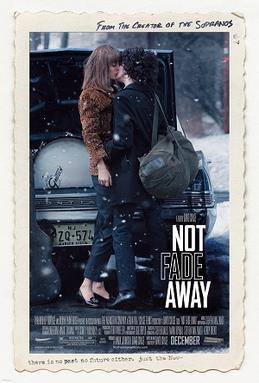
THAT THING THEY DIDN'T

Even without the presence of James Gandolfini in the cast, Not Fade Away would be recognizable as the work of Sopranos creator David Chase. It’s made in Chase’s signature style—the same short, elliptical vignettes, starting and ending suddenly, often leaping forward in time, leaving much for the audience to infer about their significance, and about what’s happened in between.

It can be a potent storytelling method, liberating both filmmaker and audience from tiresome, de rigueur narrative tropes. It has its limitations, too, and Chase runs into them here, not for the first time. But for the first half or so of its length, it frees Not Fade Away from coming-of-age movie sentiment and preciousness.


Not Fade Away is about a rock band in New Jersey in the ‘60s. John Magaro is our hero, the usurping lead singer, Gandolfini and Molly Price are superb as his disappointed working-class parents, and Bella Heathcote is his willowy muse from the other side of the tracks. A bunch of fine, funny, authentic-seeming guys play the other band members. The movie isn’t a show-biz story, however. The focus is much more on family life and girlfriends, college and summer jobs, dinner table squabbles about long hair and Vietnam.

The band plays a few gigs over a few years, shows some promise, teeters on the edge not of stardom but of simple professionalism, as opposed to adolescent goofing off. But they’re doomed by internal egos and envies and agendas. They don’t become one-hit wonders, like the guys in That Thing You Do! They don’t even have their one glorious performance, like the title ensemble of The Commitments. They’re no-hit wonders.

Chase wants find the value and importance even in this abortive venture, and he does find some. He has a firm grasp of what, ultimately, being a rock musician is for: Getting laid. But that’s not the same as what rock music, itself, is for—the soul-deepening comforts and exhilarations it can provide to its listeners and practitioners. Chase gets past the vulgarity of the desire to hit the rock-star lottery, even if his characters don’t, and gives a hint of the growth that music has given them, without their awareness.

But in the second half, as both the band and the hero’s romance begin to fracture into disillusionment, the movie just keeps on going and going. After a while, especially after the hero and heroine leave Jersey for California, it’s like a guy in a bar boring you with an over-detailed account of his long-lost youth. There’s a lovely final coda involving the hero’s little sister (the charming Meg Guzulescu) asserting the cosmic importance of rock-n-roll, but if it’s somehow intended to pull the whole movie together, it doesn’t come close.

I doubt it is so intended, however. As the non-ending of his Sopranos series finale showed, Chase has an aversion to offering dramatic resolution. Brilliant though he is, I find this a failing, and I found that last episode a failure. The desire to confound audience expectation is perhaps commendable; deliberately leaving your audience unsatisfied is less so. Not Fade Away has the same attitude, and unlike the Soparanos finale, it doesn’t even have the virtue of abruptness. Despite the title, fade away—slowly and morosely—is just what this movie does.

Thursday, January 3, 2013

OF MONSTERS OF THE WEEK AND MEN

Check out this superb video of the superb, oddly moving song “Little Talks” by Icelandic band Of Monsters and Men. Thus…

Monster-of-the-Week: …let’s give the nod to this…


…the most titanic—but also evidently most benign—of the several marvelous, deity-like monsters encountered by the band on their mythic odyssey. Good thing they have an angel-like being accompanying them, to defend them against the beasts, and also to know from which beings they need defending. She smiles with approval when she sees the guy above.

Monday, December 31, 2012

COVER STORY

As I have for the past two years, this year for no particularly good reason I again kept a list of the books I read. Here it is (it doesn’t include articles, reviews, essays, short stories, poems, comics, blogs, etc, or books I re-read):

Israel Potter: His Fifty Years of Exile by Herman Melville

Zombie Spaceship Wasteland by Patton Oswalt

Manhood for Amateurs by Michael Chabon

The Fatal Eggs by Mikhail Bulgakov

The Pharaoh’s Ghost by Kenneth Robeson

Barnabas, Quentin and the Grave-Robbers by Marilyn Ross

The Plebeians Rehearse the Uprising by Gunter Grass

The Fortune Cookie Chronicles by Jennifer 8 Lee

Tarzan at the Earth’s Core by Edgar Rice Burroughs

Tarzan and the Ant Men by Edgar Rice Burroughs

Armageddon 2419 A.D. by Philip Francis Nowlan

Tom Swift and His Flying Lab by Victor Appleton II

Sin-Ema by Steve Shadow

Unknown Man No. 89 by Elmore Leonard

The Optimist’s Daughter by Eudora Welty

Tarzan and "the Foreign Legion” by Edgar Rice Burroughs

Life of Pi by Yann Martel

Gracie: A Love Story by George Burns

Interventions by Richard Russo

The Ponder Heart by Eudora Welty

You may notice that I got on a Tarzan kick this year. I wasn’t alone—apparently a new Tarzan movie is in the works. Earlier this year the Erie Playhouse in my hometown successfully staged Disney’s Tarzan musical. Somehow Tarzan never quite goes away, not even at the age of one hundred, which he turned this year—Tarzan of the Apes was first published in 1912.


Put in a cranky Edgar Rice Burroughs-reading mood by my disappointment with the film John Carter, I reread the original Tarzan of the Apes earlier this year—it’s still a fine read, and has, for me, the most improbably touching last line of any American novel I can think of. Then I went on to several of ERB’s subsequent Tarzan tales that I had never caught up with: Tarzan at the Earth’s Core (1929), Tarzan and the Ant Men (1924) and Tarzan and "the Foreign Legion” (1947).


Earth’s Core was a fairly straightforward adventure yarn which took the Jungle Lord and some pals on a rescue mission (via German Zeppelin!) to Pellucidar, ERB’s inner-earth of endless, time-eradicating daylight. Ant Men, in which Tarz falls in with a race of mini-warriors in a remote part of Africa, was perhaps the best-written and wittiest ERB book I’ve ever read, full of charming Swiftian invention, yet the ideas behind its satire are appallingly, embarrassingly reactionary and sexist.


Maybe most interesting, however, was Tarzan and "the Foreign Legion,” the last Tarzan book Burroughs completed, while he was stationed as a war correspondent in Hawaii in WWII. The book is unapologetic propaganda—the quotation marks in the title are ERB’s, as it refers not to the French Foreign Legion, but to a ragtag assembly of American, Dutch, Chinese and native allies with whom Tarz finds himself stranded in the Sumatran jungle, making trouble for the Japanese.

The anti-“Jap” invective in the book is really venomous, yet the attitude toward strong, combat-capable women—one of them bi-racial!—is, in his usual boyishly bashful way, admiring. Don’t get me wrong—I’m not suggesting that ERB was a misunderstood early feminist. To read and enjoy his books today, one must look past a wince-inducing set of presumptions about class and race and gender (of course, this is true when reading Shakespeare, too). But ERB’s attitudes, though antiquated, are complex and reflective, and rarely mean-spirited.

RIP to puppet master Gerry Anderson of Thunderbirds, Captain Scarlet and Space: 1999 fame, passed on at 83.

Happy New Year everybody!

Friday, December 28, 2012

GONER

The Japanese filmmaker Shohei Imamura, who died in 2006, is probably best known in the US—by me, anyway—for Black Rain, his 1989 film about Hiroshima and its aftermath. This adaptation, in stunning black-and-white, of Masuji Abuse’s novel is gentle and heartbreakingly stoic. I think it was one of the great achievements in world cinema of the ‘80s, though it was understandably a bit of a tough sell as a critical recommendation.


Now the fearless folks at Icarus Films are trying to expand Imamura’s profile here in the west, with their release of his fascinating, atmospheric 1967 work A Man Vanishes (Ningen Johatsu), out this month on DVD. This feature-length investigation into the disappearance of a 30-year-old salesman begins as a documentary probe, but gradually turns into a verité-style mystery, with an ever-shifting take on the vanished man and on his enigmatic fiancé, who accompanies the director.

On various visual or thematic levels, the film may call to mind Citizen Kane, Rashomon, and some of Godard’s work. Yet it’s also a startling original, with Imamura pulling off a cheeky, admirable coup de cinema toward the end.

This Icarus Films edition also includes five short, intriguing Imamura documentaries for television, including 1971’s In Search of the Unreturned Soldiers in Malaysia, another investigation into vanished men—Imamura looks for, finds and interviews Japanese soldiers who blended into communities in Singapore and Malaysia after WWII ended. Some of their reasons for giving up their home country are, as is customary in Imamura’s work, unexpected.

Thursday, December 27, 2012

CHARACTERS

A couple of bigtime, landmark RIPs: first, to quintessential American character actor (and war hero) Charles Durning, passed on at 89.


Out of his countless memorable moments onscreen, in films ranging from The Sting to Dog Day Afternoon to Starting Over to Tootsie to The Muppet Movie to True Confessions to When a Stranger Calls to Dark Night of the Scarecrow to O Brother, Where Art Thou? and more, he may never have put on a show of equal parts performing skill and joy as this one, from 1982’s The Best Little Whorehouse in Texas. Few actors ever do. Watch it, if you want to smile.


The Wife and I were lucky enough to see Durning live, at the Orpheum Theatre in Phoenix in 1998, in a touring production of The Gin Game, with Julie Harris. We were also lucky enough to see Jack Klugman live, opposite Tony Randall, in a touring production of The Odd Couple in the early ‘90s, benefitting The National Actors Theater. Klugman, who passed on Christmas Eve at 90, had already lost a vocal cord to cancer by then, but even rasping out the role of Oscar Madison, he was clearly audible throughout Gammage Auditorium, and his warmth and vigor came through perfectly.


This New Year’s Eve marks the 34th anniversary of the death of the one-of-a-kind comic artist Basil Wolverton, so...

Monster-of-the-Week: …let’s give the nod to this particularly smug representative of The Brain Bats of Venus, a Wolverton story from a 1952 issue of Mister Mystery


A Happy, Safe, Prosperous New Year from Monster-of-the-week!

Friday, December 21, 2012

MIDDLE-AGED CRAZIES

With This is 40, Judd Apatow brings two memorable supporting characters from his 2007 hit Knocked Up to center stage: Debbie and Pete, the heroine’s bickering sister and brother-in-law. It appears that the reason they were such successful characters in the earlier film is precisely because they were supporting characters. This is 40 is well-acted, and it’s not without laughs and strong scenes. But watching these two squabble for more than two hours is, ultimately, more ordeal than pleasure.


L.A. fashion boutique owner and mother of two Debbie, played by Leslie Mann—Mrs. Apatow—is a blonde beauty and a bright-eyed, freaky obsessive. Pete, played by Paul Rudd, manages a struggling record label (he’s gambled big on a Graham Parker album). He’s emotionally recessive in the face of the intensity of his wife and daughters. He regularly retreats to the bathroom when he doesn’t need to relieve himself, just to play handheld electronic games. But he’s not safe from his wife’s intrusion even there.

Even so, for some reason Pete comes off less sympathetically than Debbie, maybe because the underlying dynamic seems to be that he’s no longer in love with his wife—he sometimes fantasizes about being a widower—yet she’s still desperately fascinated by him. In real life, of course, Pete’s trapped and overloaded feelings could awaken compassion, as could his terror at the prospect of admitting to Debbie that they’re on the brink of ruin. But in the movies, even with the always-appealing Rudd playing him, he just seems like a detached skunk who’s not trying. When we see him weeping in his car at one point, the moment falls surprisingly flat.

The movie centers, way too loosely, on the lead-up to a joint 40th and “38th” birthday party for Pete and Debbie, respectively. But it pursues a profusion of subplots, from Debbie’s troubles with her shop employees (Megan Fox and Charlyne Yi) to the growing pains and Lost fixation of her older daughter (Maude Apatow, who’s excellent) to the daddy issues that fuel Debbie and Pete’s dysfunction. Pete’s Dad (Albert Brooks) is a jolly, outrageous deadbeat—with toddlers from his more recent wife!—who shamelessly leeches off his son. Debbie’s Dad (John Lithgow) is the ultimate absentee, a hotshot spinal surgeon who can’t even confidently remember the names of his granddaughters.

I like Apatow, a lot. Knocked Up and The 40-Year-Old Virgin are already classics, I think, two of the best American comedies of the past decade. But his instincts are way off here. He tries to give every little strand, down to Debbie’s efforts to quit smoking or Pete’s cupcake addiction, its own story arc and payoff, and it’s just too much. He lets scenes play too long, and overindulges what appear to be improvisations until they become unfunny.

There’s a lot that’s good about This is 40, and with some fairly merciless cutting it could probably have been made into a decent movie. Not a great one, though, I don’t think. The core situation—affluent married people find themselves facing middle age without having attained a perfectly satisfactory life—isn’t exactly unique, and it lacks the urgency of Apatow’s earlier films. After all, at least they aren’t still virgins.


Make no mistake, the athletic and acrobatic feats captured on film in Cirque du Soliel: Worlds Away are enough to make you believe in superheroes. The performers in the circus franchise’s feature film come across like some other, higher species; some Nietzschean improvement on Homo Sapiens. What they do with their bodies doesn’t seem possible, and yet there they are, clearly doing it.

Considering how jaw-dropping their abilities are, and their beauty and erotic presence, it’s hard to understand why the movie is a bit of a bore. The franchise, started in the early ‘80s by a pair of Canadian street performers, has grown into a worldwide empire, with shows on six continents. It’s a contemporary take on the circus—no animals, a New-Agey, music-driven style and unifying themes to the performances. Worlds Away, directed by Andrew Adamson of Shrek, showcases the seven Cirque du Soleil productions in Las Vegas alone.

I have friends who are serious fans and repeat customers of the live shows, but even they admit that the videos of the performances just aren’t the same. I’m inclined to believe them—I can see how witnessing this stuff live could be overwhelming. But while watching this movie, more than once my chin began to droop toward my chest.

There’s a little bit of story to Worlds Away. An extremely cute gamine (Erica Linz) goes to the circus. In the middle of the act, a hunky aerialist (Igor Zaripov) makes eye contact with her and, distracted by her extreme gamine cuteness, misses his trapeze and plummets into the ring. But instead of going splat, he plunges right through the dirt, and the gamine, rushing to his aid, falls through after him.

She finds herself in a strange alternative avant-garde circus dimension. For the rest of the movie she wanders, accompanied by a grim-looking clown (John Clarke) with a bad case of bed head, from tent to tent, in search of her hunk. Some of her encounters are visually magical—like a lovely staging of “Octopus’s Garden”—and all are eye-popping demonstrations of physical skill and prowess.

But this slender thread of plot isn’t enough to disguise what Cirque du Soleil: Worlds Away really is—a commercial, first of all, but also a concert movie. And I would propose that the concert movie, with a handful of rule-proving exceptions, may be the most wearying of all film genres, blunting as it does both the immediacy and excitement of live performance and the narrative pull of cinema.

Oh yeah, it’s in 3-D. I honestly can’t remember one particularly striking effect that this added to the film.