Showing posts with label MAGGIE SMITH. Show all posts

Monday, July 17, 2023

FEEL THE BERN(ADETTE)

Now in theaters:

The Miracle Club--After many decades in Boston, Chrissie has returned to her working class neighborhood in Dublin in 1967, following the death of her long-estranged mother. She gets a cold reception from her old friend Eileen (Kathy Bates) and from Lily (Maggie Smith), the mother of her teenage lover who later died by drowning.

Lily and Eileen are about to leave on a trip to Lourdes; somehow Chrissie (Laura Linney) ends up on the bus too. Also on the trip is Dolly (lovely Agnes O'Casey; a descendant of Sean, no less!), a young mother hoping the waters at Lourdes will heal her little son Daniel, who hasn't started speaking yet.

This comedy-drama, directed by Thaddeus O'Sullivan from a script by Jimmy Smallhorne, Timothy Prager and Joshua D. Maurer, doesn't push too deep into the psychology and theology of pilgrimages to holy places and the search for authentic supernatural miracles. About as far as the exploration goes is the pronouncement of the priest (Mark O'Halloran): "You don't go to Lourdes for a miracle; you go for the strength to go on when there is no miracle." Well, okay, but...so many questions.

Mostly the pilgrimage is used here as a device to gradually tease out the poignant backstory of the characters, and to give them a symbolic redemption. There's also a good deal of comedy derived from the bumbling husbands, including Stephen Rea as Eileen's not-much-better half, cluelessly trying to manage back home without their wives. 

So the movie is slight, despite being adjacent to some intriguing themes. But if you appreciate fine acting, can you really afford to miss this ensemble? Between the quietly intent Linney, the bitter and frightened Bates and the chastened, open-hearted Smith, trying to decide who carries the most grandeur is not a critical task I find myself up to. Their talent is, you know, miraculous.

Friday, May 20, 2022

ABBEY NORMAL

Opening today:

Downton Abbey: A New Era--The saga of the lives of Brit nobility and their servants at the titular fictitious pile of bricks was an ITV series from 2010 to 2015, then a feature in 2019, and now this sequel. I never watched the show, and while I had seen the earlier film I could barely remember a thing about it, just the impression that it was pleasantly sedate. So it was with no special excitement that I settled in for the sequel.

Thus this New Era, directed by Simon Curtis, was a nice surprise. Screenwriter Julian Fellowes has concocted twin storylines, both of which have a fairy-tale charm and both of which pay off with a gratifying sense of wish-fulfillment. Most of us could do with a happy ending right now, and this movie serves up a couple of elegant ones.

In the first strand, Crawley family matriarch Violet (Maggie Smith) informs her astounded relations that she's been given a villa in the south of France by a passionate admirer from her youth who has passed on, and that she wishes to give the place to her great-granddaughter Sybil. Violet is past traveling, but the Frenchman's highly civil son (Jonathan Zaccai) invites the family to visit the place and get acquainted, much to the disgust of his mother (Nathalie Baye).

The other, livelier plotline has a film crew arriving to shoot a movie at Downton Abbey; the family reluctantly agrees to this indignity to finance a new roof for the house. It starts as a silent picture, but The Jazz Singer has just come out, so it becomes a talkie mid-shoot. What ensues is surprisingly similar to the plot of Singin' in the Rain, right down to a beautiful blonde silent star with an incongruously grating voice.

The regulars from the series, like Smith, Hugh Bonneville, Elizabeth McGovern, Robert James-Collier, Samantha Bond, Phyllis Logan, Jim Carter, Penelope Wilton and the beguiling Michelle Dockery as Lady Mary, who keeps an eye on the film folks while her family is in France, are in solid form. One of the veterans from the series, Kevin Doyle as butler turned schoolteacher Mr. Molesley, gets a particularly marvelous payoff here; a cinephile, Molesley's rapture at being in proximity to moviemaking is funny, but it borders on moving as well.

The fun this time, however, is mostly from the new characters. As the film producer who understandably falls for Lady Mary, Hugh Dancy hits just the right quietly lovestruck note. Just as good are Dominic West as the jovial leading man of the movie and Laura Haddock as his breathtaking, covertly cockney leading lady.

Fellowes, who also triumphed this year with The Gilded Age on HBO, has so long been a skillful--and seemingly admiring--chronicler of the obscenely rich and those who derive their living from pampering them that it may be hard, watching Downton Abbey, to stifle your class outrage at times. At one point Violet, watching the film people at work, remarks "I'd rather earn my living down the mine!"

Drawing on a lifetime's experience as a hard-working actress, Maggie Smith delivers the line peerlessly. But even as she makes you laugh, you may not be able to suppress the thought, of the Dowager: yeah, spoken like some mega-rich jerk who never had to earn a living at all. Try ten minutes "down the mine" sometime and see if you still feel that way.

But the idyllic tone of A New Era wore me down; I couldn't maintain any indignation. Of course, the social system depicted here is grotesque and, not to put too fine a point on it, wrong. But so are the social systems approvingly depicted in, say, Twelfth Night or Much Ado About Nothing, and that doesn't stop us from entering into and enjoying them. I'm not (remotely) putting Fellowes, brilliant though he is, in the same class as Shakespeare. But this movie does have the structure, and some of the pastoral flavor, of a Shakespearean comedy, with all the storylines resolving in joy.

Friday, March 6, 2015

SETTLING FOR SECOND BEST

Opening this week: 


The Second Best Exotic Marigold Hotel—This sequel to the easygoing 2012 comedy about aging Brits retiring to a crumbling but comfortable hotel in Jaipur, India doesn’t stretch the material very far. It’s just more of the same, with most of the stars—Judi Dench, Maggie Smith, Bill Nighy, Celia Imrie, Ronald Pickup, Penelope Wilton and Diana Hardcastle—returning for more mild antics.

Dev Patel is back too, as the overenthusiastic young manager, along with the imposing Lillete Dubey as his stern but attractive mother and Tina Desae as his gorgeous fiancée. Richard Gere also turns up as a mystery man at the hotel, presumably a bone tossed to the American market.

So there are new romances and adventures and intrigues. In perhaps the cleverest of them, ladies' man Pickup comes to suspect that he may have inadvertently taken out a hit on his girlfriend—this strand could actually be a solid basis for a pretty good noir thriller.

But we’re never asked to take it seriously here. Nothing too upsetting happens, and the movie climaxes with a big Bollywood-style dance to that irresistible music.

It’s no big deal, but you read that cast, right? The movie almost can’t be a complete waste with any of them in it, let alone all.

Around midpoint, Dench and Smith exchange a few commonplace lines, with the subtext that both of them know a piece of difficult news that one isn’t discussing. All the mastery that these two have accumulated over their careers is there, in the steely compassion undergirding this short scene. It made Second Best Exotic worth sitting through all by itself

Friday, January 25, 2013

JUST FOUR FUN

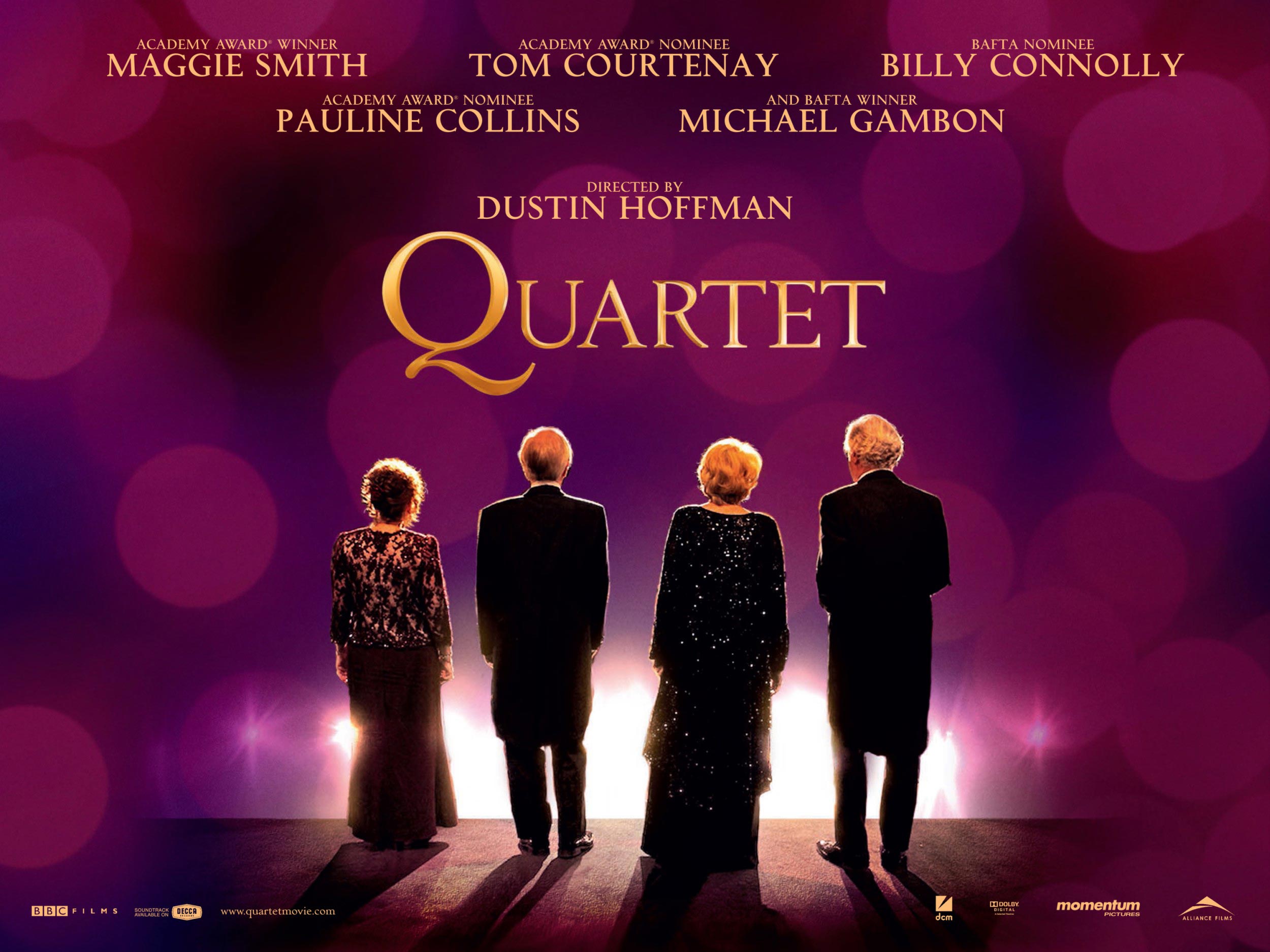
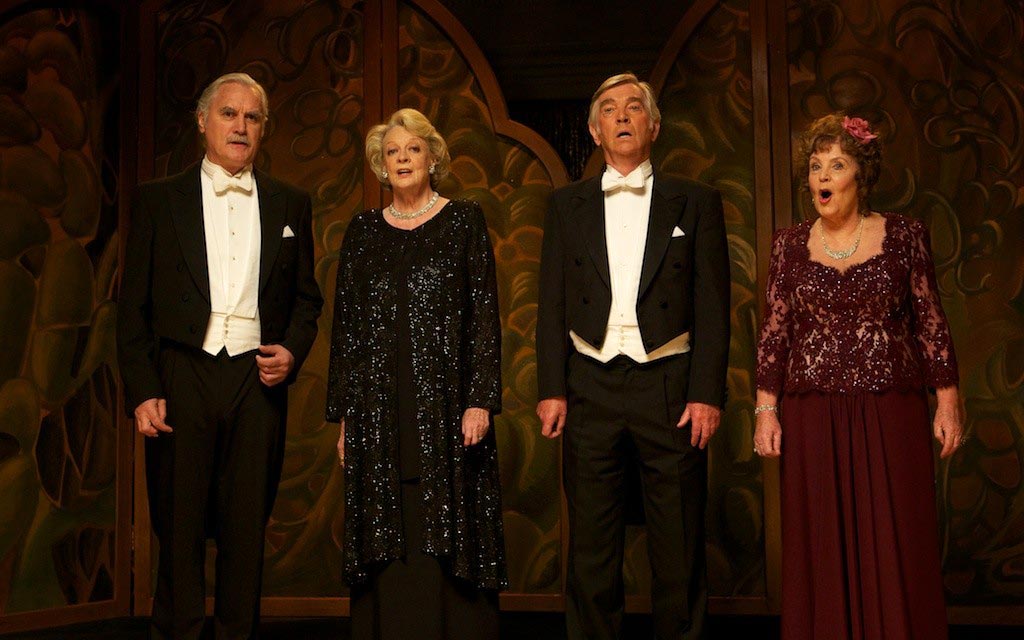
Based on Ronald Harwood’s 1999 play, Quartet takes place in a palatial retirement home for classical musicians, many of them opera singers. When they belt out “Happy Birthday” to one of their number in the dining room, it sounds particularly fine.


The film, which hinges on the preparation by the residents for a concert in celebration of Giuseppe Verdi’s birthday, marks the feature directorial debut of Dustin Hoffman. The completed directorial debut, that is; Hoffman started out as director of the 1978 crime drama Straight Time, in which he also starred, but left the job in favor of Ulu Grosbard, because he didn’t feel able to judge his own performance.

Hoffman doesn’t have that discomfort with Quartet, in which he doesn’t appear. And he’s had the good sense to stock the movie with the kind of cast for which the word “reliable” is an impertinent understatement. Like last year’s The Best Exotic Marigold Hotel, Quartet is one of those movies so full of peerless Brit veterans that you feel pretty sure going in that it’s going to be worth watching even if it’s not very good. Best Exotic indeed wasn’t all that good, but there were Judi Dench and Tom Wilkinson and Bill Nighy and Penelope Wilton and Ronald Pickup and Maggie Smith, among others, giving it life with what appeared minimal effort.

I’m pleased to report that Quartet, though slight, is a better movie than Best Exotic, thanks in part to Hoffman’s smooth direction, in part to Harwood’s gently nipping dialogue, in part to the lovely, idyllic setting, but in by far the biggest part to the cast: Tom Courtney, Billy Connolly, Pauline Collins, Michael Gambon and, once again, Maggie Smith, among others.

Smith plays a long-retired opera star who, out of financial options, comes to live at the home—played by Hedsor House in Buckinghamshire, it surely must be the most opulent old folks’ facility ever. It’s not big enough, however, for her and fellow singer Courtney, a former lover that she wronged long ago, and who hasn’t forgiven her. The two of them, along with the defiantly still-lecherous Connolly and the sweet Collins, who’s showing early signs of dementia, are asked to perform the quartet from Rigoletto at the Verdi gala. Smith alone refuses—she knows her best days as a performer are long over, and doesn’t want to betray the memory of them. The other three try to persuade her.

How it all turns out will be of no particular surprise to anyone, nor is this important—the company of these actors is such a pleasure that the mild storyline is just a formality. The point of the movie seems to be that getting old doesn’t ensure emotional maturity. True, no doubt, but as Hoffman and his four razor-sharp leads, all in their seventies, demonstrate here, it doesn’t necessarily take away talent, either.