Opening today:
The Hobbit: The Battle of the Five Armies—The third installment of Peter Jackson’s three-part adaptation—and embellishment upon—the Tolkien novel starts off big. The dragon Smaug, voiced by the ubiquitous Benedict Cumberbatch, wreaks havoc on a nearby fishing village and does battle with a valiant local boy (Luke Evans). While I sat there watching this sequence, I thought it was so strong that Jackson would have a hard time topping it, and as it ended I settled in for a long evening of droning exposition and wearying, incomprehensible-to-non-geeks prophesying.
I was wrong. Hobbit Part Two was better than Hobbit Part One, and for my money, Hobbit Part Three is the most exciting of the lot. Title character Bilbo Baggins (Martin Freeman) and his pals the dwarves have taken occupancy in the dragon’s treasure-filled lair, and dwarf king Thorin Oakenshield (Richard Armitage) is going all Treasure of Sierra Madre with gold-fueled paranoia.
Meanwhile four other legions—the elegant, aloof elves, the ogre-ish Orcs, the humans from the fishing village and more dwarves led by Thorin’s cantankerous brother Dain (the great Billy Connolly) converge outside the lair, each with its own agenda involving Smaug’s hoarded booty. At the heart of this bombast, and comically contrasted with it, is the modest sheepishness and goodwill of Bilbo, scurrying around trying to be honest and do the right thing.
When you get past the brilliance and intricacy of Jackson’s staging, I suppose all these tempestuous fight scenes don’t have anything deeper behind them than pro wrestling. But I liked how almost every positive thing that happens in this finale happens because members of different races reach out to each other.
Now that his Hobbit saga is (presumably!) complete, I really hope that Jackson puts the Tolkien on the shelf, at least for a decade or so, and tries something different. Almost anything different will do—a car chase movie, a bachelor party comedy—as long as it doesn’t involve broadswords and shaggy beards. Middle Earth has been very good to Jackson, but I hope that now this incredibly talented filmmaker will turn his attention, and his camera, back towards regular old Earth.
The Phoenix Film Critics Society, of which I am always proud to note that I'm a founding member, has announced our 2014 Award Winners. As always, some of them reflect my voting—despite my gripes about Birdman, for instance, Michael Keaton had my vote—and others don't, but there are plenty of movies worth seeing on the list. I was particularly pleased to see the powerful and artful Glen Campbell: I'll Be Me take Best Documentary.
BEST PICTURE
Birdman
TOP TEN FILMS OF 2014 (in alphabetical order)
A Most Violent Year
Birdman
Boyhood
Gone Girl
The Grand Budapest Hotel
Guardians of the Galaxy
The Imitation Game
The Lego Movie
The Theory of Everything
Whiplash
BEST DIRECTOR
Richard Linklater, Boyhood
BEST ACTOR IN A LEADING ROLE
Michael Keaton, Birdman
BEST ACTRESS IN A LEADING ROLE
Rosamund Pike, Gone Girl
BEST ACTOR IN A SUPPORTING ROLE
J. K. Simmons, Whiplash
BEST ACTRESS IN A SUPPORTING ROLE
Keira Knightley, The Imitation Game
BEST ENSEMBLE ACTING
Birdman
BEST SCREENPLAY WRITTEN DIRECTLY FOR THE SCREEN
The Grand Budapest Hotel
BEST SCREENPLAY ADAPTED FROM MATERIAL IN ANOTHER MEDIUM
Gone Girl
BEST LIVE ACTION FAMILY FILM (Rated G or PG)
Into the Woods
THE OVERLOOKED FILM OF THE YEAR
Edge of Tomorrow
BEST ANIMATED FILM
The Lego Movie
BEST FOREIGN LANGUAGE FILM
Ida
BEST DOCUMENTARY
Glen Campbell: I'll Be Me
BEST ORIGINAL SONG
"Everything is Awesome," The Lego Movie
BEST ORIGINAL SCORE
Birdman
BEST CINEMATOGRAPHY
Birdman
BEST FILM EDITING
Birdman
BEST PRODUCTION DESIGN
The Grand Budapest Hotel
BEST COSTUME DESIGN
The Grand Budapest Hotel
BEST VISUAL EFFECTS
Intersellar
BEST STUNTS
Edge of Tomorrow
BREAKTHROUGH PERFORMANCE ON CAMERA
Rosamund Pike, Gone Girl
BREAKTHROUGH PERFORMANCE BEHIND THE CAMERA
Dan Gilroy, Nightcrawler
BEST PERFORMANCE BY A YOUTH IN A LEAD OR SUPPORTING ROLE: MALE
Jaeden Lieberer, St. Vincent
BEST PERFORMANCE BY A YOUTH IN A LEAD OR SUPPORTING ROLE: FEMALE
Lilla Crawford, Into the Woods
Showing posts with label BILLY CONNOLLY. Show all posts
Wednesday, December 17, 2014
Friday, January 25, 2013
JUST FOUR FUN
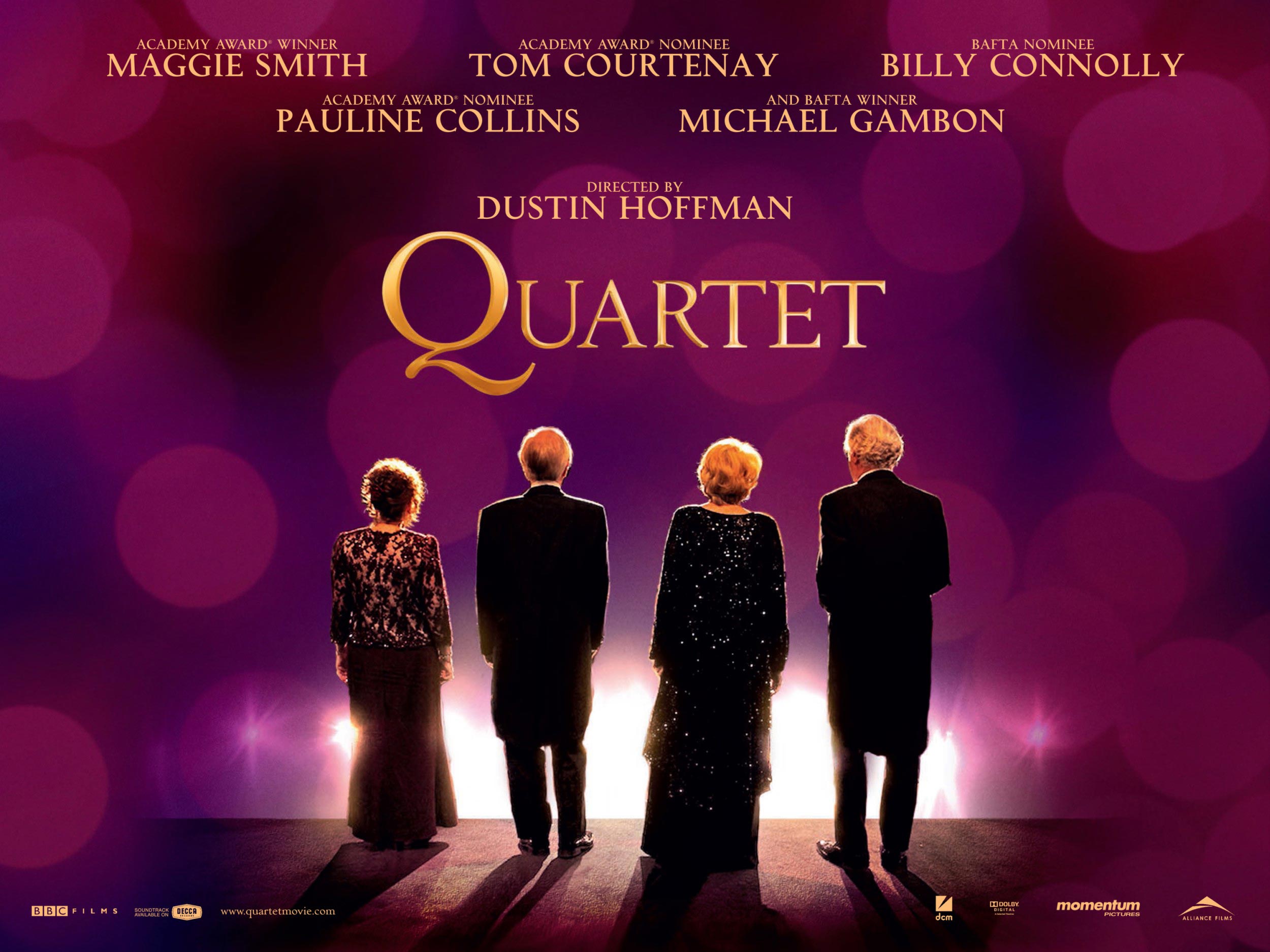
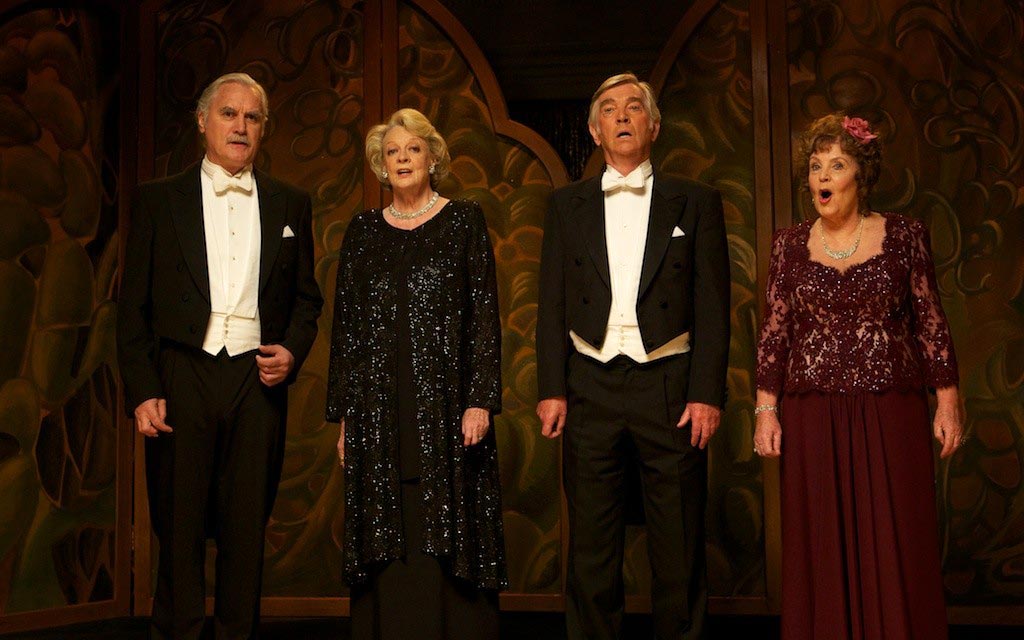
Based on Ronald Harwood’s 1999 play, Quartet takes place in a palatial retirement home for classical musicians, many of them opera singers. When they belt out “Happy Birthday” to one of their number in the dining room, it sounds particularly fine.
The film, which hinges on the preparation by the residents for a concert in celebration of Giuseppe Verdi’s birthday, marks the feature directorial debut of Dustin Hoffman. The completed directorial debut, that is; Hoffman started out as director of the 1978 crime drama Straight Time, in which he also starred, but left the job in favor of Ulu Grosbard, because he didn’t feel able to judge his own performance.
Hoffman doesn’t have that discomfort with Quartet, in which he doesn’t appear. And he’s had the good sense to stock the movie with the kind of cast for which the word “reliable” is an impertinent understatement. Like last year’s The Best Exotic Marigold Hotel, Quartet is one of those movies so full of peerless Brit veterans that you feel pretty sure going in that it’s going to be worth watching even if it’s not very good. Best Exotic indeed wasn’t all that good, but there were Judi Dench and Tom Wilkinson and Bill Nighy and Penelope Wilton and Ronald Pickup and Maggie Smith, among others, giving it life with what appeared minimal effort.
I’m pleased to report that Quartet, though slight, is a better movie than Best Exotic, thanks in part to Hoffman’s smooth direction, in part to Harwood’s gently nipping dialogue, in part to the lovely, idyllic setting, but in by far the biggest part to the cast: Tom Courtney, Billy Connolly, Pauline Collins, Michael Gambon and, once again, Maggie Smith, among others.
Smith plays a long-retired opera star who, out of financial options, comes to live at the home—played by Hedsor House in Buckinghamshire, it surely must be the most opulent old folks’ facility ever. It’s not big enough, however, for her and fellow singer Courtney, a former lover that she wronged long ago, and who hasn’t forgiven her. The two of them, along with the defiantly still-lecherous Connolly and the sweet Collins, who’s showing early signs of dementia, are asked to perform the quartet from Rigoletto at the Verdi gala. Smith alone refuses—she knows her best days as a performer are long over, and doesn’t want to betray the memory of them. The other three try to persuade her.
How it all turns out will be of no particular surprise to anyone, nor is this important—the company of these actors is such a pleasure that the mild storyline is just a formality. The point of the movie seems to be that getting old doesn’t ensure emotional maturity. True, no doubt, but as Hoffman and his four razor-sharp leads, all in their seventies, demonstrate here, it doesn’t necessarily take away talent, either.
Friday, June 22, 2012
BRAVE REVIEW
The newest Disney princess, Merida, loves to ride her horse and shoot arrows, often at the same time. She has wild red curls and a puckish smirk, and she climbs cliffs in a way that I hope the young audience members of Disney/Pixar’s Brave don’t try to imitate.
Merida, voiced by Kelly MacDonald, takes after her father Fergus (Billy Connolly), a feudal lord in medieval Scotland. He’s a good-natured, boyish braggart who loves to retell the tale of how he lost his leg defending his family against the monstrous bear Mor’du. Merida gets along famously with him, and with her swashbucklingly mischievous triplet brothers, but not so much with her civilized mother Elinor (Emma Thompson), who’s trying to prepare her for a peace-making arranged marriage to one of three princes from neighboring kingdoms.
Said princes are not a very prepossessing lot, and Merida isn’t ready to get married in any case, so she and her mother clash. In despair, and led through the forest by Will-o’-the-wisps to a witch (Julie Walters), she bargains with the old lady for a spell to “change” her mother, and…
Well, you know how trusting witches usually goes, especially in medieval Scotland. The only thing that really irked me about Brave was that Merida seemed too easy a mark for the crone, but I guess she hadn’t read the same stories that I have. Things don’t work out nearly as grimly for Merida and her family as they do for the hero of Shakespeare’s Scottish Play, but they’re still in for plenty of trouble.
Merida’s gullibility aside, Brave seems to me very nearly an instant classic; almost, though not quite, the peer of the peerless Up. Like that film and all the Pixar efforts, it’s a dazzling piece of cinematic showmanship, and is, maybe, a little less antiseptic than the others.
I don’t mean by this that it’s remotely realistic—nobody could suggest that this well-swept environment reflects, either hygienically or in terms of life options, the real medieval world. It’s a modern, middle-class girl’s fantasy of medieval life. But there is, somehow, a richness, an earthiness of color and texture to Brave that the other Pixar films, by design, didn’t have.
The movie’s people seem pungently human as well. The men, with their gnarled, bushy mugs and irregular physiques, have a comic grandeur, and Merida’s round, mirthful face has a real-girl beauty that the other, more generic Disney princesses can’t claim.
The plot of Brave was concocted by veteran animation writer/director Brenda Chapman and fiddled with by several other hands, including director Mark Andrews. It eventually takes a fanciful supernatural turn, involving both Merida’s Mom and the triplets, that seems off-the-wall at first, but in the end is entirely coherent and emotionally satisfying.
It’s often been noted that the heroines (and heroes) of Disney films rarely have strong mothers, if they have mothers at all. But Brave hinges on a difficult, complicated mother-daughter relationship, with fault on both sides, and this conflict leads to a climactic stretch that’s both highly exciting and moving.
For all the skill of its narrative, however, what’s most remarkable about Brave is that Disney finally really did it—finally gave their audience a genuinely independent-minded Princess. Merida isn’t some cookie-cutter cutie who makes a lot of noise about wanting freedom or adventure while the plot hustles her toward some square-jawed Prince. Merida’s motivation is exactly the opposite: She’s trying to keep the Princes away, at least for a while.
Two final notes: First, Mor’du the Bear was a little scary for both the nine-year-old and the ten-year-old in whose company I saw Brave. These scenes didn’t seem at all as harsh as the witch stuff in Snow White and the Seven Dwarves to me, but parents be forewarned.
Second, don’t be late, as Brave is preceded by a short called La Luna that you don’t want to miss.
Said princes are not a very prepossessing lot, and Merida isn’t ready to get married in any case, so she and her mother clash. In despair, and led through the forest by Will-o’-the-wisps to a witch (Julie Walters), she bargains with the old lady for a spell to “change” her mother, and…
Well, you know how trusting witches usually goes, especially in medieval Scotland. The only thing that really irked me about Brave was that Merida seemed too easy a mark for the crone, but I guess she hadn’t read the same stories that I have. Things don’t work out nearly as grimly for Merida and her family as they do for the hero of Shakespeare’s Scottish Play, but they’re still in for plenty of trouble.
Merida’s gullibility aside, Brave seems to me very nearly an instant classic; almost, though not quite, the peer of the peerless Up. Like that film and all the Pixar efforts, it’s a dazzling piece of cinematic showmanship, and is, maybe, a little less antiseptic than the others.
I don’t mean by this that it’s remotely realistic—nobody could suggest that this well-swept environment reflects, either hygienically or in terms of life options, the real medieval world. It’s a modern, middle-class girl’s fantasy of medieval life. But there is, somehow, a richness, an earthiness of color and texture to Brave that the other Pixar films, by design, didn’t have.
The movie’s people seem pungently human as well. The men, with their gnarled, bushy mugs and irregular physiques, have a comic grandeur, and Merida’s round, mirthful face has a real-girl beauty that the other, more generic Disney princesses can’t claim.
The plot of Brave was concocted by veteran animation writer/director Brenda Chapman and fiddled with by several other hands, including director Mark Andrews. It eventually takes a fanciful supernatural turn, involving both Merida’s Mom and the triplets, that seems off-the-wall at first, but in the end is entirely coherent and emotionally satisfying.
It’s often been noted that the heroines (and heroes) of Disney films rarely have strong mothers, if they have mothers at all. But Brave hinges on a difficult, complicated mother-daughter relationship, with fault on both sides, and this conflict leads to a climactic stretch that’s both highly exciting and moving.
For all the skill of its narrative, however, what’s most remarkable about Brave is that Disney finally really did it—finally gave their audience a genuinely independent-minded Princess. Merida isn’t some cookie-cutter cutie who makes a lot of noise about wanting freedom or adventure while the plot hustles her toward some square-jawed Prince. Merida’s motivation is exactly the opposite: She’s trying to keep the Princes away, at least for a while.
Two final notes: First, Mor’du the Bear was a little scary for both the nine-year-old and the ten-year-old in whose company I saw Brave. These scenes didn’t seem at all as harsh as the witch stuff in Snow White and the Seven Dwarves to me, but parents be forewarned.
Second, don’t be late, as Brave is preceded by a short called La Luna that you don’t want to miss.
Subscribe to:
Posts (Atom)