Showing posts with label OSCAR ISAAC. Show all posts

Friday, October 1, 2021

NOT QUITE SO ALTOGETHER OOKY

Opening this weekend:

The Addams Family 2--Wednesday, the emotionally reserved daughter, is the focus of this sequel to 2019's animated adaptation of the classic Charles Addams cartoons from The New Yorker. Her exuberant clan gets on her nerves, and she's especially full of woe when her ebullient dad Gomez insists that she go on a family road trip. So when she is told that she may not be biologically an Addams, she's willing to listen.

The whole gang, almost, piles into the spacious, splendidly Gothic camper; along with Chloe Grace Moretz as Wednesday, Gomez (Oscar Isaac), Morticia (Charlize Theron), Uncle Fester (Nick Kroll) and Puggsley (Javon Walton), as well as the faithful, ever-gloomy Lurch (co-director Conrad Vernon), the ever-handy Thing, the moplike Cousin It (Snoop Dogg) and leonine pet Kitty Kat are along for the ride. Only Grandmama (Bette Midler) stays at home, to keep an eye on things (and party). Episodic wackiness ensues, as the family gets involved with everything from child pageants to bikers, while pursued by the shifty rep (Wallace Shawn) of a mad scientist (Bill Hader).

It's an above-average CGI production, with plenty of slapstick chases, fine voice acting and a standard emotional template; Wednesday gradually learns what family she wants to be part of. But the plot runs counter to the usual Addams Family schtick.

The retro-rerun network MeTV recently began airing the original Addams Family series (1964-1966), and I've watched a few episodes for the first time in decades. The show holds up amusingly, and what makes it work, I think, is that the actors don't play spooky. They have a hearty, aggressive geniality that makes them lovable--and, in the case of Carolyn Jones as Morticia, sexy--as well as funny in their macabre context. Even Ted Cassidy's baleful Lurch doesn't exactly play spooky; he's just deeply apprehensive.

The old series bounced the family's antics off of conventional midcentury banality, with the liberating suggestion that people who embraced their eccentricities might just be happier. Addams Family 2 comes to a really bizarre, shape-shifting finale, with the Addams folk in the clutches of the Dr. Moreau-like crazy scientist, that overshadows their peculiarity. Even the kiddie pageant world seems weirder than these title characters. Maybe the exposure of our culture to a couple of decades of reality TV has made the Addams Family seem normal.

Friday, February 23, 2018

GROWTH SPURT

Opening this weekend:


Annihilation--An extraterrestrial object crashes next to a lighthouse on a remote coastline. This gives rise to a slowly spreading zone with a border of eerie prismatic light referred to, by the government researchers who work on the edge of the evacuated area, as "The Shimmer." Military expeditions are sent into The Shimmer, but nobody comes back out.

We learn all this along with Lena (Natalie Portman), an ex-military biologist. Six months earlier her soldier husband (Oscar Isaac) left on a covert mission. She hasn't seen or heard from him since, and assumes he's dead. Then one evening, just as she's in the therapeutic act of re-painting the bedroom, in walks Isaac, handsome as ever but somehow different--quiet, blank, uncommunicative. Shortly thereafter he falls deathly ill, and he and Lena are both whisked off to the secret facility just outside The Shimmer. When Lena learns that a new expedition into the zone is soon to leave, she volunteers to go along.

That's the set-up for this sci-f thriller directed by Alex Garland, based on a novel by James VanderMeer, and it's intriguing enough that you stay with the movie for a long time. Lena's comrades (Jennifer Jason Leigh, Gina Rodriguez, Tuva Novotny and Tessa Thompson) are all women, all intellectual and/or physical badasses, and each with some tragedy in their pasts. Beyond the border of The Shimmer, they find a realm of mutant plants and animals, souped-up versions of familiar species. Some are beautiful and some hideous and lethal, but these external menaces turn out be the least of their worries.

The story echoes ideas and motifs from Lem's Solaris to Carpenter's The Thing to Attack of the Crab Monsters, among others. It's gripping for most of its length, but I wanted to like it better. The tone is somber to the point of pretentiousness, with muted light and murmured dialogue, like a sci-fi flick by Harold Pinter. The monster-picture scare scenes are crudely effective, but there's also a lot of gore that's fairly unpleasant, and the Ligeti-like electronic music is headache-inducing.

Then, after three acts of rising tension and curiosity, the climatic scenes give us a blow-out of (very good) special effects. But the revelations, to the extent that they're made clear at all, are nothing we couldn't have guessed. It's sort of underwhelming.

If I were a more rigorous Freudian I might point out the juxtaposition of the phallic earthly lighthouse with the alien orifice from which the invading presence issues. I might make note of the horror of the male characters at the prospect of life and movement inside their bodies, or of the general atmosphere of gloom and dread that hangs over this story of distaff orientation, written and directed by men.

But I'm not that rigorous a Freudian. So I'll just say that Annihilation is three-quarters of an excellent sci-fi picture, but in the end it loses its shimmer.

Friday, December 15, 2017

JEDI HARD

Opening this week:


Star Wars: The Last Jedi--After a lively space battle at the opening to get us warmed up, the latest from the franchise picks up right where The Force Awakens left off. Scavenger-turned-warrior Rey (Daisy Ridley) has caught up with Luke Skywalker (Mark Hamill), now a recluse on a windswept island on some distant planet. She's been sent by his sister Leia (Carrie Fisher) to fetch him back into the struggle between The Resistance and the brutal "First Order."

While she pleads with Luke to get back in the game, Rey is also in psychic touch with Kylo Ren (Adam Driver), Leia and Han Solo's wayward son who is still in the service of the dreadful First Order overlord Snoke (Andy Serkis). Elsewhere in that galaxy far, far away, the last ragged remnant of the Resistance is trying to elude the First Order's ships, with the help of a desperate plan by former stormtrooper Finn (John Boyega), his new friend Rose (Kelly Marie Tran), hotheaded space ace Poe (Oscar Isaac) and others. This involves a detour to a Monte-Carlo-like casino planet, and then sneaking aboard the First Order's warship, none of which goes smoothly.

As with The Force Awakens, much of the pleasure in The Last Jedi comes from the attractively non-generic actors, saddled with cringe-inducing dialogue but at least allowed some welcome freedom to be funny at times. Through the character of the commoner heroine Rey, the story also takes a mild stab at acknowledging the dynastic bias that has been such a persistent part of the Star Wars series, and the attitudes on class that it would seem to imply. These movies are more fixated on the inherent importance of bloodlines than a documentary on the Royal Family, and the treatment of the revelations about Rey's lineage would have seemed quaint in the '30s.

But much amusement also comes, as with all Star Wars movies, from the marginal verisimilitude--such casually observed fauna as the elephant-seal/dinosaur-like creatures which provide Luke with sustenance, and the toad-like maintenance workers that keep up his domicile. The obligatory adorable creatures this time, by the way, are the porgs, beakless, wide-eyed seabirds with nesting-doll-shaped bodies.

I liked all of this, and I thoroughly enjoyed The Last Jedi. But as so often with big blockbuster movies it seemed too long to me. Since this is such a perennial cranky complaint from me, I was relieved to hear others saying the same as I left the screening. It isn't just a question of a tired backside; director Rian Johnson, to whom the script is solely credited, puts together one of those big climatic finales typical of the series, crosscutting between several strands of action and building to a noble act of self-sacrifice, and then...it turns out it's not the end at all. There's another whole act still to go, and another big climactic confrontation. And a very good confrontation it is, but by then we've had our emotional release. And also, our backsides are tired.

Despite the Gotterdammerung title, The Last Jedi is not slated to be the last of this Star Wars trilogy. It was, alas, the final film of Carrie Fisher, who has an imperturbably majestic mien here, and whose absence will be sorely felt in the series.

Even so, the best thing about the movie is Hamill. As Luke in the original films, he was sweet and likable but callow to the point of insubstantial; it was like Richie Cunningham at the center of a space opera. In The Last Jedi, with his scraggly hair and graying beard, his raspy voice and haunted, haggard eyes, he has a bearing that can fairly be called Shakespearean.


Ferdinand--Fox Animation and Blue Sky Studios are bravely opening this animated feature for kids the same weekend as The Last Jedi. Maybe the theory is that they'll get the spillover audiences if the Star Wars flick sells out.

In any case, it's a sweet film. It's an adaptation of Munro Leaf's 1936 children's book, with superb illustrations by Robert Lawson, about the gentle-souled bull in Spain who doesn't want to fight, he just wants to sit under his favorite cork tree and smell the flowers. Leaf and Lawson's tiny, beautiful classic (sometimes condemned for its hero's nonviolent nature) was already turned into a very faithful, Oscar-winning 8-minute cartoon short by Disney, Ferdinand the Bull, in 1938.

Turning it into a feature is another matter, of course. The story had to be embellished, and to some extent vulgarized. It's spun out into an escape thriller, as Ferdinand (voiced by John Cena) and his "calming goat" Lupe (Kate McKinnon) try to help the other bulls crash out of their corral, having figured out what will happen to them wether they win or lose in the ring.

It took me a while to warm up to this over-plotting, but happily the movie is willing to go silly. About the time that Ferdinand and his pals were engaging in a dance-off with the uppity German horses in the next stable over, I started to crack up. Said bulls are voiced, by the way, by the likes of Anthony Anderson, Bobby Cannavale, David Tennant and, of all people, Peyton Manning.

By the end, Ferdinand had won me over with its generous heart. Which, I must confess, did not stop me from having a hamburger the following day.

Wednesday, December 16, 2015

BEST SPACE SCENARIO

Opening this Thursday:


Star Wars Episode VII: The Force Awakens—The three Star Wars “prequels,” from 1999, 2002 and 2005, all started in the standard manner for the series, with the preface “A long time ago in a galaxy far, far away,” followed by the blasting John Williams fanfare and the title. But then that crawl of yellow text would start, and it was a bunch of gobbledygook about trade alliances and congressional debates that would have seemed dry, complicated and confusing on C-SPAN.

The expository crawl for the new entry, Star Wars Episode VII: The Force Awakens, starts with the line…

Well, wait a minute. As we were leaving the press screening, the PR folks asked us for our reactions. One of the ushers, headed in to clean the theater, was holding his hands over his ears as he passed us, terrified that he’d overhear some “spoiler.” So if you’re of this guy’s mindset, maybe you’d better stop reading until after you’ve seen the flick. I’ll do my best not give away any specific plot points, but perhaps you’d rather go in completely uncontaminated.

OK, now: The opening crawl for The Force Awakens begins with the line “Luke Skywalker has disappeared.” It goes on to explain that Leia Organa (Carrie Fisher) has dispatched “her most daring pilot” to track down a clue to her brother’s whereabouts.

Now we’re talking. Much like in the original 1977 Star Wars, a hero has disappeared, and the good guys have to find him. It’s the sort of simple, fairy-tale set-up that’s implied by that “Once upon a time” opening line.

And it’s this approach that makes The Force Awakens so much more fun than the “prequel trilogy.” In those films, there would be shootouts and spaceship dogfights and light saber duels, but it was hard to know what was at stake at any given point—at times I almost wasn’t sure who I was supposed to root for. The spectacle was great, but the storytelling was muddled. It certainly didn’t seem like the feeling a Star Wars movie should give you.

With The Force Awakens, however, director J. J. Abrams, working from a script he co-wrote with Lawrence Kasdan and Michael Arndt, gets about as close, probably, as it’s possible to get to bringing us the feeling that the originals gave us back in the ‘70s and ‘80s—that sense of a new mythology, and a set of shiny new toys. The cinematography and set designs and props have a subtly retro look—one robot has a head that looks a lot like an old-school drive-in movie speaker—that links them convincingly to the original trilogy’s universe.

The actors have a retro look, too. The story, set decades after the end of 1983’s Return of the Jedi during a period in which the Empire is trying to re-assert itself as the “First Order,” allows for the presence of original cast members like Carrie Fisher, Harrison Ford and, buried under Wookie fur not noticeably gone gray, Peter Mayhew as Chewbacca.

But even the youngsters in the cast, like Daisy Ridley as a scavenger girl on a desert planet, John Boyega as a stormtrooper gone rogue with conscience, or Oscar Isaac as the aforementioned most daring pilot, seem to echo the gee-whiz young characters of the early films. There’s even a spherical, chirping-and-whistling robot, and a villain with a rumbling voice behind a dark helmet and mask.

All of the actors are proficient, but the standout—a little surprisingly, considering his supposed great indifference to these films—is Ford, who brings lightness and warmth to the middle-aged Han Solo that I don’t think he had back in the ‘70s. When he and Fisher’s Leia exchange their crooked, ruefully nostalgic smiles, it’s very charming.

There are innovative new characters, like a tiny, wizened, thousand-year-old barkeep (wonderfully performed, behind motion capture, by Lupita Nyong’o) who looks like a talking kumquat with coke-bottle glasses, but even she serves as a somewhat Obi-Wan-like mentor presence for Scavenger Girl. There are new creatures, too—a hornbill-like bird pecking at a helmet, an enormous boar-like beast at a water trough, tentacled horrors running amok on a cargo ship. But they, too, recall the barely-glimpsed fauna in the early movies.

This applies to the whole of Force Awakens. It starts on a desert planet, follows the search for a cute robot entrusted with vital information, involves mentors and pupils and family connections and a super-weapon and Jedi mind tricks and cringing underlings bringing bad news to scary bad guys and crosscutting between space battles and personal confrontations. It’s almost less a sequel than a series of variations on the original trilogy’s themes. That’s the shrewd and sensible method that Abrams, Kasdan and Arndt have used: Everything’s new, but everything’s old as well.

On the way to the screening, I saw, no kidding, an electric traffic sign on a Phoenix highway that read “AGGRESSIVE DRIVING IS THE PATH TO THE DARK SIDE.” For better or for worse, that’s how ingrained in mainstream culture this once-nerdy mythos has become. Oddly, the movie uses a variation on this metaphysic: The previous Star Wars films were heavily concerned with the allure of the Dark Side, but this film is about the seductions of the Light, the risks and perils of giving in to one’s better impulses. This, I think, it’s what gives the movie its vitality. It might be called A Franchise Awakens.

Friday, January 16, 2015

ROBOTS & GANGSTERS & BEARS, OH MY!

Opening this weekend:


Spare Parts—A down-on-his-luck substitute science teacher at a Phoenix high school reluctantly inherits the job of advising the robotics club. He finds his handful of students to have talent, ingenuity and heart. They are also undocumented, and have various personal challenges. They enter their low-budget, scraped-together robot submersible in an underwater robotics competition for college students at UC Santa Barbara.

George Lopez plays the teacher—actually a conflation of two guys—in this triumph-of-the-underdogs comedy-drama, based on a true story. Carlos PenaVega of Big Time Rush leads the quartet of guys, all charming, who play the team, with the grownups represented by the likes of Marisa Tomei, Esai Morales and Jamie Lee Curtis as the wry, amused principal.

Directed by Sean McNamara from a script by Elissa Matsueda, based on “La Vida Robot,” a 2005 article by Joshua Davis in Wired, Spare Parts is one hundred percent out of the standard Stand and Deliver or Hoosiers inspirational high school drama playbook. As such, it’s perfectly well executed, crisply paced, energetically acted, with obligatory crises and touches of sweet humor and romance.

What makes it different from other films of this sort is that it puts a human face on the plight of undocumented kids in the US, trying to get somewhere in life, and in some cases—like that of Oscar Vasquez, the main kid here—to serve this country, and blocked by the obtuse idiocies of our immigration policy. At the end of Spare Parts, when we’re shown the real-life outcomes of the team’s stories, it’s hard not to be moved by them. As such, this very conventional movie could help to win the hearts and minds of mainstream audiences.

A side note: The film is mostly set in here in west Phoenix, in and around Carl Hayden High School. But it was mostly shot in Albuquerque—probably thanks to the obtuse idiocies of this state’s production-tax-incentive policy—and it looks it. Just as the U.S. hurts itself economically by shutting out kids like these, so Arizona missed out on some of the economic benefits of this uplifting Arizona story.


A Most Violent Year—The setting is New York, and the year referred to is 1981, a record-breaker for violent crime in the Big Apple. Our hero is Abel Morales (Oscar Isaac), who was set up in business by the gangster father of his wife (Jessica Chastain). Abel runs a fleet of fuel-oil trucks which regularly get hijacked, in broad daylight, by the thugs of his business rivals.

But Abel is determined not to be a crooked businessman. His wife, on the other hand, is perfectly comfortable calling on her family connections, especially after their children are threatened.

Written and directed by J. C. Chandor of the impressive All Is Lost, A Most Violent Year seems intended as a stylistic throwback to the crime dramas from around the period it depicts—something dark and brooding directed by Sidney Lumet or maybe Stuart Rosenberg, with cinematography by Gordon Willis or Andrzej Bartowiak. The star, almost certainly, would have been Al Pacino.

The young Pacino is, at least, who Isaac seems to be channeling with his quiet, intense performance; Chastain is perhaps trying for Faye Dunaway. Albert Brooks shines as their long-suffering, ironically upbeat lawyer, a role that might have been played, in 1981, by, say, Albert Brooks.

Chandor gives the story an authentic feel, nothing too hokey or melodramatic, and his revulsion to violence seems genuine. More importantly, his tacit critique of the way other movies in this genre romanticize violence is well taken. But there was something about Abel’s naïve and slightly sanctimonious protestations of purity that I found comical—in the context of his career choice, it’s like he’s a fisherman determined never to get wet.

This engrossing, polished movie is, somehow, both a tease and a scold. As well-conditioned audience members, we want to see Abel retaliate violently against the thugs—the movie seems almost to tremble on the verge of gratifying this wish, yet Chandor is telling us that, at bottom, we’re wrong to want this. He’s right, of course, but the moviegoer’s bloodthirsty heart wants what it wants.


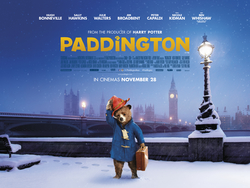
Paddington—Based on the children’s books by Michael Bond, this story of a civilized, courteous, marmalade-loving bear from “Darkest Peru” who winds up in London on the platform at Paddington Station is cute and funny, with first-rate use of CGI, cleverly-directed, Rube-Goldberg-like slapstick, and some good, silly, free-floating gags. Sally Hawkins and Hugh Bonneville are excellent as the heads of the upper-middle-class family that takes him in, and Jim Broadbent, Peter Capaldi and Julie Walters contribute nice turns as well.

The movie is even a little bit touching. Bond claimed he was inspired by the sight of tagged refugee children in the train stations during WWII, and the theme of hospitality to strangers runs through Paddington too, without heavy-handedness.

The only serious trouble into which the movie runs us the introduction of a villainess, a nutty museum taxidermist (Nicole Kidman) who wants to mount a specimen of Ursa Marmalada. This Cruella de Vil knockoff is gratuitous, and a bit overly grim for the tone of the tale.

Still, this strand allows us the sight of Kidman in a blond China-doll 'do, with really chic bangs, plus a good-natured send-up of the star’s ex. So it isn’t a total loss.

Friday, December 20, 2013

BANKS JOB, INSIDE MAN, WALKING TOUR

Opening in the Valley this weekend:


Saving Mr. Banks—It’s 1961, and P.L. Travers (Emma Thompson) doesn’t want to sell the movie rights to her novel Mary Poppins to Walt Disney (Tom Hanks). She’s afraid he’ll vulgarize it with music, animation and sentimentality. This movie, directed by John Lee Hancock, dramatizes how Disney and his cronies succeeded in wearing the prickly, exasperating Travers down, so that they could, indeed, vulgarize her book into a sentimental, partly animated musical.

Thompson is superb, as usual, as the impossible woman, but Hanks steals the picture with a delightful—and probably appallingly whitewashed—portrayal of the drawling, relentlessly genial Disney. With its terrific acting and its loving period detail—we get not only early-‘60s Hollywood but also flashbacks to early-20th-Century Australia, as we learn the author’s sad backstory—this is a highly enjoyable movie. It’s also, being a Disney picture, a rather unbecoming piece of company propaganda: Its message is that once you sign your soul over to Uncle Walt, your life will become a wonderful world of color. Vulgarization is salvation.


Inside Llewyn Davis—The latest from the Coen Brothers is also set against a backdrop of early-‘60s show business, albeit a very different one than that of Saving Mr. Banks—this time it’s the folkie scene in New York. Llewyn, stunningly played by Oscar Isaac, is a performer in the Village clubs. He sings and plays traditional-style folk songs beautifully, but he’s a chronic screw-up, basically homeless, sleeping on other people’s couches after gigs, impregnating women—including, possibly, the wife (Carey Mulligan) of his best friend (Justin Timberlake)—and even losing his benefactor’s cat on the streets. His blundering odyssey from New York to Chicago and back is infuriating to watch—it’s as if the Coens are deliberately trying to see how annoyed they can make us with a protagonist and still keep rooting for him. I almost began to wonder if they were trying to make people hate folk music (more than most do already).

But I, at least, did keep rooting for Llewyn (except in his encounters with animals), and while it’s far from the Coen’s best work, the movie, with its weird humor and unpredictable twists, has stuck in my head since I’ve seen it.


Walking With Dinosaurs 3-D—This feature was made using the same techniques as the popular BBC series aired in the US on the Discovery Channel: majestic live settings (Alaska and New Zealand) into which computer-generated, more or less scientifically-accurate dinosaurs are added, creating the sense of a live nature documentary about the extinct beasts. Unlike the documentaries, however, this movie adds corny voice-over dialogue to turn the story into a kids-friendly adventure. The coming-of-age plot follows a young Pachyrhinosaurus, called Patchi, who has a distinguishing (and occasionally musical) hole in his frill, through his perilous, predator-filled migrations, his conflict with his brother Scowler, his love for a pretty she-dino called Juniper, and his eventual rise through the herd hierarchy.

Justin Long provides the voice of Patchi, and the narration and commentary is provided by John Leguizamo as the bird that rides on his back. The blend of kidflick dramatics with the occasional harshness of the paleontological accuracy creates an odd effect, but the movie is great to look at—even some of the 3D effects are worthwhile—and the young audiences seem to respond to it.