Showing posts with label JESSICA CHASTAIN. Show all posts

Friday, September 17, 2021

EYES WITH QUITE A FACE

Opening in theaters this weekend:

The Eyes of Tammy Faye--One day in 2001, I spent about an hour with Tammy Faye. She was Tammy Faye Messner by that time, not Tammy Faye Bakker. We chowed down together while I interviewed her at the food court at an outdoor swap meet in east Mesa where she was signing her memoir Tammy: Telling It My Way. The copy I bought from her that day is still on my bookshelf; she signed it "God bless you Mark--Love, Tammy Faye."

For those who may not remember: Tammy Faye was a star of evangelical TV in the 60s, '70s and '80s. Growing up poor in International Falls, Minnesota, she married aspiring preacher Jim Bakker, who she met at Bible college and who believed that God wanted us--especially him--to be prosperous. They had a traveling Christian puppet show with which they broke into TV through Pat Robertson's Christian Broadcasting Network (Jim was the original host of The 700 Club). Then they struck out on their own, founding the enormously lucrative PTL Satellite Network and other ventures such as the theme park Heritage USA. She was the life of the party on their show, and they lived in conspicuous and kitschy luxury funded by viewer donations.

Financial improprieties and sex scandals deflated the PTL enterprise in the late '80s; Jim Bakker went to federal prison for years. Tammy Faye divorced him, remarried to developer Roe Messner, and then, well, she had lunch with me. Did I mention that?

By the time I met her, Tammy Faye was on a roll thanks, in part, to a feature documentary of 2000 by Fenton Bailey and Randy Barbato called The Eyes of Tammy Faye. Probably initiated to mock its subject, this film helped her rehabilitate her image into a lovable media personality and pop-culture icon, particularly for the gay community; sort of an honorary drag queen. Now the same title has been given to a dramatized version of the story, directed by Michael Showalter from a script by Bailey and Barbato, and starring Jessica Chastain in the title role.

Based on my single brief meeting, I have to say that Chastain disappears into the part; this is the woman I met back in 2001. To what extent either that interview or this performance represents the whole person can be known only to those who knew her better than either Chastain or I did--Tammy Faye passed on, from cancer, in 2007 at the age of 65. But as far as her public persona, Chastain nails it. She also gives us notes of the humor, the bold vivacity, the restlessness, the impatience, the lack of wifely subservience that made her a handful in the evangelical world of the time, and, more striking still, a sense of genuine spiritual exaltation that alienated her from the thievery and sanctimony. Chastain will probably get award buzz, and it won't be undeserved.

Andrew Garfield plays Jim Bakker, and his excellence would be easy to overlook; there's poignancy in his dim, queasy realizations of his carefully self-justified avarice, and his guilty resentment of his wife's popularity. Cherry Jones is terrific as Tammy Faye's hard-assed, no-nonsense mother, who smells trouble the first time Jim comes into the house. Frederic Lehne makes his presence felt as her more easygoing and affectionate stepfather, and in the smallish role of Jerry Falwell, Vincent D'Onofrio has fun imitating the way the preacher would clamp his lips down on terminal consonants: "JiMM."

Aside from the superb acting and the flawless period flavor, this Eyes of Tammy Faye is pretty good; not quite great. Bailey and Barbato simplify and streamline Tammy Faye's life, and maybe whitewash it a bit, too. At one point, as things are falling apart, Jim screams at Tammy that he did what he did to satisfy her greed, but while she's clearly shown enjoying the glitz, we don't really see her ask him for anything other than conjugal relations (which he neglects). It's unclear whether the movie's position is that she was greedy, or that he used her as an excuse for his own rapacity. The movie also gets a little shapeless in its final act; Bailey, Barbato and Showalter can't seem to quite figure out how to wrap it up, though Chastain is powerful in her closing scene.

Those who don't remember Tammy Faye on TV may well think that these performances are caricatures, as many thought about the Coen Brothers' masterpiece Fargo, another movie with a dauntless, cheerful Minnesotan heroine. But those who watched The PTL Club back then, or even those from an equivalent religious or cultural or even geographical background, will realize that this isn't an exaggeration at all.

Monday, December 25, 2017

TREE FOR ALL

Merry Christmas to everybody!

If you're a bit burned out on all the standard Christmas classics, I may have a new selection for you: This past Friday my film historian pal Richard hosted his annual Christmas party/movie night, and the feature selection was 1950's Trail of Robin Hood...


...a Roy Rogers western in ghastly "Trucolor" from Republic. The story concerns, I kid you not, crooked Christmas tree growers poaching tannenbaums off of Roy's pal Jack Holt's tree farm, because Holt wants to sell the trees cheap to needy families, and his competitors are afraid he'll drive down prices.

A bunch of other cowboy stars, like Rocky Lane, Kermit Maynard, William Farnum, Ray "Crash" Corrigan, Tom Tyler and Rex Allen, among others, show up as themselves to help Roy get Holt's trees to market. Needless to say, Roy is also aided by Trigger, here billed second in the credits as "The Smartest Horse in the Movies," and by his tireless dog Bullet.

It was awesome, and as Richard pointed out, it's a great illustration of how progressive the values championed by old school western programmers often tended to be: Evil businessmen or bankers versus heroes who stuck up for ordinary people.  Roy is even bilingual in this one, singing one verse of a wonderful cowboy swing song in Spanish.

One more Christmas weekend opening:


Molly's Game--Aaron Sorkin of A Few Good Men and The West Wing makes his feature directorial debut with this intriguing drama, which he also scripted in his usual fast-talking manner. It's based on a memoir by Molly Bloom, not the Joyce heroine but the hostess of insanely high-stakes celebrity poker games in L.A. and New York during the first decade of this century.

Her games were legal, until, inevitably, she crossed the line by taking a "rake," and they weren't anymore. She was busted by the feds, but refused to sing for them; against the prospect of years in prison, she clung to her personal and professional discretion.

It's a pretty engrossing story, and Sorkin's dialogue steers it briskly through its twists. The glue that holds the picture together, however, is the lead performance. Ably supported by Idris Elba as her standoffish lawyer and Kevin Costner as her standoffish Dad, Jessica Chastain has the best role so far of her young career, as a complex and flawed but ultimately brave and ethical woman who might have been referred to, in an earlier age of movies, as a "stand-up dame."

Friday, October 2, 2015

MARS NEEDS TATERS

Opening this weekend:


The Martian—As in 1964’s excellent Robinson Crusoe on Mars, Ridley Scott’s latest maroons an American astronaut on the Red Planet and lets him figure out how to stay alive. It’s a pretty faithful adaptation of the 2011 novel by Andy Weir, a self-described space nerd who originally self-published the well-researched “hard sci-fi” tale online.

Much of the book consists of first-person narration by our hero, Mark Watney, who has been lost in a sandstorm and thought dead by his fellow astronauts during an evacuation. Watney logs his initially futile-seeming survival efforts—figuring out how to grow potatoes in lifeless Martian soil, how to reestablish communication with NASA, etc.—for posterity, along with copious whistling-in-the-dark wisecracks. When the book is the monologues of the desperate-yet-snarky Watney it’s a terrific read; later, when Weir shifts the scene to the rescue efforts back on Earth, his touch is less assured.

But The Martian is a real achievement, and first-rate movie source material, and Scott makes it convincing and absorbing. Or, rather, he creates the necessary polished setting for his leading man to make it convincing and absorbing. I heard that Matt Damon was playing the title role before I started Weir’s novel, with the result that I heard Damon’s voice in my head the whole time I was reading Watney’s narrative.

But I think I would have heard something very close to his voice anyway. There are other solid performances in the cast, especially Chiwetel Ejiofor as a NASA honcho, but this is potentially the role of Damon’s career, Jason Bourne notwithstanding. I’m not sure any part he’s played has fit his persona like a spacesuit quite like this boyish, decent-hearted yet smart-ass Tom Swift.

For all Weir’s inventiveness and storytelling flair, his book is so practical-minded that it’s a bit lacking in otherwordly wonder. Scott can help here, bringing an eerie, lonely feel to the Martian landscapes without pushing it. On the downside, he can’t resist embellishing the climactic scenes with unnecessary and hokey derring-do. It’s the movie’s only significant misstep (on its own terms), and it’s forgivable. 

The Martian does have an eccentricity, however: The cultural references are persistently retro even for our time, much less for a story set, presumably, decades from now. The mission Commander (Jessica Chastain) is a geek for ‘70s pop, so Mark is stranded with her collection of disco music and Happy Days reruns for entertainment. This leads to some nostalgic numbers for Boomers on the soundtrack, including one, over the end titles, that in context is particularly funny and apt.

Friday, January 16, 2015

ROBOTS & GANGSTERS & BEARS, OH MY!

Opening this weekend:


Spare Parts—A down-on-his-luck substitute science teacher at a Phoenix high school reluctantly inherits the job of advising the robotics club. He finds his handful of students to have talent, ingenuity and heart. They are also undocumented, and have various personal challenges. They enter their low-budget, scraped-together robot submersible in an underwater robotics competition for college students at UC Santa Barbara.

George Lopez plays the teacher—actually a conflation of two guys—in this triumph-of-the-underdogs comedy-drama, based on a true story. Carlos PenaVega of Big Time Rush leads the quartet of guys, all charming, who play the team, with the grownups represented by the likes of Marisa Tomei, Esai Morales and Jamie Lee Curtis as the wry, amused principal.

Directed by Sean McNamara from a script by Elissa Matsueda, based on “La Vida Robot,” a 2005 article by Joshua Davis in Wired, Spare Parts is one hundred percent out of the standard Stand and Deliver or Hoosiers inspirational high school drama playbook. As such, it’s perfectly well executed, crisply paced, energetically acted, with obligatory crises and touches of sweet humor and romance.

What makes it different from other films of this sort is that it puts a human face on the plight of undocumented kids in the US, trying to get somewhere in life, and in some cases—like that of Oscar Vasquez, the main kid here—to serve this country, and blocked by the obtuse idiocies of our immigration policy. At the end of Spare Parts, when we’re shown the real-life outcomes of the team’s stories, it’s hard not to be moved by them. As such, this very conventional movie could help to win the hearts and minds of mainstream audiences.

A side note: The film is mostly set in here in west Phoenix, in and around Carl Hayden High School. But it was mostly shot in Albuquerque—probably thanks to the obtuse idiocies of this state’s production-tax-incentive policy—and it looks it. Just as the U.S. hurts itself economically by shutting out kids like these, so Arizona missed out on some of the economic benefits of this uplifting Arizona story.


A Most Violent Year—The setting is New York, and the year referred to is 1981, a record-breaker for violent crime in the Big Apple. Our hero is Abel Morales (Oscar Isaac), who was set up in business by the gangster father of his wife (Jessica Chastain). Abel runs a fleet of fuel-oil trucks which regularly get hijacked, in broad daylight, by the thugs of his business rivals.

But Abel is determined not to be a crooked businessman. His wife, on the other hand, is perfectly comfortable calling on her family connections, especially after their children are threatened.

Written and directed by J. C. Chandor of the impressive All Is Lost, A Most Violent Year seems intended as a stylistic throwback to the crime dramas from around the period it depicts—something dark and brooding directed by Sidney Lumet or maybe Stuart Rosenberg, with cinematography by Gordon Willis or Andrzej Bartowiak. The star, almost certainly, would have been Al Pacino.

The young Pacino is, at least, who Isaac seems to be channeling with his quiet, intense performance; Chastain is perhaps trying for Faye Dunaway. Albert Brooks shines as their long-suffering, ironically upbeat lawyer, a role that might have been played, in 1981, by, say, Albert Brooks.

Chandor gives the story an authentic feel, nothing too hokey or melodramatic, and his revulsion to violence seems genuine. More importantly, his tacit critique of the way other movies in this genre romanticize violence is well taken. But there was something about Abel’s naïve and slightly sanctimonious protestations of purity that I found comical—in the context of his career choice, it’s like he’s a fisherman determined never to get wet.

This engrossing, polished movie is, somehow, both a tease and a scold. As well-conditioned audience members, we want to see Abel retaliate violently against the thugs—the movie seems almost to tremble on the verge of gratifying this wish, yet Chandor is telling us that, at bottom, we’re wrong to want this. He’s right, of course, but the moviegoer’s bloodthirsty heart wants what it wants.


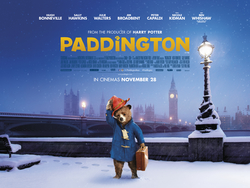
Paddington—Based on the children’s books by Michael Bond, this story of a civilized, courteous, marmalade-loving bear from “Darkest Peru” who winds up in London on the platform at Paddington Station is cute and funny, with first-rate use of CGI, cleverly-directed, Rube-Goldberg-like slapstick, and some good, silly, free-floating gags. Sally Hawkins and Hugh Bonneville are excellent as the heads of the upper-middle-class family that takes him in, and Jim Broadbent, Peter Capaldi and Julie Walters contribute nice turns as well.

The movie is even a little bit touching. Bond claimed he was inspired by the sight of tagged refugee children in the train stations during WWII, and the theme of hospitality to strangers runs through Paddington too, without heavy-handedness.

The only serious trouble into which the movie runs us the introduction of a villainess, a nutty museum taxidermist (Nicole Kidman) who wants to mount a specimen of Ursa Marmalada. This Cruella de Vil knockoff is gratuitous, and a bit overly grim for the tone of the tale.

Still, this strand allows us the sight of Kidman in a blond China-doll 'do, with really chic bangs, plus a good-natured send-up of the star’s ex. So it isn’t a total loss.

Friday, October 21, 2011

CREEP IN THE HEART OF TEXAS

In the middle of Texas Killing Fields, two detectives are examining the body of a murdered young woman, lying half-submerged in the water of the title marshland. Detective Heigh (Jeffery Dean Morgan) observes a fingerprint on her neck, & at the same moment it starts to rain. In a panic, he & his friend Detective Stall (Jessica Chastain) struggle to preserve this crucial clue while pulling the wet, unwieldy corpse onto the bank.


It’s a harrowing, heartbreaking scene, maybe the best in this grim & atmospheric police drama, loosely based on true events & directed by Ami Canaan Mann. It reflects the overall experience of Texas Killing Fields: You get a glimpse of the forces behind the horror, & then the hostile, unpredictable environment shifts, & you’re lost again.

It’s rare for an American crime movie to treat a dead body as something other than a prop, a font of exposition, but the bodies of young women that keep turning up in this small, grungy Gulf Coast Texas city, or dumped in the marshlands adjacent, have a physicality, a wretched weight. The investigators aren’t depicted, in the manner of so many movies of this sort, as casual & business-as-usual around the victims; they’re anxious &, though they speak softly, palpably angry.

The angriest is Detective Souder (Sam Worthington), Heigh’s partner & Stall’s ex-husband. His anger leads him to stupid, counterproductive outbursts of violence, but it also paralyzes him. Heigh wants to explore the link between their victim & a string of others that have been found in the “Killing Fields” nearby, while Souder wants nothing to do with cases outside his jurisdiction, especially on his ex-wife’s turf.


He’s pretty sure that his & Heigh’s case is linked to a sordid prostitution ring in town anyway. Heigh, a haunted ex-NYC cop & a devout Catholic—he murmurs the Hail Mary over a victim—suspects that there’s a bigger picture. Both of them are terrified for Little Anne (Chloe Moretz), daughter of a miserable local hooker (a shockingly haggard-looking Sheryl Lee, of Twin Peaks). Poor Anne seems appallingly tailor-made to join the gallery of victims.

Director Mann (the daughter, as she is probably weary of reviewers noting, of Michael Mann) nails the settings—the town is a muggy, dirty shithole that’s no place to live, let alone die, while the marsh, with its twisted, leafless trees, would have an unearthly beauty if it weren’t so charged with threat. She shows a strong touch with the actors here, too. Worthington, Chastain & especially Morgan are so low-key that it’s almost disorienting at first; they aren’t working from the standard cop-show-acting playbook, even when Donald F. Ferrarone’s dialogue seems to call for it. But their controlled intensity accumulates force.

Mann & Ferrarone are less successful with the police-procedural side of the material; at times I found myself confused, & not in the good way. But there’s an emotional maturity to Mann’s work here which even some of her father’s films can’t claim—an awareness of the reality of human suffering that can without too much pushing be called authentically tragic.


It comes out, especially, in her handling of Moretz, as Little Anne. She strikes me as one of the least smarmily sexualized adolescent girls I can think of in many a movie. Through the other characters, & through her alert, sympathetic, unleering camera, Mann treats Little Anne not as a white trash Lolita but as an imperiled & precious child.

Friday, June 10, 2011

TRUNK SHOW

The specific subject of Terrence Malick’s new film The Tree of Life is a mid-century, middle-class, middle-American family—dysfunction & tragedy played out in Norman Rockwell light. Malick isn’t big on specificity, though, & it wouldn’t be an exaggeration to say that what he’s really taking on with this movie is no less than the Meaning of Life, the inscrutable Fruit & Root of the title Tree.


Malick’s story concerns the O’Briens, of Boomer-era Waco, Texas: Dad (Brad Pitt), who gave up his dream to be a classical pianist for a career as an industrial engineer, the radiant & saintly Mom (Jessica Chastain), and three boys. The eldest of these, Jack (played by Sean Penn as an adult & by the terrific Hunter McCracken as a preteen), is our point of view for most of the film.

It’s an iconic American motif; what makes The Tree of Life different from innumerable other treatments is, first of all, Malick’s narrative style. The story is given to us in elliptical fragments, mostly brief, often enigmatic, seemingly meant to suggest snatches of memory. In its broader organization, it’s also suggestive of a piece of symphonic music, with movements: a light & joyous passage devoted to the mother, a brooding one for the father, a turbulent one for the boy’s sexual awakening, and so forth (the powerful score is by Alexander Desplat).

Past and present, the dramatic & the trivial, are freely mixed with scenes of the characters wandering in expressionistic landscapes. It’s disorienting at first, and some of the questions that arise about exactly what’s happened to the family remain ambiguous. But the wisps & glimpses of story accrue emotional force, & most of what’s onscreen is superbly done—it includes, among other merits, one of Brad Pitt’s best performances, a turn of almost Brando-like vibrancy. Still, what we aren’t shown can be exasperating.


Secondly, The Tree of Life is remarkable for Malick’s ambitiousness of scope: In addition to emotional conflicts—career and personal disappointments turn Dad from a stern & hard-assed but by no means unloving father to a repressive tyrant—& coming-of-age drama, the family is also visited by heartbreak & loss. They cry out to the Almighty, as people do in such times, with the Eternal Questions: “Who are You? What are we to You?” And Malick takes his unironic best shot at giving them, & us, an answer, in visual terms.

The oddest branch on The Tree of Life is a lengthy, epic special-effects sequence depicting the formation of the Cosmos, and the development of life on Earth, from slimy blobs & worms to plesiosaurs & dinosaurs. It’s a majestic free-standing episode, inevitably reminiscent, in atmosphere, of Kubrick’s 2001 (Kubrick crony Douglas Trumbull reportedly worked on the effects), but what, you might well ask, does this titanic spectacle have to do with the O’Briens of Waco, Texas?


The question could be answered in more than one way. It could be that Malick is saying to the bereaved questioner, in the manner of a rationalist-era Voice of God to Job: In light of this magnificent, terrible, pitiless, glorious pageant, how dare you ask for an explanation for your sufferings?

I don’t think, so, though. I think he’s trying to put personal & family travails into a cosmic context—to suggest that our lives are every bit as important, in the grand scheme of things, as exploding suns & volcanoes & primordial monsters. The film seems in some sense theistic in outlook, though not simplemindedly so, & the point seems to be that human life & our interpersonal connections do have metaphysical or transcendental significance, even if we can’t quite understand it.

Of course, Malick’s depiction of The Grand Scheme of Things is just that—a depiction. Your own sensibility will have a lot to do with whether it repels you or thrills you, whether it seems pretentious & presumptuous or an audacious & visionary use of the medium.

For me, it was the latter. Malick, now 67, has made only five features as a director. His marvelous debut, 1973’s Badlands, holds up as a classic; I’ve found most of his subsequent work interesting but diffuse. But The Tree of Life, for all its loose ends & ramblings, strikes me as another that may still look like a classic four decades from now.