Showing posts with label BILL HADER. Show all posts

Friday, October 1, 2021

NOT QUITE SO ALTOGETHER OOKY

Opening this weekend:

The Addams Family 2--Wednesday, the emotionally reserved daughter, is the focus of this sequel to 2019's animated adaptation of the classic Charles Addams cartoons from The New Yorker. Her exuberant clan gets on her nerves, and she's especially full of woe when her ebullient dad Gomez insists that she go on a family road trip. So when she is told that she may not be biologically an Addams, she's willing to listen.

The whole gang, almost, piles into the spacious, splendidly Gothic camper; along with Chloe Grace Moretz as Wednesday, Gomez (Oscar Isaac), Morticia (Charlize Theron), Uncle Fester (Nick Kroll) and Puggsley (Javon Walton), as well as the faithful, ever-gloomy Lurch (co-director Conrad Vernon), the ever-handy Thing, the moplike Cousin It (Snoop Dogg) and leonine pet Kitty Kat are along for the ride. Only Grandmama (Bette Midler) stays at home, to keep an eye on things (and party). Episodic wackiness ensues, as the family gets involved with everything from child pageants to bikers, while pursued by the shifty rep (Wallace Shawn) of a mad scientist (Bill Hader).

It's an above-average CGI production, with plenty of slapstick chases, fine voice acting and a standard emotional template; Wednesday gradually learns what family she wants to be part of. But the plot runs counter to the usual Addams Family schtick.

The retro-rerun network MeTV recently began airing the original Addams Family series (1964-1966), and I've watched a few episodes for the first time in decades. The show holds up amusingly, and what makes it work, I think, is that the actors don't play spooky. They have a hearty, aggressive geniality that makes them lovable--and, in the case of Carolyn Jones as Morticia, sexy--as well as funny in their macabre context. Even Ted Cassidy's baleful Lurch doesn't exactly play spooky; he's just deeply apprehensive.

The old series bounced the family's antics off of conventional midcentury banality, with the liberating suggestion that people who embraced their eccentricities might just be happier. Addams Family 2 comes to a really bizarre, shape-shifting finale, with the Addams folk in the clutches of the Dr. Moreau-like crazy scientist, that overshadows their peculiarity. Even the kiddie pageant world seems weirder than these title characters. Maybe the exposure of our culture to a couple of decades of reality TV has made the Addams Family seem normal.

Friday, June 19, 2015

BRAIN/BIRD

Opening this weekend:


Inside Out This animated feature dramatizes the workings of the human mind by personifying the emotions, in this case those of a 12-year-old girl named Riley. Working in a NASA-like mission control is our heroine Joy (voiced by Amy Poehler), a radiant Tinkerbell-like sprite determined to keep Riley happy; she’s supported by Fear (Bill Hader), Anger (Lewis Black), Disgust (Mindy Kaling) and frumpy, blue-skinned Sadness (Phyllis Smith).

The team’s job is to create memories, here seen as tiny transparent globes glowing with their emotional coloring—gold for Joy, red for Anger, and so forth. Joy tries hard to keep Sadness from touching Riley’s memories and tingeing them blue, but when Riley moves from Minnesota, where she has a best friend and plays hockey, to San Francisco, Joy finds it much harder to suppress Sadness.

Eventually the emotional crises that come with a move during childhood cause Joy and Sadness to get separated from the headquarters, leaving Fear, Anger and Disgust in charge. The rest of the movie concerns their Bunyan-esque journey through Riley’s personality to take over again in headquarters.

The conceit of this movie isn’t new. It wasn’t new as the premise of the early-‘90s Fox sitcom Herman’s Head, and wasn’t even new as one of the funnier segments of Woody Allen’s 1972 Everything You Always Wanted to Know About Sex (But Were Afraid to Ask) or the 1970 movie of Norman Juster’s The Phantom Tollbooth. It goes back through the Good and Evil Angels that appear on the shoulders of cartoon characters, and Marlowe’s Dr. Faustus, through medieval morality plays to the Psychomachia of the Roman poet Prudentius.

But it’s possible that no one’s ever done this idea quite as well as Inside Out. One’s expectations for Pixar’s features tend to be pretty high, but even so I wasn’t prepared for how deeply imagined this movie is, or how emotionally potent. Or, for that matter, how wise: the theme is emotional gestalt, and the role of sadness in a healthy personality.

I walked out of the theatre feeling like I’d seen a masterpiece, and a few days later this doesn’t feel like an overreaction. It may be the best movie I’ve seen all year. My only concern is that Inside Out is so fast and complex that some of its subtleties may get past smaller children—the gags about abstract thought could leave a college kid studying for a psych final feeling confused. But even so, the movie is so full of color and comedy that kids will likely enjoy it even if they don’t entirely get it.

Opening today at FilmBar Phoenix:


I Am Big BirdWell, maybe it isn’t quite as soul-stirring a line as “I Am Spartacus.” But only maybe. Certainly the title avian has had a longer and happier career than the hapless gladiator.

Subtitled The Caroll Spinney Story, this documentary chronicles the life of the puppeteer who has given soul to the towering, yellow-plumed fowl, the long-beaked, guileless face of Sesame Street. A soft-spoken Bostonian with a narrow, goateed hippie’s face, Spinney has performed both the childlike Big Bird and, for a bit of Hyde to go with that Jekyll, the curmudgeonly Oscar the Grouch for more than forty years.

Directed by Dave LaMattina and Chad N. Walker and partly funded via Kickstarter, the film is smoothly made if fairly conventional as cinema. It's helped along because Spinney’s life, even before his Sesame Street days, seems to have been unusually well-documented, first by home movies and later, after his marriage to Debra Gilroy in 1979, by home video. It’s the content, however, that makes this the most fascinating show business documentary I’ve seen since, at least, Andrew Leavold’s The Search for Weng Weng.

I’ve been a Sesame Street fan since the show started—I clearly remember watching the first episode, and I watched it religiously for years even though I was too old for it, educationally speaking (I already knew how to read and count). I loved the show simply because it was genuinely funny, and had richer characters than almost any live-action show aimed at kids (or, for the most part, adults) at the time. Oscar was a special favorite of mine from the first.

Even so, I Am Big Bird was full of stuff I didn’t know. It covers everything from Spinney’s difficult relationship with his father to Big Bird’s visits to China to Mitt Romney’s backfired shot at PBS in the 2012 election—probably an attempt, tactically idiotic, to throw red meat to that part of the reactionary Right that hates Sesame Street for being multicultural propaganda (which it certainly is)—to Spinney’s startling near-miss with another historical moment.

But probably nothing in I Am Big Bird is as astounding as the technical explanation of how Big Bird works, and what that has meant, for Spinney and his apprentices, over the years. As a physical acting challenge it makes, say, a DeNiro weight gain or a Christian Bale weight loss look like a walk in the park.

Friday, September 26, 2014

CRATE PERFORMANCES

New this week:


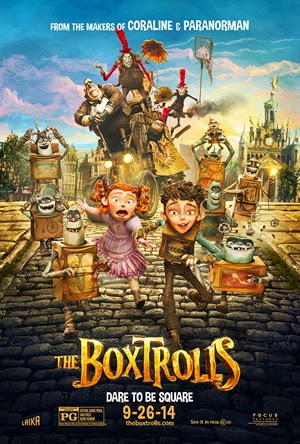
The BoxtrollsThe title characters in Laika’s new stop-motion fantasy are, um, trolls that wear boxes. They take their names from whatever’s on the sides of these packages: Fish, Shoe, Clocks, Wheels and so on.

The trolls live deep beneath Cheesbridge, a hilltop city of vaguely European and late-19th-Century character. They’re harmless to humans—they’re insectivores, and their nighttime raids on the town are aimed at its trash, which they like to repurpose. But they’ve been demonized to the Cheesebridgians by Snatcher, a scurvy exterminator, and his entourage of Dickensian henchmen.

It’s true that the Boxtrolls are raising a human boy, the “Trubshaw Baby” whose disappearance Snatcher uses to terrify the locals. But we soon learn that this is a case of foster care, not abduction.

Adapted from Alan Snow’s novel Here be Monsters! by Irina Brignull and Adam Pava and directed by Graham Annable and Anthony Stacchi, The Boxtrolls is one of the odder children’s movies to get a big release since The Pirates! Band of Misfits, another stop-motion kid flick. But Pirates! was overtly (and excellently) silly, while The Boxtrolls, though very funny, takes a more lyrically weird, fairy-tale tone. Ben Kinsgley hams it up grandly as Snatcher, leading a cast that includes Jared Harris, Nick Frost, Simon Pegg, Toni Collete, Richard Ayaode, Elle Fanning and Tracy Morgan.

The theme of the movie is pretense—Snatcher is trying, through his campaign against the Boxtrolls, to get a “White hat” making him one of the cheese-sampling city fathers. This despite his severe lactose intolerance. The trolls also react with horrified propriety whenever one of their boxes is shed, or even opened. It’s a wonderfully crazy, generous-hearted movie, though its pungency and gleeful gross-outs won’t appeal to all kids, or all adults.


The Skeleton TwinsThe celebratory lip-sync. Among the tropes of comedy-drama, it’s not my favorite. You know the sort of scene I mean—characters mouth along to a song, maybe using a hairbrush or something as a microphone, sometimes solo, like Tom Cruise in Risky Business, sometimes in a group.

It’s not that I think such activities don’t happen in life, or even that I don’t think they’re fun. But they’re usually an annoyance in movies, because it seems like a lazy way to establish bonding between characters or the breaking down of a reserved character’s defenses, to get a popular tune on the soundtrack, and to kill a few minutes. It’s taking a free ride on someone else’s art.

But right in the middle of The Skeleton Twins, troubled brother Milo (Bill Hader) and troubled sister Maggie (Kristen Wiig) perform a lip-sync, to “Nothing’s Gonna Stop Us Now” by Starship. And something about the lustiness of Hader’s pantomime and the hilariously wary, reluctant acquiescence of Wiig to that appallingly effective piece of ‘80s schlock got to me. It’s a potent dramatization of how even the cheesiest pop culture can be a source of strength and a balm to the spiritually wounded.

And Maggie and Milo, differently damaged by tragic childhoods, certainly are wounded. Milo, a failed L.A. actor turned waiter who drinks too much, makes a half-hearted suicide attempt. Word of this interrupts Maggie as she’s contemplating ending it all herself. She hasn’t seen Milo in a decade, but she heads to the west coast and drags him back to their upstate New York hometown to recuperate in the house she shares with her cluelessly decent husband (Luke Wilson).

This guy wants to have a baby with her, but she’s secretly still on the pill, perhaps partly because she doesn’t want to perpetuate her family craziness, but also because she’s an unhappy serial adulteress. Milo makes himself at home, and tries to reconnect with the disgraced English teacher (Ty Burrell) with whom he had an affair back in high school.

There’s really nothing very funny about any aspect of the plot of this small film, directed by Craig Johnson from a script he wrote with Mark Heyman. The comedy arises not from the bitterly sad situation but from the resigned gallows humor with which Maggie and Milo deal with it. They’re deeply exasperating people, even to themselves, but as The Skeleton Twins progresses—partly because of that stupid lip-sync!—I started to root for them. Hader and Wiig have a rapport that does, indeed, seem fraternal.