Showing posts with label BEN KINSGLEY. Show all posts

Friday, October 24, 2014

MADHOUSE PARTY

Opening today at AMC Arizona Center:


Stonehearst AsylumIn this period melodrama, an ambitious young fellow (Jim Sturgess) arrives at the spooky, fog-shrouded title institution, late in 1899, asking to learn the ropes of the new field of psychology. The headshrinker in charge (Ben Kingsley) seems a decent, civilized sort, but soon the new guy realizes that this haven for wealthy crazies harbors a shocking secret.

It won’t be that much of a secret to those who have read Poe’s “The System of Doctor Tarr and Professor Fether,” on which this absorbing, slyly old-school Gothic is based. But the twists are unraveled skillfully by director Brad Anderson and screenwriter Joe Gangemi, and the cast is hard to beat: Along with Kingsley, there’s Kate Beckinsale and Brendan Gleeson and David Thewlis—scary as the asylum’s enforcer—and even the great Michael Caine.

Stonehearst Asylum hits the tropes of the madhouse scare picture, but the subtlety of the script and of these actors brings this conventional material some troubling moral ambiguity and shifts in sympathy. It’s a small gem—a horror movie with heart.

Friday, September 26, 2014

CRATE PERFORMANCES

New this week:


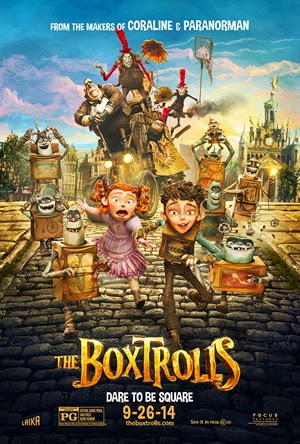
The BoxtrollsThe title characters in Laika’s new stop-motion fantasy are, um, trolls that wear boxes. They take their names from whatever’s on the sides of these packages: Fish, Shoe, Clocks, Wheels and so on.

The trolls live deep beneath Cheesbridge, a hilltop city of vaguely European and late-19th-Century character. They’re harmless to humans—they’re insectivores, and their nighttime raids on the town are aimed at its trash, which they like to repurpose. But they’ve been demonized to the Cheesebridgians by Snatcher, a scurvy exterminator, and his entourage of Dickensian henchmen.

It’s true that the Boxtrolls are raising a human boy, the “Trubshaw Baby” whose disappearance Snatcher uses to terrify the locals. But we soon learn that this is a case of foster care, not abduction.

Adapted from Alan Snow’s novel Here be Monsters! by Irina Brignull and Adam Pava and directed by Graham Annable and Anthony Stacchi, The Boxtrolls is one of the odder children’s movies to get a big release since The Pirates! Band of Misfits, another stop-motion kid flick. But Pirates! was overtly (and excellently) silly, while The Boxtrolls, though very funny, takes a more lyrically weird, fairy-tale tone. Ben Kinsgley hams it up grandly as Snatcher, leading a cast that includes Jared Harris, Nick Frost, Simon Pegg, Toni Collete, Richard Ayaode, Elle Fanning and Tracy Morgan.

The theme of the movie is pretense—Snatcher is trying, through his campaign against the Boxtrolls, to get a “White hat” making him one of the cheese-sampling city fathers. This despite his severe lactose intolerance. The trolls also react with horrified propriety whenever one of their boxes is shed, or even opened. It’s a wonderfully crazy, generous-hearted movie, though its pungency and gleeful gross-outs won’t appeal to all kids, or all adults.


The Skeleton TwinsThe celebratory lip-sync. Among the tropes of comedy-drama, it’s not my favorite. You know the sort of scene I mean—characters mouth along to a song, maybe using a hairbrush or something as a microphone, sometimes solo, like Tom Cruise in Risky Business, sometimes in a group.

It’s not that I think such activities don’t happen in life, or even that I don’t think they’re fun. But they’re usually an annoyance in movies, because it seems like a lazy way to establish bonding between characters or the breaking down of a reserved character’s defenses, to get a popular tune on the soundtrack, and to kill a few minutes. It’s taking a free ride on someone else’s art.

But right in the middle of The Skeleton Twins, troubled brother Milo (Bill Hader) and troubled sister Maggie (Kristen Wiig) perform a lip-sync, to “Nothing’s Gonna Stop Us Now” by Starship. And something about the lustiness of Hader’s pantomime and the hilariously wary, reluctant acquiescence of Wiig to that appallingly effective piece of ‘80s schlock got to me. It’s a potent dramatization of how even the cheesiest pop culture can be a source of strength and a balm to the spiritually wounded.

And Maggie and Milo, differently damaged by tragic childhoods, certainly are wounded. Milo, a failed L.A. actor turned waiter who drinks too much, makes a half-hearted suicide attempt. Word of this interrupts Maggie as she’s contemplating ending it all herself. She hasn’t seen Milo in a decade, but she heads to the west coast and drags him back to their upstate New York hometown to recuperate in the house she shares with her cluelessly decent husband (Luke Wilson).

This guy wants to have a baby with her, but she’s secretly still on the pill, perhaps partly because she doesn’t want to perpetuate her family craziness, but also because she’s an unhappy serial adulteress. Milo makes himself at home, and tries to reconnect with the disgraced English teacher (Ty Burrell) with whom he had an affair back in high school.

There’s really nothing very funny about any aspect of the plot of this small film, directed by Craig Johnson from a script he wrote with Mark Heyman. The comedy arises not from the bitterly sad situation but from the resigned gallows humor with which Maggie and Milo deal with it. They’re deeply exasperating people, even to themselves, but as The Skeleton Twins progresses—partly because of that stupid lip-sync!—I started to root for them. Hader and Wiig have a rapport that does, indeed, seem fraternal.

Friday, May 3, 2013

3 IRON

Once again, Robert Downey, Jr. triumphs in the role of the armored Marvel superhero Iron Man and his alter-ego Tony Stark.


In Iron Man 3, as always, he has the light touch of a comedian and the soulfulness and charisma and glamour of a movie star. His jumpy, fast-talking insolence doesn’t come across as narcissism, because it’s mixed with an uncommon sense of empathy—he seems connected to the other people onscreen, even the villains with whom he’s grappling.

Thus, even when he’s playing a self-absorbed egomaniac like Tony Stark, he, Downey, doesn’t come across as a self-absorbed egomaniac. Or rather, he does come across as a self-absorbed egomaniac, but a lovable one.

Iron Man 3 (or Iron Man Three, as the credits spell it) begins with a sequence set in Bern, Switzerland on the last day of 1999, in which a younger, more obnoxious Tony, by way of snubbing a stranger, unwittingly sets in motion the troubles which will follow. Thirteen years later, a sinister figure calling himself The Mandarin, played with spooky panache by Ben Kingsley, claims responsibility for a series of mysterious explosions.

Eventually Iron Man, now suffering from PTSD after his experiences in The Avengers, runs afoul of a circle of fanatics claiming allegiance to The Mandarin. They’ve been treated with an agent called “Extremis,” allowing them to regenerate when injured, and to turn red-hot from within. This gang kidnaps Tony’s sweetie Pepper Potts (Gwyneth Paltrow), as well as The President of the United States (William Sadler).

The boots-on-the-ground leader of these hotties is played, rather well, by Guy Pearce. Tony and his pal Rhodey (Don Cheadle), aka Iron Patriot, must ride to the rescue. There are twists and turns—Tony befriends a little kid, for instance—and absurdly magical sequences, like Iron Man’s rescue of multiple people falling out of a ripped-open jet plane. The director here is Shane Black, replacing Jon Favreau of Iron Man and Iron Man 2 (though Favreau plays a sizable acting role here), and while the movie is probably about a half-hour too long—like almost all action blockbusters seem to be any more—it’s polished and mostly engrossing.

But there’s no way around it, or at least there wasn’t for me—recent events intrude into one’s enjoyment of Iron Man 3 as a simple action entertainment. The explosions, the amputees turned into “Extremis” henchpersons, even the Iron Man suits themselves—here often used empty, by remote control, like drone aircraft—all give the movie an ugly, unsavory real-world resonance it wouldn’t have had a few months ago, rightly or wrongly, and a tragic atmosphere it doesn’t really deserve. This doesn’t ruin the picture, but it does leave you more poignantly aware than usual of the genre’s limitations.

No doubt superhero stories have their legitimate place in the human tradition, just as the stories of Hercules or Beowulf did in their time. The fantasies they service, both of being protected and of being a protector, are perfectly human, even noble.

They’re also vain, taken literally. Even if Tony Stark’s technology existed, and even if —far less likely—it was in the hands of somebody as well-intentioned as Tony, it couldn’t protect us from evil. Superhero stories have become far more complex in last half-century, yet in the end, they tend to return reflexively to the touching idea that evil can be vanquished in a fistfight. But evil is the part of human badness that can’t be socked in the jaw. Iron Man 3 reminds us, probably without meaning too, that the superhero archetype is, in the end, an empty suit.