Showing posts with label BENEDICT CUMBERBATCH. Show all posts

Friday, August 29, 2025

Friday, May 6, 2022

WHEN YOU'RE STRANGE

Opening this weekend:

Dr. Strange in the Multiverse of Madness--On the one hand, I'm a little over the Marvel "Multiverse." On the other hand, this newest adventure of Marvel's mystical mage is a lot of fun.

For those who may be unacquainted with this conceit in the "Marvel Cinematic Universe," I'll summarize as best I understand it: The Multiverse is the premise that our reality exists alongside countless concurrent realities in other dimensions, complete with other versions of ourselves and the people we know, including our favorite superheroes, and that many of these alternate realities are similar, but none are quite identical. When we dream, according to this movie, we're really experiencing a taste of the lives of other versions of ourselves.

The Multiverse has already played a major role in two previous entries, 2018's dazzling animated flick Spider-Man: Into the Spider-Verse, where it was wittily used to explore racial, gender and other variations on comic book themes, and last year's Spider-Man: No Way Home, where it was used as an amusing excuse to mingle the actors and situations from various "reboots" of the franchise. In both cases, it was also a spoof (and a servicing) of the familiar, OCD nerd need to make every "canonical" version of a pop culture franchise at least technically consistent with every other version (Star Wars and Star Trek fans sometimes demand this too).

Enjoyable as both of those earlier movies were, I'm afraid that the Multiverse has the effect, for me, of diluting the dramatic stakes. Death has always been negotiable in superhero stories, of course, but in Multiverse-heavy yarns, major characters--iconic characters--are killed off, or lose their heroic status, and it doesn't feel like it matters that much, because there's an apparently endless and easily accessible supply of replacements from other Universes.

Thus I don't know how sustainable the Multiverse gimmick is for me; even though I greatly enjoyed the original 2016 version of Dr. Strange, I went to this sequel a little grumpily. It turned out to be a non-stop, vigorously imaginative blast.

This time the surgeon-turned-sorcerer Stephen Strange (Benedict Cumberbatch) is called away from the wistful experience of attending the wedding of his ex (Rachel McAdams) to come to the defense of America Chavez (Xochitl Gomez), a teenage girl who has innate magical powers she can't control. She's pursued by Scarlet Witch (Elizabeth Olsen), who for some reason needs the kid to obtain a book that will allow her to steal the life, including two little boys, of a suburban-mom version of herself in another Universe. (All of this is related, I understand, to a Marvel TV show called WandaVision that I haven't seen.) Strange and his allies attempt to prevent this; tentacled Lovecraftian abominations interfere with his efforts.

Or something like that. Big-name Marvel characters from other franchises turn up, sometimes in new versions, sometimes in versions we've seen. Epic surreal action scenes leap giddily from Universe to Universe. And if you sense more than a nod or two to the Evil Dead flicks, it probably won't surprise you that the director is Sam Raimi, back after a hiatus from directing features. His wild headlong style is as exhilarating as ever, as is his flair for macabre slapstick, and both are splendidly abetted by a driving score from Danny Elfman.

Cumberbatch plays Strange with his usual old-school movie star suavity and aplomb, and Gomez is charming as America. The standout in the cast, however, is Olsen, who keeps her voice down and makes Scarlet Witch intimidating, but also poised and glamorous, with a strong undercurrent of the sorrowful.

Friday, February 12, 2021

VAN FICTION

Opening this weekend at Arizona Mills IMAX...


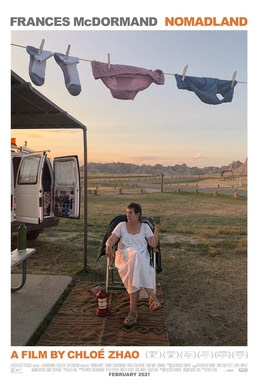
Nomadland--Frances McDormand is Fern, a widow left adrift after her gypsum mining village in Nevada becomes a ghost town. She wanders the western states in her beloved van, which she calls "Vanguard," following seasonal work, and connects with the subculture of van and RV nomads with a hub in Quartzsite, Arizona. She works cleaning state parks or in the kitchen at Wall Drug in South Dakota, at a beet harvest in Nebraska, at an Amazon facility in Nevada. She makes friends; a fellow nomad named Dave (David Strathairn) might even be a love interest, although Fern is cautious in such matters.

Scripted and directed by Chloe Zhao, this adaptation of Jessica Bruder's nonfiction book feels like a true original, heartwarming without sentimentality, maybe a hair slow but beautifully acted and shot. McDormand and Strathairn are the only two professional actors that I recognized; most of the rest of the cast, including "vandwelling" YouTube guru Bob Wells, use their own names and play themselves, with great warmth and poignancy. This gives the movie the quality of a documentary, but with a movie star presence at its center.

And it need hardly be said that McDormand is wonderful; Fern is another of her classic sensible yet frayed at the edges creations. She gets across Fern's aching sadness at finding herself at such a cosmically loose end, but she also shows us the exhilaration she feels at her independence. Whenever Fern is tempted with an offer of permanence, her instinct is to move on. Maybe when Kris Kristofferson observed that freedom is just another word for nothing left to lose, Fern's lifestyle is what he meant.

Also opening today...


Minari--Lee Isaac Chung wrote and directed this autobiographical chronicle of a Korean family struggling to start a farm in rural Arkansas in the early 1980s. Dad Jacob (Steven Yeun) is an expert "chicken-sexer" (able to quickly determine the sex of chicks at a hatchery and sort them). He's dragged his family from California to the south, to the horror of his pretty, pious wife Monica (Han Ye-ri), because he wants to start a produce farm specializing in Korean vegetables and fruits for what he perceives as a growing immigrant market in Dallas and Oklahoma City (the title refers to an herb popular in Korean cuisine).

The couple and their two young children, Annie (Noel Kate Cho) and David (Alan Kim) are eventually joined by a mischievous, fun-loving Grandma (Youn Yuh-jung), who doesn't seem to David to act like a grandma is supposed to. There's also a showcase role for Will Patton, as a religiously ecstatic, tongue-speaking farm hand trying to help Jacob realize his dream.

This may be the best film I've seen so far this year; a contemporary take on the early-'30s dramas about ordinary people up against agricultural and meteorological fate, like Murnau's City Girl or Dovzhenko's Earth. As in those films, the antagonists are largely elemental: water, fire, health. But Minari's characters aren't emblematic; they have a psychological subtlety and reality, and their passions and priorities also drive the conflict. The story-telling is simple, but the problems these people have with the land, and with each other, are anything but.


The Mauritanian--The title character, played with disconcerting charm by the Algerian-French actor Tahar Rahim, is Mohamedou Ould Salahi, who was held at Guantanamo Bay for a decade and a half, and tortured, without ever being charged with a crime, on suspicion of having been a recruiter for 9/11 terrorists. Jodie Foster and Shailene Woodley are the pro bono lawyers working to free Salahi under habeas corpus, and getting stonewalled by U.S. intelligence. Benedict Cumberbatch is the Marine officer assigned to prosecute Salahi, who finds himself equally stonewalled.

Directed by the capable Scotsman Kevin Macdonald, this is another of the surprisingly large class of political dramas like The Report or Official Secrets or Fair Game, which remind us of the constitutional outrages of the W. Bush administration, as well as the failure of the Obama administration to rectify most of them. Macdonald sets a unhurried pace, and generates a steadily waxing sense of almost Kafkaesque fury and horror. It's a well-acted, compelling movie and it can boil your blood. And it should.

Friday, November 16, 2018

ROY AND HAL AND MARK AND ROSE

Whenever I think of the greatest live performances I've been lucky enough to see, along with Stacey Keach as Richard III at the Folger Theatre and Penn & Teller at Ford's Theatre, and Screamin' Jay Hawkins at the 9:30 Club, all in Washington, D.C. and Tito Puente at the Celebrity here in Phoenix, I also think of Roy Clark, playing Ernesto Lecuona's magnificent "Malageuna" at the Sundome in Sun City. RIP to the funny and unpretentious but virtuoso Clark, who passed on this week at 85.


RIP also to the Canadian classical stage actor Douglas Rain, immortal in the movies as the voice of HAL in 2001: A Space Odyssey, passed on at 90.


Opening this weekend:


Pete and Ellie, childless “houseflippers” in their forties, decide to foster, and then adopt, three kids all at once, a teenage girl and her two young siblings. All three come with behavioral and social issues, and this, combined with the naïveté and inexperience of the new parents, leads to trouble, some of it wacky, some of it serious, in the comedy-drama Instant Family.

Mark Wahlberg and Rose Byrne both do sweet but never maudlin work as Pete and Ellie. They convey an awakening sense of open-hearted mission as they become aware both of the needs of foster kids and of their own desire to parent.

There are capable supporting turns in the film as well, notably by Octavia Spencer and Tig Notaro, who turn a pair of social workers into a low-key comedy team, and by Julie Hagerty and Margo Martindale as the Grandmas, demure and boisterous respectively. Most impressive of all, maybe, is Isabela Moner as the teenage daughter, convincing as a bright, decent-hearted kid who’s also an infuriating problem child.

The director and co-writer is Sean Anders, drawing on his own life for inspiration. Anders’ other credits include the likes of Horrible Bosses 2 and Daddy’s Home and similar broad comedies in the modern vein, and that sensibility finds its way into this movie as well. There are slapstick sequences that feel heavy and contrived, and throw the movie off-balance at times.

But the overall effect of Instant Family is surprisingly moving. What Anders gets right about the experience of coming to parenting later in life, and of parenting a teenager—especially in the terrifying era of social media—feels considerable.

Allowing for the conventions of this sort of mainstream family flick, the degree to which Instant Family doesn’t sugarcoat parenting's challenges is impressive: The language is raw, and so is the guilty candor of Pete and Ellie’s private conversations. So when the movie jerks tears, as it did for me at several points, it jerks them honestly.

I had the opportunity to chat with Anders recently about the experiences that led to this film; check out the interview on Phoenix Magazine online.

Still in theaters:


It’s hard for me to imagine any new version replacing, in my affections, the original 1966 TV version of How the Grinch Stole Christmas. That half-hour animated special based on the classic Dr. Seuss children’s book of 1957, directed by the great Chuck Jones and voiced by the great Boris Karloff, was one of the true high points of the holiday season every year of my childhood.

Ron Howard’s laborious live-action feature version of 2000, with Jim Carrey in the title role, certainly didn’t come close to capturing the Seussian magic of the original. Neither does the new animated version, titled simply The Grinch, and featuring the voice of Benedict Cumberbatch. But it has its merits, and it’s better than the Howard/Carrey version.

For the benighted few who may not know, The Grinch is a tall, green-furred recluse who bitterly resents the relentless Christmas festivity of the Whos, elfin citizens of nearby Whoville, and thus decides to steal the town’s presents and decorations, disguised as Santa Claus. It is, of course, a nutty variation on the Scrooge theme, economically unfolded through Dr. Seuss’s inimitable, metrically flawless rhyme.

The new film expands the story in a number of directions, all of them thoroughly gratuitous, for no reason other than to stretch it out to feature length. Most annoyingly, it gives us a psychological backstory for the Grinch’s dislike of Christmas—after the narrator (Pharrell Williams) tells us “please don’t ask why/No one quite knows the reason,” he goes on to explain the banal reason.

He’s no Karloff, but Cumberbatch gives good, snide line readings. Even so, this movie’s Grinch is very watered-down as a villain; his redemption is telegraphed so early and often that it has little impact when it arrives.

This aside, it should be said that the movie has visual wit, and that, as with the TV version, The Grinch’s good-natured dog Max is a very successful character, and that a plus-sized reindeer named Fred is also lovable. It’s a testament to how softened-up this Grinch is that the filmmakers don’t let him be mean to Max.

Friday, April 27, 2018

THE WRATH OF GODARD

Opening this weekend:


Godard Mon Amour--The "mon" in the title refers to Anne Wiazemsky (Stacy Martin), Godard's much younger second wife and the star of his 1967 La Chinoise. Directed by Michel Hazanavicius of The Artist, Godard Mon Amour chronicles the years of Godard and Wiazemsky's marriage. The particular focus is on the anti-De Gaulle demonstrations of May 1968, and the miseries Godard (Louis Garrel) inflicted on his wife, his friends and himself during that period, in his flailing attempts to be an authentic revolutionary.

Shot in gorgeous, sunny tones by Guillaume Shiffman, the film is well-acted, funny, sexy at times, and has a buoyant energy that is, if not Godardian, at least an amusing parody of the style. There are also nods to Woody Allen, like a redo of the subtitle gag from Annie Hall or, a la Stardust Memories, people asking Godard if he'll go back to making funny movies. And there are fourth wall gags, both overt and subtle, as when Godard is complaining about tracking shots just as Hazanavicius is in the midst of tracking up the length of Anne's sunbathing bikini-clad body.

In terms of its story, however, Godard Mon Amour most reminded me of Sullivan's Travels, the 1941 Preston Sturges comedy about a film director (Joel McCrea) of lightweight entertainments who hits the road as a bum to enrich his artistry by learning first hand about hardscrabble "real life." Sullivan ultimately comes to the conclusion that he can best serve mankind by making them laugh, but the humorless Godard we get here isn't about to reach that epiphany.

Hazanavicius derives much deadpan comedy from seeing Godard rant about the class struggle while dining with his friends at posh restaurants or romping with Anne in their beautiful Parisian apartment, and of course by snubbing admirers and behaving rudely toward the few actual working class people with whom he interacts. If the aim of the film, based on a book by Wiazemsky and also known under the title Le Redoubtable, is to depict Godard as an insufferably posturing, petulant, self-loathing douche, it succeeds mightily.

How fair any of this is I couldn't say; I don't even know how faithful Hazanavicius is to Wiazemsky's own, presumably subjective, account. But in general, fury at the inability to escape one's own middle-class sensibility is a very common phenomenon among middle-class lefty intellectuals, and it's a great subject, especially for comedy.  Hazanavicius makes his Godard the butt of this joke, but isn't able to make his hero likable in the process, as Godard himself might have.


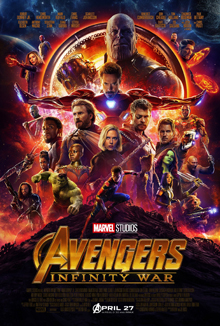
Avengers: Infinity War--A big ogreish alien called Thanos (Josh Brolin) feels a strong need to de-clutter. Specifically, he wants to destroy half of all the living beings in the universe. To do this, he must capture six "Infinity Stones" stashed around the cosmos, including a couple on Earth, and implant them on his big armored gauntlet thingy. Opposed to his plan are both Iron Man's and Captain America's estranged factions of the Avengers, the Wakandans from Black Panther, the Guardians of the Galaxy, Spider-man, Dr. Strange, and other Marvel stars and bench players.

This Gotter-half-dammerung free-for-all, largely based on a limited-run comic series from the early '90s, was directed by the brothers Joe and Anthony Russo, who also helmed two of the earlier Captain America flicks. Unless you're a hardcore Marvel brand loyalist, there's a good chance you could get lost now and then in the specifics of the eye-crossing multi-strand narrative. But the Russos do a capable job of keeping the basic conflict clear, and they keep the big action set-pieces coming.

Over the last few years, Marvel has given us some half-dozen genuinely fun, delightful pictures, like Ant-Man, Guardians of the Galaxy the first, Dr. Strange, Spider-Man: Homecoming, and Thor: Ragnarok, leading up to this year's grand slam Black Panther. For me, Infinity War was a slight step down from these, probably because it's such an overstuffed all-star spectacular that it inevitably lacks a certain balance and focus, and also because the plot and the stakes are so cosmically, apocalyptically heavy.

Even so, the actors manage to find more playfulness than might be expected. There's some serious charisma in this cast: Robert Downey, Jr.'s top billing feels right, he seems to just naturally assume a leading man status in this ensemble. But his costars come across strongly too--Chris Hemsworth's harried Thor, Benedict Cumberbatch's suavely low-key Dr. Strange, Chadwick Boseman's quiet, bashfully authoritative Black Panther with his elegant entourage, the peerlessly soulful Elizabeth Olsen's Scarlet Witch, and Mark Ruffalo's chagrined Bruce Banner, who's having a bit of trouble getting a rise out of his inner green self.

A few of the stars seem to get lost in the shuffle of this movie's ambitions, among them the recessive Captain America of Chris Evans, Anthony Mackie's Falcon and the Black Widow of Scarlett Johansson. And when Scarlett Johansson is one of the less vivid presences in a movie, you know there's glamour going on.

It will be interesting to see how this movie is received by casual fans. Even allowing that mortality is highly flexible in comics, there are surprising losses here, and a resolution that seems inconclusive in the Empire Strikes Back vein. I enjoyed Infinity War, but it left me thoroughly unsatisfied, just as it was supposed to.

Friday, November 4, 2016

LONG STRANGE TRIPS

Opening this week:


Doctor Strange—Once he’s fully decked out in the cloak and amulet, with the neatly trimmed goatee, Benedict Cumberbatch really looks and sounds the part of the title character, one of Marvel’s more agreeably metaphysical superheroes. This is an origin story for the “Master of Mystic Arts,” conjured up in 1963 by Steve Ditko and Stan Lee for the pages of Strange Tales.

As in the comics, he’s a brilliant but selfish and arrogant surgeon who loses the use of his hands in a car accident. In desperation, he travels to Nepal to seek out “The Ancient One” (a droll and courteous Tilda Swinton) in hopes of being healed. Instead she recruits him as a new student of sorcery, teaching him to leave his physical body and use his astral form, travel through the “multiverse” and battle evil psychically. Reality-bending adventures across M.C. Escher-ish cityscapes ensue, as Strange and Mordo (Chiwetel Ejiofor)—a villain in the comics; here sympathetic—take on the sinister Kaecilius (Mads Mikkelsen), who has purloined a spell from one of the Ancient One’s books.

On the whole, I found this the most enjoyable comic book movie since Ant-Man in 2015, and Guardians of the Galaxy the year before that. Despite the cosmic scope of the material, director Scott Derrickson takes a straightforward and coherent approach to the narrative, which goes pleasingly easy on tired action-movie conventions.

Technically speaking, there’s little physical violence in the film at all. There’s plenty of martial-arts fighting, to be sure, but most of it takes place outside the physical realm, so for once the superhuman feats are justifiable. Better still, as we were leaving the screening, my friend pointed out “No guns,” and he was right—unless I missed it, there isn’t a single gunshot in Doctor Strange, and I didn’t feel cheated by this in the least.

Toward the end, the forces of darkness are unleashed, and buildings start to crumble in Hong Kong. I sighed. Again with the crumbling buildings, like in just about every other big action blockbuster of recent years—blocks literally being busted. But then Strange and his allies do battle with the bad guys while time runs backwards around them, and we get to see the buildings reassemble. This inversion of the sad, frightened post-9/11 subtext of the genre is very refreshing.


Trolls—Like the Smurfs flicks of recent years, this movie doesn’t shy away from its own potential to be annoying. The kitschy, cloying cutesiness of the “Good Luck Trolls” developed in the mid-20th Century by the Danish toymaker Thomas Dam is built right into this CGI musical from Dreamworks Animation, in the hope that it can be turned to ironic, self-deprecating advantage. For the most part, this works, or at least it worked for me.

The Trolls, who have long shocks of prehensile hair sticking up above their elfin faces, live like perennial glam clubbers. Led by Princess Poppy (voiced by Anna Kendrick), they spend their days singing, dancing and partying, under a philosophy of life as “Cupcakes and Rainbows,” not to mention hourly scheduled hugs.

Twenty years earlier, they narrowly escaped from the “Bergens,” a race of miserable snaggle-toothed ogres who believe they can only attain happiness by eating Trolls. The lone Troll dissenter from constant cheerfulness, the glum Branch (Justin Timberlake), is sure that the Bergens are still a threat, and that Princess Poppy’s blithe insistence on noisy partying increases the danger. He’s proved right, of course, and he and Poppy must team up to rescue a group of captured Trolls in danger of becoming a Bergen banquet.

A variety of allegorical interpretations are possible here, from a straightforward vegetarian reading to an evaluation, at times surprisingly subtle and nuanced, of pessimism versus optimism. But in any event, the movie is a silly good time, with inventive, laugh-out-loud gags and a generous heart.

Also, the music’s pretty good. In part, this is a jukebox musical—Zooey Deschanel, as a lovesick Bergen, gets to sing Lionel Richie’s “Hello,” for instance. But there are some original numbers as well, and a couple of them are sung by Kendrick, in her singular steely yet sweetly plangent belt. Her presence on the soundtrack biases me in favor of Trolls, I admit—not to put too fine a point on it, I could listen to her sing all day. 


Coming Through the Rye—It’s 1969, and Jamie Schwartz (Alex Wolff) has written a stage version of Catcher in the Rye as his senior project at a private school in Pennsylvania. He hasn’t been able to secure permission from J.D. Salinger to produce it, however, so one weekend he and a free-spirited girl (Stefania Owen) head to New Hampshire to seek out the man in person.

This slight coming-of-age yarn is ostensibly based on the real-life experience of writer-director James Steven Sadwith. It’s pleasant, and sometimes poignant, and Wolff and Owen have a sweet chemistry. But there wouldn’t be much to the movie without the brush-with-reclusive-celebrity encounter.

Eventually Jamie manages to get a few minutes with Salinger, sharply played here, in two brief scenes, by the always-commanding Chris Cooper. Brusque and irritable but not unkind, the author endures another kid telling him about the connection he feels with Holden Caulfield. Momentous as this was to him, Sadwith is under no illusions that the episode was at all significant (or even unique) for Salinger, and this modesty gives Coming Through the Rye its rueful charm.

Friday, September 18, 2015

TRIAL & TERROR

Opening this weekend:


The Scorch Trials—The screen version of James Dashner’s novel The Maze Runner, released a year ago this month, was about a bunch of teenage boys with no memory, living in an encampment surrounded on all sides by an enormous maze that only opened during daylight hours. At the end they got out, to find they were test subjects of an evil scientist (Patricia Clarkson) in a post-apocalyptic society.

This sequel follows the surviving boys, and one girl, as they escape from yet another sinister complex, only to find themselves in the Scorch, the godforsaken, sandblasted ruin of an American city. As they try to reach a (possibly mythical) resistance, they’re beset by zombies (here called “cranks”) and other menaces, and are pursued all the while by the scientist’s minions.

The first film was fairly routine masochistic young-adult-fiction melodrama, but that mysterious maze gave it a certain fascination, at least until everything was overexplained toward the end. Scorch Trials doesn’t have anything that tantalizing. It’s just a jumble of sci-fi chase movie tropes. Everything seems to have been borrowed from other movies—The Omega Man, Logan’s Run, The Road Warrior, Coma.

Director Wes Ball, who also helmed The Maze Runner, manages the big action scenes well, and several fine character actors—Giancarlo Esposito, Aidan Gillen, Barry Pepper, Lili Taylor and Alan Tudyk, among others—provide some energy. Most of the kids are attractive but on the uninteresting side, with one big exception: a young actress named Rosa Salazar joins the gang about midpoint, and gives Scorch Trials a much-needed dose of soulfulness.


Black Mass—Jonny Depp plays James “Whitey” Bulger, a notoriously brutal South Boston gang boss of the ‘70s and ‘80s, in Scott Cooper’s somber, violent true-crime drama. Cooper’s focus is on Bulger’s unholy alliance with the FBI, apparently the result of the boyhood hero-worship that one of the agents (Joel Edgerton) had for him.

Depp is convincing and scary but repellent, and you may find yourself wondering why you should care about this charmless monster. Not, of course, that he would be less of a monster if he was more charming, but part of the dynamic of the gangster picture is the transgressive thrill it offers in making gangsters so charming we forget they’re monsters while we’re watching.

We certainly don’t forget it here. But the cast is strong—Benedict Cumberbatch stands out as Whitey’s respectable brother—and the movie packs plenty of punch.

By the way, for the tens of readers out there who are no doubt wondering why there was no Monster-of-the-Week yesterday, the feature is on hiatus. Probably at least until October gets here.

Friday, December 13, 2013

LAIR RAID

Part Two of Peter Jackson’s three-part adaptation of Tolkien’s The Hobbit opens today. This episode is called The Desolation of Smaug, and it can be dealt with briefly: It’s a much more exciting couple of hours than last year’s An Unexpected Journey, good as that film was.


No doubt this is because the first film, like the first film in Jackson’s Lord of the Rings trilogy, was concerned in a rather deliberate way with delivering backstory and carefully setting up the reasons for the adventure to come. There was a lot of feasting and singing and portentous flashbacks and solemn declarations, and it seemed to take a while to get to the chases and battles.

The Desolation starts with a quick recap of Part One and ends with an infuriating—and highly effective—cliffhanger, and in between it’s very nearly non-stop action. Our hero, as before, is the hobbit Bilbo Baggins (Martin Freeman), who along with his full-sized pal, the wizard Gandalf (Ian McKellen), is accompanying a band of Dwarves on a quest across Tolkien’s mythic Middle Earth to recover a treasure in Dwarf-forged gold from inside a mountain.

The difficulty with getting this ancestral treasure back is that it’s guarded by Smaug, a gargantuan fire-breathing dragon who exhibits unmistakable hoarding tendencies. Bilbo is the expedition’s designated “burglar,” tasked with sneaking into Smaug’s lair and finding a McGuffin called “The Arkenstone,” a magical rock that will somehow give the Dwarves clear title to the treasure.

I think. As is so often the case for me with high fantasy stories, I got a little lost in the exposition, and was a bit unclear on the Arkenstone’s value. But it doesn’t matter much more than “the microfilm” or whatever does in a Hitchcock thriller; I just accepted that it was important that Bilbo find the thing, and that when it came to giving it up, Smaug would be a dangerously reluctant dragon.

Anyway, as no particular Tolkien buff, I can still say that I found The Hobbit: TDOS a rollicking time. It’s one showcase scene after another. We follow the lads as they encounter a giant bear who shape-shifts at times into a giant man (or maybe it’s the other way around), or escape a nest of giant spiders, or hurtle down white water rapids in empty wine casks chased by hideous Orcs—that last sequence looks ready-made for a theme park somewhere. There’s an escape from the palaces of the Elves, and a yearning between one of the Dwarves and a quite adorable She-Elf (Evangeline Lilly). And all this comes before Bilbo ever even creeps into Smaug’s lair.

When he does, Jackson gives us the most spectacular movie dragon since, at least, the terrifying monster in the splendid 1982 fantasy Dragonslayer. Voiced by Benedict Cumberbatch, Smaug is a more or less traditional dragon in design, but Jackson stages an entrance for him, gradually rising from under his drifts of gold, that is nearly as good as the original King Kong’s.

A part of what makes Smaug’s introduction so hair-raising is the slyly underscaled comic takes of Martin Freeman. As Bilbo realizes the colossal monster is aware of him and he’s been caught with his hand in the ultimate cookie jar, he reacts with bemused, almost mild irritation, like somebody who’s failed to avoid a boring colleague or a tiresome neighbor.

A couple of other notes for the weekend: Those here in the Valley who might want to do the young dinosaur buffs of their acquaintance a solid might consider taking them to the Walking With Dinosaurs 3-D event tomorrow afternoon at Arizona Museum of Natural History.


Also, somebody forwarded me this year’s necrology from Turner Classic Movies. You can check it out here, it seems comprehensive compared to the one on the Oscars.

Thursday, December 12, 2013

SMAUG ALERT

Phoenix Film Critics Society, of which I am always proud to note myself a founding member, has announced its 2013 Award Nominations. As always, some of them reflect my nominating and some do not, but there are plenty of good movies on the list. The winners will be announced next week; my Top Ten list will appear here after the New Year.

In theaters this week is the next chapter in Peter Jackson’s multi-movie adaptation of The Hobbit: The Desolation of Smaug, with its grand new incarnation of the title dragon, voiced by Benedict Cumberbatch. So…

Monster-of-the-Week: …this week let’s look back to an earlier version of Smaug, from the 1977 Rankin-Bass version of The Hobbit…


…in which he was gruffly voiced by Western fixture Richard Boone.

Friday, October 18, 2013

THE LEAK IN REVIEW

Opening this weekend:


The Fifth Estate—The British actor Benedict Cumberbatch, recently impressive as the villain in Star Trek: Into Darkness, does a striking impersonation of Julian Assange in this chronicle of the WikiLeaks saga. Like 2010’s The Social Network, it’s the story of a virtual-world revolutionary, based on a book by a disgruntled former second-banana—Zuckerberg pal Eduardo Saverin in the case of the Facebook movie, and WikiLeaks crony Daniel Domscheit-Berg (sympathetically played by Daniel Bruhl) in the case of The Fifth Estate.

Surprise, surprise, in both the sidekicks are depicted as decent and long-suffering, and the central figures as socially awkward, paranoid, narcissistic ingrates.

The director is Bill Condon of Chicago, and as in that film he shows some ingenuity in creating psychological landscapes, and his illustrations of the real-world impact of Assange’s online activities are cleverly handled as well. But there’s something slack and artificial about the attempts to generate conventional political-thriller suspense from the release of the Afghan War Logs or the Diplomatic Cables. The performances are sharp and witty—Stanley Tucci and Laura Linney have fun as a couple of jaded State Department stooges—and so is much of the dialogue, but somehow the movie doesn’t feel urgent.

Maybe that’s because it’s off-center. I don’t mean to suggest that Assange’s psychology, at least as it relates to the ethics of his leaks, is an unimportant subject. I just don’t think it’s as important as most of what, rightly or wrongly, he leaked.

Most people would probably agree that at least some state secrecy is necessary for a nation’s security; most people would probably even more strongly agree that this shouldn’t be used as a catch-all excuse to cover up brutality or illegality, or even avoid embarrassment. Yet this is clearly much of what WikiLeaks exposed. The focus on Assange’s admittedly questionable character has kept this material from being as widely discussed as it should be, and it’s hard to believe that isn’t at least partly by design.


A.C.O.D.—The title stands for Adult Children of Divorce, and the central character, Carter (Adam Scott), is a prime specimen of such. His younger brother (Clark Duke) is getting married, and it falls to Carter to negotiate the brief truce between his long-divorced, still-enraged parents (Richard Jenkins and Catherine O’Hara) necessary for the occasion. None of the wackiness which ensues is especially revelatory—the direction, by Stu Zicherman, and the script, by Zicherman and Ben Karlin, are on about the level of an above-average sitcom.

But the great O’Hara and the great Jenkins bring this material to life without breaking a sweat. The supporting players, including Jane Lynch, very funny as an opportunistic therapist, Ken Howard, Amy Poehler, Mary Elizabeth Winstead and Jessica Alba, are all proficient. Scott, from Parks and Recreation, is agreeable as the straight man at the center of it all.

The climactic attempt to resolve the various family conflicts with a single stroke of the plot is on the clumsy side, but then, at the very end, Jenkins is given a simple, poignant monologue. He hits it out of the park, of course, and for aficionados of fine acting the movie would be worth seeing just for this.

Now in theatres:


Machete Kills—The title here is, at least, truth in advertising. Scary-looking, likable Danny Trejo returns to his role from the 2010 action parody, a Federale-turned-avenger who slaughters both Cartel goons south of the border and nativist goons north of it. Director Robert Rodriguez, with the help of a cast which includes everybody from Sofia Vergara to Mel Gibson to Lady Gaga to Charlie Sheen, here billed (accurately) as “Carlos Estevez,” as the President of the United States, makes this one even more cartoonishly gory and raunchy than the original, and for my money, more enjoyable (for adults, that is). We’re told at the end that the character will return in Machete Kills Again…In Space. I, for one, hope so.

A couple of RIPs: First, to the fine character actor Ed Lauter, passed on at 74—I just watched him the other night in Hitchcock’s Family Plot, but he was in dozens of movies and TV shows ranging from the original Longest Yard to The Artist.

RIP also to the great Stanley Kauffman, longtime movie critic at The New Republic, passed on at 97. Though I often—maybe even usually—disagreed with his cranky conservative judgments, Kauffman’s impeccable style and wit always made him a terrific read. At the age of 18—years before I discovered Pauline Kael—I was given Kauffman’s 1980 review collection Before My Eyes by a bookstore-owning family friend as a high school graduation present. It was endlessly rereading this book that made me want to get serious about being a film reviewer.