Showing posts with label ARNOLD SCHWARZENEGGER. Show all posts

Friday, November 7, 2025

STALK CHARACTERS

Opening this weekend:

Predator: Badlands--Try to hear the line in Arnold Schwarzenegger's voice: "You're one ugly mother[expletive]!"

This rude remark comes near the end of Predator, John McTiernan's sci-fi action flick of 1987, when Arnie finally gets a look at the face of the title character, an alien trophy hunter. Maned with dreadlocks, it's leathery, reptilian and noseless, with an outer quartet of fangs set in a membrane that bells out impressively when the creature roars.

The original saga has spawned numerous sequels and prequels over nearly four decades, as well as a couple of cross-overs with the Alien franchise. The latest, Predator: Badlands, takes the story from the point of view of one of the "Yautja," those selfsame ugly MFs. Dek (Dimitrius Schuster-Koloamatangi), a smaller-than-average Yautja living on their bleak home planet, is protected by his older brother from their contemptuous father, who wants him destroyed as a runt and a weakling.

Fleeing the planet, Dek travels to Genna, an even deadlier and more dog-eat-dog world, determined to show what a badass he is by hunting down a "Kalisk," a huge spiky monster that even his Dad fears. While he's there, he meets Thia (Elle Fanning), a cheerful, chatty robot from an Earth corporation working to exploit the planet's resources (it's the company from the Alien flicks).

Thia, who has emotions and a moral compass, is currently present only from the waist up; she's been ripped in half by a Kalisk. Dek takes her with him for the help, along with a sort of ape-dog creature she calls Bud; gradually they all begin to bond. They eventually tangle with the Kalisk, and also with more robots from Earth, including Thia's less sweet-natured identical colleague Tessa.

The story, which director Dan Trachtenberg concocted with screenwriter Patrick Aison, is about choosing compassion and empathy within a warrior culture--for Dek--and a corporate culture--for Thia--both of which favor power and ruthlessness. Visually, the movie looks like a string of hard rock album covers from the '70s, but for all its violence and blaring music and blood-and-thunder bombast, it has a heart.

Fanning's Thia helps with this. Her guileless nattering lets enough of the Wagnerian air out of the proceedings to keep things light and amusing. Better still is Schuster-Koloamatangi, a New Zealander who somehow manages to connect with the audience through the makeup. A true soulfulness shines out from his wide, stricken eyes; leaving the theater, a friend of mine said he was reminded of Kash Patel.

As the movie proceeds, Dek starts to seem less like an ugly MF; his big fangy head starts to seem...well, sort of handsome. Silly as Predator: Badlands may be, it demonstrates the power of cinema to place beauty in the eyes of us beholders.

Friday, October 20, 2017

HOTSHOTS, HITMEN & HERCULES

Opening this week:
 

Only the Brave—Wildland firefighting is regarded, on the whole, as more strenuous and demanding than structure firefighting, and usually more dangerous. But it isn’t more cinematic. A structure firefighter with a hose gets to enact one of the iconic cinematic dynamics—shooting at an enemy. But the methods of wildland firefighters, while no less agonistic, are subtler—digging in the dirt, cutting trees and brush with chainsaws, and sometimes, counterintuitively for us laypeople, actually setting fires.

This is what we get in the firefighting sequences of Only the Brave, the story of the Granite Mountain Hotshots, the wildland crew connected to the Prescott, Arizona fire department. Nineteen of these young men—all but one member of the active crew—died in the Yarnell Hill Fire in June of 2013, in the worst loss of firefighters since 9/11, and the worst  loss of wildland firefighters since the ‘30s.

There’s terrifying spectacle, certainly, in a wildfire, but the response to it is guys hiking, digging, sawing. So the meat of the film is less this drudgery than the lives of hotshots, and especially that of Brendan “Donut” McDonough (Miles Teller), who was assigned as a lookout that day and thus became the Ishmael of the Granite Mountain Hotshots. McDonough had a history of substance abuse and petty crime until he became a hotshot, and was mentored by Granite Mountain Superintendant Eric Marsh (Josh Brolin).

Despite the hopeful outcome of McDonough’s story, there’s no good way to present this material that isn’t horrifying and heartbreaking, and director Joseph Kosinski doesn’t try. There’s a sense of restraint and dignity to his work, and that of the actors. The flavor for much of the movie’s length is that of a John Ford/Howard Hawks/Raoul Walsh male bonding drama, and there’s action and humor and touching sentiment and inspirational uplift, but a somber tinge hangs over it, at least for viewers who know where the story’s heading.

This is reflected in Brolin’s performance. The movie’s Marsh has a look in his eyes that suggests a foreknowledge of disaster, and a sad acceptance of it. It’s an old-school star turn in the Henry Fonda vein, one of Brolin’s best. He even gets a Sam Shepherd-ish Oscar-clip monologue about the flaming bear that haunts his dreams. But Teller also does strong work in the “tenderfoot” role of McDonough, Taylor Kitsch throws a charge into his scenes as hotshot Christopher Alan MacKenzie, and Jeff Bridges, as wildland chief Duane Steinbrink, has a great moment, a small groan of grief that’s like a gut punch.

I had the opportunity to talk with Kosinksi and Brolin before the film’s opening, and they both stressed how they spent a lot of time in Prescott with the families and friends of the hotshots, and became close to them, in order to achieve authenticity. But this may have led the filmmakers, in understandable deference to the feelings of the survivors, to omit or soften errors or interpersonal conflicts within the crew that maybe had a bearing on the disaster. The climactic scenes, though inevitably powerful, also leave it unclear as to what led to the decisions that placed the crew in the path of the fire.

Partly, no doubt, this is because it remains unclear even from reports of the official investigations. But in terms of the movie’s narrative, it’s just confusing, and it’s about all that keeps this well-crafted, well-acted movie from feeling like a triumph.

You can check out my interviews with Brolin and Kosinski, by the way, on the New Times blog.

On a lighter note...


Killing Gunther—Saturday Night Live alumnus Taran Killam wrote, directed and stars in this broad, zany comedy about murder. Killam plays Blake, a high-end assassin leading a plot to kill a legendary veteran hitman known as Gunther (Arnold Schwarzenegger).

Blake's team includes a bomber (Bobby Moynihan), a sniper (Hannah Simone), an insufferable tech whiz (Paul Brittain), a poisoner (Aaron Yoo) and other wacky specialists. The central absurd gag is that Blake has hired a film crew to chronicle the mission, so that as with The Office and Modern Family, this movie can employ faux-documentary devices, including straight-to-the-camera monologues.

It's possible that Killing Gunther simply suffers from unfortunate timing; its bloody shootings and mayhem didn't seem as funny to me right now as they might have at another time. That said, just about any six or seven minute stretch of this movie would make a servicebly amusing SNL sketch, and is good for a few chuckles. The cast is strong, but Schwarzenegger, who doesn't show up until quite late in the proceedings, probably shows more gleeful comic energy than anyone.

Killam's principal comedic mechanism here is deflation. Again and again, someone will be on the verge of a dramatic flourish, and they'll be interrupted, or forget what they were going to say, and the mood will be broken. It's as if the anger under the gags is at life's failure to be like the movies.

One more note: In case you haven't had your fill of me, you can check out my very short article, on The PHiX, about Arizona Opera's production of Hercules vs. Vampires this weekend.

Friday, May 8, 2015

MAGGIE HE COULDN'T HAVE TRIED ANY MORE

Opening at Arizona Mills this weekend: 


Maggie—Abigail Breslin plays the title role, a Midwest farmer’s daughter who’s been bitten and infected during a cannibal zombie plague. Arnold Schwarzenegger is Wade, the farmer, who has brought her home from the hospital to wait out the four-to-six week period before she undergoes “The Turn” and becomes “necroambular.”

Directed by Henry Hobson from a script by John Scott 3, this is an austere, low-key horror drama that attempts to depict what a zombie apocalypse would really look like. It’s broodingly atmospheric and well-acted. I don’t know if Schwarzenegger is a better actor than he used to be or if age has just given him more weather-beaten gravitas, but either way he’s a strong presence here. His understated star turn is genuinely poignant, and Breslin does fine work as well, as does Joely Richardson as Maggie’s stepmom.

The movie is very well done on its own terms, but I can’t say I enjoyed it. There’s almost no action to speak of, and, because the situation seems pretty hopeless from the start, not much suspense. There’s a scene in which Maggie has a date with a similarly infected boy that’s rather good, and the last five minutes or so are redemptively touching, but other than that, the movie offers Schwarzenegger’s haggard, haunted visage as he helplessly watches his beautiful, fresh-faced daughter turn into a corpse. It wasn’t my idea of fun.

But perhaps Maggie’s lack of fun is a sign of integrity. The zombie genre has burgeoned so much in the last twenty years partly because it’s an economical way to make a horror picture, and partly because it’s proven more resonant than would have been guessed. But it’s also expanded, I think, because of a queasy enthusiasm that some fans show for the anything-goes world it depicts—especially, I fear, an enthusiasm for the opportunity to shoot people in the head with impunity.

Maggie can be seen as a reproach to the idea that a zombie plague would be cool—a reminder that it would be, rather, mostly about people witnessing the loss of their loved ones. What The Road was to the post-apocalyptic sci-fi action movie, Maggie is to the zombie movie.

Hot Pursuit—Sofia Vergara’s shtick works for me; I find her elongated, nasal, whining vowel sounds and her sense of tempestuous grievance sexy and funny. And while Reese Witherspoon has never been a special favorite of mine, her work in Wild and Election and other films shows that she’s a formidable actress.

So it would take a lot for a movie to rob these two of their appeal. Yet this wretched chase comedy manages the impressive feat.

Witherspoon is a high-strung, hyper-by-the-book San Antonio cop, and Vergara is the protected witness against a drug lord she must transport to Dallas to testify. Various goons shoot at them and chase them in cars.

Conventional though this is, there’s nothing very wrong with it as the premise for a buddy comedy. There’s nothing terribly wrong, even, with the way the director, Anne Fletcher, shapes some of the action scenes. But the dialogue is vacuous, and the two leads, perhaps sensing no help from the writing, push their personas to cartoonish extremes.

The resulting antics are excruciatingly unfunny. In fairness, I suppose I should report that the screening audience with whom I saw the film seemed to be having a fairly good time. But I’m very indulgent when it comes to lowbrow comedy, and I’m not sure that Hot Pursuit made me laugh out loud a single time.

The great Jim Gaffigan has a minor role, and even he didn’t make me laugh. When Jim Gaffigan doesn’t make you laugh, it means the movie isn’t working.

Friday, January 18, 2013

BARRELS OF FUN

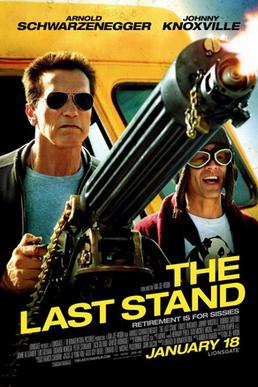
Much as I would like to avoid any weary reference to his famous Terminator catchphrase: he’s back. Arnold Schwarzenegger, that is. After a ten-year hiatus from starring roles so that he could do some temporary state government job, Schwarzenegger has returned with The Last Stand, a simplistic, bloody action picture which is, like Arnie himself, very much of the old school.


I’m a fan; I’ve always liked him. I don’t know what it says about me, but I’ve always sheepishly enjoyed the childish shoot-‘em-up fantasies of the middlebrow Republican manly men, starting with John Wayne and continuing through Clint Eastwood, Sylvester Stallone and Bruce Willis. I even have a (slight) soft spot for Chuck Norris.

But Schwarzenegger is a particular favorite. There’s a sweetness that sneaks past his stony, stilted delivery and his action-figure physique and gives him a droll charm, even when he’s playing a killer robot (that, I think, is why the first Terminator, in which he’s a menace, is so much sharper than the sentimental sequels, in which he’s the hero).

The physique is looking more human now that he’s in his mid-‘60s, but he still appears fit in The Last Stand, and his face is agreeably weathered. He seems a little rusty in the acting department, though. Never exactly Olivier, he had nonetheless gradually developed a little timing and panache, and had learned to use his accent to comic advantage. Now he’s back to picking his way through his lines word by laborious word.

Not that the lines he’s given in this movie offer him much help. The dialogue in The Last Stand, credited to Andrew Knauer, is of deadening banality. The plot is equally basic: an odious young drug lord (Eduardo Noriega) escapes from federal custody in Vegas and makes a dash for Mexico in a supercar. The little Arizona border town of which Arnie is the sheriff is the last barrier to this creep and freedom, so he and his ragtag deputies prepare to block his way.

This simplicity wouldn’t be a fault, could indeed be a strength, if the dialogue and characterizations weren’t so dreary. The best performance is by the ever-reliable Forest Whitaker as the earnest head G-Man. Luis Guzman is entertaining as Arnie’s deputy sidekick. Peter Stormare, making some strange attempt at a southern accent, is cartoonish as the leader of the bad guy’s advance team of goons, and so is Johnny Knoxville as a local gun nut. The great Harry Dean Stanton turns up, and it’s nice to see him, but it’s only a bit. Everyone else in the movie, from the pretty deputy (Jaimie Alexander) to her troubled old flame (Rodrigo Santoro) to the fresh-faced young kid (Zach Gilford), is straight out of Walker, Texas Ranger.

None of this matters, however—on its own silly, fairy-tale terms, The Last Stand works perfectly well. The director, the South Korean Jee-woon Kim (of the notorious revenge thriller I Saw the Devil) manages the preposterous chases and gunfights expertly, and cinematographer Kim Ji-Yong makes both the faces and the desert landscapes beautiful.

Poor Arnie has, of course, chosen a singularly uncomfortable moment to release an orgy of firearms porn—the gun nut’s stash, which is lovingly mooned over, saves the day for the sheriff. But the intolerable real-life horror of recent weeks didn’t seem to spoil the picture—the screening audience with whom I saw it clapped and cheered as Arnie and pals massacred the heavies.

I enjoyed myself, too. Whether this sort of bang-you’re-dead absurdity is culturally pernicious or harmless fun seems like an important question right now, and my answer, I’m afraid, is: I don’t know. But harmless or not, fun it is.