Opening this weekend at Harkins Shea:
Being Evel—Johnny Knoxville was both an executive producer and a talking head for this documentary about ‘60s-and-‘70s-era motorcycle daredevil Evel Knievel, which of course makes perfect sense. It never occurred to me, but Knievel is regarded as a major influence on both the “extreme sports” movement and the Jackass culture of idiotically risky and painful stunts as comedic performance art.
For the uninitiated, or the young: Robert Craig “Evel” Knievel was a hell-raising kid from Butte, Montana who started doing gimmicky, insanely unsafe motorcycle stunts up and down the Pacific coast in the ‘60s. After ABC Sports aired footage of his (unsuccessful) 1967 jump of the fountains outside Caesar’s Palace in Vegas, he rose to mega-stardom and fortune, in no small measure through the adulation of preadolescent boys and their enthusiasm for a licensed Evel Knievel Stunt Cycle toy from Ideal.
I was around 10 at the height of Knievel-mania, and I remember it vividly. I wasn’t particularly a fan myself, but my best friend and several other kids I knew idolized Knievel and we saw him all the time on ABC’s Wide World of Sports. I have an especially clear memory of watching him flawlessly execute a jump over a row of trucks—the footage is in Being Evel—and of my Mom saying “He did it! That was right pretty.”
It wasn’t always. Many of Knievel’s stunts ended in injurious wipe-outs. Most famous among these was his 1974 debacle at Idaho’s Snake River Canyon—the Department of the Interior had denied him permission to jump the Grand Canyon—not in a motorcycle but in a steam-powered rocket. Knievel suffered both physically and mentally from these ridiculous risks, and eventually became paranoid and unstable. Hubris, violence, jail time, loss of fortune and illness ensued.
Being Evel was directed by Daniel Junge, who co-directed the recent Lego Brickumentary, and like that film it’s presented in a slick, graphically flashy, somewhat impersonal style. Unlike the Brickumentary, however, it has a human charge—Knievel’s scary aggression and his pathos, neither of which were so easily spotted by kids back in the ‘70s, come across here big time.
Other talking heads include pals from Knievel’s youth, his outrageously long-suffering wife, his kids, his publicists. We even hear from George Hamilton, who played the title role in 1971’s Evel Knievel (seemingly irked at the usurpation of his persona, Knievel later played himself in 1977’s Viva Knievel!). Many of these commentators, even those Knievel had alienated, describe him as a hero who came along during a time of national ennui—Vietnam, civil rights struggles, student protests, etc.
It’s probably true that, to that part of the American psyche that preferred a distraction from such conflicts, Knievel had the right qualifications for a hero: Undeniable bravery in service of profit and popularity, and braggadocio wrapped in a banal and superficial patriotism. But I don’t know that it’s a truth to be celebrated.
Don’t misunderstand, I’m certainly not puritan enough to claim that risk to life and limb, undertaken by an adult of reasonably sound mind, can have no place in entertainment. I’ve enjoyed too many Jackie Chan movies. But to suggest that Knievel’s act was more than canny and self-serving showmanship is to push even the fond and nostalgic memories one might have of his heyday a bit far.
Also, the degree to which his popularity hinged on morbid curiosity shouldn’t be underrated. As I said before, I remember my Mom saying “That was right pretty” after we watched Knievel land a jump back then. I also, full disclosure, remember the pang of disappointment that went through my evil little boy’s heart that I hadn’t gotten to see a crash. Knievel was apparently well aware of this aspect of his appeal. In Being Evel, one of his old cronies remembers him saying “Nobody wants me to get killed, but nobody wants to miss it if I do.”
Showing posts with label JOHNNY KNOXVILLE. Show all posts
Friday, August 21, 2015
Friday, January 18, 2013
BARRELS OF FUN
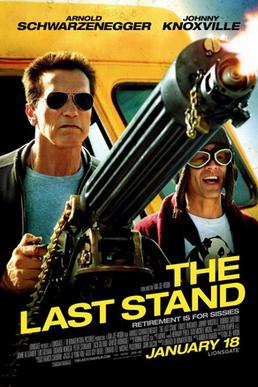
Much as I would like to avoid any weary reference to his famous Terminator catchphrase: he’s back. Arnold Schwarzenegger, that is. After a ten-year hiatus from starring roles so that he could do some temporary state government job, Schwarzenegger has returned with The Last Stand, a simplistic, bloody action picture which is, like Arnie himself, very much of the old school.
I’m a fan; I’ve always liked him. I don’t know what it says about me, but I’ve always sheepishly enjoyed the childish shoot-‘em-up fantasies of the middlebrow Republican manly men, starting with John Wayne and continuing through Clint Eastwood, Sylvester Stallone and Bruce Willis. I even have a (slight) soft spot for Chuck Norris.
But Schwarzenegger is a particular favorite. There’s a sweetness that sneaks past his stony, stilted delivery and his action-figure physique and gives him a droll charm, even when he’s playing a killer robot (that, I think, is why the first Terminator, in which he’s a menace, is so much sharper than the sentimental sequels, in which he’s the hero).
The physique is looking more human now that he’s in his mid-‘60s, but he still appears fit in The Last Stand, and his face is agreeably weathered. He seems a little rusty in the acting department, though. Never exactly Olivier, he had nonetheless gradually developed a little timing and panache, and had learned to use his accent to comic advantage. Now he’s back to picking his way through his lines word by laborious word.
Not that the lines he’s given in this movie offer him much help. The dialogue in The Last Stand, credited to Andrew Knauer, is of deadening banality. The plot is equally basic: an odious young drug lord (Eduardo Noriega) escapes from federal custody in Vegas and makes a dash for Mexico in a supercar. The little Arizona border town of which Arnie is the sheriff is the last barrier to this creep and freedom, so he and his ragtag deputies prepare to block his way.
This simplicity wouldn’t be a fault, could indeed be a strength, if the dialogue and characterizations weren’t so dreary. The best performance is by the ever-reliable Forest Whitaker as the earnest head G-Man. Luis Guzman is entertaining as Arnie’s deputy sidekick. Peter Stormare, making some strange attempt at a southern accent, is cartoonish as the leader of the bad guy’s advance team of goons, and so is Johnny Knoxville as a local gun nut. The great Harry Dean Stanton turns up, and it’s nice to see him, but it’s only a bit. Everyone else in the movie, from the pretty deputy (Jaimie Alexander) to her troubled old flame (Rodrigo Santoro) to the fresh-faced young kid (Zach Gilford), is straight out of Walker, Texas Ranger.
None of this matters, however—on its own silly, fairy-tale terms, The Last Stand works perfectly well. The director, the South Korean Jee-woon Kim (of the notorious revenge thriller I Saw the Devil) manages the preposterous chases and gunfights expertly, and cinematographer Kim Ji-Yong makes both the faces and the desert landscapes beautiful.
Poor Arnie has, of course, chosen a singularly uncomfortable moment to release an orgy of firearms porn—the gun nut’s stash, which is lovingly mooned over, saves the day for the sheriff. But the intolerable real-life horror of recent weeks didn’t seem to spoil the picture—the screening audience with whom I saw it clapped and cheered as Arnie and pals massacred the heavies.
I enjoyed myself, too. Whether this sort of bang-you’re-dead absurdity is culturally pernicious or harmless fun seems like an important question right now, and my answer, I’m afraid, is: I don’t know. But harmless or not, fun it is.
I’m a fan; I’ve always liked him. I don’t know what it says about me, but I’ve always sheepishly enjoyed the childish shoot-‘em-up fantasies of the middlebrow Republican manly men, starting with John Wayne and continuing through Clint Eastwood, Sylvester Stallone and Bruce Willis. I even have a (slight) soft spot for Chuck Norris.
But Schwarzenegger is a particular favorite. There’s a sweetness that sneaks past his stony, stilted delivery and his action-figure physique and gives him a droll charm, even when he’s playing a killer robot (that, I think, is why the first Terminator, in which he’s a menace, is so much sharper than the sentimental sequels, in which he’s the hero).
The physique is looking more human now that he’s in his mid-‘60s, but he still appears fit in The Last Stand, and his face is agreeably weathered. He seems a little rusty in the acting department, though. Never exactly Olivier, he had nonetheless gradually developed a little timing and panache, and had learned to use his accent to comic advantage. Now he’s back to picking his way through his lines word by laborious word.
Not that the lines he’s given in this movie offer him much help. The dialogue in The Last Stand, credited to Andrew Knauer, is of deadening banality. The plot is equally basic: an odious young drug lord (Eduardo Noriega) escapes from federal custody in Vegas and makes a dash for Mexico in a supercar. The little Arizona border town of which Arnie is the sheriff is the last barrier to this creep and freedom, so he and his ragtag deputies prepare to block his way.
This simplicity wouldn’t be a fault, could indeed be a strength, if the dialogue and characterizations weren’t so dreary. The best performance is by the ever-reliable Forest Whitaker as the earnest head G-Man. Luis Guzman is entertaining as Arnie’s deputy sidekick. Peter Stormare, making some strange attempt at a southern accent, is cartoonish as the leader of the bad guy’s advance team of goons, and so is Johnny Knoxville as a local gun nut. The great Harry Dean Stanton turns up, and it’s nice to see him, but it’s only a bit. Everyone else in the movie, from the pretty deputy (Jaimie Alexander) to her troubled old flame (Rodrigo Santoro) to the fresh-faced young kid (Zach Gilford), is straight out of Walker, Texas Ranger.
None of this matters, however—on its own silly, fairy-tale terms, The Last Stand works perfectly well. The director, the South Korean Jee-woon Kim (of the notorious revenge thriller I Saw the Devil) manages the preposterous chases and gunfights expertly, and cinematographer Kim Ji-Yong makes both the faces and the desert landscapes beautiful.
Poor Arnie has, of course, chosen a singularly uncomfortable moment to release an orgy of firearms porn—the gun nut’s stash, which is lovingly mooned over, saves the day for the sheriff. But the intolerable real-life horror of recent weeks didn’t seem to spoil the picture—the screening audience with whom I saw it clapped and cheered as Arnie and pals massacred the heavies.
I enjoyed myself, too. Whether this sort of bang-you’re-dead absurdity is culturally pernicious or harmless fun seems like an important question right now, and my answer, I’m afraid, is: I don’t know. But harmless or not, fun it is.
Subscribe to:
Posts (Atom)