Showing posts with label WILLIAM SHATNER. Show all posts

Saturday, November 15, 2025

TRIUMPH OF THE BILL

Last March, for my birthday, The Wife gifted me a ticket to William Shatner Live at the Orpheum Theatre in downtown Phoenix, preceded by a showing of Star Trek II: The Wrath of Khan. Thursday night was the big night!

Great to be at the Orpheum, and among my people: Boomer nerds!

My pal Gayle was there...


Among other friends and costumed fans...


There were many great Star Trek t-shirts, but I also saw one guy wearing a black shirt with "DENNY CRANE" in white letters across the chest. That's a serious Shatner fan, I thought.

Walking up the aisle I saw a woman that I know, who has never struck me as the Star Trek type.

"I never knew you were part of this particular dorkdom," I said.

"It's [my husband's] thing," she quickly assured me. "I told him I wanted to walk around saying 'Nanu, Nanu' to everybody."

Great also to see Wrath of Khan again. I hadn't seen it from beginning to end in some years; it holds up most entertainingly. Not only as a ripping adventure yarn but as a rumination on age and youth and mortality and the needs of the many and of the one, it felt far more meaningful to me now than it did when I was in my twenties.

And then there was the star of the evening. As soon as I entered the Orpheum's lobby, I was urged to get into a second line to sign up for a post-show VIP experience of a meet-and-greet, autograph, picture and access to exclusive merch. I resisted, but hundreds of people (including Gayle) lined up.

After the film, two hosts, local radio morning man John Holmberg and the talented comedian and impressionist Frank Caliendo came out, both doing pretty respectable Shatners. Then the man himself, now 94, came bounding onstage. At very little provocation from the emcees, he started talking...


...and talking and talking...


...and talking. His talk ranged from knock knock jokes ("Who's there?" "KHAAAAN!") and stories of using the men's room at the Denny's in Quartzsite to extended riffs about his conversations with Neil deGrasse Tyson and his (Shatner's) belief that the Universe is sentient, to a strange story about DeForest Kelley's dog, to a stranger story about his own dog, in his barnstorming theatre days in Cape Cod. Among much else. He rambled, losing the track of one story and shifting to another, often searching for words which the audience called out to him.

It was wonderful to be there, because there he was, up on stage: Captain Kirk himself. Of course he isn't Captain Kirk, and never was; by most accounts he was always a hyper, frenetic fellow. Now he seems like a crazy old man, but with the energy and exuberance of a man at least forty years younger.

All of which is well and good and enjoyable, as long as he isn't being exploited by this tour. It was almost 11 p.m. when the main show was over, and as I walked back to my car it occurred to me that he still had those hundreds of VIP fans to work through, after which, he said, they were headed on to Anaheim for a Friday show.

The next day I asked Gayle how the experience was, and she texted back "quick. he didn't say a word. he just smiled when i said he was my first crush...they ran us through there like a streamlined machine."


This was the second time in my life I saw Shatner, by the way. For many decades I have been "collecting" meetings with the original series Star Trek cast: I interviewed DeForest Kelley and Walter Koenig and, by phone on my KTAR radio show, Grace Lee Whitney. And I got an autograph from James Doohan. Alas, I missed Leonard Nimoy, Majel Barrett and my first crush, Nichelle Nichols. And I'd still like to catch up with George Takei.

But I saw Shatner first. In 1973 my Mom took me and my Trek-loving cousin Debbie to the Kenley Playhouse in Warren, Ohio, to see Shatner in Arsenic and Old Lace, supported by Sylvia Sidney as one of the lethal Aunts and by Peter Lupus of Mission: Impossible as Johnny Brewster (I later learned that this role was originally cast with Lon Chaney, Jr., but he died just before the production and was replaced by Lupus at the last minute; I've often thought that if I saw both William Shatner and Lon Chaney Jr. on the same day my head might have exploded).


Seeing that show was a big, formative highlight of my childhood. My memory is that Shatner was genuinely first-rate as the panicked hero Mortimer Brewster. As with Wrath of Khan's themes of age and youth, to see Shatner scramble around farcically onstage when I was 11, and then to see him do it again now that I'm 63 certainly gave me a circle-of-life feeling.

Thursday, May 4, 2023

DOVE TALE

Again and again I find myself sheepishly admitting that Star Trek, as in the original series, is my all-time favorite TV show. It's a little embarrassing to acknowledge that, north of sixty years old, I keep going back for comfort and refreshment to the corny sci-fi show that I loved as a kid.

Worse yet, for all the show's sophomoric heavy-handedness and cultural chauvinism and ludicrous science and inconsistently applied social values, I keep finding relevance, even prescience in it.

For instance, this past weekend I watched the third-season episode, scripted by the redoubtable Jerome Bixby (also author of the story that became the Twilight Zone favorite "It's a Good Life"), called "Day of the Dove..."


You may remember it: Both the Enterprise and a crew of Klingons arrive at a planet, lured there under false pretenses by a powerful incorporeal alien Entity. Through a variety of mind tricks and matter transmutation, the Entity gets the Federation crew and the Klingons trapped together aboard the Enterprise, which is hurtling out of control on course to leave the galaxy.

Onboard, the factions are allowed their own turf, armed with swords--Scotty admires "a Claymore..."

...and psychically aroused to furious hatred toward their adversaries and even toward each other. They soon discover that the conflict between them is self-renewing; their wounds heal miraculously and the Entity allows neither side complete victory.

As a kid, I always thought it was a pretty cool episode. It had plenty of action, including swordfights, and the coolest and most badass of all the original series Klingons, Kang, played by the rumbly-voiced Michael Ansara...

...towering over Shatner...

It was also the only glimpse we ever got, in the original series, of Klingon women, notably Susan Howard as Kang's wife and science officer Mara...

In the course of the show Chekov, under the Entity's evil influence, attempts to violate Mara, although it looks like she could smack his little ass across the corridor with one hand.

Along with Chekov, Kirk, McCoy, Scotty and Uhura all get to work themselves up into highly entertaining angry lathers in this one. Shatner's in particularly hilarious, wound-up form here: "Look at me...Look. At. Me." And there's the great moment when the hysterical Scotty, responding to Spock's attempt to calm him, says "Keep your Vulcan hands off me," but it sounds like he said "Keep your f**kin' hands off me."

But watching it the other night, it occurred to me that this episode seems unusually relevant these days. I noticed this a few years ago about the second-season episode "The Omega Glory" as well. The theme, about the dangers of fetishizing and theocratizing America's foundational documents and other objects of patriotic regard like the flag, seems like a pedestrian, basic civics lesson. But it turns out that our society needs to be reminded of it regularly.

Similarly, with "Day of the Dove," the message might seem, at a glance, like the usual honorable but ineffectual Star Trek platitudes about the horrors of war and the bondage of bigotry and the liberating virtue of tolerance. But now, in light of the revelations from the Dominion lawsuit, it has a strikingly specific subtext. Because, of course, the reason the invading Entity is attempting to create this hellish eternal conflict on the Enterprise is that it feeds on violent hatreds, turning from yellowish-white to a happy shade of red...


...when it sucks up some delicious fury.

It creates false narratives in people's minds to stir up their bloodlust--Chekov claims his brother was killed by the Klingons; Sulu later explains that the brother is imaginary, as Chekov is an only child--and feeds both sides with propaganda to gin up enmity. Essentially, the Entity is a farmer, planting outrage so that it can harvest rage. 

In other words, the Entity is Fox News, and the "news" media machine of which Fox News is the most successful and egregious example. I mean, isn't it, kind of?

In this context, some of Bixby's lines take on an extra resonance, as when Kirk speculates "Has a war been staged for us, complete with weapons and ideology and patriotic drum beating? Even...Spock...even race hatred?"

Or, when Kirk says "It exists on the hate of others," and Spock replies "To put it simply. And it has acted as a catalyst, creating this situation in order to satisfy that need."

Or, again, Kirk's desperate appeal to Kang, in the climactic minutes: "...and it goes on, the good old game of war, pawn against pawn! Stopping the bad guys. While somewhere, something sits back, and laughs, and starts it all over again."

In the end, Kang is persuaded, a truce is ordered, and the weakened Entity is chased off the Enterprise to hearty laughter from both sides...

Kang slaps Kirk on the back and for a second it looks like Kirk is going to pass out. A lovely moment; I would highly recommend it for our nation right now. But as the Entity goes flittering off the ship into space, it's all too easy to imagine it scurrying down to some TV "News" Network on some unsuspecting planet.

Sunday, September 4, 2022

A LITTLE LESS CONVERSATION, A LITTLE MORE REACTION

Check out Your Humble Narrator's short article, online at Phoenix Magazine, about the upcoming TCM/Fathom Events revival of Star Trek II: The Wrath of Khan at select AMC Theatres on Sunday, September 4, Monday September 5 and Thursday September 8...


...and also of the showing of Nosferatu at the Orpheum Theatre here in Phoenix next Tuesday.

It's bad enough that Nosferatu is marking its centennial this year, but it's really irksome that Wrath of Khan is being shown in observance of its fortieth anniversary. Wrath of Khan is forty freakin' years old.

I have a bit of personal history with this film. My review of Wrath of Khan was the first movie review of mine ever to appear in a daily newspaper, the Erie Times-News. I was twenty years old, and had been submitting my work to the editors there for a while without success. My break came because the regular reviewer disliked sci-fi, and horror, and action pictures, and pretty much any kind of movie in which, as he liked to put it, "the dialogue appears in word balloons over the characters' heads."

Needless to say, I was more than happy to relieve him of this beat, and Wrath of Khan was my first opportunity to do so. I dragged my then-girlfriend to it at the Strand on 10th Street in Erie. I think she was a little taken aback at how much I responded to it. She knew I was a nerd; she didn't know I was that much of a nerd.

Forty years later, it's still a favorite of mine. All these years, however, I've had a complaint about the movie, and I doubt there will be a better occasion than now to air it. But it involves a moment in the very climatic scene of the film, so if you've never seen it, and want to discover it for yourself, consider this a MAJOR SPOILER warning.

Okay, for those still reading: Near the end of Wrath of Khan, Kirk's titular nemesis, grandly played by Ricardo Montalban, is dying aboard the starship Reliant, scarred by radiation burns, but still lashing out at Kirk by trying to detonate the Genesis Device, spewing Ahab's invective toward Moby-Dick all the while. Meanwhile, aboard the Enterprise, Kirk and his crew are frantically trying to regain warp speed so that they can escape the blast zone. The director, Nicholas Meyer, cuts between the two vessels, with Khan's crazed, disfigured face gleefully watching the Enterprise on his viewscreen.

At the last second, of course, warp speed is attained, and the Enterprise zips away to safety as the Reliant explodes behind her. Yay, the good guys win; all is well, except...Meyer doesn't cut to a reaction shot so that we can see Khan register, in that final second, that Kirk has defeated him once and for all.

I've never understood this omission. Everything about the way the scene is shot and edited up to that point seems to set up such a reaction shot, maybe even a final "NOOOOO!" from Montalban. It would have been the perfect payoff to Kirk's much-parodied roar of "KHAAAAAN!" earlier in the film.

I'm well aware that the reason for the dissatisfaction I feel at the lack of this shot has to do with my persistent, spiteful feelings about revenge in melodramas. Khan himself, in this movie, quotes a "Klingon proverb" that "revenge is a dish best served cold," but the innumerable action pictures that end with the bad guy simply being killed leave me cold; they're entirely unsatisfying. Far better that they should live long to wallow in their defeat; at a minimum, they should die knowing that they've lost. There are a few movies that have grasped this: the original Cape Fear, also The Princess Bride among them. But few movies have ever left me hanging in this regard as badly as Wrath of Khan, wonderful as it is.

Was such a shot planned, but never filmed? Was it filmed, but cut for some deliberate reason, or just for time? Did Montalban have to leave early that day? Or was it truly never considered? If I ever get the chance to interview Meyer (no matter what the subject of the interview is supposed to be), these are likely to be the first questions I ask him. Or, by some chance, does the shot exist after all, and is it at last included in the "Director's Cut" being shown at the TCM/Fathom Events revival?

In the meantime, I'll ask you: Am I the only one that ever noticed this or felt this way?

Thursday, August 30, 2018

BACK TO THE GRINDSTAFF

Last week we paid tribute to the late Douglas Grindstaff, the brilliantly imaginative sound effects man whose contribution to the atmosphere of the original Star Trek would be hard to overstate. But I think Grindstaff deserves at least one more monster, so...

Monster-of-the-Week: ...let's acknowledge the "neural parasite" that attacks poor Spock in the second-season episode "Operation--Annihilate!"


In one interview I found, Grindstaff claimed that he produced the creature's icky sounds by using samples of kissing.

While we're on the subject of Star Trek, check out...Quentin Tarantino's Star Trek!

Wednesday, July 1, 2015

HE'S THE SHAT

Playing Friday night only at FilmBar Phoenix, for those who might want to kick off their Independence Day weekend with a feast of Canadian ham:

  
Shatner!!! The Lost Years—From 1969, when the original Star Trek series ended, until the late ‘70s, when the first Star Trek feature film hit theatres, William Shatner was extremely…available. Divorced and broke, he lived for a time in a camper and essentially answered the phone not with “hello” but with “I’ll do it.”

To call this period in Shatner’s career “The Lost Years” is, in a sense, a misnomer, since he was rarely more visible—he racked up a staggering number of credits on episodic television, TV movies, low-budget schlock films, game shows, talk shows, commercials, anything. I myself saw him during those years, in a 1973 Kenley Players production of Arsenic and Old Lace in Warren, Ohio, with Sylvia Sidney and Peter Lupus. It was certainly one of the highlights of my eleventh year on earth.

Well, Friday at FilmBar, The Unfathomable Film Freakout presents this compilation of movies, abridged down to their Shatnerian essence. We see him at his tortured best as the lapsed priest facing druidical evil in The Horror at 37,000 Feet, alongside the likes of Chuck Connors, Buddy Ebsen, Paul Winfield, Jane Merrow, France Nuyen, Russell Johnson and Roy Thinnes, among others, besieged by angry arachnids alongside Pamela Tiffin, Woody Strode and my friend (even if he is, now, a conservative member of the Arizona legislature) Jay Lawrence in Kingdom of the Spiders, battling a demonic Ernest Borgnine in The Devil’s Rain, or pursuing David Carradine in an episode of Kung Fu. In the latter his character asserts that, after long travels, he is “Rump-sprung and callused where no man ought to be callused,” which may have described Shatner’s actual feelings about his own life at the time.

This facetiously-edited footage is enjoyable for Shatner fans, although I would like to have seen shorter clips and a wider selection—especially, Shatner clashing with a scary Andy Griffith in the 1974 wheeler Pray for the Wildcats. But the really juicy and nostalgic items are the clips which connect the movie footage, showing Shatner on the talk shows of Dinah Shore or Mike Douglas, turning songs like “Lucy in the Sky With Diamonds” or “How Do You Handle a Woman” or Harry Chapin’s “Taxi” into overwrought spoken-word monologues, or doing commercials for Loblaws supermarkets or Promise Margarine, or competing on Celebrity Bowling with Fran Jeffries, against Hugh O’Brian and Michele Lee, or breaking boards with his fist on Circus of the Stars.

The songs are excruciating. Like, really excruciating. But everything else in Shatner!!! The Lost Years transcends the snark. Eventually, of course, Shatner got in on the joke, and like his countryman Leslie Nielsen, became an improbable comedy star. But it’s exhilarating to watch a sample of the years before that happened—to see the guy gut out a decade’s worth of paychecks, working with other vivid performers of the period, particularly since you know that wealth and Emmys and a Golden Globe are in his future.

Thursday, March 12, 2015

GORN TO BE WILD

OK, one more Star Trek monster (for a while, that is)…

Monster-of-the-Week: …a returning favorite, just because he’s March’s calendar image: the Gorn Captain from the original series episode “Arena.”


I also have this bobblehead on my desk...

…who always provides me, in return for a tap on the head, with plenty of validation.

Friday, February 27, 2015

SPOCK OUT

A few days ago, when I first heard that Leonard Nimoy had gone to the hospital with heart trouble, I was wearing his face on my t-shirt. The shirt, bright red with Nimoy as a jowlier, heavier-featured late-vintage Mr. Spock—he always reminds me of Jackie Mason in that picture—holding up his split-fingered Vulcan salute next to the inevitable well-wish “LIVE LONG AND PROSPER,” was a gift from The Wife and The Kid. There are days when I suppose I might be a little embarrassed to admit that, at the age of fifty-two, I still sometimes wear Star Trek t-shirts.

This is not one of those days.


I’ve been a Star Trek fan for the vast majority of my life. I can dimly remember the show’s original run, but it was a few years later, when it ran in syndication in the very early ‘70s, that it became one of the fanatical enthusiasms of my childhood. And it appears that the original Star Trek is something I’m not likely to ever outgrow. I still watch it, still notice new aspects of the episodes—often new absurdities and illogicalities—and take comfort and refreshment from it. I recognize the validity of every criticism that could be leveled against Gene Roddenberry’s silly space opera—the cultural chauvinism, the jocularity, the often preposterous science, the inconsistent social values—and I say there’s something about the show, some core of decency and good-will and gallantry, that transcends all of it and makes it mythic.

Spock was one of the main reasons for this. Nimoy, who passed on today at 83, had a fairly rich career as an actor before Spock, and very rich career as an actor and a director after Spock. But it is, of course, as Spock that he’ll be most remembered—a supposedly emotionless native of the planet Vulcan, though plagued by emotional flare-ups from his maternal human half, cool, curious, expansively knowledgeable, quietly ironic. Spock was my childhood role model, and though I have never succeeded in emulating him—I’m far closer, alas, to the irascible and sentimental Dr. McCoy—I’m still extremely grateful for the influence.

We were, of course, always meant to see that Spock’s lack of emotion was a pose—that he was more compassionate, and in his way possibly even more passionate, than any of the other characters. His cerebral rationality, sometimes mistaken for callousness, was really in service of a bottomless, if sometimes bemused, sympathy for the wound-up humans around him.

When I say that Star Trek in general and Spock in particular were major and lifelong influences on me, I mean it without condescension—my gratitude is serious. But one of the reasons that Spock was able to influence so many people of my generation is that Nimoy wasn’t that serious. Like many members of that cast, he was a little sheepish about his identification with the character, to the point that he titled his first memoir I Am Not Spock. He later made enough peace with the role—finally getting some serious financial reward for it probably helped—that the sequel was titled I Am Spock.

All of those actors were essential to the show’s unique alchemy, but the original Star Trek would have been an especially dreary affair without Nimoy’s droll sensibility. I was watching Star Trek just last weekend, before I heard about Nimoy’s illness, and had been thinking how truly good he was, how much wry deadpan comedy he was able to bring to the show (“Sir, there is a multi-legged creature crawling on your shoulder.”).

The actor’s slyness fed into the character’s—I remember hearing Nimoy, in various interviews, explain that he came up with Spock’s handy nerve pinch so that he could avoid the strenuous fight scenes that William Shatner so often had to engage in, and how Spock had borrowed the Vulcan hand gesture from rabbis at the Orthodox services of his Boston youth. In short, like many hero figures, he—and Kirk and McCoy and the rest, each in their own way—made heroism look like fun. Spock’s upraised eyebrow may ultimately prove as iconic as Groucho’s brow-wiggle.


I had hoped to meet or see all the members of the original Star Trek cast before they headed off to the Undiscovered Country, and so far I haven’t done too badly—I saw Shatner in a play in Ohio in the ‘70s, and in the decades that followed I interviewed DeForest Kelley and Walter Koenig and Grace Lee Whitney, and got an autograph from James Doohan. I haven’t yet caught up with George Takei and Nichelle Nichols, and now Nimoy (along with Majel Barrett) has slipped away from me. No doubt Mr. Spock would tell me that it’s highly illogical to feel sad about this, but I do. No matter though—Nimoy lived long, and prospered, and will live on in many of our memories.

Thursday, May 16, 2013

GORN BUT NOT FORGOTTEN

Starting today and continuing through Sunday is the 14th Annual Arthur Lyons Film Noir Festival, at the Camelot Theatre in Palm Springs, California. Among the obscurities—and some over-familiar selections like Champion and The Asphalt Jungle—on this year’s schedule is the way-too-little-known 1950 effort Try and Get Me (aka The Sound of Fury).


It features Lloyd Bridges in a flashy role as a fast-talking, hyper-confident stick up man and the underrated Frank Lovejoy in a heartbreaking performance as an unemployed family man who, desperate for money, gets sucked into a kidnapping scheme. The director was Cyril “Cy” Endfield, just before he was blacklisted, and it’s not hard to see why the Red-baiters might have thought the guy was a Commie—for its first two-thirds, it’s an angrily anti-capitalist drama, then it shifts into a startling critique of how irresponsible journalism can lead to mob violence.

The story is based on the same California lynch-mob incident that inspired Fritz Lang’s 1936 American debut Fury, but it’s a better, more honest, less sentimental movie than Fury. In its final stretch (shot in downtown Phoenix) it becomes truly epic—amazingly so, considering its budget. It has the feel of something from the early Eisenstein. Despite the clumsiness with which the movie presents its high moral values—placing them in the mouth of a visiting Italian academic—I think it’s a neglected classic, and the Palm Springs festival is to be commended for showcasing it.

I wasn’t able to attend the Phoenix area screening of Star Trek—Into Darkness, and therefore the multitudes breathlessly awaiting my take on it will have to wait until I'm able to catch up with it. I was excited to learn, however, that the new Star Trek video game involves the Gorns, the reptilian race that Kirk encountered back in the original series episode “Arena.” So…

Monster-of-the-Week: …let’s recognize the Gorn Captain with which Kirk was forced into one-on-one combat in that episode…


“Arena” is my earliest memory of Star Trek, when I was five or six years old, and the Gorn—who politely offers to kill Kirk quickly and mercifully—remains my favorite Star Trek alien. Can’t wait to see what the game's version looks like, but I very much doubt it can rival the original in my affections. I even have this bobble-head…

…sitting on my desk. Anytime I need some validation, I just tap his head. Think I’ll do it right now: “Is this a good post, Gorn?”

Man, that’s a load off.

Monday, February 25, 2013

DARK LORD OF THE SETH

I understand that Seth MacFarlane has gotten poor reviews online for his stint as Oscar host last night. I’m no particular MacFarlane fan, but I thought he did just fine. He made some of the mildly tasteless jokes that were, of course, precisely why he was hired, and he made a solid effort at old-school song-and-dance showmanship. His opening routine, opposite William Shatner, went on a little too long, but I thought it was pretty funny all the same.


I maintain, as I wrote here about last year’s show, that the reason that middle-aged viewers so often react with cranky petulance toward the Oscars isn’t that the show is on the lame side—though it usually is—but that they fail to feel the excitement that the spectacle gave them as kids. Many viewers in my own circle are also show-biz wannabes, wash-outs or bush-leaguers ourselves, so there’s often an unacknowledged streak of career envy behind the Oscar-hatin’. The fault, dear Brutus, is typically not in these overhyped stars, but in our tired-ass selves.

This weekend The Kid and I also caught up with Escape From Planet Earth, a computer-animated flick that wasn’t screened for critics, in Phoenix at least, prior to its release.


It’s the story of a milquetoast, blue-skinned, nose-less alien (voiced by Robb Corddry) from the planet Baab who travels to Earth to rescue his hotshot brother (Brendan Fraser), and winds up imprisoned with him and other wacky aliens at Area 51 in Nevada by an evil General (Shatner again!) who’s running a technology sweatshop there.

The movie is watchable and pleasant but mostly routine. The conflicts are standard for the genre—caution versus recklessness, the desire to seem heroic to your kid—but there are some odd, almost free-standing episodes that struck me as curiously witty and erudite. Then, in the end credits, I noticed an “additional material by” credit, and the first writer listed was Stephen Fry. That probably explains the erudition.

Wednesday, July 4, 2012

ANDYLAND

Happy 4th everyone.

RIP to Andy Griffith, passed on at 86. This is kind of a big one for me—watching that show after school with my brother ranks among the happiest memories of my younger years.


Griffith was a seriously skilled performer, and shrewd enough to know that he’d look better yet if he surrounded himself with terrific actors, then stood back and let them shine. But for all the hilarity that The Andy Griffith Show was capable of, I still think that its real achievement was in the rapport between Griffith as Sheriff Andy Taylor and Don Knotts as Deputy Barney Fife—what they captured, in the rhythm of their conversation and interaction, may be the most quietly convincing portrait of a close friendship ever committed to film. The famous scenes in which they discuss their laid-back Sunday plans (“Go downtown, get a bottle of pop…”) over and over again are—for me quite literally—heavenly; the sheer tangible savor in their anticipation of these simple pleasures is about as good as American TV comedy has ever gotten. It’s an example for life.

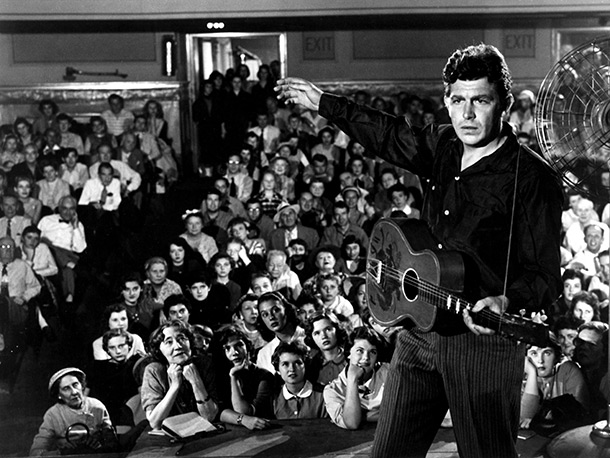
Among the encomia to Griffith of the last day are many mentions of his brilliant performance as the Glenn-Beck-ish reactionary media conman Lonesome Rhodes in Elia Kazan’s wonderful 1957 A Face in the Crowd.


Well-deserved, but it should be mentioned that Griffith often put his genial persona to sinister, villainous use—he had a great time playing heavies on TV in the ‘70s. A few years ago I was able to snag a VHS copy of the 1974 TV-wheeler Pray for the Wildcats, in which Griffith, leading a cast that includes William Shatner, Robert Reed and Marjoe Gortner, plays a sheer bastard, an unapologetically murderous SOB, and is amazingly convincing and scary.


And if I needed one more reason to love Griffith, there’s this.