Opening this weekend:
Godard Mon Amour--The "mon" in the title refers to Anne Wiazemsky (Stacy Martin), Godard's much younger second wife and the star of his 1967 La Chinoise. Directed by Michel Hazanavicius of The Artist, Godard Mon Amour chronicles the years of Godard and Wiazemsky's marriage. The particular focus is on the anti-De Gaulle demonstrations of May 1968, and the miseries Godard (Louis Garrel) inflicted on his wife, his friends and himself during that period, in his flailing attempts to be an authentic revolutionary.
Shot in gorgeous, sunny tones by Guillaume Shiffman, the film is well-acted, funny, sexy at times, and has a buoyant energy that is, if not Godardian, at least an amusing parody of the style. There are also nods to Woody Allen, like a redo of the subtitle gag from Annie Hall or, a la Stardust Memories, people asking Godard if he'll go back to making funny movies. And there are fourth wall gags, both overt and subtle, as when Godard is complaining about tracking shots just as Hazanavicius is in the midst of tracking up the length of Anne's sunbathing bikini-clad body.
In terms of its story, however, Godard Mon Amour most reminded me of Sullivan's Travels, the 1941 Preston Sturges comedy about a film director (Joel McCrea) of lightweight entertainments who hits the road as a bum to enrich his artistry by learning first hand about hardscrabble "real life." Sullivan ultimately comes to the conclusion that he can best serve mankind by making them laugh, but the humorless Godard we get here isn't about to reach that epiphany.
Hazanavicius derives much deadpan comedy from seeing Godard rant about the class struggle while dining with his friends at posh restaurants or romping with Anne in their beautiful Parisian apartment, and of course by snubbing admirers and behaving rudely toward the few actual working class people with whom he interacts. If the aim of the film, based on a book by Wiazemsky and also known under the title Le Redoubtable, is to depict Godard as an insufferably posturing, petulant, self-loathing douche, it succeeds mightily.
How fair any of this is I couldn't say; I don't even know how faithful Hazanavicius is to Wiazemsky's own, presumably subjective, account. But in general, fury at the inability to escape one's own middle-class sensibility is a very common phenomenon among middle-class lefty intellectuals, and it's a great subject, especially for comedy. Hazanavicius makes his Godard the butt of this joke, but isn't able to make his hero likable in the process, as Godard himself might have.
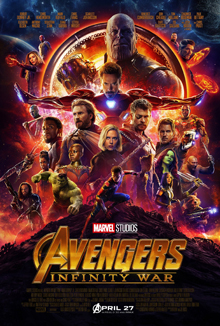
Avengers: Infinity War--A big ogreish alien called Thanos (Josh Brolin) feels a strong need to de-clutter. Specifically, he wants to destroy half of all the living beings in the universe. To do this, he must capture six "Infinity Stones" stashed around the cosmos, including a couple on Earth, and implant them on his big armored gauntlet thingy. Opposed to his plan are both Iron Man's and Captain America's estranged factions of the Avengers, the Wakandans from Black Panther, the Guardians of the Galaxy, Spider-man, Dr. Strange, and other Marvel stars and bench players.
This Gotter-half-dammerung free-for-all, largely based on a limited-run comic series from the early '90s, was directed by the brothers Joe and Anthony Russo, who also helmed two of the earlier Captain America flicks. Unless you're a hardcore Marvel brand loyalist, there's a good chance you could get lost now and then in the specifics of the eye-crossing multi-strand narrative. But the Russos do a capable job of keeping the basic conflict clear, and they keep the big action set-pieces coming.
Over the last few years, Marvel has given us some half-dozen genuinely fun, delightful pictures, like Ant-Man, Guardians of the Galaxy the first, Dr. Strange, Spider-Man: Homecoming, and Thor: Ragnarok, leading up to this year's grand slam Black Panther. For me, Infinity War was a slight step down from these, probably because it's such an overstuffed all-star spectacular that it inevitably lacks a certain balance and focus, and also because the plot and the stakes are so cosmically, apocalyptically heavy.
Even so, the actors manage to find more playfulness than might be expected. There's some serious charisma in this cast: Robert Downey, Jr.'s top billing feels right, he seems to just naturally assume a leading man status in this ensemble. But his costars come across strongly too--Chris Hemsworth's harried Thor, Benedict Cumberbatch's suavely low-key Dr. Strange, Chadwick Boseman's quiet, bashfully authoritative Black Panther with his elegant entourage, the peerlessly soulful Elizabeth Olsen's Scarlet Witch, and Mark Ruffalo's chagrined Bruce Banner, who's having a bit of trouble getting a rise out of his inner green self.
A few of the stars seem to get lost in the shuffle of this movie's ambitions, among them the recessive Captain America of Chris Evans, Anthony Mackie's Falcon and the Black Widow of Scarlett Johansson. And when Scarlett Johansson is one of the less vivid presences in a movie, you know there's glamour going on.
It will be interesting to see how this movie is received by casual fans. Even allowing that mortality is highly flexible in comics, there are surprising losses here, and a resolution that seems inconclusive in the Empire Strikes Back vein. I enjoyed Infinity War, but it left me thoroughly unsatisfied, just as it was supposed to.
Showing posts with label ROBERT DOWNEY JR. Show all posts
Friday, April 27, 2018
Friday, July 7, 2017
SPIDER-KID
Opening this weekend:
Spider-Man: Homecoming--The latest Marvel feature depicts the "Web-Head" still in high school in Queens. Peter Parker/Spider-Man (Tom Holland) has taken part in one quick adventure with The Avengers, which we saw in last year's Captain America: Civil Wars, and now has an "internship" with Stark Industries.
Tony Stark/Iron Man (Robert Downey, Jr.) clearly sees that Peter is a good kid with superhero potential, but also that he's impetuous, impulsive, reckless, in short, a teenager. He hasn't yet internalized the lesson that with great power comes...well, you know.
So Stark gives Peter a high-tech, interactive Spidey suit to replace the homemade costume he's been wearing, but encourages him to remain a "friendly neighborhood Spider-Man" for the time being, rather than a full-fledged Avenger. Peter makes a pest of himself to Stark and his employees, but he also stumbles across a genuinely world-threatening criminal enterprise right in his own back yard, involving the sale of alien technology. Plus, there's the matter of his schoolwork, and the Academic Decathlon team, and the girl he has a crush on.
What ensues is a lively, fast-moving hybrid of superhero action saga and teenage angst comedy. The two tones don't always gel perfectly, but this slight unevenness only adds to the film's loose, free-swinging feel. After several years of curmudgeonly grumbling about turgid, apocalyptic, buildings-crumbling-to-rubble superhero flicks, I'm glad to admit that I've wholeheartedly enjoyed the last three big releases in that line: Dr. Strange, DC's Wonder Woman, and this one.
Holland hits the right note as Peter, callow and heartfelt but light-footed. Downey has played a beleaguered, glamorous father figure already, opposite Anton Yelchin in 2007's Charlie Bartlett; he did it beautifully then, and he does it beautifully here. Zendaya only gets a little to do as Peter's socially conscious classmate, but she's set up nicely for future films. And Marisa Tomei is charmingly showcased as Aunt May, re-conceived as a sexy young "cool" Aunt.
But the real reason that even somebody who wasn't particularly a fan of this sort of thing might consider Spider-Man: Homecoming is Michael Keaton. Returning to comic book movies 28 years after Batman, he brings real bite and originality to the role of Adrian Toomes aka The Vulture, a startlingly no-nonsense, blue-collar mastermind who seems almost sheepish about the trappings of supervilliany.
Keaton plays the role quietly, with no zany, over-the-top antics, but with a clear-eyed intelligence and directness that makes his menace unusually authoritative. When he levels a threat, he isn't gloating or grandstanding; he honestly wants Spider-Man to back off, but you never doubt that it's a final warning. He makes pragmatism and sanity scary.
Friday, May 6, 2016
SUPERFEUD
Opening this week:
Captain America: Civil War—In March it was Batman and
Superman that couldn’t get along; now it’s the gang over at Marvel. The U.N.
wants the Avengers to agree to regulation. Iron Man (Robert Downey, Jr.) thinks
it’s a good idea. Captain America (Chris Evans) doesn’t want anyone telling him
what he should and shouldn’t do.
I’ve become a bit of a curmudgeon about the current run of
superhero flicks; technically eye-popping though they are, most of them seem
overlong and humorless to me. That’s true of Civil War too, but I will say I enjoyed it more than Batman v Superman. About midpoint the
quarrel leads Iron Man and his pals into a brawl with Cap and his pals at an
airport, and the goofy, semi-slapstick action and the trading of corny quips
between adversaries really conjured up the fun of reading an old-school comic.
For once, the movie didn’t feel like Wagner without the arias.
The point of contention between Iron Man and Cap is, I
suppose, a fair dramatization of a central conflict in the American attitude
toward the rule of law, especially international law. But whichever side with
which you may sympathize ideologically, there’s little doubt of which leading
man wins this Civil War from an acting standpoint—Downey is as manically vibrant
as ever, while poor Evans is as pleasantly bland a leading man as you can find
in American movies right now.
Also adding some liveliness is Paul Rudd, returning as Ant-Man,
Chadwick Boseman as Black Panther, and Tom Holland as another new Spider-Man.
Spidey gets a new Aunt May his time, too—Marisa Tomei. Yes, that’s right; since
the first Spider-Man flick back in 2002
the role of Aunt May has gone from Rosemary Harris to Sally Field to Marisa
freakin’ Tomei. It’s a bit of a jolt to realize that Aunt May is two years
younger than I am (and looks at least ten years younger).
Friday, May 1, 2015
TYPE A PERSONALITIES
Opening this week:
Avengers: Age of Ultron—The big-budget superhero blockbusters of the last decade or so are not, I confess, my favorite genre. I loved Sam Raimi’s first two Spiderman movies and the first two Iron Man flicks as well, and the first Captain America movie, the period piece, had some flavor. But as these and other series have extended and expanded and intermingled with each other, bloat and rote have begun to set in.
Don’t get me wrong; I always find something in all of them to enjoy—there are always exciting scenes and entertaining performances, or, if nothing else, Scarlett Johansson to look at. But for me, there’s a certain hyper-seriousness to the writing of the recent Marvel and DC spectacles, and also a sterile visual atmosphere—a result, I think, of the wall-to-wall CGI—that’s a bit dreary, almost oppressive. Most of them also feel overplotted, and at least a half-hour too long.
So it’s possible that you could find less cranky and whiny commentators than I to hold forth on the matter of Avengers: Age of Ultron. Because, though it gives me no pleasure to take a “you kids get out of my yard” tone, everything I said above applies to this latest Marvel all-star game.
The main hero line-up this time includes Tony Stark aka Iron Man (Robert Downey, Jr.), Bruce Banner aka The Hulk (Mark Ruffalo), the aforementioned Scarlett Johansson as Black Widow, Chris Evans as Captain America, Jeremy Renner as Hawkeye, Chris Hemsworth as Thor, and Samuel L. Jackson as Nick Fury, among others. The plot this time is yet another variation on the Frankenstein theme: Ultron is an android endowed with massive artificial intelligence, recklessly created by Tony Stark to keep the world peaceful and safe.
Regrettably, Ultron decides the most efficient way to accomplish this is to wipe out the human race with the help of his army of killer robots, and Tony and his Avenger pals have their hands full stopping this. Interminable wild chase and fight scenes ensue, many featuring buildings collapsing into graying clouds of rubble—an unsavory, reflexive modern motif that can’t cease to be obligatory in movies like this soon enough to suit me.
But, as usual, Avengers: Age of Ultron has its compensations. For instance, there’s Elizabeth Olsen, soulful as ever, as Scarlet Witch, some sort of freaky Eastern European super-psychic, and Aaron Taylor-Johnson as her super-fast twin brother Quicksilver. And, as aforementioned, there’s Scarlett Johansson to look at.
But the most fun that this movie offered me was its title character, voiced, and performed by “motion capture,” by James Spader. I’ve long been a fan of Spader, from his beginnings in the‘80s as a sort of off-the-bench honorary Brat Packer, through to his hilarious courtroom harangues and pervy lewdnesses on Boston Legal. Avengers: Age of Ultron should have devoted far more of its length to verbal sparring between Spader’s ironic purring and Downey’s nervous, nattering insolence—a clash between two of the greatest smart-alecks in contemporary pop culture.
Friday, May 3, 2013
3 IRON
Once again, Robert Downey, Jr. triumphs in the role of the armored Marvel superhero Iron Man and his alter-ego Tony Stark.
In Iron Man 3, as always, he has the light touch of a comedian and the soulfulness and charisma and glamour of a movie star. His jumpy, fast-talking insolence doesn’t come across as narcissism, because it’s mixed with an uncommon sense of empathy—he seems connected to the other people onscreen, even the villains with whom he’s grappling.
Thus, even when he’s playing a self-absorbed egomaniac like Tony Stark, he, Downey, doesn’t come across as a self-absorbed egomaniac. Or rather, he does come across as a self-absorbed egomaniac, but a lovable one.
Iron Man 3 (or Iron Man Three, as the credits spell it) begins with a sequence set in Bern, Switzerland on the last day of 1999, in which a younger, more obnoxious Tony, by way of snubbing a stranger, unwittingly sets in motion the troubles which will follow. Thirteen years later, a sinister figure calling himself The Mandarin, played with spooky panache by Ben Kingsley, claims responsibility for a series of mysterious explosions.
Eventually Iron Man, now suffering from PTSD after his experiences in The Avengers, runs afoul of a circle of fanatics claiming allegiance to The Mandarin. They’ve been treated with an agent called “Extremis,” allowing them to regenerate when injured, and to turn red-hot from within. This gang kidnaps Tony’s sweetie Pepper Potts (Gwyneth Paltrow), as well as The President of the United States (William Sadler).
The boots-on-the-ground leader of these hotties is played, rather well, by Guy Pearce. Tony and his pal Rhodey (Don Cheadle), aka Iron Patriot, must ride to the rescue. There are twists and turns—Tony befriends a little kid, for instance—and absurdly magical sequences, like Iron Man’s rescue of multiple people falling out of a ripped-open jet plane. The director here is Shane Black, replacing Jon Favreau of Iron Man and Iron Man 2 (though Favreau plays a sizable acting role here), and while the movie is probably about a half-hour too long—like almost all action blockbusters seem to be any more—it’s polished and mostly engrossing.
But there’s no way around it, or at least there wasn’t for me—recent events intrude into one’s enjoyment of Iron Man 3 as a simple action entertainment. The explosions, the amputees turned into “Extremis” henchpersons, even the Iron Man suits themselves—here often used empty, by remote control, like drone aircraft—all give the movie an ugly, unsavory real-world resonance it wouldn’t have had a few months ago, rightly or wrongly, and a tragic atmosphere it doesn’t really deserve. This doesn’t ruin the picture, but it does leave you more poignantly aware than usual of the genre’s limitations.
No doubt superhero stories have their legitimate place in the human tradition, just as the stories of Hercules or Beowulf did in their time. The fantasies they service, both of being protected and of being a protector, are perfectly human, even noble.
They’re also vain, taken literally. Even if Tony Stark’s technology existed, and even if —far less likely—it was in the hands of somebody as well-intentioned as Tony, it couldn’t protect us from evil. Superhero stories have become far more complex in last half-century, yet in the end, they tend to return reflexively to the touching idea that evil can be vanquished in a fistfight. But evil is the part of human badness that can’t be socked in the jaw. Iron Man 3 reminds us, probably without meaning too, that the superhero archetype is, in the end, an empty suit.
Subscribe to:
Posts (Atom)


