Weird in many far more important ways, 2020 was a weird movie year. For one thing, it was for most of us a vastly truncated moviegoing year; at this writing, I haven’t gone to see a movie at a theater, either a press screening or a regular commercial showing, since The Wife and I went to that new version of Emma in late March.

This is almost certainly the longest such stretch for me since I was a small child. I also haven’t been to a movie at any kind of public venue at all since I went to see Sonic the Hedgehog at the West Wind Drive-In in Glendale a few days later.
All the same, I’ve managed to see quite a few movies.
Via streaming, DVDs and the like, movies have been a major
diversion during the months of lockdown, as well as the months since the
relaxation of lockdown during which many of us still haven’t heard of a movie
worth risking COVID infection to see on a big screen.
The releases of lots of big-budget, screen-filling movies
got postponed, like the James Bond flick No Time to Die. So 2020
turned out to be a year for the sort of movies that critics often claim to wish
would get more attention: low-budget indies, obscure festival bait
and—especially—documentaries would get releases and notice they might otherwise
have struggled to find.
This year we got Korean small-town horror with Zombie
for Sale, micro-budget Great Lakes absurdism with Lake Michigan
Monster, sexual awakening at church camp with Yes, God, Yes, and
a comic Scottish Most Dangerous Game with Get Duked!
We got documentaries about everything from post-Soviet Russian
hockey to Harry Chapin to the Moonies to the Church of the Subgenius to President
45’s psychology. And all of them got a marketing push that would have been all
but unthinkable the year before.
Anyway, here are the ten films that, at this writing, seemed like they helped me pass this Plague Year most agreeably:

The Trial of the Chicago 7—Aaron Sorkin’s dramatization of the 1968-70 trial was as lively, funny, sad, cogent, thought-provoking and entertaining as anything I saw this year.
First Cow—The story of
two guys trying to get ahead in the Oregon Territory in the early 19th
Century, directed and co-written by Kelly Reichardt, is an austere and heartbreaking
take on the American Dream.
Never Rarely Sometimes Always—More tough but touching naturalism, this follows a teenage
girl in trouble as she and her best friend travel from small-town Pennsylvania
to New York City. Sidney Flanigan gives one of the performances of the year in
the lead.

The King of Staten Island—Pete Davidson co-wrote and stars in a semi-autobiographical comedy about a directionless young guy in the title borough, directed by Judd Apatow; Marisa Tomei plays his widowed Mom. The movie’s a little poky and shapeless, but it’s hilarious and good-hearted.
Desert One—The disastrous
attempted rescue mission of the American hostages in Iran in 1980 is chronicled
in this painfully honest documentary from Barbara Kopple, fleshed out with
graceful animation by Zartosht Soltani.
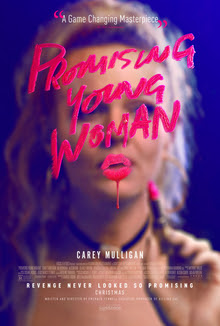
Promising Young Woman—Carey
Mulligan shines in this harsh but bracing and caustically witty rape-culture
revenge shocker, an impressive feature debut for writer and director Emerald
Fennell.
Kajillionaire—Maybe the
strangest big-name release of the year, this deeply eccentric portrait of a family
of the smallest of small-time grifters is made unforgettable by performances
from Evan Rachel Wood, Richard Jenkins, Debra Winger and Gina Rodriguez.
My Darling Vivian—This
documentary about Vivian Liberto, the first wife of Johnny Cash, is narrated by
their four daughters. It’s essential viewing for Cash buffs, but fascinating
for anybody.
The Way I See It—Another
documentary; this one about Reagan and Obama White House photographer Pete
Souza’s awakening to political engagement. There are maybe too many corny inspirational
anthems, but the subject’s photos are potent.

Borat: Subsequent Moviefilm—The Candid-Camera-on-crack style of comedy practiced by Sasha Baron Cohen is, I must admit, not my cup of tea; I find it excruciatingly embarrassing to watch at times. But there’s also no doubt that Cohen, through the adventures of his “Kazahk” alter-ego Borat, makes highly trenchant and relevant satirical points, and Maria Bakalova, the young Bulgarian actress who plays Borat’s daughter, brings the movie an unexpected dose of genuine emotion.
Also worth sitting through this year: The Invisible Man,
for Elizabeth Moss; the uneven Filipino historical drama Quezon’s Game, for
its fascinating subject; Freaky, for Vince Vaughn as a teenage girl; Ham:
A Musical Memoir for the singing of Sam Harris; Lucky Grandma, for Tsai Chin’s badass
performance; Radioactive, for Rosamund Pike’s badass performance; the
live-action Punch and Judy show Judy and Punch; the overlooked Hitchcockian
set-bound thriller 7500, for Joseph Gordon-Levitt; Yes, God, Yes,
especially for Natalie Dyer; the rather hair-raising horror indies The
Wretched and Homewrecker; tiny-budget dramas like Angelfish
and Clementine; the near-miss showbiz tale The High Note; the
near-miss psychology romcom Sunny Side Up; the near-miss biopic The
Glorias; the near-miss sci-fi yarn The Vast of Night; the cheeky WW84; the intriguingly
stylized school drama Selah and the Spades and the Irish supernatural
comedy-thriller Extra Ordinary. Also, a bunch of worthwhile
documentaries: Our Time Machine; Blessed Child; J.R. “Bob”
Dobbs and the Church of the Subgenius; Boys State; the hard-hitting
wildlife documentary Wild Daze and the dazzling Time.

While I’m at it, here are quick hits on a few notable
flicks I hadn’t previously reviewed:

Hillbilly Elegy—Ron Howard’s adaptation of the J. D. Vance memoir is compelling and well-acted in itself, especially by Glenn Close and Amy Adams, but politically evasive and timid in what it omits.
Mank—This chronicle of Herman Mankiewicz and the writing of Citizen Kane, a long-cherished project of director David Fincher and his late father Jack Fincher, has some superb acting and looks good, but it’s accuracy-challenged, and worse, appallingly slow and overlong.

On the Rocks—The latest from Sofia Coppola, this mild comedy-drama has rascally art dealer Bill Murray helping daughter Rashida Jones stalk her possibly-straying husband Marlon Wayans. Murray’s performance is another classic of avuncular mischievousness, and Jones is just as good, but the movie lacks urgency, like a piece of literary fiction that ultimately doesn’t feel like it’s about anything much.
The Prom—A gay high
school student throws her Indiana hometown into a tizzy because she wants to go
to prom with her girlfriend, and Broadway stars Meryl Streep, James Corden,
Nicole Kidman and Andrew Rannells swoop down uninvited on the town for what
they hope will be a career-boosting protest of this intolerance. The tunes in
this musical are unmemorable but pleasant, the stars have a self-deprecating
blast; it’s sort of boring to say so at this point, but Streep is particularly marvelous.
And Jo Ellen Pellman, as our heroine, is a wonder.
I also managed, at this writing, to have not yet caught up
with several important films: Ma Rainey’s Black Bottom, News of the World, Tenet, Soul and Nomadland, to name a few. Any of these could have altered my list.
Happy New Year everybody; have a great 2021, at the movies and everywhere!