Showing posts with label MARGOT ROBBIE. Show all posts

Friday, July 21, 2023

BOMBS & BOMBSHELLS

Opening in theaters this weekend:
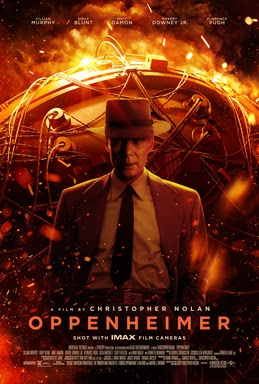
Oppenheimer--This biopic splits time the way its hero splits the atom. Narrative is fissionable to writer-director Christopher Nolan; he skips back and forth between episodes of Oppenheimer (Cillian Murphy) as a bumbling student, then as a philandering rising star in the new field of quantum physics, then as the determined yet haunted lord of Los Alamos, then as a post-bomb martyr to '50s era red-baiting. It glides along smoothly through its fractured scheme, beautifully shot by Hoyt van Hoytema in black and white and varyingly muted shades of color depending on period and point of view, and pushed along by a solemn Philip Glass-esque score by Ludwig Göransson.

Often crowned by a horizontal wide-brimmed preacher-style hat that makes him look like Brad Dourif in Wise Blood, Murphy uncannily captures the bursting, wide-eyed, near-ecstatic face that we see in photos of Oppenheimer. But he manages to give the performance a human dimension, with everyday foibles and touches of humor. He's not a pageant figure.

Murphy carries a star presence. But he's very ably supported by a huge, colorful gallery of star character players: Robert Downey Jr. as AEC Chairmen Lewis Strauss and Josh Hartnett as Ernest Lawrence and Benny Safdie as Edward Teller and Tom Conti as Albert Einstein and David Krumholtz as Isidore Rabi, Oppenheimer's menschy colleague who makes sure he eats and nudges his conscience, and Matthew Modine and Casey Affleck and Kenneth Branagh and Rami Malek and Alden Ehrenreich, to name only a few.

They're all entertaining, but two in particular jolt the movie to life: Florence Pugh as Oppenheimer's joyless lover Jean Tatlock and Matt Damon as the practical-minded, professionally unimpressed Leslie Groves, representing us laypeople in his deadpan, flummoxed scenes with Murphy. For a while it seems like Emily Blunt is underserved as Kitty Oppenheimer, but near the end she gets a juicy, angry scene opposite AEC lawyer Roger Robb (Jason Clarke), who has underestimated her. 

Other than maybe a few too many scenes of the young "Oppie" having visions that look like the psychedelic mindtrip at the end of 2001, there was no point where I found Oppenheimer less than absorbing. Few would suggest that this ambitious, superbly acted, superbly crafted film isn't a major, compelling work, a vast expansion on Roland Joffé's watchable but modest Fat Man and Little Boy from 1989. If Nolan's film isn't quite completely satisfying, there could be two reasons.

One is that trying to arrive at a moral conclusion about this movie's hero seems impossible. Put (too) simply: on the one hand, Oppenheimer won World War II for the good guys and checked fascism (not checkmated it, alas) for more than half a century. On the other hand, his invention killed hundreds of thousands of people, and still has the potential to ruin the world for everybody. Both can be true, and the ambiguity is unresolvable.

Another problem with the film, however, is a matter of simple showmanship. Back in 1994, James Cameron brought his silly action picture True Lies to a point where Arnold Schwarzenegger and Jamie Lee Curtis kiss while, far in the distance, we see a mushroom cloud erupt on the horizon. Triumphant, but then Cameron pushed his luck, piling on one last struggle with the villain in a Harrier jet. I remember thinking (and writing) at the time that when your hero and heroine kiss in front of a mushroom cloud, the movie is over.

Oppenheimer, obviously a very different movie, is uneasily structured in the same way. The scenes leading up to the Trinity Test at White Sands in 1945 are riveting, pulse pounding. The explosion and the immediate aftermath, ending the war in Japan, is a stunning dramatic climax.

But then the movie keeps going, for another hour or so, detailing the war of spite and will between Strauss and Oppenheimer, and the revocation of Oppenheimer's security clearance. It's interesting, provocative material in itself, but it seems a little petty and trivial after the "I am become death; destroyer of worlds" stuff. Given Nolan's supposed consummate skill at scrambling sequence, couldn't he have somehow structured the movie to end with a bang and not a whimper?

Barbie--Something is rotten in the state of Barbieland. As this, her first live-action feature begins, our titular heroine finds herself haunted, right in the middle of raging dance parties at her Dreamhouse, by thoughts of death. Still more alarming, when she steps out of her pumps, her feet go flat to the ground.

To be clear, the Barbie in question, played by Margot Robbie, is "Stereotypical Barbie," the blond, inhumanly thin and leggy iconic version of the Mattel doll. She shares the relentlessly cheery pink-plastic realm of Barbieland with countless other Barbies of every race and body shape and profession, all happy and accomplished and untroubled and mutually supportive. They're dimly aware of us in the "Real World"; they believe that their own harmony has created an example that has led to female empowerment and civil rights over here.

The Barbies also share Barbieland with Ken (Ryan Gosling) and countless variant Kens, as well as Ken's featureless friend Allan (a perfectly cast Michael Cera). But the guys exist entirely as accessories to the relatively uninterested Barbies. Ken's unrequited fascination with Barbie makes him subject, unlike the Barbies, to dissatisfaction.

Barbie goes for advice to "Weird Barbie" (Kate McKinnon), whose hair is frizzy and patchy and who's stuck in a permanent split. She's told that her troubles come from the dark feelings of somebody who's playing with her in our reality, so she sets out on a quest to the Real World, emerging in Venice Beach. Barbie connects with a mom and teenage daughter (America Ferrera and Ariana Greenblatt) whose relationship is strained; she's also pursued by the all-male board of Mattel, led by Will Ferrell. Ken, meanwhile, learns about our patriarchy, likes what he hears, and heads back to Barbieland alone to institute it, with himself at the top.

Mattel was founded in 1945, the same year as the Trinity Test, and there are probably feminist social critics who would argue that Barbie, invented in 1959 by Mattel co-founder Ruth Handler (well played by Rhea Perlman in the film), has wreaked only a little less havoc on the modern psyche than Oppenheimer's gadget. Even though I'm in exactly the right generational wheelhouse (I was born in 1962), my own childhood experience with Barbie was very limited, and thus so were my nostalgic associations with her.

Even so, this nutty fantasy, directed by Greta Gerwig from a brilliant script she wrote with Noah Baumbach, made me laugh from its inspired first scene to its Wings of Desire finish. Narrated in the droll, arch tones of Helen Mirren, it manages to come across as both an ingenious pop-culture lampoon/celebration and an unpretentious but surprisingly heartfelt deep dive into the implications of the Barbie archetype. I wasn't a big fan of Gerwig's 2019 version of Little Women, but here she builds her world with the freedom of, well, a kid playing with dolls, but also with the confidence and adult perspective of an artist.

Not everything in the movie works; in the second half the narrative gets a little lost at times in some very strange musical numbers/battle scenes, and the whole thing comes close to going on a bit too long. And it's hard to say just who this movie is for. It hardly seems intended for little girls; however smart, they're too young for the commentary about female identity to mean much to them yet. It seems more like it's meant for adult women with both a fondness for and an ambivalence toward Barbie.

No doubt there are those who would also complain that, however witty and self-effacing, the movie amounts to a feature-length commercial for the brand. But in the age of Marvel and other such franchises, it seems a little late to object to this.

The revelation in the film is Margot Robbie. It seems ridiculous that she's able, in the role of freaking Barbie, to give a performance of such subtlety and nuance and shading and quiet, unforced wistfulness, but she does. And she gets to deliver the best last line of the year.

Theater Camp--Joan, the founder of "AdirondACTS," a slightly gone-to-seed theater camp in upstate New York, has fallen into a coma. The job of keeping the struggling camp afloat falls to her decidedly non-theatrical "crypto bro" son Troy. Meanwhile the devoted instructors work with the exuberantly happy campers to mount the shows, including an original musical about the life of poor comatose Joan (Amy Sedaris). Needless to say, all does not go smoothly.

The creators of this Waiting for Guffman-esque "mockumentary" comedy, Molly Gordon, Nick Lieberman, Ben Platt and Noah Galvin, know the world they're depicting very well; all of them have been doing theater since they were small children. Gordon and Lieberman co-directed, from a script by all four; Platt and Gordon play Amos and Rebecca-Diane, the utterly enmeshed, co-dependent acting instructors and Galvin plays the low-profile tech director.

They capture the camaraderie and the sense of belonging that theater can give kids, and their affection for that world is unmistakable, but they're careful not to get too sentimental. The envies and resentments and passive-aggressive denigrations among theater folk, especially at this often professionally frustrated level, are vividly represented.

Getting laughs from the self-important vanities of theater people is pretty low-hanging fruit, I suppose, but Theater Camp is nonetheless often hilarious. The film also manages to get a little deeper at times, touching on the irony that while theater can create a haven and a community for misfit kids, this can generate its own clannishness and exclusionary snobbery, as in Amos and Rebecca-Diane's coldness toward the imbecilic but well-intentioned Troy, charmingly played by a sort of poor-man's Channing Tatum named Jimmy Tatro.

The real joy in Theater Camp, of course, is the acting: Platt, Gordon, Tatro, plus a few vets like Sedaris, Caroline Aaron and David Rasche bring the material to life. But as Glenn, the long-suffering backstage drudge who really ought to be onstage, Noah Galvin, who replaced Platt on Broadway in Dear Evan Hansen, is the revelation among the adults in the cast. He's a knockout.

The revelation among the kids playing the campers is, well, pretty much all of the kids playing the campers. There are some real singing, dancing and acting prodigies in this company. If there was a real theater camp somewhere with this kind of talent, their shows would sell out.

Friday, August 6, 2021

SQUAD IS IN THE DETAILS

Opening this weekend...

The Suicide Squad--Sort of a Dirty Dozen for the comic book world, The Suicide Squad is a team of DC supervillains offered suicide missions in return for reduced sentences. The premise debuted in 1959 in the team-up title The Brave and the Bold, and was revived in the late '80s. It made it to the movies in 2016 as Suicide Squad; this sequel adds a "The" to the title.

James Gunn directed this darkly comedic adventure, in which the Squad, led by Bloodsport (Idris Elba) under the direction of Colonel Flag (Joel Kinnaman) and Amanda Waller (Viola Davis), invades a small South American country which harbors a sinister alien force. Wild gory violence ensues, making Deadpool look like Paw Patrol.

The film is self-consciously brutal and cynical, as well as foul-mouthed and sexually frank; as such it can at times feel a bit wearyingly like reading the nihilistic yet energetic poetry of an angry sixteen-year-old. Yeah, yeah, you may want to say, life sucks, got it.

Even so, there's a lot to like in the film. Elba, who wisely plays it very straight, is always good company, and Margot Robbie, back as The Joker's jilted, cheerfully lethal girlfriend Harley Quinn, is as endearing as ever. Peter Capaldi only has one really juicy scene as a mad scientist, but he makes it count, and Jon Cena is quite droll as gung-ho '60s-era superhero Peacemaker. My own favorite is lovely, kindly Daniela Melchior as Ratcatcher, who can communicate with and command rats the way Aquaman can lead the fish.

I also loved Starro, the giant, colorful cyclopean starfish that menaces the team in the movie's nutty climax. He strongly resembles the aliens from the 1956 Japanese sci-fi flick known in the U.S. as Warning from Space, but he's a lot less benign.

Saturday, February 8, 2020

GOOD TIME HARLEY

Hope everybody is having a great February. Check out this month's issue of Phoenix Magazine...


...for my story "Cooking Out of Bounds," about rogue chefs around the Valley, as well as my "Four Corners" column. Also check out my "Friday Flicks" column, with reviews of Birds of Prey (and the Fantabulous Emancipation of One Harley Quinn), The Traitor and the Osgood Perkins-directed shocker Gretel and Hansel...


...and my review of the Filipino historical epic Quezon's Game.

Have a great Valentine's month everybody!

Friday, February 9, 2018

BUNNY BUSINESS

Hopping into theaters this weekend:


Could Beatrix Potter have imagined a movie adaptation of her Tale of Peter Rabbit with Eminem on the soundtrack?

No, I suppose she couldn't have. She died in 1943, after all, so she probably would have had a hard time imagining Eminem at all.

The question was rhetorical, anyway. That's what we've got, a new Peter Rabbit with CGI bunnies and other cute little creatures interacting with live-action human actors, engaging in broad slapstick and bickering family dynamics and slyly "meta" and "fourth wall" gags, all driven along by popular songs.

Even so, it's a little surprising how much of Potter's 1902 tale survives in this modern-dress version. Peter's siblings and cousin, the encouraging sparrows, Mr. McGregor (Sam Neill), the sieve, the flower pots in the shed, the blue jacket used as a scarecrow, even the grim backstory of Peter's father--these and other elements trace back to Potter's brief but effective heist thriller and juvenile delinquency drama.

But this story line can only take the movie so far. After that, director Will Gluck, who previously helmed the recent modern version of Annie, and his co-writer Rob Lieber concoct a deus ex machina for old man McGregor, then bring in his nephew (Domhnall Gleeson) and heir from London, a control-freak Harrod's employee. This guy goes to war with Peter and his pals as well, but must keep it secret from his neighbor Bea (Rose Byrne), a sweet painter who adores the rabbits.

Some of the battles which follow seem to owe almost as much to the Loony Tunes, if not to Peckinpah's Straw Dogs, as to Potter, and while at times they become a bit tediously repetitive, overall the film is visually deft and light-footed and enjoyably anarchic. Even so, some of the funniest passages are verbal rather than visual, throwaway gags like a store clerk's explanation of the human urge to anthropomorphize animals. The voice cast, led by James Corden as Peter--who also sings a pretty song over the end credits--includes Daisy Ridley, Margot Robbie, Elizabeth Debicki, Matt Lucas and Sia.

The kids in the audience with whom I saw this film seemed to find it hilarious, and on the whole I was pretty amused myself. I thought it struck a nice balance between edgy mischief and just the right degree of non-sappy warmth. If you remain unmoved by the sight of the rabbits apologizing by inclining their foreheads together, you're tougher than I am.

Friday, December 22, 2017

SMALL WORLD AFTER ALL

Opening this weekend:


Downsizing–Scientists have figured out how to shrink humans down to five inches tall. The discovery, which has obvious environmental advantages, is promptly commercialized, with people enticed to "downsize" into tiny planned communities where they can now afford a luxurious lifestyle.

Our Midwestern  everyman hero Matt Damon undergoes the irreversible process, regrets it at once, then gradually finds renewed purpose in his new home in New Mexico through his connection with a one-legged Vietnamese cleaning lady (Hong Chau) who was shrunk against her will for her dissident activities back home. He also forms a sort of bond with his neighbor (Christoph Waltz), a grinning Serb hustler who, if he wasn't shady enough already, hangs out with Udo Kier.

This neo-Swiftian satire is perhaps the most ambitious effort yet from the always-interesting Alexander Payne. He takes his time, working out the process and its implications in deadpan detail (although the obvious issues of civil-rights vulnerability for downsized people are not really addressed). This fully-imagined atmosphere extends to the characters. Damon, who wanted to be a doctor, ended up some sort of workplace physical therapist for Omaha Steakhouse–a perfect American intersection of frustrated aspiration, good intentions and barely-conscious consumption.

Downsizing is full of brilliant touches like that. But I'm not sure it amounts to much more than the sum of those brilliant touches, and of some fine performances, especially by Damon, Hong Chau and the ever-freaky Waltz.

The movie dawdles a bit, and Payne can't quite seem to bring it the emotional payoff he's trying for. Even so, this one of the more fascinating and substantial movies I've seen all year. I'll confess, however, that I'm too much of a philistine, and was too much a fan of Dr. Cyclops and Attack of the Puppet People and The Incredible Shrinking Man not to hope that a tarantula or a Gila monster might invade Damon's subdivision and liven things up.


The Greatest Showman –Understatement is strained by referring to this musical as “loosely based” on the life of P.T. Barnum. But then, Barnum wasn’t big on understatement, and it’s likely that nobody would appreciate this portrait of the founder of American pop culture more than Barnum himself.

Hugh Jackman plays the celebrated mid-19th century purveyor of anomalies, human and otherwise, genuine and “humbug,” the promoter of the first American tour of “Swedish Nightingale” Jenny Lind, and the eventual co-founder of Barnum and Bailey’s Circus (and thus, as someone pointed out to me recently, of about a century and a half of unnecessary animal suffering). He’s characterized here not as an exploiter both of disadvantaged people and of unseemly public curiosity, but as a raffish yet open-hearted champion of misfits.

This may not be entirely unfair. Barnum was, for instance, a fairly ardent abolitionist, and a (carefully self-promoting) philanthropist, a capable and progressive mayor of Bridgeport, Connecticut, and an early benefactor of Tufts University. His highly entertaining 1869 memoir Struggles and Triumphs (which the filmmakers could have ransacked for far more colorful episodes than they have), for all its self-congratulation expertly passed off as modesty, nonetheless suggests a decent, well-meaning fellow.

Still, you have to check your sense of period context at the door to accept this movie’s vision of Barnum, or of his time. Screenwriters Jenny Bicks and Bill Condon try to give texture by showing him fold to social pressure here and there, but still, under his influence in this movie, even interracial romance can flourish—between Barnum’s junior partner Zac Efron and lovely aerialist Zendaya—and the human oddities find an empowering community under his roof and stand up to the bigots.

If you can tune yourself into this rosy view, it's very possible to enjoy the film. Jackman is a seamlessly proficient song-and-dance man here. The tunes, by Benj Pasek and Justin Paul of La La Land, could be a bit more varied, but director Michael Gracey and choreographer Ashley Wallen, both young Australians, bring ingenuity and verve to the staging, as in an imaginative duet between Jackman and Efron involving shot glasses.

Michelle Williams doesn't have to do much more than look serenely beautiful as Mrs. B, but the two Barnum daughters seem, creepily, not to age; when Barnum returns from a trip and says "You got so big" to one of them he seems to be trying to convince himself. Rebecca Ferguson has a regal presence as Jenny Lind, but the real standout in the cast is Broadway vet Keala Settle as Lettie Lutz the Bearded Lady, who lets it rip vocally in the movie's one really rousing and memorable song, "This Is Us," a proud anthem to letting your freak flag fly.


I, Tonya–Based on "irony free, wildly contradictory, totally true interviews with Tonya Harding and Jeff Gillooly," this docudrama retells the 1994 scandal from the world of big-time figure skating. In case you're lucky enough to have forgotten: The U.S. champ Harding's moronic main squeeze Gillooly and some even more imbecilic associates conspired to wack the skating champ's biggest American rival, Nancy Kerrigan, in the leg to ensure Harding victory at the Lillehammer Olympics. It didn't work out.

Harding may or may not have known, or known much, about the plot (she eventually pleaded guilty to a lesser charge to avoid jail time), but in any case her career was destroyed. The movie efficiently places this squalid, embarrassing story in the context of Harding's abusive white-trash background with her crazed, furious mother LaVona Golden, played by Allison Janney with her usual crisp acerbity. It also gets at some of the class-based ugliness in the skating world. Through it all, that opening disclaimer conveniently excuses the filmmakers from having to pass judgment on the characters.

Directed by Craig Gillespie from a script by Steven Rogers, it's a watchable, well-acted picture overall, but it contains a classic performance. Margot Robbie somehow makes Tonya Harding both a comic and a tragic figure, all the while never milking the audience for pity. Her face in the mirror in the film’s wordless emotional climax is devastating—it reminded me, no kidding, of Falconetti’s facial close-ups in Dreyer’s Passion of Joan of Arc.


Pitch Perfect 3 –The Barden Bellas, now out of college and down on their luck, reunite for a USO tour, and have wacky adventures across southern Europe. They’re competing with other acts on the tour, including an all-women rock band called “Evermoist,” to land a spot opening for DJ Khaled (who amusingly plays himself), and of course there’s some undemanding romance and even a bit of facetious action-movie peril.

This is the broadest, silliest and easily the weakest of the three flicks about the a cappella ensemble. But it’s nonetheless pleasant to sit through its brief running time. The young actresses, led by Anna Kendrick and Rebel Wilson, are still adorable and funny, and there’s some enjoyable music, although the film could have done with an extra number or two at the expense of some dumb slapstick.

The first Pitch Perfect was charming, and has proven surprisingly re-watchable in TV reruns. The sequels are increasingly laborious, but they both retained enough of the original’s merits to be fun. Judging from PP3, I don’t think this is further sustainable—it’s time to sing a fond aca-adieu to the series.