About two months ago, while driving through a rather remote and isolated part of Arizona, I pulled over to read a roadside historical marker. It referred to the Camp Grant Massacre, which happened nearby in April of 1871.

Ever heard of it? I had not, and neither had a friend of mine who worked for decades at a Native American museum. Briefly: A mob of more than a hundred Anglos, Mexican-Americans and Tohono O’odhams, led by Tucson mayor William Oury, raided a settlement near the Camp Grant outpost and murdered more than a hundred Apaches, most of them women and children; others were captured and enslaved in Mexico. It was a national story at the time and led to a shift in sympathy toward the plight of the Apache, although the killers were acquitted at trial in Tucson.
I didn’t learn all of this from the marker, of course; it inspired me to read up a bit on the incident. The marker is a simple stone slab with a metal plaque and plain, functional, unemotional text. If anybody suggested removing it for any ideological reason, or for any reason other than the information was determined to be inaccurate and needed updating, I would object. Despite its lonely location, it’s possible that more people learn about the Camp Grant Massacre every year from this little marker than hear about it in a high school history class. To remove it truly would be “erasing history.”
That’s what I keep hearing from folks opposed to the recent push to remove public statues dedicated to historical figures deemed offensive, especially Confederates—that the removal of a statue of Robert E. Lee from a park or town square, or changing the name of a military base from Bragg or Hood to something, you know, not derived from an enemy of the U.S.—is a foolish and oppressive attempt to “erase history,” like what Stalin did (and, ironically, what eventually happened to Stalin). In some cases, this is even followed by a sage quoting of Santayana’s “Those who cannot remember the past are condemned to repeat it.”
Very respectfully…that’s crap. Is the “erasing history” crowd actually suggesting that a statue of Lee, majestic on his horse in a city park or outside a courthouse or capitol building, is intended to prevent another Civil War?
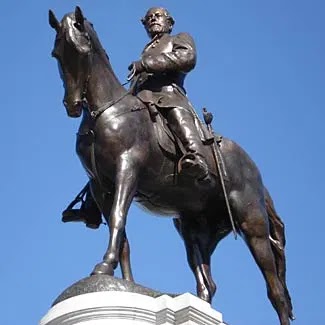
A statue isn’t a history book. It isn’t a museum; it isn’t even that modest historical marker in Middle-of-Nowhere Arizona. A statue isn’t principally informational in purpose. A statue is—at least usually—intended as a celebration of its subject. People don’t normally erect statues of historical figures they don’t like and admire.
And a historical figure needn’t be perfect, or even close to perfect, to be liked and admired. But it seems to me that they shouldn’t be actual insurrectionists who betrayed their country in the cause of preserving white supremacy and legal enslavement.
This seems so obvious that it’s difficult for me to believe that the “erasing history” complainers don’t know it, deep down. “They’re trying to erase history!” is just a catchphrase, one that they hope you won’t think about too hard.
If you did, it might occur to you that after the Soviet Union collapsed, Russians tore down statues of Lenin. Were they wrong? When Baghdad fell, Iraqis tore down statues of Saddam Hussein. Were they wrong? If you don’t think so, then why is it wrong to get rid of statues of Confederate bigwigs?
Well, I’ve heard it argued that a statue of Lee, for instance, is intended not as a tribute to the Confederacy, but to honor Lee’s supposed military brilliance, or the supposed great gentility of his character. Even setting aside the historians who suggest that both of these traits may have been overrated, you’re going to have to do better than that. Rommel, I understand, is widely regarded as a fine general by military historians, but there aren’t many Rommel Parks or Rommel Memorial Boulevards around the United States (though I’m unsure how much the current administration would mind if there were).
There is, indeed, important history to be found in the Confederate statuary that sprang up so many places around this country in the late 19th and early 20th Centuries, but it isn’t, on the whole, a history that the people who want the statues left alone prefer to emphasize. The real, subtle historical significance of those statues is in the calculated and tireless efforts of the Daughters of the Confederacy and other “heritage” organizations to sponsor such memorials, and through them to gradually make the Confederacy and its leaders respectable, even revered and tragically gallant in their romantic “lost cause.”
To give this campaign its due, it’s been far longer-lasting than the Confederacy, far more strategically sophisticated, and far more successful. I experienced it, even as a kid in the North—more than one of my elementary and high-school history teachers passed on the received wisdom that “the War wasn’t really about slavery,” but rather about “economics” or “States’ Rights.” Many years later, it occurred to me that the embrace of these abstractions may have less to do with shame over slavery and more with a desire to debunk the idea that black people could be important enough to fight a war over.
Renouncing the rehabilitation of the Confederacy is an easy call, at least for me. When you move past the Confederacy toward memorials to other notable Americans who were slaveholders or had other aspects of their lives now understood to be reprehensible, I admit that the issue can become more complex.
There were calls this past week to remove statues of Thomas Jefferson from New York’s city hall and from the University of Missouri; another statue of Jefferson was removed from a park in Decatur, Georgia at the donor’s request, for its own safety. Statues of George Washington and Francis Scott Key were pulled down in Portland, Oregon and San Francisco, respectively. And a creepy statue of Teddy Roosevelt outside the American Museum of Natural History in New York, depicting him flanked by and towering over Native American and African-American figures, is reportedly slated to be removed.
This is another issue. Jefferson, at least, should get to stay, in my opinion; despite the despicable, hypocritical aspects of his private life—not to mention his and the other Founders’ failure to abolish slavery at the beginning of this nation—his documents and the vision they articulate have been essential to the progress of civil rights and the ideal of human equality not only here but around the world.
But you know what? That’s easy for me to say. If Jefferson statues have to go, as part of starting to make things right in this country, so be it. A statue or two more or less isn’t the hill I want to die on, if the spirit inspired by Jefferson’s words in those documents is furthered by removing them.
In any case, while I have zero problem with the removal of Confederate statues—and I say this as the great-grandson of a Confederate soldier from Mississippi, albeit one who, family legend claims, deserted and went to Indiana in search of his POW brother—I would also make the “Don’t Erase History” crowd a counterproposal: Leave the statues, but add signage describing the barbaric institution for which they traitorously and ignominiously fought. Or, maybe, add statues of Malcolm X or Martin Luther King, Jr. or Barack Obama next to each one; taller, and looking down with a smirk.


