Tuesday, July 14, 2020

FORGIVE US OUR 'SKINS

To the meager extent that I can be called a sports fan at all, I'm a baseball fan, not a football fan. But during the brief period I lived in Washington, D.C., from 1987 to 1992, my girlfriend at the time was a passionate fan of D.C.'s NFL team.


She wasn't alone. Led by head coach Joe Gibbs and QBs like Doug Williams and Mark Rypien, the team was really good during those years. As a result, almost every home game was a sellout, and tickets were extremely hard to come by. There's a good inside-the-Beltway gag in the 1987 Bette Midler-Shelley Long comedy Outrageous Fortune, in which a CIA agent (John Shuck) is trying to persuade a KGB agent (Robert Prosky) to defect, promising him townhouses and all sorts of perks, and the KGB man hesitantly asks "Redsk**s tickets?" The CIA man furrows his brow; that may be too big an ask.

Anyway, as I said, my then-girlfriend Stephanie adored the team, and somehow or another scored two tickets for a home game at RFK in November of 1991. The lads were having a superb season; they finished 14-2 and went on to win Super Bowl XXVI over the Buffalo Bills. Their only home loss? You guessed it, the one game that Stephanie and I ever managed to go to together; a 24-21 defeat to their loathed rivals, the Dallas Cowboys, under head coach Jimmy Johnson and QB Troy Aikman.

I have many vivid memories of that chilly day, including watching a drunken and insufferable Dallas fan a few rows ahead of us get seriously manhandled by D.C. cops--to joyous applause--for taunting his neighbors. I also recall the palpable funk of anger and misery, including Stephanie's, on the Metro ride home. But I also remember, as we entered the stadium, seeing a good-sized band of Native American activists beating drums and chanting in protest of the team's name. I was handed a flyer explaining its offensiveness.

I wish I still had that flyer, to read it a little more attentively than I did at the time. I dismissed it then, thinking the matter trivial; I may have formulated some evasion along the lines of "gee, that community has problems they really should be focusing on ahead of a sports team's name." It wasn't until years later, hearing the matter debated in the media, that it struck me that the issue's triviality or lack thereof really wasn't my call.

Many American sports teams are named after Native Americans; the Cleveland Indians, the Atlanta Braves, the Florida State Seminoles. I'm sure there are Native activists who would like to get rid of all of them, but to point out the obvious, the D.C. football team is a little different even from these--it's an actual racial epithet. It's not different, in any way that I can see, from using the N-word as a team name.

I was reflecting on all this to a friend of mine who told me that she had attended Miami University, aka Miami of Ohio. Their team was also called the Redsk**s in those days, and the on-field performing mascot at games was a kid dressed up in a stereotypical Indian outfit.

According to my friend, at a certain point Miami struck up a relationship with the Miami Tribe in Oklahoma, and sent their mascot performer to the tribe to train to do accurate tribal dances; they also provided scholarships and other programs for tribal youth. Even so, in 1996 they changed the name to the RedHawks, but kept the relationship with the tribe.


In 2014 Dan Snyder, the douche-baggy-sounding owner of the D.C. NFL team, started an "Original Americans Foundation" in answer to criticism over the name. But according to Sports Illustrated that funding has steadily dried up over the years since.

It will be interesting to see if the appropriately-initialed OAF continues at all in the future, as it appears that, almost three decades later, those protesters I saw that day are getting their wish; the D.C. team has announced it will retire the name. At this writing, the new name has not yet been announced.

The question of why slurs toward indigenous people have remained less socially opprobrious than slurs against other races for so much longer is an interesting one. I don't have an answer for it. Indeed, I don't have any great wisdom to impart about the matter at all; I'm just glad that the grotesque name has been retired, and that Snyder's obstinance has finally been worn down. I've heard some commentators wonder if the change will make some fans decide they're done with the organization. To that, I can only say that if so, they don't sound like very loyal fans.

Friday, July 10, 2020

PARALLAX, GO TO IT

Opening today...


Parallax--A beautiful young California painter named Naomi (Naomi Prentice) has suddenly gone near-catatonic. She's haunted by horrifying dreams of drowning, and she's afflicted with amnesia, not quite knowing Lucas (Nelson Ritthaler), the computer programmer fiance with whom she shares a pleasant California house.

Lucas, of course, thinks it's mental illness, but Naomi, and we in the audience, suspect she may be somehow plugged into a different reality. When she paints, she sometimes finds her way into the idyllic beaches or deserts on her canvasses. She meets other people in these painting-worlds, and experiences hints of an alternate version of her life.

This sci-fi drama, written and directed by Michael Bachochin, is a heavy exercise in "things are not as they seem." It has a polished look, but takes a while to get going, and we in the audience may be excused, I think, if we initially find Naomi's blank unresponsiveness as frustrating as Lucas does. Gradually, however, the movie does take hold, generating a quiet, moody sense of the sunlit SoCal sinister.

(Update: I have since been informed that this movie's scheduled release to theaters and drive-ins on July 10 was pulled due to COVID-19 concerns; when/if it is eventually released I'll update again.)

Thursday, July 2, 2020

PSAMMEAD, NOT PENNYWISE

Streaming this week on YouTube and other platforms...


Four Kids and ItThis British fantasy is based on the 2012 book Four Children and It by Jacqueline Wilson, which in turn was adapted from the 1902 novel Five Children and It by E. Nesbit. Directed by Andy De Emmony, it places the four squabbling kids—two each from either side of a new relationship between their single parents (Matthew Goode and Paula Patton)—on a beach at Cornwall. Here they meet the “It,” otherwise known as the Psammead, a long-limbed, hairy, flatulent, prehistoric sand-troll who can grant them one wish per day, which only lasts until the sun sets.

The wishes are mostly standard kid stuff—to be a pop star, to be able to fly—but they’re pretty well-staged. The kids are charming; the parents are attractive, and Russell Brand wins some laughs as a birdbrained neighbor. Michael Caine voices the Psammead very well; his sensible Cockney tones convincingly articulate the movie’s oft-repeated moral: Be careful what you wish for.


SqueegeeThis 11-minute Short of the Week from shortoftheweek.com is a skillfully-made adults-only vignette by Morgan Krantz about an erotic encounter between an executive and a window washer. It's dirty and funny, but also, thanks to the wistful performances of the leads (Amy Rutherford and Blair McKenzie), truly yearning and poignant, especially in these isolated times.

Saturday, June 27, 2020

IT'S NOT CARVED IN STONE

About two months ago, while driving through a rather remote and isolated part of Arizona, I pulled over to read a roadside historical marker. It referred to the Camp Grant Massacre, which happened nearby in April of 1871.


Ever heard of it? I had not, and neither had a friend of mine who worked for decades at a Native American museum. Briefly: A mob of more than a hundred Anglos, Mexican-Americans and Tohono O’odhams, led by Tucson mayor William Oury, raided a settlement near the Camp Grant outpost and murdered more than a hundred Apaches, most of them women and children; others were captured and enslaved in Mexico. It was a national story at the time and led to a shift in sympathy toward the plight of the Apache, although the killers were acquitted at trial in Tucson.

I didn’t learn all of this from the marker, of course; it inspired me to read up a bit on the incident. The marker is a simple stone slab with a metal plaque and plain, functional, unemotional text. If anybody suggested removing it for any ideological reason, or for any reason other than the information was determined to be inaccurate and needed updating, I would object. Despite its lonely location, it’s possible that more people learn about the Camp Grant Massacre every year from this little marker than hear about it in a high school history class. To remove it truly would be “erasing history.”

That’s what I keep hearing from folks opposed to the recent push to remove public statues dedicated to historical figures deemed offensive, especially Confederates—that the removal of a statue of Robert E. Lee from a park or town square, or changing the name of a military base from Bragg or Hood to something, you know, not derived from an enemy of the U.S.—is a foolish and oppressive attempt to “erase history,” like what Stalin did (and, ironically, what eventually happened to Stalin). In some cases, this is even followed by a sage quoting of Santayana’s “Those who cannot remember the past are condemned to repeat it.”

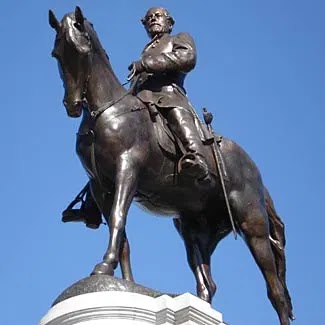
Very respectfully…that’s crap. Is the “erasing history” crowd actually suggesting that a statue of Lee, majestic on his horse in a city park or outside a courthouse or capitol building, is intended to prevent another Civil War?


A statue isn’t a history book. It isn’t a museum; it isn’t even that modest historical marker in Middle-of-Nowhere Arizona. A statue isn’t principally informational in purpose. A statue is—at least usually—intended as a celebration of its subject. People don’t normally erect statues of historical figures they don’t like and admire.

And a historical figure needn’t be perfect, or even close to perfect, to be liked and admired. But it seems to me that they shouldn’t be actual insurrectionists who betrayed their country in the cause of preserving white supremacy and legal enslavement.

This seems so obvious that it’s difficult for me to believe that the “erasing history” complainers don’t know it, deep down. “They’re trying to erase history!” is just a catchphrase, one that they hope you won’t think about too hard.

If you did, it might occur to you that after the Soviet Union collapsed, Russians tore down statues of Lenin. Were they wrong? When Baghdad fell, Iraqis tore down statues of Saddam Hussein. Were they wrong? If you don’t think so, then why is it wrong to get rid of statues of Confederate bigwigs?

Well, I’ve heard it argued that a statue of Lee, for instance, is intended not as a tribute to the Confederacy, but to honor Lee’s supposed military brilliance, or the supposed great gentility of his character. Even setting aside the historians who suggest that both of these traits may have been overrated, you’re going to have to do better than that. Rommel, I understand, is widely regarded as a fine general by military historians, but there aren’t many Rommel Parks or Rommel Memorial Boulevards around the United States (though I’m unsure how much the current administration would mind if there were).

There is, indeed, important history to be found in the Confederate statuary that sprang up so many places around this country in the late 19th and early 20th Centuries, but it isn’t, on the whole, a history that the people who want the statues left alone prefer to emphasize. The real, subtle historical significance of those statues is in the calculated and tireless efforts of the Daughters of the Confederacy and other “heritage” organizations to sponsor such memorials, and through them to gradually make the Confederacy and its leaders respectable, even revered and tragically gallant in their romantic “lost cause.”

To give this campaign its due, it’s been far longer-lasting than the Confederacy, far more strategically sophisticated, and far more successful. I experienced it, even as a kid in the North—more than one of my elementary and high-school history teachers passed on the received wisdom that “the War wasn’t really about slavery,” but rather about “economics” or “States’ Rights.” Many years later, it occurred to me that the embrace of these abstractions may have less to do with shame over slavery and more with a desire to debunk the idea that black people could be important enough to fight a war over.

Renouncing the rehabilitation of the Confederacy is an easy call, at least for me. When you move past the Confederacy toward memorials to other notable Americans who were slaveholders or had other aspects of their lives now understood to be reprehensible, I admit that the issue can become more complex.

There were calls this past week to remove statues of Thomas Jefferson from New York’s city hall and from the University of Missouri; another statue of Jefferson was removed from a park in Decatur, Georgia at the donor’s request, for its own safety. Statues of George Washington and Francis Scott Key were pulled down in Portland, Oregon and San Francisco, respectively. And a creepy statue of Teddy Roosevelt outside the American Museum of Natural History in New York, depicting him flanked by and towering over Native American and African-American figures, is reportedly slated to be removed.

This is another issue. Jefferson, at least, should get to stay, in my opinion; despite the despicable, hypocritical aspects of his private life—not to mention his and the other Founders’ failure to abolish slavery at the beginning of this nation—his documents and the vision they articulate have been essential to the progress of civil rights and the ideal of human equality not only here but around the world.

But you know what? That’s easy for me to say. If Jefferson statues have to go, as part of starting to make things right in this country, so be it. A statue or two more or less isn’t the hill I want to die on, if the spirit inspired by Jefferson’s words in those documents is furthered by removing them.

In any case, while I have zero problem with the removal of Confederate statues—and I say this as the great-grandson of a Confederate soldier from Mississippi, albeit one who, family legend claims, deserted and went to Indiana in search of his POW brother—I would also make the “Don’t Erase History” crowd a counterproposal: Leave the statues, but add signage describing the barbaric institution for which they traitorously and ignominiously fought. Or, maybe, add statues of Malcolm X or Martin Luther King, Jr. or Barack Obama next to each one; taller, and looking down with a smirk.

Friday, June 26, 2020

DAY OF WRECKONING

Opening virtually this weekend:


Homewrecker--Michelle (Alex Essoe), a lovely young interior designer, is trying to get some work done on her laptop in a trendy coffee bar. All of a sudden she's accosted by Linda (Precious Chong), an aggressively over-friendly, strangely trapped-in-the-'80s woman from her yoga class. Linda invites herself to sit down, then bullies and cajoles Michelle into coming to her home on the pretext of offering her a design job. Once she gets her in the house, she won't let her leave.

The early part of this blackly comedic Canadian-made shocker, directed by Zach Gayne from a script he co-wrote with Essoe and Chong, is so socially excruciating that when the movie finally tips over into gruesome violence, it's almost a relief. Chong's persona is somewhat reminiscent of Leslie Mann's not-so-passively-aggressive shtick, and her energy drives the movie, but Essoe is subtly funny as well; Michelle's death-defying politeness and decency constitute Homewrecker's best joke.

The film is slight to the point that extended tussling and even a lip-synch sequence feel like padding to get it (just barely) to feature length. Even so, it improves steadily as it goes along; there are inventive episodes throughout, as when Michelle and Linda play an old-school '80s-style "video board game" called Party Hunks! It may be the best game between enemies since Boris Karloff and Bela Lugosi played chess in The Black Cat.


My Spy--Dave Bautista of Guardians of the Galaxy plays a CIA badass who is assigned, for reasons I don't feel like explaining, to surveillance of a beautiful single mom and her cute nine-year-old daughter in Chicago. The daughter gets wise to the operation, and in return for silence about the blown cover, the badass agrees to be her special friend, to treat her to ice cream, take her skating and teach her to be a spy.

This comedy, aimed at families though surprisingly violent and crude at times, has the feel of something that Dwayne "The Rock" Johnson might have taken a pass on. There isn't an original moment; indeed, a great many of the gags derive from acknowledging that they're borrowed from earlier movies. But the kid (Chloe Coleman) is poised and agreeable; vets like Ken Jeong and the excellent Kristen Schaal add some texture; and Bautista, if not as polished as The Rock, nonetheless has an almost childlike quality that's touchingly sweet.

Friday, June 19, 2020

VIVIAN ADVANCE

Streaming this weekend...


My Darling Vivian--This documentary portrait of Vivian Liberto, the breathtaking, exotically beautiful, atrociously maligned first wife of Johnny Cash, is told by their four daughters. Rashomon-style, talking heads Roseanne, Kathy, Cindy and Tara each recount, with different perspectives and faintly different tinges of bitterness and perplexity but all with candor and palpable love, the story of their parents' turbulent marriage and its long aftermath.

Though she looked like the sort of woman required to fling herself into a volcano to appease the gods, Vivian was by this account a traditional, private San Antonio Catholic girl. She adored her husband, but never bargained for a life in the public eye, and certainly not for a life raising four daughters mostly by herself, while her pillhead husband disappeared for months on tour; where she was the target of a hate campaign by racist groups because they thought (erroneously, not that it matters) that she was African-American; and where she would later be a barely-acknowledged footnote in the story of her ex-husband's great love affair with June Carter, who was given to publicly claiming Vivian's daughters as if they were her own.

This dramatic, painful story is smoothly and efficiently presented by director Matt Riddlehoover and produced by Cash grandson Dustin Tittle. It's packed with vivid early photos and film footage, and is obviously a must for Cash fanatics. But the central figure remains enigmatic; an extraordinarily vibrant camera subject, yet a somehow recessive personality. Her life was richly documented but her inner thoughts were not; her most heartfelt letter went unmailed, and only at the very end of this film do we get to hear her speak a few words.

Thursday, June 18, 2020

BUMPY FLIGHT

Streaming today (rather than Friday, out of respect for Juneteenth)...


7500--Many thrillers are called Hitchcockian, but this German/Austrian/US production truly qualifies; after the opening minutes, it unfolds both in real time like Rope, and in a confined space like Lifeboat. Joseph Gordon-Levitt plays Tobias, the co-pilot of a jetliner flying out of Berlin. A few minutes into the flight the cockpit is stormed by terrorist hijackers and the Captain (Carlo Kitzlinger) is badly wounded; Tobias is also hurt but manages to keep control of the aircraft and re-lock the cockpit door.

Thereafter the terrorists outside keep relentlessly pounding on the door demanding he open it, and Tobias must watch the monitor in horror as they threaten to harm the passengers and crew, which include his flight attendant girlfriend (Aylin Tezel), the mother of his young child. He tries desperately to diffuse the situation, but the standoff escalates. Eventually, Tobias ends up in a strange semi-alliance with the youngest and least committed of the hijackers (Omid Memar).

The feature debut of the young German writer-director Patrick Vollrath, 7500 (the title is apparently flight code for a hijack attempt) begins with a low-key, naturalistic atmosphere that is very convincing, and therefore intensely suspenseful. After the violence starts, the film becomes grueling, but it never feels exploitative, thanks to Gordon-Levitt's touching tour de force turn, as Tobias clamps down on his anger and terror for the sake of the lives depending on him. As with Tom Hanks in Captain Phillips, there isn't a moment in Gordon-Levitt's performance that says "action hero"; the movie is, rather, a portrait of what true, grown-up heroism looks like.